
TL;DR:
- AI is revolutionizing marketing through personalized content ecosystems and generative search.
- Retail media networks and social commerce are becoming major drivers of e-commerce growth.
- Tangible sustainability benefits and genuine wellbeing messaging outperform vague eco-claims in 2026.
Most small and medium-sized business leaders entering 2026 expect digital marketing to mean more AI ads, bigger budgets, and faster automation. That framing misses the real shift. The rules of engagement have changed, and the gap between businesses that understand what's driving growth and those still running 2024 playbooks is widening fast. This guide breaks down the four most consequential trends reshaping paid and organic digital strategy right now, from AI-powered content ecosystems to sustainability messaging that actually converts. If you lead marketing at an e-commerce, telehealth, or retail business, these are the moves worth your attention.
Table of Contents
- The new AI marketing revolution: From GEO to true personalization
- Retail media, social commerce, and the maturing of digital storefronts
- AI-driven engagement in telehealth, e-commerce, and retail
- Sustainability marketing: Tangible value > vague pledges
- What savvy SMBs get right: Balancing bold innovation with pragmatic focus
- Ready to unlock your 2026 growth playbook?
- Frequently asked questions
Key Takeaways
| Point | Details |
|---|---|
| AI transforms strategy | AI is now central to marketing, shifting focus from keywords to content ecosystems and personalization. |
| Retail media dominates | Retail media networks and social commerce are vital channels for SMB growth and brand visibility. |
| AI in engagement | AI-driven chatbots and automation power customer engagement in telehealth, e-commerce, and retail. |
| Value-first sustainability | Proving tangible sustainability impact is critical for trust—vague promises no longer persuade customers. |
| Pragmatic innovation wins | Balanced adoption of new tools with proven marketing fundamentals leads to lasting success in 2026. |
The new AI marketing revolution: From GEO to true personalization
Artificial intelligence is no longer a feature you bolt onto your campaigns. It's becoming the architecture underneath them. The most important shift is the move away from isolated keyword bidding toward what industry analysts are calling Generative Engine Optimization (GEO). Per Google's own research, AI-driven GEO and conversational search require SMBs to build rich ecosystems of authoritative content for AI-powered campaigns. That means a blog post is no longer a blog post. It's a node in a content network that feeds AI algorithms, trains personalization engines, and surfaces your brand in generative search results.
The numbers make this hard to ignore. 86% of marketers now use AI in some capacity, with personalized content (49%) and automation (47%) leading adoption. For SMBs, this creates both an opportunity and a trap.
The opportunity: AI can help a lean team punch well above its weight. Automated bidding, dynamic creative, and predictive audience segmentation used to require enterprise budgets. Now they're accessible. Pair data-driven advertising with smart retargeting and you have a scalable system.
The trap: What practitioners are calling "AI slop." When teams automate content generation without editorial oversight, quality collapses. AI-generated copy that lacks specificity, brand voice, or real expertise gets ignored by both readers and algorithms. Pragmatic AI adoption for SMBs means using AI to accelerate humans, not replace the judgment that makes marketing land.
| AI use case | SMB benefit | Watch out for |
|---|---|---|
| Dynamic creative optimization | Faster A/B testing at scale | Generic messaging without brand voice |
| Predictive audience targeting | Reduced wasted ad spend | Over-reliance on black-box signals |
| Content generation assistance | Faster production cycles | Quality drop and loss of authority |
| Automated bidding | Real-time bid efficiency | Loss of strategic control if unchecked |
Building a content library isn't a content marketing exercise. It's infrastructure for every paid and organic channel you run in 2026.
Pro Tip: Before you automate content creation, document your brand voice in a one-page brief. Feed it to every AI tool your team uses. This single step will separate your output from 90% of competitors running generic automation.
For SMBs with limited creative bandwidth, the winning move is to map retargeting strategies for ROI alongside your content ecosystem. These two systems reinforce each other.
Retail media, social commerce, and the maturing of digital storefronts
If AI is the engine, retail media networks are becoming the highway. The scale here is staggering. Retail media networks like Amazon are projected to reach $197 billion this year, capturing 16% of global ad spend. Social commerce and live shopping now account for 5% of global e-commerce sales, with TikTok Shop maturing into a serious retail channel.
For e-commerce and retail brands, this reframes the core strategic question. It's no longer just about owning your website traffic. It's about deciding how much of your growth comes from owned channels versus third-party retail media environments.
Key advantages of retail media networks:
- Purchase-intent data that no first-party source can replicate
- Closed-loop attribution from ad impression to completed purchase
- Built-in audience trust on platforms where buyers already shop
- Access to live shopping formats that compress the discovery-to-purchase cycle
| Channel | Best for | Trade-off |
|---|---|---|
| Owned storefront | Brand control, margin, long-term loyalty | Requires traffic investment |
| Amazon ads | High-intent buyers, product discovery | Competitive, margin pressure |
| TikTok Shop | Impulse-driven, younger demographics | Requires strong creative output |
| Meta social commerce | Retargeting, interest-based audiences | Increasing CPM costs |
The smartest brands in 2026 are running both. They use retail ad campaign examples across third-party networks for acquisition while building owned customer relationships for retention and lifetime value.
Live shopping deserves special attention. It's not a gimmick anymore. When a product demo converts 4x better than a static image, that's a format worth testing. Start small: a 15-minute weekly live session on TikTok or Instagram can surface buyer objections, generate authentic content, and drive immediate conversions simultaneously.
For high-ROI digital strategies in competitive retail categories, combining retail media for top-of-funnel discovery with owned email and retargeting for bottom-of-funnel conversion is now table stakes.
AI-driven engagement in telehealth, e-commerce, and retail
Every vertical has its own version of this AI engagement story, and the specifics matter. Let's get concrete.
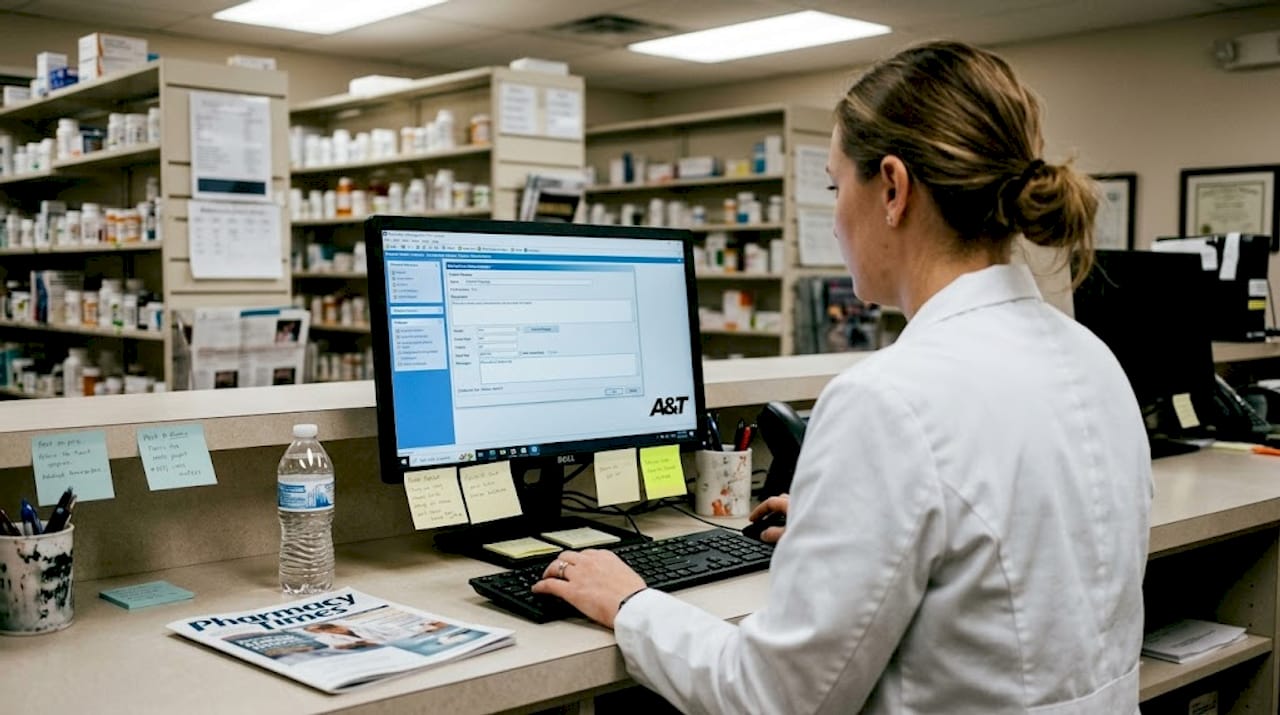
In telehealth and pharma, the transformation is significant. Online pharmacies are projected to grow to $416 billion by 2030, driven by AI chatbots handling patient triage, direct-to-patient education flows, and virtual consultations that blend retail and healthcare touchpoints. Patients now expect to get answers before they talk to a human. That means your digital funnel needs to educate, qualify, and reassure at scale.
| Vertical | AI tool | Primary benefit |
|---|---|---|
| Telehealth | Chatbot triage + FAQ automation | Reduces drop-off before consultation |
| E-commerce | Product recommendation engine | Increases average order value |
| Retail (physical) | O2O loyalty and personalization | Bridges online behavior with in-store visit |
Here's a numbered framework for deploying AI engagement across verticals:
- Map the friction points in your current customer journey. Where do people drop off? What questions go unanswered?
- Deploy a chatbot or FAQ automation at those exact friction points. Don't automate everything at once. Target one high-exit page first.
- Build an education flow relevant to your vertical. Telehealth: condition explainers. E-commerce: usage guides. Retail: styling or pairing content.
- Create a retention loop using behavioral triggers. If a user reads three product pages but doesn't buy, they need a different message than a first-time visitor.
- Measure engagement, not just conversion. Time on page, chatbot completion rate, and email open rates tell you if the education layer is working.
Pro Tip: In telehealth especially, patients are anxious. Your AI chatbot should lead with empathy and clarity, not just efficiency. A cold, robotic response at the triage stage loses patients permanently. Script your chatbot the same way you'd train your best front desk staff.
For practical guidance on structuring these flows from the start, strong digital campaign planning is what separates teams that get results from those that stay busy without moving the needle.
Sustainability marketing: Tangible value > vague pledges
Here's something most marketing leaders don't want to admit: sustainability messaging is losing its power. Not because consumers don't care, but because they've been burned by vague pledges that delivered nothing. The term "greenwashing" has moved from activist vocabulary into mainstream consumer awareness, and that changes everything.
Google's 2026 digital marketing research confirms the shift: sustainability messaging now works best when it demonstrates tangible value over abstract pledges, connects to real wellbeing outcomes, and deconstructs value propositions into intermediate, believable wins.
What this looks like in practice:
- Replace "we're committed to sustainability" with specific numbers. "We've reduced packaging waste by 34% since 2023" is a claim that builds trust.
- Connect sustainability to the buyer's immediate benefit. A healthier product, a lower cost, a cleaner supply chain that gets them their order faster.
- Celebrate intermediate wins. You don't need a perfect carbon record to market your progress. Show the steps.
- Avoid borrowed credibility. Vague certifications and logos without context now trigger skepticism, not trust.
Consumers in 2026 aren't looking for perfect brands. They're looking for honest ones. Show your work, not just your badges.
For e-commerce and retail brands especially, sustainability messaging integrated into paid ad trends performs best when it's specific, visual, and tied to a direct customer benefit. A product ad that shows the actual material sourcing, or the community it supports, outperforms one that simply says "eco-friendly."
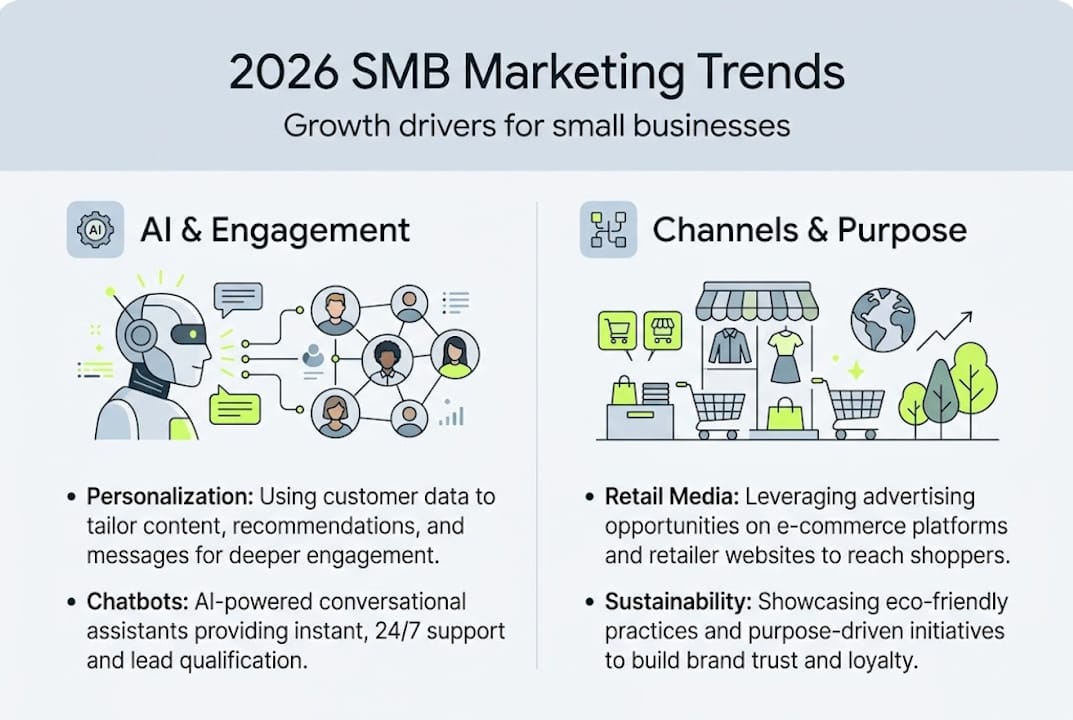
The wellbeing angle is equally important. Consumers are anxious. Economic pressure, health concerns, and information overload are all real. Marketing that addresses genuine wellbeing, rather than projecting aspirational lifestyles, resonates more deeply and converts better.
What savvy SMBs get right: Balancing bold innovation with pragmatic focus
We work with SMBs across e-commerce, telehealth, and retail. And we see two failure patterns repeat constantly. The first is chasing every shiny trend because a competitor or trade publication said to. The second is waiting for certainty before testing anything new. Both patterns are expensive.
The truth is that not every 2026 trend applies to your business. GEO matters more if organic search is already part of your mix. Retail media networks are essential if you sell physical products in competitive categories. Social commerce is worth testing if your audience skews under 40. Start by asking which trends integrate cleanly with your existing growth engine, not which ones are generating the most buzz.
Our framework is simple: test small, measure results, double down on what works, and ignore everything else. A 30-day test on TikTok Shop with a $1,500 budget tells you more than six months of planning. A properly structured ad funnel gives you the data you need to make that call confidently. In marketing like in chess, those who calculate their moves ahead win. Hype is noise. Results are the signal.
Ready to unlock your 2026 growth playbook?
Digital marketing in 2026 rewards precision, not volume. The brands gaining ground are the ones with clear channel strategy, smart AI integration, and campaigns built around measurable outcomes. That's exactly what we build at A&T Digital Agency. If you're ready to turn these trends into actual revenue, we manage Google Ads campaigns and Meta Ads programs that are designed to perform, not just run. No unnecessary meetings, no generic strategies. Just purposeful ad spend and real results tailored to your vertical and your goals.
Frequently asked questions
What is Generative Engine Optimization (GEO) in 2026 marketing?
GEO is the practice of building rich, interconnected content libraries optimized for AI-powered search and campaign algorithms, moving well beyond traditional keyword targeting. Per Google's research, this content ecosystem approach is now required for SMBs to compete in AI-driven search environments.
How big are retail media platforms in 2026?
Retail media networks like Amazon are forecast to reach $197 billion this year, representing roughly 16% of total global ad spend. That scale makes them impossible to ignore for any brand selling physical products.
How is AI used in telehealth and e-commerce marketing today?
AI chatbots handle patient triage and direct-to-patient education in telehealth, while product recommendation engines and behavioral triggers drive e-commerce conversions. Both applications reduce friction and improve the customer experience at scale, as detailed in 2026 digital marketing predictions.
What kind of sustainability messaging works best in 2026?
Marketing that proves real, tangible value and measurable wellbeing gains consistently outperforms vague pledges or generic eco-labels, according to Google's 2026 AUNZ research. Specific numbers, honest progress updates, and direct buyer benefits are the elements that build trust.
Recommended
- Why data-driven advertising matters for SMB growth in 2026
- Why data-driven advertising matters for SMB growth in 2026
- Digital ad types: 3.17% CTR boosts SMB leads in 2026
- Digital marketing compliance explained: Essential rules for SMBs
- Amazon sales growth tips: optimize listings, boost 2026 sales - Searchoneers
- 6 Amazon-Werbung Trends 2026, die Verkäufer kennen müssen