
That fee is billed separately from your actual ad budget. Most small business accounts under $15,000 in monthly spend land closer to a flat fee, while larger accounts often shift toward percentage-based pricing.
Here's the quick benchmark set to hold any quote against:
- Flat retainer: $500 to $5,000/month for most SMB accounts
- Percentage of spend: 10% to 20%, often with a $500 to $1,000 monthly floor
- Hybrid: lower flat base plus a smaller percentage or performance kicker
- Hourly/consulting: billed for specific projects, audits, or short-term strategy work
Pro Tip: Before you compare a single dollar figure, ask what your total monthly investment looks like: ad spend plus management fee plus any setup or tool costs. A $150,000 ad budget with a 10% fee costs more in absolute dollars than a $10,000 budget at 20%, even though the second number looks scarier on paper.
A workable rule of thumb: don't hire a dedicated management team below roughly $3,000 to $5,000 in monthly ad spend. Below that, the fee-to-spend ratio usually doesn't make sense for either side. Ask any prospective agency for their minimum ad spend requirement and their exact deliverable list before you look at price at all.
Key Takeaways
Fee structure matters less than fee clarity: a well-scoped percentage model with clean deliverables beats a vague flat retainer every time.
| Point | Details |
|---|---|
| Know your benchmark range | Flat retainers run $500 to $5,000/month; percentage fees run 10% to 20% with a common $500 floor. |
| Fee is separate from ad spend | Budget your total investment as management fee plus ad spend plus any setup costs. |
| Demand a deliverable list | Named roles, hours per month, and reporting cadence in writing prevent scope creep. |
| Use the breakeven formula | Divide the flat fee by the percentage rate to find the ad spend where each model costs the same. |
| Compare boutique scoping | Atdigiagency ties fee structure to account complexity and spend tier rather than a fixed template. |
Table of Contents
- Pricing Models: How Each One Works and What It Rewards
- Typical Fee Ranges by Ad Spend Tier
- What Does a Management Fee Actually Cover?
- Setup Fees and Tooling Costs You Should Budget For
- How to Compare Quotes and Negotiate a Fair Fee
- Red Flags That Turn a Cheap Quote Into a Costly Mistake
- How Atdigiagency Structures Fees Across Budget Tiers
- Why Fee Transparency Matters More Than the Number Itself
- Get a Fee Structure That Matches Your Actual Growth Stage
- Sources
Pricing Models: How Each One Works and What It Rewards
The billing model an agency chooses shapes its behavior, not just its invoice. Understanding the mechanics behind each one tells you what incentives you're actually buying into.
- Flat monthly retainer. You pay a fixed amount regardless of spend, usually $500 to $5,000 depending on account complexity. This model rewards efficiency: the agency isn't paid more for spending more of your money, so there's less temptation to inflate budgets.
- Percentage of ad spend. The agency takes 10% to 20% of monthly spend, often with a floor around $500. This scales naturally as your account grows, but it can quietly reward the agency for recommending bigger budgets rather than better targeting.
- Hybrid pricing. A smaller flat base plus a percentage or performance bonus. Hybrid structures are becoming more common because they split the difference: predictable revenue for the agency, growth incentive tied to results rather than raw spend.
- Hourly or consulting fees. Billed for specific work, an account audit, a one-time strategy session, a campaign rebuild. This fits businesses that need expertise but not ongoing management.
- Performance-based fees. Tied to a metric like cost per lead or revenue share. Rare as a standalone model for SMBs, but it shows up as a kicker inside hybrid deals.
Percentage models lower the barrier to entry for small advertisers who don't want to negotiate a flat number up front, but the incentive misalignment is real. Hybrid models exist precisely to blunt that pressure.
Flat fees tend to fit smaller or local campaigns where spend is modest and predictable. Percentage models make more sense once an account is scaling and complexity grows alongside the budget. Hourly consulting fits businesses testing the waters before committing to a full retainer.
Pro Tip: Ask directly whether your quote includes a media markup, meaning the agency buys ad space at one rate and bills you at another. Some agencies disclose this upfront; others bury it in "platform fees" language. If a contract won't specify whether you're billed the exact platform spend or a marked-up version of it, that's worth a direct follow-up question before signing anything.
Typical Fee Ranges by Ad Spend Tier
Your management fee should scale down as a percentage even as it scales up in dollars, because the work per dollar of spend doesn't grow linearly. Here's how that typically plays out across common spend bands for US advertisers:
- Under $5,000/month: flat fees of $500 to $1,500, or a percentage model hitting its $500 minimum floor. Few agencies profitably manage accounts this small without a flat structure.
- $5,000 to $15,000/month: $750 to $2,500 flat, or 15% to 20% of spend. This is the range where typical SMB management fees cluster most heavily.
- $15,000 to $50,000/month: 12% to 18% of spend, or flat retainers from $2,500 to $6,000. Complexity starts driving the fee more than raw dollars.
- $50,000 to $150,000/month: 10% to 15% of spend is typical, often paired with dedicated reporting and a named account strategist.
- Over $150,000/month: rates frequently drop below 10%, since the fixed labor cost of managing a large account doesn't scale at the same rate as the budget.
The pattern holds across the industry: percentage rates fall as spend rises, while flat retainers climb to reflect added complexity, more campaigns, more creative variants, more testing cycles. Minimum floors rarely disappear, though. Even agencies quoting a low percentage will usually protect themselves with a $500 to $1,000 monthly minimum.
Running campaigns across both Google Ads and Meta typically adds a premium over single-platform management, since each platform has its own optimization rhythm, creative specs, and reporting requirements. Regional cost variance in the US is real but modest.
What Does a Management Fee Actually Cover?
A fee without a deliverable list is just a number. Before comparing prices, compare what each quote actually includes.
Standard inclusions in most management retainers:
- Campaign strategy and initial setup across approved platforms
- Ongoing bid, budget, and audience optimization
- Negative keyword management and search term review
- Monthly or biweekly reporting with a scheduled business review
- Basic conversion tracking configuration
Items agencies commonly bill separately:
- Creative production (video, static ads, ad copy variants beyond a baseline set)
- Landing page design or development
- Server-side tracking builds and advanced analytics pipelines
- Third-party software licenses (heat mapping, call tracking, attribution tools)
Ask any prospective vendor three direct questions before signing: How many hours per month are allocated to my account, and by whom? What is your reporting cadence, and can I see a sample report? Which of these deliverables are included in the base fee versus billed as add-ons?
Pro Tip: Get the deliverable list in writing, not in a sales call. A clear list of deliverables and named roles is the strongest defense against scope creep, because it gives you something concrete to point to when the agency's involvement quietly shrinks three months in.
Setup Fees and Tooling Costs You Should Budget For
First-month costs often run higher than your steady-state retainer, and that's normal, not a red flag, as long as it's disclosed upfront.
Typical one-time setup items include account audits, campaign architecture builds, and tracking infrastructure. Advanced tracking setups, including Enhanced Conversions, server-side Google Tag Manager, and GA4-to-BigQuery pipelines, can run from the low thousands into five figures depending on how much legacy tracking debt needs cleanup. A business with clean existing analytics pays far less than one migrating off broken or missing tracking.

Tooling and reporting software costs get handled two ways: as a pass-through at cost, or with a markup baked into the retainer. Neither approach is wrong, but you should know which one you're getting.
Some agencies amortize a setup fee across the first three to six months of the contract rather than charging it all upfront. That's a fair ask to make in negotiation if a large one-time cost feels front-loaded relative to the value you'll see in month one.
How to Compare Quotes and Negotiate a Fair Fee
Getting comparable proposals from three agencies quoting three different pricing structures is hard unless you force a common format. Build a checklist before you take a single call.
- Request identical deliverable categories from every agency: platforms managed, hours per month, named roles assigned, reporting cadence, and service-level response times.
- Confirm what's included versus billed separately, specifically creative, tracking setup, and third-party tools.
- Ask about exit terms. A month-to-month agreement with a 30-day notice period is standard; anything longer without a strong reason deserves scrutiny.
- Propose a scoped pilot if you're uncertain, 60 to 90 days with clearly defined success metrics, before committing to a 12-month contract.
- Negotiate the fee structure itself. If you're near a spend tier boundary, ask whether the fee model shifts once you cross it, and get that threshold written into the agreement.
Two levers tend to work better than straightforward price haggling. First, ask for a performance bonus structure instead of a flat rate increase, tying a portion of the fee to results rather than raw spend. Second, cap any tool pass-through costs at a fixed dollar amount so a software price hike doesn't quietly inflate your bill six months in.
Pro Tip: Ask every agency the same question: "At what ad spend would you recommend I switch from a flat fee to a percentage model, or vice versa?" A confident, specific answer signals an agency that actually thinks about pricing on your behalf, not just theirs.
Breakeven Math: A Quick Worked Example
The formula is simple: flat fee ÷ percentage rate = breakeven ad spend. If Agency A quotes a $2,000 flat fee and Agency B quotes 15% of spend, the breakeven point is $2,000 ÷ 0.15, or about $13,333 in monthly spend.
Below the breakeven point, the percentage model costs less. Above it, the flat fee wins. Add an amortized setup fee, say $3,000 spread across six months, or $500/month, and the flat-fee side becomes $2,500 in that comparison, shifting the breakeven point higher. Plug your own spend and quoted rates into this same formula before signing anything.
Red Flags That Turn a Cheap Quote Into a Costly Mistake
The lowest quote in your inbox isn't automatically the best deal. Watch for these signals before you sign:
- No account access. If you can't log into your own Google Ads or Meta account, walk away. You should always own your data.
- Vague deliverables. "Ongoing optimization" with no hours, no cadence, and no named contact is a placeholder, not a plan.
- Suspiciously low pricing paired with a high account load per strategist. One person managing 40+ accounts can't give any of them real attention.
- Surprise markups discovered only after the first invoice arrives.
- Restrictive termination clauses locking you into 12 months with no exit option.
If you spot any of these, ask for a sample report, request client references, and get a written scope addendum before your next payment goes out. Checking an agency's reputation and case history through independent listings is a reasonable step before signing a longer contract.
How Atdigiagency Structures Fees Across Budget Tiers
Boutique agencies price differently than large firms with account minimums stacked high per strategist. At Atdigiagency, scope maps directly to spend tier rather than a one-size template.
- Smaller accounts get a flat retainer covering strategy, setup, and optimization across Google Ads and Meta, with a monthly reporting review.
- Growing accounts shift toward a structure where fee scales with complexity, more campaigns, more creative testing, more platforms, rather than spend alone.
- Larger accounts get dedicated strategist hours and deeper conversion tracking builds tied directly to reported ROI.
Onboarding starts with an account audit before any budget increases, and reporting cadence is set upfront so there's no ambiguity about what's included versus billed separately.
Our clients don't need more meetings, they need campaigns that convert. That's the whole premise behind how we scope engagements: less overhead, more work that actually moves revenue.
Case studies across telehealth, entertainment venues, and retail brands show this tiered approach applied to real accounts rather than a flat industry template.
Why Fee Transparency Matters More Than the Number Itself
Most articles on this topic obsess over finding the "right" percentage or flat number, as if there's a universal correct answer. There isn't.
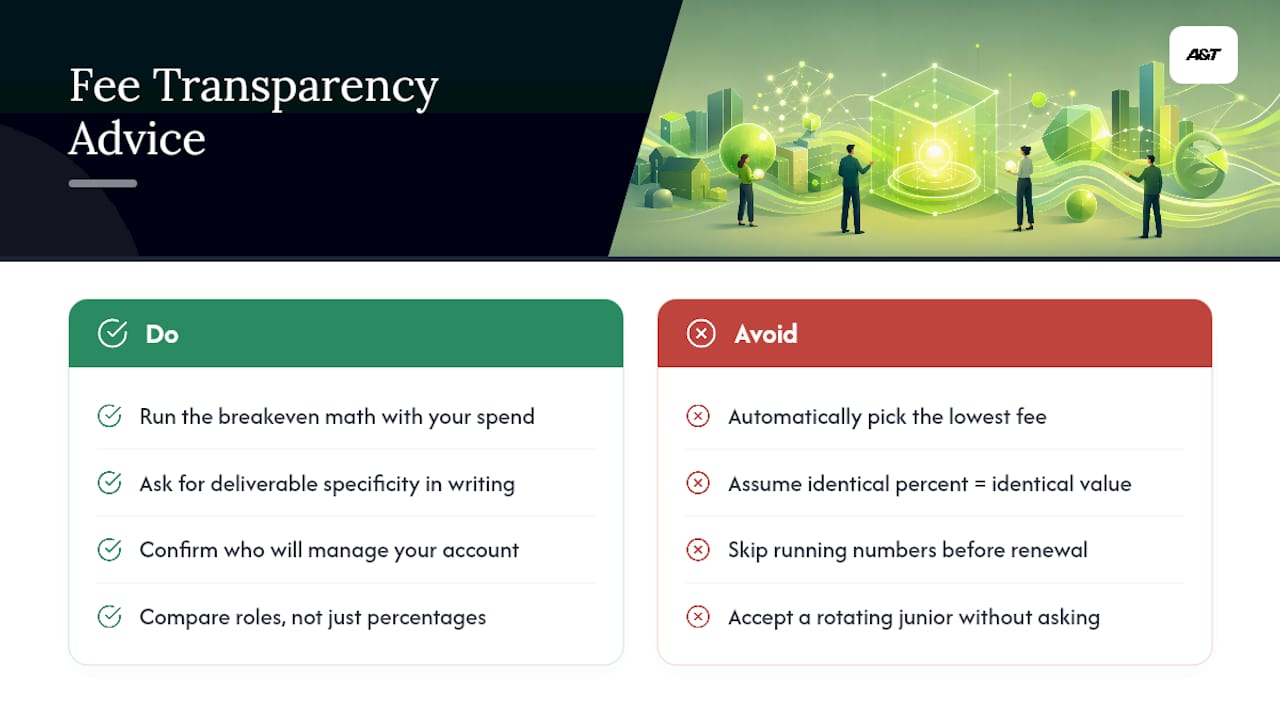
The conventional advice to "shop around for the lowest fee" misses the actual lever that matters: deliverable specificity. Two agencies quoting the identical percentage can deliver wildly different value depending on whether that fee buys you a dedicated strategist or a rotating junior account manager splitting attention across forty clients.
If you take one thing from this guide, make it the breakeven math. Most business owners never run the numbers on flat versus percentage pricing, they just react to whichever number sounds smaller. Run your own spend through the formula before your next renewal conversation. It changes the negotiation entirely.
— Ann
Get a Fee Structure That Matches Your Actual Growth Stage
Atdigiagency prices engagements around what your account needs, not a flat industry template applied regardless of complexity. If you've read this far comparing percentage models against flat retainers, you already know the real question isn't "what's the going rate," it's "what does this fee actually buy me." That's the scoping conversation Atdigiagency starts every engagement with: a real account audit, a deliverable list with named hours, and a fee structure that shifts as your spend and complexity grow, instead of locking you into pricing built for a different stage of business. Reach out through the performance marketing team page to get a scoped quote built around your current ad spend and goals, not a generic tier.
Sources
- PPC Management Pricing: What Agencies Charge in 2026 (+ Calculator) | Pitchsite
- PPC Management Cost Calculator — 2026 Google Ads Agency Fee Estimator | UseCalcPro
- Get-ryze