
Advantage+ Shopping campaigns are Meta's automated engine for finding buyers by optimizing audience, placements, creative, and budget in one system, now folded into Advantage+ Sales in Ads Manager. Use it when your catalog is clean, your conversion signal is reliable, you're seeing steady weekly conversion volume, and you have more than one or two creative assets ready to feed the machine. Skip it if any of those pieces are missing.
TL;DR:
- Advantage+ Sales performs best when your catalog is fully optimized, with comprehensive product data and consistent weekly conversions above 10, with at least 4 active creative assets.
- The system prioritizes creative variety over detailed interest or audience stacking, making creative refreshes every two to four weeks essential for sustained performance.
- Starting budgets should support at least 10 conversions per day to prevent slow learning, with gradual spend increases to avoid resetting the learning phase.
- Performance measurement should focus on mid-funnel metrics like blended MER and holdout tests rather than just Ads Manager ROAS, especially as scale increases.
- Troubleshooting issues often involves addressing catalog errors, low conversion volume, creative fatigue, or underfunding before considering the algorithm or targeting as the cause.
Table of Contents
- What Advantage+ Shopping (Advantage+ Sales) Actually Automates
- Is Your Account Actually Ready to Run It?
- How to Set Up Your First Advantage+ Sales Campaign
- Scaling and Measuring Advantage+ Without Fooling Yourself
- Why Advantage+ Shopping Might Look Missing (And How to Fix It)
- How an Agency Structures Advantage+ Tests
- What Actually Moves the Needle in Advantage+
- Get a Managed Test Plan for Your Advantage+ Campaign
- Where to Go Deeper on Advantage+ Setup
- Sources
- FAQ
What Advantage+ Shopping (Advantage+ Sales) Actually Automates
Meta built Advantage+ Shopping to remove the manual guesswork of audience targeting, placement selection, and budget splits across ad sets. The system tests creative combinations across Feed, Reels, Stories, and Audience Network simultaneously, then shifts spend toward whatever converts, all inside one campaign structure rather than a dozen ad sets you'd manage by hand. Meta's own product page describes it as an automated shopping ad type built specifically to optimize delivery, creative, and conversions together.
A common point of confusion: the Advantage+ Audience toggle you see inside a standard campaign is not the same thing as the Advantage+ Shopping campaign type. The toggle expands manual targeting with algorithmic reach. The full campaign type hands over targeting, placement, and creative selection almost entirely. As of 2025, Meta consolidated the standalone Advantage+ Shopping campaign objective into the broader Advantage+ Sales framework, which is why some advertisers now search for a setting that has effectively moved, not disappeared.
The automation itself runs on Meta's newer delivery models (often referenced by advertisers as the Andromeda and GEM systems), which score and rank ads with far more granularity than older lookalike-and-interest targeting ever could. Practically, that shift means:
- Your targeting inputs matter less than they used to.
- Your creative variety matters more, because creative is now the primary signal the algorithm reads.
- Manual exclusions and detailed interest stacks add little value inside this campaign type.
Is Your Account Actually Ready to Run It?
Advantage+ punishes weak inputs faster than manual campaigns do, because there's less for you to manually correct once it's live. Before you launch, run through this checklist.
- Catalog hygiene. Fill every required field (title, description, price, availability, product type, GTIN where applicable). Feed errors and missing images are the single most common cause of poor delivery, and a catalog with too few active SKUs gives the algorithm too little variety to work with, so consider tools like Salesforce Commerce Cloud SEO Automation to address feed and catalog integration challenges.
- Tracking setup. Run Meta Pixel alongside the Conversions API. Server-side reporting through CAPI recovers signal that iOS privacy settings and browser tracking restrictions routinely strip out of pixel-only setups, and it directly improves your Event Match Quality score.
- Conversion volume. Agencies generally want to see a steady conversion volume at the ad-account level before trusting Advantage+ output, a threshold echoed in Skale's Advantage+ practitioner guide. Below that, the learning phase drags and results stay noisy.
- Creative supply. Plan for somewhere between 4 and 15 active assets at launch, mixing polished product shots with rougher, UGC-style video. Refresh the mix every two to four weeks; stale creative is the fastest way to stall a campaign that was performing fine a month earlier.
Pro Tip: Don't launch Advantage+ with a single hero video and call it "creative volume." The algorithm needs contrast, not repetition, to find which angle actually converts.
How to Set Up Your First Advantage+ Sales Campaign
Getting the configuration right the first time avoids the most expensive mistake in Advantage+: resetting the learning phase halfway through a testing window. Follow these steps in order.
- Pick your objective and conversion event. Choose Sales as the campaign objective, then select the specific conversion event (Purchase, in most catalog cases) that matches what you're actually optimizing revenue against, per Meta's Advantage+ Sales documentation.
- Set your budget. Start with a daily budget that comfortably supports your estimated daily conversion volume. Underfunding a launch is the fastest way to starve the algorithm of data.
- Upload and map your catalog. Confirm every product field is pulling correctly before you launch, not after.
- Set the existing-customer budget cap. This control limits how much spend goes toward retargeting people who already bought, which keeps the campaign honest about how much new revenue it's actually generating.
- Choose your conversion location and performance goal, typically the website with a goal of maximizing conversion value.
- Upload your creative mix, following Meta's recommended aspect ratios for Feed, Stories, and Reels, and leave Advantage+ Creative and Advantage+ Placements switched on unless you have a specific, documented reason to override them.
Once live, resist the urge to touch anything for at least three to five days. Watch these in the first 72 hours:
- Delivery pacing (is the daily budget actually spending?)
- Frequency (climbing too fast signals audience saturation)
- Cost per result trending, not day-to-day noise
Any edit to budget, creative, or targeting during this window resets the learning phase and pushes your real read further out, a pattern Jon Loomer's setup walkthrough covers in detail.
Scaling and Measuring Advantage+ Without Fooling Yourself
Optimization here isn't about tweaking targeting. It's about feeding the algorithm better raw material and reading results honestly.
Creative testing discipline. Rotate in two to four new concepts every two weeks rather than waiting for existing assets to fully fatigue. Retire anything whose frequency has climbed while conversion rate has dropped, and keep a running log of which hooks, formats, and offers actually moved the needle, since creative is now the primary targeting signal inside Advantage+, not audience selection.
Budget scaling. Increase spend gradually in moderate steps, rather than doubling overnight. Bigger jumps reliably trigger a fresh learning phase and a temporary performance dip right when you least want one. Pause any planned increase if cost per result is still swinging widely week to week; stabilize the signal before you add fuel to it.
Measurement beyond Ads Manager ROAS. Reported ROAS inside Ads Manager tends to run optimistic because of modeled conversions and cross-surface attribution. Blended MER (total revenue divided by total ad spend across channels) and periodic holdout tests give a far more honest read on incremental impact than the platform's own dashboard.
- Run a geo or audience holdout quarterly to confirm the campaign is generating incremental sales, not just claiming credit for sales that would have happened anyway.
- Track marginal ROAS as you scale. The tenth dollar of spend rarely returns what the first dollar did.
For advertisers still building conviction, a manual ABO test against a narrow, clean audience segment first, then scaling the winning creative into Advantage+ once volume is proven, remains a sound hybrid pattern many practitioners use before committing full budget to automation.
Why Advantage+ Shopping Might Look Missing (And How to Fix It)
If you can't find "Advantage+ Shopping" as a distinct option in Ads Manager, it's almost certainly not a bug. Meta rolled that objective into the broader Advantage+ Sales campaign type, and recent Ads Manager overhauls now default several AI-driven settings on by default, changing what advertisers see at campaign creation, a shift documented in troubleshooting guides tracking the rollout.
When performance drops instead of the option itself disappearing, check these before assuming the platform is broken:
- Feed errors. A disapproved or out-of-stock batch of products can quietly gut delivery.
- Conversion volume dropping below threshold. If your weekly conversions drop below a stable threshold, the learning phase may reopen repeatedly.
- Creative fatigue. Rising frequency paired with falling click-through rate is the clearest tell.
- Underfunded daily budget. A budget too small to clear ten conversions a day starves the algorithm of data.
How an Agency Structures Advantage+ Tests
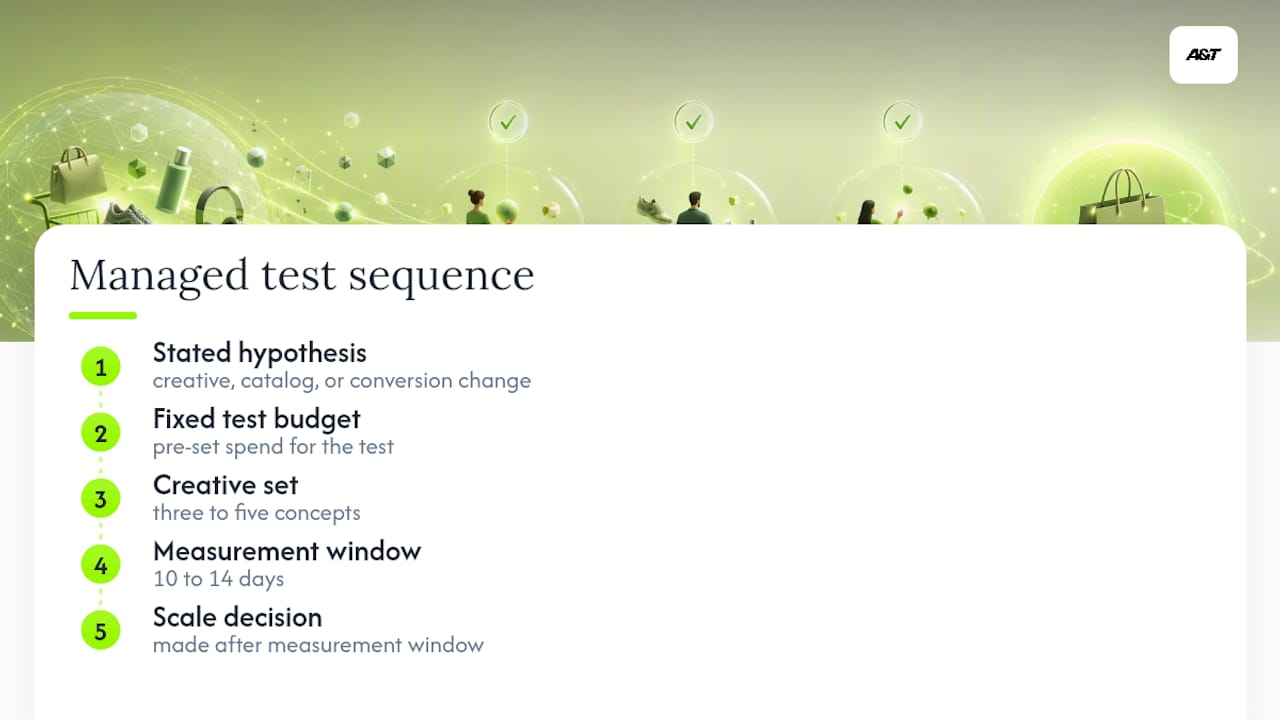
A managed test plan usually starts with a stated hypothesis (a new creative angle, a widened catalog segment, a shifted conversion event), a fixed test budget, a defined creative set of three to five concepts, and a measurement window of 10 to 14 days before any scale decision gets made. That structure exists precisely because Advantage+ punishes impatience.
Retail and e-commerce engagements have followed this pattern across categories including health and wellness products and ticketed venues, pairing catalog audits with staged creative rollouts rather than launching everything at once.
DIY management works fine when conversion volume is healthy, the catalog is small enough to audit in an afternoon, and measurement needs stop at Ads Manager's own reporting. A managed partner earns its cost when signal is thin, timelines are tight, or you need blended MER and holdout testing layered on top of platform reporting, work that eats hours most in-house teams don't have.
What Actually Moves the Needle in Advantage+
Most guidance on Advantage+ treats it as a settings problem: adjust settings carefully and monitor performance over time. That framing undersells what's actually happening. The algorithm is a creative-testing machine wearing a targeting costume, and advertisers who keep feeding it the same three product shots are the ones complaining it "doesn't work."
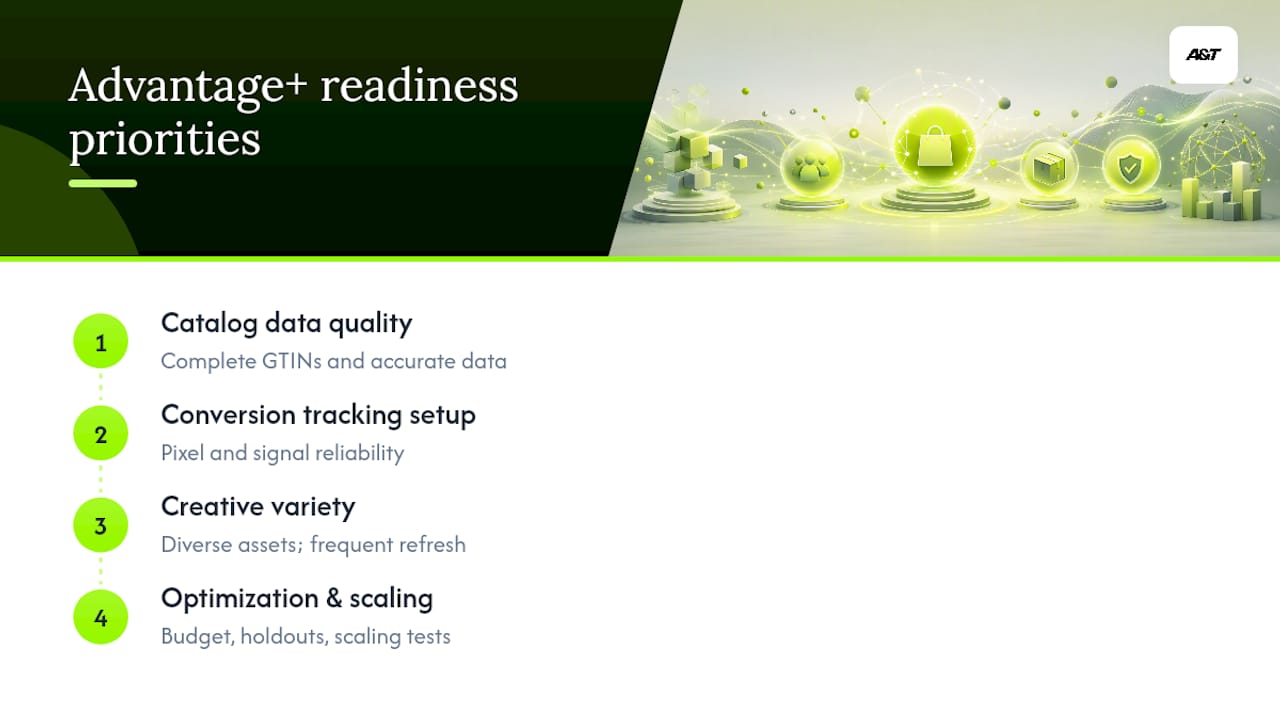
The conventional advice to "just trust the algorithm" is half right and half lazy. Trust it with targeting. Do not trust it to compensate for a feed with missing GTINs, a pixel that's losing half its signal to iOS restrictions, or a creative library that hasn't been touched since launch. Those are inputs Meta's documentation cannot fix for you.
If you take one thing from this guide, prioritize the boring stuff first: catalog data quality and proper conversion tracking setup are foundational before budget optimization. Everything downstream, the scaling rules, the holdout tests, the creative cadence, only works once the foundation is solid. Skipping straight to "optimization" on a shaky base is the single most common reason Advantage+ underperforms its reputation.
— Ann
Get a Managed Test Plan for Your Advantage+ Campaign
Atdigiagency runs performance marketing and Meta ads management for e-commerce and retail brands, and Advantage+ setup is exactly the kind of work where a second set of eyes pays for itself: catching a broken feed, an undercapped budget, or a creative library that's gone stale before it quietly drains your spend. If your catalog and tracking are already solid and volume is healthy, running it yourself is a reasonable call. If you're not sure your inputs are clean, or you want blended MER and holdout measurement layered on top of Ads Manager's own numbers, consider requesting a campaign audit and a staged test plan built around your actual conversion volume, not a generic template.
Where to Go Deeper on Advantage+ Setup
For technical parameter definitions, start with Meta's own Advantage+ Shopping product page and its Advantage+ Sales help documentation. For hands-on setup walkthroughs, Jon Loomer's guides remain the most detailed practitioner resource, and Skale Strategy's 2026 breakdown covers feed and scaling specifics in more depth than most agency blogs attempt.
Sources
- Advantage+ Shopping Campaigns: Automated Shopping Ads
- Meta Advantage+ Shopping Campaigns in 2026: How to Structure, Feed, and Scale Them | Skale Strategy
- Get Started with Advantage+ Shopping Campaigns
FAQ
What Is an Advantage+ Sales Campaign?
It's Meta's automated campaign type that optimizes audience targeting, ad placement, creative selection, and budget allocation together, replacing what used to be the standalone Advantage+ Shopping campaign objective.
Should I Turn On Advantage+ Audience?
Turn it on if you're running a standard manual campaign and want Meta's algorithm to extend reach beyond your defined targeting; it's a separate control from the full Advantage+ Sales campaign type and generally low-risk to test.
Is $10 a Day Enough for Facebook Ads?
Not for Advantage+ specifically. A budget that small rarely clears the roughly ten conversions a day needed to exit the learning phase quickly, so expect a slower, noisier ramp at that spend level.
What Are Some Famous Ad Campaigns Built on Meta's Automation?
Meta highlights retail and DTC brands across categories like apparel and consumer goods that scaled prospecting through Advantage+ Sales after building clean catalogs and steady conversion volume, though specific published case names vary by industry and year.
When Should I Use Manual Campaigns Instead of Advantage+?
Use manual ABO testing when you need a clean A/B read on a specific creative or offer hypothesis; once a winner is proven, scale it inside Advantage+ rather than running both approaches indefinitely in parallel.