
Despite intense pressure to adopt AI in marketing, only 6% of marketers fully integrate AI into their advertising systems. Most businesses struggle not because AI tools are unavailable, but because they lack the foundational data strategy to make analytics work. With $664.2 billion in US marketing spend flowing through digital channels in 2026, understanding how to leverage analytics transforms campaigns from guesswork into precision systems that consistently deliver measurable ROI.
Table of Contents
- Introduction To Analytics In Advertising
- How Analytics Supports Targeting, Budgeting, And Personalization
- Measuring Advertising Performance Accurately
- Emerging Analytics And AI Trends Impacting Advertising
- Common Barriers And Misconceptions In Analytics Adoption
- Implementing Analytics In Small To Medium E-Commerce And Healthcare Businesses
- Conclusion And Next Steps For Analytics-Driven Advertising Success
- Maximize Your Advertising Impact With Expert Performance Marketing Support
- Frequently Asked Questions
Key takeaways
| Point | Details |
|---|---|
| Analytics evolution | Modern advertising analytics uses AI-driven systems to optimize campaigns in real time, replacing manual reporting with automated insights. |
| Composite measurement | Multi-touch attribution and incrementality testing outperform last-click models, improving budget efficiency by up to 20%. |
| Strategy before tools | Only 6% of marketers successfully integrate AI because effective analytics requires data governance and clear KPI ownership first. |
| SMB opportunity | Small businesses can compete with larger advertisers by implementing privacy-compliant first-party data strategies and AI-capable platforms. |
| Privacy compliance | First-party data collection and privacy-first measurement frameworks are essential for sustainable advertising in 2026. |
Introduction to analytics in advertising
Advertising analytics transforms raw campaign data into actionable insights that drive targeting precision, budget allocation, and creative optimization. Instead of relying on intuition or surface-level metrics, analytics reveals which channels, audiences, and messages generate actual revenue. This capability has become essential as digital advertising grows more complex and competitive.
The evolution from manual reporting to AI-enhanced analytics marks a fundamental shift in how marketers operate. Early analytics required teams to manually compile spreadsheets, wait days for reports, and make decisions based on outdated information. Today's systems process data in real time, identify patterns humans miss, and automatically adjust campaigns to maximize performance.
The commercial stakes are enormous. The $664.2 billion US marketing spend flowing through digital channels in 2026 demands accountability. Marketing directors must prove every dollar generates returns. Analytics provides that proof while simultaneously improving outcomes.
The role of Google Ads in small business growth illustrates this transformation. Businesses that implement proper analytics see which keywords drive conversions, which ad copy resonates, and which audiences offer the highest lifetime value. Without analytics, advertising becomes expensive experimentation.
First-party data has emerged as the foundation for effective analytics in 2026. Privacy regulations and browser changes have rendered third-party tracking unreliable. Smart advertisers now focus on collecting their own customer data through website interactions, email subscriptions, and purchase histories. This shift actually improves targeting accuracy because first-party data reflects genuine customer interest rather than probabilistic assumptions.
Key capabilities modern analytics provides:
- Real-time performance monitoring across all advertising channels
- Audience segmentation based on behavior, demographics, and purchase intent
- Predictive modeling to forecast campaign outcomes before spending budgets
- Attribution analysis showing which touchpoints contribute to conversions
- Automated reporting that eliminates manual data compilation
How analytics supports targeting, budgeting, and personalization
Precise targeting starts with understanding who your customers actually are, not who you assume they might be. Analytics reveals audience segments based on demonstrated behavior rather than demographic guesses. An e-commerce company might discover their highest-value customers aren't the demographic they originally targeted, but a completely different group that analytics identified through purchase patterns.

First-party data powers this targeting precision. When you collect information directly from customer interactions, you build profiles that reflect genuine interest and intent. This data becomes exponentially more valuable than purchased lists or third-party cookies because it captures actual behavior on your properties.
Budget allocation transforms from art to science with AI-powered prescriptive analytics. Instead of splitting budgets evenly or relying on past performance, prescriptive systems calculate optimal spend distribution across channels, campaigns, and audience segments. These systems continuously adjust as performance data flows in, shifting dollars from underperforming areas to high-return opportunities.
Dynamic creative optimization takes personalization further by automatically testing and serving different ad variations to different audience segments. Analytics identifies which images, headlines, and calls-to-action resonate with specific groups. The system then serves the best-performing creative to each audience, dramatically improving engagement and conversion rates.
AI agents now handle real-time campaign adjustments that previously required constant human monitoring. These automated systems detect performance shifts, pause underperforming ads, increase bids on converting keywords, and reallocate budgets across campaigns. The creative intelligence powered by AI analyzes thousands of creative elements to determine what drives response.
Analytics-driven budget optimization delivers:
- Channel performance comparison showing true ROI by platform
- Predictive spend recommendations based on conversion probability
- Real-time budget pacing to prevent overspending or underutilization
- Seasonality adjustments that anticipate demand fluctuations
- Competitive intelligence revealing market opportunity windows
Pro Tip: Start budget optimization by identifying your top 3 conversion actions (purchases, leads, subscriptions) and track cost per action across all channels. This single metric immediately reveals where analytics should focus your dollars. Most businesses discover they're overspending on channels that drive awareness but underfunding those that drive conversions.
The key to optimizing ad campaigns ROI lies in connecting analytics insights to actual campaign management. Data without action wastes time. Successful marketers create feedback loops where analytics findings trigger immediate campaign adjustments, creating continuous improvement cycles that compound results over time.
Measuring advertising performance accurately
Last-click attribution misleads advertisers by crediting only the final touchpoint before conversion. This approach ignores the awareness ads, consideration content, and retargeting that actually moved prospects through the funnel. A customer might see five different ads across three platforms before converting, but last-click attribution credits only the final click. This distortion causes chronic underinvestment in upper-funnel activities that drive eventual sales.
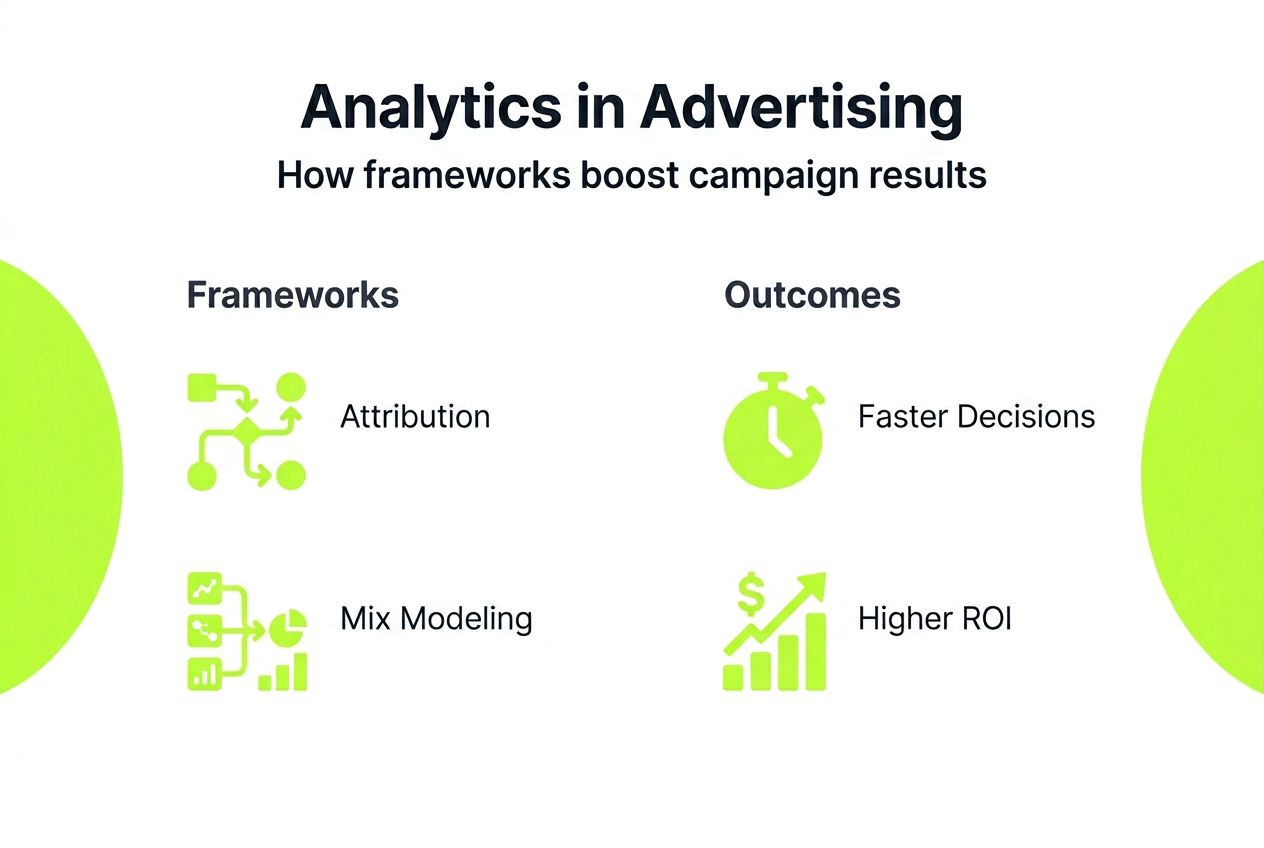
Composite measurement systems solve this problem by allocating credit across multiple touchpoints. These frameworks combine multi-touch attribution, marketing mix modeling, and incrementality testing to create a complete picture of campaign impact. Organizations using composite measurement report budget efficiency improvements of up to 20% compared to last-click models.
Multi-touch attribution tracks every interaction a prospect has with your advertising before converting. It assigns fractional credit to each touchpoint based on its role in the customer journey. Different models (linear, time decay, position-based) weight touchpoints differently, but all provide more accurate insights than last-click.
Marketing mix modeling analyzes historical performance data to determine how different marketing inputs affect outcomes. This statistical approach reveals correlations between spending levels, channel mix, and results. It's particularly valuable for understanding macro-level effectiveness and planning annual budgets.
Incrementality testing measures what actually works by comparing results between exposed and control groups. These experiments isolate the true impact of specific campaigns or channels by measuring the lift they generate beyond baseline performance. Incrementality reveals whether campaigns drive new behavior or just capture demand that would have occurred anyway.
Measurement framework comparison:
| Approach | Strength | Limitation |
|---|---|---|
| Last-click attribution | Simple to implement | Ignores upper-funnel impact |
| Multi-touch attribution | Credits all touchpoints | Requires comprehensive tracking |
| Marketing mix modeling | Reveals macro patterns | Lacks granular insights |
| Incrementality testing | Proves causal impact | Resource-intensive setup |
| Composite measurement | Complete accuracy | Requires integrated data infrastructure |
Privacy restrictions complicate cross-platform tracking in 2026. Cookie deprecation, app tracking transparency, and data regulations limit traditional measurement approaches. Smart advertisers adapt by focusing on first-party data collection, server-side tracking, and privacy-preserving measurement technologies that comply with regulations while still providing actionable insights.
Live reporting powered by AI reduces decision lag from days to hours. Traditional reporting cycles required waiting for data to compile, dashboards to update, and teams to analyze results. By that time, market conditions had changed and opportunities had passed. Real-time systems surface insights immediately, enabling rapid response to both problems and opportunities.
Conversational analytics interfaces let marketers ask questions in plain language instead of building complex queries. You can ask "Which campaigns drove the most revenue last week?" and get instant answers with visualizations. This accessibility democratizes analytics, allowing more team members to extract insights without technical expertise.
Essential metrics for accurate performance measurement:
- Customer acquisition cost (CAC) by channel and campaign
- Lifetime value (LTV) to CAC ratio showing long-term profitability
- Return on ad spend (ROAS) calculated at different attribution windows
- Conversion rate by audience segment and creative variation
- Brand lift and awareness metrics from exposed vs. control groups
The tracking ad performance metrics process becomes exponentially more valuable when measurement frameworks align with actual business outcomes. Vanity metrics like impressions or clicks matter less than metrics directly tied to revenue, profit margins, and customer retention. Our digital ad campaign ROI guide explains how to connect advertising metrics to financial results.
Emerging analytics and AI trends impacting advertising
AI agents represent the next evolution in campaign automation. These autonomous systems don't just execute predefined rules but make complex decisions based on multiple data signals. An AI agent optimizes campaigns automatically, adjusting bids, pausing underperformers, reallocating budgets, and even generating new creative variations without human intervention. Early adopters report ROAS improvements of 30% or more.
These agents operate continuously, processing performance data every few minutes rather than daily or weekly. They detect patterns and anomalies that human analysts miss simply because they can evaluate millions of data points simultaneously. The technology moves advertising from periodic optimization to constant evolution.
Generative Engine Optimization (GEO) emerges as a critical new discipline as AI-powered search and shopping assistants reshape how consumers discover products. Traditional SEO optimized for Google's algorithm, but GEO optimizes for how AI models synthesize and present information. Brands that master GEO gain visibility in AI-generated recommendations and summaries.
The impact extends beyond search. AI-powered shopping assistants influence purchase decisions for 24% of AI users. These tools analyze products, compare prices, read reviews, and make recommendations based on individual preferences. Advertising analytics must now account for how brands appear in these AI-mediated experiences.
Predictive analytics forecasts future outcomes with increasing accuracy. By analyzing historical patterns, seasonal trends, competitive dynamics, and external factors, predictive models estimate campaign results before spending begins. This capability transforms planning from reactive to proactive, allowing marketers to scenario-plan different budget allocations and strategies.
AI capabilities reshaping advertising analytics:
- Autonomous bid management that responds to micro-fluctuations in auction dynamics
- Predictive audience modeling that identifies prospects before they show buying signals
- Automated creative generation and testing across thousands of variations
- Anomaly detection that instantly flags performance issues or opportunities
- Cross-channel orchestration that coordinates messaging across all touchpoints
Pro Tip: Don't wait for perfect AI implementation to start benefiting from these trends. Begin with one high-impact use case like automated bid management or predictive audience modeling. Master that capability, measure results, then expand to additional AI applications. Trying to implement everything simultaneously overwhelms teams and dilutes focus.
The paid advertising trends 2026 landscape reveals how quickly AI transforms from experimental to essential. Organizations that delay adoption risk falling behind competitors who achieve better results with lower costs through AI-enhanced analytics. The technology advantage compounds over time as systems learn and improve.
Conversational interfaces make advanced analytics accessible to non-technical users. Instead of learning SQL or mastering BI tools, marketers ask questions in plain language. The system interprets intent, queries relevant data, and presents insights with visualizations. This democratization means strategic decisions get informed by data rather than gut feelings.
Common barriers and misconceptions in analytics adoption
The biggest misconception is that AI tools automatically solve ROI problems. Businesses buy expensive platforms expecting immediate transformation but discover the tools are only as good as the underlying data strategy. Without clean data, clear objectives, and proper governance, AI amplifies existing problems rather than fixing them.
Only 6% of marketers fully integrate AI into their advertising systems. The failure rate isn't because the technology doesn't work. It stems from organizations skipping foundational work like data auditing, KPI definition, and team training. They chase shiny tools while ignoring the strategy and infrastructure those tools require.
Last-click attribution remains surprisingly common despite its obvious flaws. Many marketers continue using it because it's simple, readily available in most platforms, and aligns with how finance departments think about costs. Breaking free requires educating stakeholders on attribution limitations and demonstrating how better models improve decisions.
Data governance gaps prevent analytics success even when tools and strategy exist. Who owns the customer data? Which team controls campaign tags? How do we ensure tracking stays consistent? 40% struggle to prove ROI due to fragmented analytics and unclear ownership. Without clear governance, data quality degrades and insights become unreliable.
Why analytics adoption fails:
- Organizations implement tools before defining what success looks like
- Teams lack training to interpret analytics insights and take action
- Data silos prevent comprehensive cross-channel analysis
- Privacy compliance gets treated as afterthought rather than foundation
- Leadership expects immediate results without investing in proper infrastructure
Low AI adoption despite high pressure creates a dangerous gap. Executives demand AI-driven results while refusing to fund the data infrastructure and strategic planning AI requires. This disconnect leaves marketing teams trapped between impossible expectations and inadequate resources.
Data readiness determines AI success more than which tools you choose. Clean, comprehensive, well-structured data enables even basic AI to deliver impressive results. Conversely, the most sophisticated AI platform fails when fed incomplete, inconsistent, or inaccurate data. Audit and clean your data before shopping for AI solutions.
"Most businesses don't have an AI problem. They have a data strategy problem. Fix the foundation first, then add advanced tools." This principle applies across industries and company sizes.
Privacy compliance challenges multiply as regulations evolve. What worked last year may violate new rules today. Organizations must build privacy-first analytics frameworks that collect only necessary data, respect user preferences, and maintain compliance across jurisdictions. The digital ad spend ROI challenges often trace back to measurement gaps created by privacy restrictions.
Cultural resistance undermines technical implementations. Teams accustomed to intuition-based decisions resist data-driven approaches. Overcoming this requires demonstrating quick wins, celebrating data-informed successes, and gradually shifting organizational culture toward analytics-first thinking.
Implementing analytics in small to medium e-commerce and healthcare businesses
Successful analytics implementation follows a structured process that builds capability systematically. Rushing into advanced AI without foundational work wastes time and money. Follow these steps:
-
Audit existing data infrastructure. Document what customer data you currently collect, where it lives, how it's structured, and who can access it. Identify gaps between available data and insights you need. Most businesses discover they're collecting lots of data but missing critical pieces.
-
Clean and consolidate data sources. Eliminate duplicates, fix inconsistencies, establish naming conventions, and create single sources of truth. This unglamorous work enables everything else. Budget adequate time because data cleaning always takes longer than expected.
-
Define clear KPIs aligned with business goals. Don't track everything; track what matters. For e-commerce, focus on customer acquisition cost, average order value, purchase frequency, and lifetime value. For healthcare, prioritize patient acquisition cost, appointment show rates, treatment adherence, and patient satisfaction scores.
-
Implement privacy-compliant tracking. Ensure all data collection respects user consent, complies with GDPR/CCPA requirements, and follows platform policies. Use first-party cookies, server-side tracking, and consent management platforms. Privacy compliance isn't optional in 2026.
-
Select AI-capable tools matching your needs. Evaluate platforms based on integration capabilities, ease of use, support quality, and pricing. Bigger isn't always better; choose tools your team can actually use effectively rather than enterprise solutions that sit unused.
-
Integrate analytics into campaign planning. Use historical performance data to inform budget allocation, audience selection, and creative development. Our ad campaign setup guide shows how to build analytics into planning from the start.
-
Establish cross-team ownership. Analytics isn't just the marketing team's responsibility. Sales, customer service, product development, and finance all contribute data and benefit from insights. Create shared dashboards and regular review meetings.
-
Start with high-impact, low-complexity use cases. Begin where analytics can quickly demonstrate value. For most businesses, this means optimizing top-spending campaigns or improving targeting for best-selling products. Quick wins build momentum for bigger initiatives.
Essential analytics capabilities for SMBs:
- Unified dashboard showing performance across all advertising channels
- Automated alerts for significant performance changes or anomalies
- Audience segmentation based on behavior and purchase patterns
- Creative performance tracking by variant and audience
- Budget pacing monitors preventing overspend or underutilization
Pro Tip: Healthcare businesses face unique analytics challenges due to HIPAA compliance and longer patient journeys. Focus first on top-of-funnel metrics like cost per lead and lead quality scores before attempting full patient journey attribution. Build compliance into every analytics implementation rather than retrofitting it later.
E-commerce companies should prioritize connecting advertising data to actual purchase behavior and customer lifetime value. Surface-level metrics like clicks mislead; focus on which campaigns drive profitable customers who buy repeatedly. The digital ad spend management principles apply regardless of company size.
Training and change management determine whether teams actually use analytics capabilities. Technical implementation alone achieves nothing if people don't understand how to interpret insights and adjust campaigns accordingly. Invest in regular training, create clear documentation, and celebrate analytics-driven wins to build adoption.
Conclusion and next steps for analytics-driven advertising success
Analytics transforms advertising from expensive guesswork into precision systems that consistently deliver measurable returns. The businesses winning in 2026 don't rely on intuition or outdated attribution models. They build data infrastructure, implement AI-enhanced analytics, and create governance frameworks that turn insights into action.
The opportunity for small and medium businesses is genuine. You don't need massive budgets or large teams to compete effectively. What matters is strategic implementation: clean data, clear objectives, privacy compliance, and choosing tools that match your actual needs rather than chasing buzzwords.
Start with one high-impact improvement. Maybe that's implementing proper multi-touch attribution, automating bid management, or connecting advertising data to customer lifetime value. Master that capability, prove the results, then expand. Analytics adoption succeeds through focused execution, not trying to transform everything simultaneously.
The stakes are high as digital advertising spending continues growing. Without analytics, you're flying blind while competitors optimize every dollar. The gap between analytics-driven advertisers and those relying on guesswork will only widen. Our digital ad spend management insights show how proper analytics turns advertising from cost center to growth engine.
The tools exist, the frameworks work, and the ROI improvements are proven. The question isn't whether analytics delivers value but whether you'll implement it before competitors establish insurmountable advantages.
Maximize your advertising impact with expert performance marketing support
Implementing analytics-driven advertising requires specialized expertise most businesses don't have in-house. You need teams who understand both the technical aspects of data infrastructure and the strategic nuances of campaign optimization across multiple channels.
A&T Digital Agency specializes in building performance marketing systems that connect analytics insights to actual campaign execution. We handle everything from tracking implementation to AI-powered optimization, focusing specifically on Google Ads and Meta campaigns for e-commerce and healthcare businesses. Our Google Ads management services and Meta Ads management services combine strategic planning, creative development, and data-driven optimization to maximize your advertising ROI. We're a boutique team that delivers enterprise-level results without the bureaucracy or endless meetings. Visit atdigiagency.com to explore how we turn analytics into advertising growth.
Frequently asked questions
What is advertising analytics and why is it important?
Advertising analytics involves systematically analyzing campaign data to improve targeting precision, budget allocation, and creative performance. It transforms advertising from guesswork into a measurable system where every dollar spent connects to specific outcomes. For businesses competing in crowded digital markets, analytics reveals which strategies actually drive revenue rather than just consuming budgets.
How do composite measurement frameworks improve ROI tracking?
Composite frameworks combine multi-touch attribution, marketing mix modeling, and incrementality testing to allocate credit across all customer touchpoints accurately. This comprehensive approach reveals true campaign impact instead of crediting only the last click, enabling better budget decisions and preventing overspending on channels that don't actually drive incremental results. Organizations using composite measurement report budget efficiency improvements of up to 20%.
What are common obstacles for SMBs adopting AI in advertising?
Limited AI adoption stems primarily from unclear data ownership, fragmented analytics infrastructure, and lack of foundational data strategy before implementing tools. Only 6% of marketers successfully integrate AI because most organizations skip essential groundwork like data auditing, KPI definition, and governance frameworks. The tools work when properly implemented, but they require clean data and strategic planning to deliver results.
How does privacy compliance affect advertising analytics in 2026?
Privacy regulations and browser changes have eliminated most third-party tracking, forcing advertisers to focus on first-party data collected directly from customer interactions. This shift actually improves targeting accuracy because first-party data reflects genuine interest rather than probabilistic assumptions. Successful analytics in 2026 requires privacy-compliant tracking infrastructure, proper consent management, and measurement approaches that work within regulatory constraints.