
Urgency-based event ads work because they collapse the gap between "I'm interested" and "I bought a ticket." When you tell an audience that price tiers will increase, seats are capped, or a deadline is real, you convert passive intent into an immediate decision. That's the entire mechanism, and the results tend to show up fast: quicker ticket sell-through, higher click-through rates, better conversion rates, and shorter time-to-purchase windows compared to always-on promotion.
None of this works without honesty. A meta-analysis of 131 studies on scarcity effects found that supply-based scarcity produces especially large effects for experiences like events, while time-based scarcity performs best with high-involvement purchases, the kind where a buyer weighs cost against personal value before clicking "buy." At Atdigiagency, we've watched this play out across client accounts in entertainment, wellness, and retail verticals: campaigns built on real constraints consistently outperform generic "buy now" messaging.
Here's what to expect when urgency mechanics are built correctly into your event ad campaigns:
- Faster sell-through, often concentrated in the 48 to 72 hours before a price tier changes or a presale window closes
- Higher click-through rates on ads that show a visible counter or deadline versus static promotional creative
- Shorter time-to-purchase, meaning fewer days between first ad impression and completed checkout
- Improved attendee quality, since buyers who act on a real deadline tend to show up rather than let a ticket go unused
Statistic to remember: industry analysis from TicketFairy shows tiered pricing, countdowns, and verified social proof reliably speed up ticket purchases, but only when the urgency is ethical and the deadlines actually hold.
Key Takeaways
Urgency-based event ads work because real, verifiable constraints, time deadlines, capped quantities, tiered pricing, convert passive interest into faster purchases and higher revenue per attendee.
| Point | Details |
|---|---|
| Match scarcity to purchase type | Use time scarcity for high-involvement buys and quantity scarcity to trigger competitive FOMO on capped inventory. |
| Design FOMO across the timeline | Build urgency into pre-event, live-event, and post-event touchpoints, not just a single ad push. |
| Sync every touchpoint | Ad creative, landing pages, and ticketing platforms must show the same counter and deadline. |
| Measure by phase, not blended | Track sell-through, CPA, and time-to-purchase separately for presale, general, and last-chance phases. |
| Never fake scarcity | Verify inventory before every claim; honor deadlines or explain changes publicly. |
| Get expert campaign structure | Atdigiagency builds phased urgency campaigns across Meta and Google Ads with measurement plans built in from day one. |
Table of Contents
- What Are the Benefits of Urgency-Based Event Ads?
- Why Does Urgency-Based Advertising Actually Work?
- What Ad Copy and Creative Formats Drive Urgency?
- How Do You Wire Urgency Into Your Ad Funnel?
- Which KPIs Prove Urgency Campaigns Are Working?
- What Are the Ethical Risks of Fake Urgency?
- How Atdigiagency Applies Urgency in Client Campaigns
- Ready to Build Urgency Into Your Next Event Campaign?
- Sources
What Are the Benefits of Urgency-Based Event Ads?
The core benefits break down into five business outcomes that matter to whoever signs off on your ad budget: attendance, conversion speed, revenue per attendee, cash flow predictability, and attendee quality.
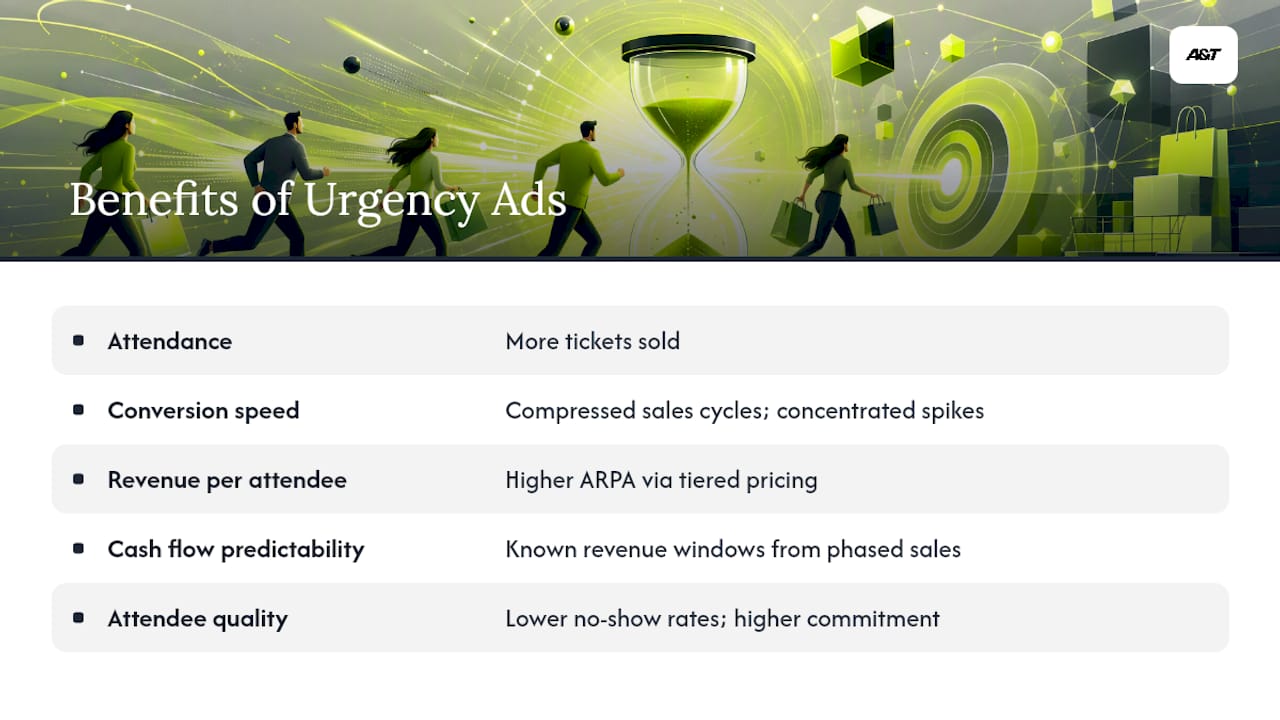
Higher attendance. Scarcity cues push fence-sitters to commit instead of waiting. A buyer who might have "meant to get around to it" now has a reason to act today, and that reason shows up as tickets sold rather than tickets browsed.
Faster conversions. This is the most measurable benefit and the one clients ask about first. When you introduce a real deadline, whether it's a 48-hour flash sale or a price increase at midnight, you compress your sales cycle. Instead of a slow trickle of purchases over three weeks, you get concentrated spikes around each urgency trigger. That's easier to forecast and easier to staff for.
Increased revenue per attendee. Tiered pricing does double duty. Early adopters pay less but generate cash flow and word-of-mouth early; latecomers pay more, which lifts your average revenue per attendee (ARPA) without a single additional ad dollar spent. VIP and limited packages push this further, since a capped-quantity premium tier often sells out precisely because it's capped.
Improved predictability of cash flow. Instead of guessing when revenue will land, phased urgency (presale, general sale, last-chance) gives you known revenue windows. You can staff, budget, and plan production around dates you set, not dates that happen to you.
Better attendee quality. Buyers who purchase under a real deadline tend to show up. No-show rates on urgency-driven purchases are typically lower than on tickets bought far in advance with no pressure, because the act of beating a deadline creates a small sense of commitment that carries through to event day.
Micro-examples that show the pattern
- Concert ticket tiers: A venue releases 500 tickets at a lower price, then raises the price for the next 500. The first tier often sells out within days, driven by fans who don't want to pay more later. Digital marketing for venues that leans on capacity-based scarcity tends to outperform flat-rate campaigns on speed alone.
- Early-bird conference pricing: B2B event organizers commonly see a spike in the final 72 hours of an early-bird window, as budget-conscious attendees who were "thinking about it" convert once the deadline becomes real.
- VIP limited packages: A capped VIP tier, say 50 meet-and-greet passes, sells through faster than general admission, and it lifts ARPA even if it represents a small share of total ticket volume.
Urgency ads versus always-on campaigns
Always-on event ads generate steady, low-intensity interest over a long window. They're useful for brand awareness, but they rarely produce the kind of sales spikes that let you predict revenue with confidence. Urgency-based campaigns trade some of that steady reach for concentrated action: shorter windows, sharper spikes, and typically a better return on ad spend per dollar because the message does more work per impression. The tradeoff to watch is attendee quality dilution if urgency is layered on top of a weak offer. Scarcity accelerates a decision; it doesn't manufacture demand that isn't there.
Why Does Urgency-Based Advertising Actually Work?
Two different psychological mechanisms drive urgency, and confusing them is one of the most common mistakes in event marketing.
Time-based scarcity ("Presale ends Friday at midnight") creates urgency without much social comparison. The buyer is racing a clock, not another person. Quantity-based scarcity ("Only 12 VIP passes left") tends to spark something closer to competition. The buyer is racing other buyers, and that taps into a slightly different, more socially charged form of FOMO. Match the mechanic to the moment: use time scarcity for big-ticket, high-involvement purchases where people need a nudge to stop deliberating, and use quantity scarcity when you want to trigger the "someone else might get this before me" instinct, which works especially well for premium or capped inventory.
A 2025 conceptual framework published in the International Journal of Marketing and Business Researchs.4602) makes a point worth internalizing: FOMO isn't something that just happens to a buyer, it's something you design into the event timeline. The framework maps FOMO across three touchpoints, pre-event anticipation (countdowns, limited presale windows), the live event itself (social proof, "who's already here" content), and post-event reflection (recap content that makes non-attendees feel they missed something worth attending next time). Treating urgency as a one-off ad tactic instead of a full-funnel design choice is why so many campaigns get a short spike and nothing more.
The scarcity meta-analysis referenced earlier isn't just an academic footnote. Across 131 studies, the effect held up strongly for experiential purchases, the category events fall into, more so than for many physical goods. That's a meaningful distinction, since it tells you scarcity messaging is genuinely well-suited to what you're selling, not a borrowed tactic from e-commerce that happens to work here too.
Quantity-based scarcity tends to spark direct competition and a stronger FOMO response for experiences, while time-based scarcity creates urgency without as much interpersonal competition. The mechanic you choose should match the audience and the offer, not just habit.
Pro Tip: Pair scarcity with social proof whenever you can. A countdown timer alone says "act fast." A countdown timer next to "347 people bought in the last hour" says "act fast, and you'd be joining a crowd that already decided this was worth it." That combination consistently outperforms either cue used alone.
The practical takeaway for your next campaign brief: time scarcity for early-bird and presale windows aimed at risk-averse buyers, quantity scarcity for VIP and capped-inventory offers aimed at buyers who respond to competition, and social proof layered on top of both.
What Ad Copy and Creative Formats Drive Urgency?
Once you know which scarcity mechanic fits your offer, the execution comes down to copy formulas, creative formats, and channel fit.
Copy swipes by scarcity type
- Time scarcity headline: "Presale ends Friday. General pricing kicks in Saturday at 9am." Body: name the exact price jump. CTA: "Lock In Presale Pricing."
- Quantity scarcity headline: "Only 40 VIP passes left for [Event]." Body: state the current count if you can update it live. CTA: "Claim Your VIP Spot."
- Flash sale headline: "24 hours only: $15 off every ticket tier." Body: state the exact end time in the reader's likely timezone. CTA: "Grab the Flash Price."
- VIP exclusive headline: "This tier includes what general admission doesn't." Body: list two or three concrete perks. CTA: "See What's Included."
- Social proof plus urgency headline: "1,200 tickets sold. 200 left in this tier." Body: reinforce that the count is real and updates as sales happen. CTA: "Join Before This Tier Sells Out."
Creative formats worth testing
Countdown timers work well in Stories and Reels formats because the vertical, full-screen frame makes the ticking clock unavoidable. Seat maps and capacity visuals work best for venue-based events where physical space is the actual constraint. UGC and social-proof overlays, think a short clip of last year's crowd with a text overlay reading "back for round two," tend to outperform polished branded video for mid-funnel retargeting, because they read as evidence rather than advertising.

Channel map
Meta Ads (Facebook and Instagram) is the strongest home for countdown creative and dynamic urgency, since Instagram Stories and Reels support native countdown stickers and the platform's algorithm rewards fast engagement, which urgency creative naturally produces. Our Facebook campaign best practices guide covers bidding adjustments worth making once you introduce a hard deadline.
Google Ads (Search and Display) works best for time-scarcity messaging tied to branded and high-intent search terms, "[event name] tickets," "presale ends," and similar. Display remarketing is where countdown-timer creative earns its keep, especially against cart abandoners.
Email and SMS, using platforms like Mailchimp or Klaviyo, are your highest-leverage urgency channels because they reach people who've already shown intent. A three-email sequence (announcement, "24 hours left," "final call") consistently outperforms a single blast, and SMS should be reserved for the final six to twelve hours before a deadline, when open rates matter more than message length.
Eventbrite and Ticketmaster integrations matter for one reason: inventory display. If your ad says "only 40 left" but your ticketing page shows unlimited availability, you've broken the message before the buyer even reaches checkout. Sync your public inventory counters with what your ads claim.
Tactical guardrails
- Never state a specific ticket count in ad copy unless your ticketing platform can confirm and update that number.
- Treat every deadline as a hard commitment. If you extend it, say so publicly and explain why.
- Sequence campaigns deliberately: presale to your warmest list first, general sale to broader targeting, then a final-push phase reserved for genuine last-chance inventory, not manufactured scarcity dressed up as a deadline.
How Do You Wire Urgency Into Your Ad Funnel?
Getting urgency to work across channels requires the messaging, the landing page, and the ticketing platform to say the same thing at the same time. A mismatch anywhere breaks trust immediately.
- Structure campaigns by phase. Build separate ad sets for presale, general sale, and last-chance, each with its own creative, budget, and end date rather than one long-running campaign with a single message.
- Tag URLs by phase. Use UTM parameters that identify which urgency phase drove the click, so your reporting can separate presale performance from last-chance performance later.
- Sync landing pages with ad claims. If the ad shows a countdown or a quantity count, the landing page needs the same real-time counter, not a static "limited tickets" line that never updates.
- Sequence your audiences. Send presale offers to your warmest list first, past attendees and your email/SMS subscribers, then open general sale to cold and lookalike audiences on Meta and Google.
- Set remarketing windows deliberately. Cart abandoners should see a countdown-specific ad within 24 hours, since urgency creative loses effectiveness the longer it sits unaddressed.
Platform notes worth keeping close: on Meta, build dynamic countdown creative directly into the ad rather than relying on a static image with a date baked in, since dynamic assets update automatically and reduce the risk of an ad running past its own deadline. On Google Ads, countdown customizers in responsive search ads let you show live day and hour counts in the headline itself. On email and SMS, personalize send times around each recipient's engagement history rather than blasting your entire list at once, and always reserve your most urgent SMS language for the final hours, not the opening announcement.
A short troubleshooting checklist for common breakdowns:
- If a countdown timer isn't updating, check whether your ad platform cached the creative; Meta and Google both cache dynamic assets more aggressively than most marketers expect.
- If you're seeing double discounting, audit whether an old presale code is still live alongside a new flash-sale code.
- If tiered pricing jumps feel jarring, test smaller price-gap increments between tiers rather than one large jump, which tends to suppress last-minute conversions instead of accelerating them.
Which KPIs Prove Urgency Campaigns Are Working?
The minimum measurement plan for an urgency-based event campaign covers eight metrics: click-through rate, landing-page conversion rate, cost per acquisition, sell-through rate by phase, time-to-purchase, average revenue per attendee, no-show rate, and lifetime value where you're running recurring events.
Track sell-through rate separately for each phase, presale, general, last-chance, rather than as one blended number. A campaign that looks mediocre overall might be masking a presale phase that converted extremely well and a general-sale phase that underperformed, and you need that distinction to know what to fix.
Test ideas worth running:
- Real, fixed deadline versus a rolling "reminder" deadline that shifts if sales are slow.
- Visible quantity counter versus no counter at all, on otherwise identical ad creative.
- Small early-bird price gap (10%) versus a larger gap (25%) to see which moves more volume without cannibalizing later-tier revenue.
- Creative timing sequences, testing whether a three-touch email sequence outperforms a two-touch sequence for the same offer.
For reporting, structure cohorts by sales phase and note your attribution model explicitly, last-click tends to overcredit last-chance urgency messaging while undercrediting the presale touch that actually built intent. A simple stakeholder update should include phase, spend, CTR, conversion rate, CPA, and sell-through percentage, updated at the close of each phase rather than only at campaign end.
When to act: accelerate budget when a phase is outperforming its sell-through target with more than 48 hours of runway left. Extend a deadline publicly, with a clear explanation, only when inventory genuinely remains and you're transparent about why. And when you see a short-term spike, wait for the next 24 to 48 hours before declaring victory. According to EventXGames' breakdown of scarcity mechanics, sustained uplift shows up as a shift in the overall sell-through curve, not just a single day's spike.
What Are the Ethical Risks of Fake Urgency?
Urgency only works if it's real. The moment an audience catches a deadline that never actually arrived, or a "limited" count that turns out to be unlimited, you don't just lose that sale, you lose credibility for every future campaign.
Don't:
- Claim limited quantity without a verified inventory number behind it
- Repeat a "final call" deadline that already passed once without explanation
- Use vague scarcity language ("limited spots") when you could state a real number
- Bury important terms, refund policy, resale restrictions, in fine print your ad never mentions
Do:
- Verify actual inventory before every urgency-based ad goes live
- Honor every deadline you publish, or explain clearly and publicly if circumstances change
- Be transparent about cohort presales, telling your general audience why an earlier group got first access
- Document your promotional end times internally so no team member accidentally extends a "final" sale
Consumer research from the American Marketing Association found that online audiences have grown skeptical of limited-time offers generally, which means credibility is now a competitive advantage, not just an ethical box to check. And a qualitative study of live music ticket markets found that scarcity-driven tiered pricing raises perceived value but also fuels resale and fairness concerns if organizers don't build in guardrails like purchase limits per buyer.
Pro Tip: If you accidentally misreport inventory or extend a deadline by mistake, don't quietly fix it and hope nobody notices. Send a short, honest correction to your list. Audiences forgive an honest mistake far more readily than they forgive a pattern of "urgency" that never delivers.
How Atdigiagency Applies Urgency in Client Campaigns
We structure urgency in phases for every client campaign: a presale window for warm audiences, a general sale push once inventory opens broadly, and a final, tightly scoped last-chance phase. Which mechanic we lean on depends on the event. A capacity-constrained venue gets quantity scarcity built around real seat counts. A conference with flexible capacity gets time-based tiering instead, since the constraint is the calendar, not the room.
Clients working with us on event and entertainment campaigns have seen earlier sell-through in their presale windows, stronger revenue per attendee from tiered pricing, and better attendee quality overall, fewer no-shows on tickets bought under a genuine deadline versus tickets bought months out with no urgency at all.
We verify inventory before any scarcity claim goes into an ad, and we document every deadline internally so nothing gets quietly extended without a client-facing explanation. That governance step isn't optional. It's what keeps urgency working campaign after campaign instead of burning out after one aggressive push.
Ready to Build Urgency Into Your Next Event Campaign?
Atdigiagency handles the parts of urgency-based event advertising that are easy to get wrong on your own: syncing ad creative with real inventory counts, structuring presale-to-last-chance phases across Meta and Google, and building measurement plans that separate a genuine sales lift from a one-day spike. You get a boutique team that skips the unnecessary meetings and focuses on ad spend that's tested and purposeful, not guessed at.
In a first engagement, we run a quick audit of your current funnel, map out an urgency-phase plan tailored to your event type, build ad creative templates for each phase, and set up the measurement structure so you can prove results to stakeholders from week one. If you manage Meta Ads campaigns or need Google Ads management that syncs urgency messaging across search and display, reach out for an audit and we'll walk you through what a phased campaign would look like for your next event.
Sources
- Meta-analysis of scarcity effects on purchase intentions (ScienceDirect)
- The psychology of ticket sales: using urgency & FOMO ethically in 2026 event marketing
- Time Pressure Tactics: Scarcity mechanics that create urgency