
Marketing teams using systematic data analysis are up to 23 times more likely to hit revenue targets than those relying on intuition. This dramatic performance gap reveals why more than 80% of marketing professionals rely on data analytics for decisions across digital campaigns. For SMB marketers managing Google Ads and Meta campaigns, mastering data analysis transforms raw performance metrics into precise optimizations that maximize return on ad spend.
Table of Contents
- Introduction To The Role Of Data Analysis In Marketing
- Importance Of Data-Driven Decision Making In Marketing
- Types Of Data Analytics Models In Marketing
- Key Tools For Marketing Data Analysis
- Common Misconceptions About Marketing Data Analysis
- Step-By-Step Implementation Of Data-Driven Marketing
- Practical Case Examples In SMB Marketing
- Summary And Next Steps For SMB Marketers
- Discover Expert Performance Marketing Services To Maximize Your ROI
Key takeaways
| Point | Details |
|---|---|
| Data analysis drives measurable ROI gains | Marketing teams using systematic analytics achieve 23x higher success rates in hitting revenue targets compared to intuition-based approaches. |
| Three analytics models guide optimization | Descriptive, predictive, and prescriptive analytics each serve distinct purposes from measuring past performance to recommending future actions. |
| Common myths hinder SMB adoption | Misconceptions about complexity, cost, and reliance on gut instinct prevent many small businesses from leveraging analytics effectively. |
| Stepwise implementation is practical | A cyclical process of collecting, analyzing, forecasting, and optimizing campaign data makes data-driven marketing accessible to any SMB. |
| Real case studies prove ROI impact | SMBs integrating first-party data with Google Ads and Meta platforms demonstrate quantifiable improvements in engagement and conversions. |
Introduction to the role of data analysis in marketing
Data analytics transforms raw campaign numbers into actionable marketing insights that drive revenue growth. When you track clicks, impressions, conversions, and customer behaviors across channels, you generate massive amounts of information. Without systematic analysis, these data points remain disconnected metrics that fail to inform strategic decisions.
The industry has recognized this transformation. More than 80% of marketing professionals rely on data analytics for decisions across multi-channel digital campaigns. This widespread adoption confirms that data analytics in digital marketing has moved from competitive advantage to fundamental requirement.
For SMB marketers managing Google Ads and Meta campaigns, data analysis serves several critical functions:
- Identifies which ad creative, targeting parameters, and bidding strategies produce the highest conversion rates
- Reveals customer journey patterns that show how prospects move from awareness to purchase
- Quantifies the revenue impact of each marketing channel and campaign element
- Enables rapid testing and optimization cycles that improve ROI continuously
The ability to align marketing activities directly with pipeline growth and revenue outcomes separates thriving SMBs from struggling competitors. Data analysis provides the connective tissue between ad spend decisions and business results.
Importance of data-driven decision making in marketing
Systematic use of data to guide marketing decisions significantly outperforms strategies based on experience or intuition alone. The performance gap is substantial. Marketing teams using systematic data analysis are up to 23 times more likely to achieve their revenue targets.
This dramatic difference stems from data's ability to reveal causal relationships between marketing actions and business outcomes. When you test ad variations systematically and measure results, you discover which messages resonate with target audiences. When you track customer acquisition costs across channels, you identify where to allocate budget for maximum return.
Data-driven decision making also improves accountability and strategic alignment. Every dollar spent on digital advertising connects to measurable outcomes like leads generated, customers acquired, or revenue produced. This transparency allows marketing teams to demonstrate value and secure continued investment in high-performing channels.
"The shift from gut-feel marketing to data-driven strategies represents the most significant competitive advantage available to SMBs in 2026."
Understanding why campaigns succeed or fail enables smarter future decisions. When a Google Ads campaign underperforms, data analysis reveals whether the issue lies in targeting, creative, landing page experience, or bidding strategy. This diagnostic capability accelerates optimization and prevents repeated mistakes.
For SMBs competing against larger competitors with bigger budgets, the ability to optimize ad campaigns for ROI through precise data analysis levels the playing field. Small teams using data effectively can outperform larger teams operating on hunches.
Types of data analytics models in marketing
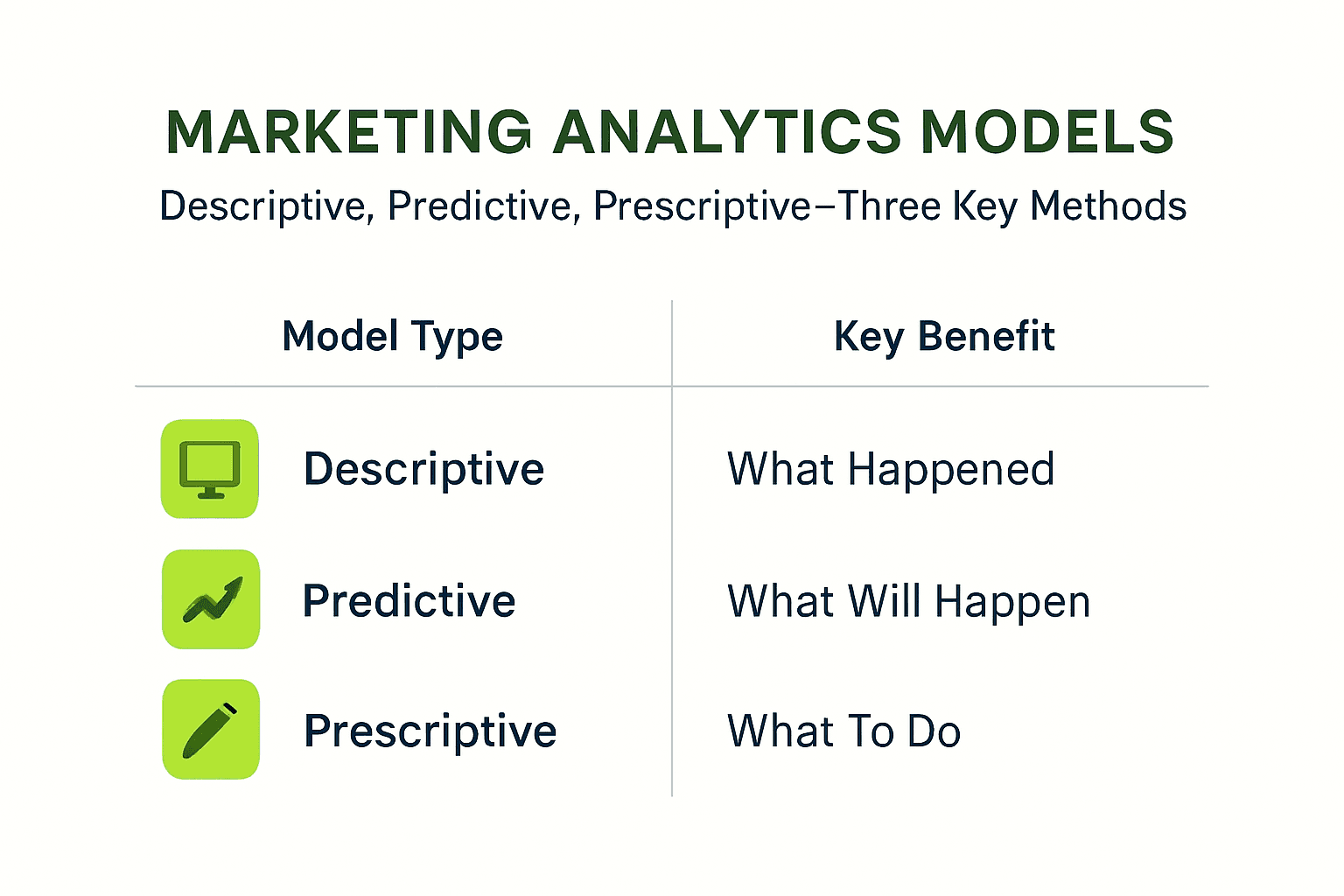
Three primary analytics models help marketers transform data into strategy and execution. Each builds on the previous to guide you from understanding past performance to taking optimized future actions.
Descriptive analytics summarizes what happened in your campaigns. This model answers questions like "How many conversions did we generate last month?" or "Which ad creative produced the highest click-through rate?" Descriptive analytics forms the foundation by establishing baseline performance metrics and identifying trends over time.

Predictive analytics forecasts future customer behavior and campaign outcomes based on historical patterns. Using techniques like regression analysis and machine learning, predictive models estimate which prospects are most likely to convert, when seasonal demand will peak, or how campaign changes will affect results. This foresight enables proactive optimization.
Prescriptive analytics recommends specific marketing actions to maximize ROI. This advanced model evaluates multiple scenarios and suggests the optimal allocation of budget, the best audience segments to target, or the ideal bidding strategy. Prescriptive analytics essentially tells you what to do next based on your goals and constraints.
Here's how these models compare:
| Analytics Type | Primary Question | Marketing Application | Technical Complexity |
|---|---|---|---|
| Descriptive | What happened? | Performance dashboards, campaign reports | Low |
| Predictive | What will happen? | Customer lifetime value forecasts, conversion probability | Medium |
| Prescriptive | What should we do? | Budget optimization, bid strategy recommendations | High |
Most SMB marketers start with descriptive analytics using tools like Google Analytics to understand campaign performance. As you gain experience, incorporating predictive elements like conversion forecasting improves planning accuracy. Marketing analytics models and tools evolve with your sophistication.
Pro Tip: Begin with descriptive analytics to establish reliable measurement before investing in predictive or prescriptive capabilities. Solid foundational data beats complex models built on shaky metrics.
Descriptive, predictive, and prescriptive analytics work together to create a complete picture of campaign performance and optimization opportunities. Master each level sequentially rather than jumping directly to advanced techniques.
Key tools for marketing data analysis
Selecting the right analytics tools depends on your SMB's budget, technical expertise, and campaign complexity. Three platforms dominate the marketing analytics landscape, each offering distinct capabilities.
Google Analytics provides comprehensive web and user behavior analysis at no cost. The platform tracks visitor sources, navigation patterns, conversion paths, and revenue attribution across channels. Google Analytics is a widely used tool with strong tracking and integration features critical for measuring customer journeys. For SMBs running Google Ads campaigns, the native integration enables seamless performance tracking from ad click to conversion.
Adobe Analytics delivers advanced visualization and segmentation capabilities suited to enterprises with complex multi-channel strategies. The platform excels at real-time data processing and custom reporting. However, Adobe's pricing places it beyond most SMB budgets, making it more appropriate for larger organizations.
Tableau specializes in data visualization, transforming raw datasets into interactive dashboards and reports. The tool requires more technical expertise than Google Analytics but offers superior customization for businesses with dedicated analysts. Tableau connects to multiple data sources, enabling unified reporting across platforms.
Here's a practical comparison:
| Tool | Best For | Monthly Cost | Integration Ease | Learning Curve |
|---|---|---|---|---|
| Google Analytics | SMBs, Google Ads users | Free | Excellent | Low |
| Adobe Analytics | Enterprise multi-channel | $$$$ | Good | High |
| Tableau | Custom visualization needs | $$-$$$ | Medium | Medium |
For most SMB marketers focused on Google Ads and Meta campaigns, Google Analytics combined with platform-native analytics provides sufficient capability. The free tier handles typical campaign measurement needs while integrating seamlessly with advertising accounts.
Consider these selection criteria:
- Does the tool integrate with your advertising platforms?
- Can your team operate it without extensive training?
- Does pricing align with your marketing budget?
- Will it scale as your campaigns grow?
Pro Tip: Start with Google Analytics and master its core features before investing in specialized tools. Most SMBs underutilize the free capabilities already available.
Explore top marketing analytics tools and detailed analytics software comparison to evaluate options for your specific needs.
Common misconceptions about marketing data analysis
Several persistent myths prevent SMB marketers from fully embracing data analytics. Correcting these false beliefs removes barriers to adoption and improves campaign performance.
Myth: Gut instinct works as well as data for marketing decisions. Reality shows the opposite. Relying solely on gut instinct consistently leads to underperformance compared to systematic data-driven approaches. While experience provides valuable context, decisions guided by actual performance metrics outperform hunches.
Myth: Third-party data is more valuable than first-party data. Your own customer and campaign data holds far more value than purchased third-party datasets. First-party data reflects actual behavior of your target audience interacting with your brand. It's more accurate, compliant with privacy regulations, and directly actionable for campaign optimization.
Myth: Marketing analytics means just collecting more data. Collection alone provides no value. Analytics requires transforming data into insights that inform specific optimization actions. An SMB drowning in unanalyzed metrics performs no better than one ignoring data entirely. The goal is actionable intelligence, not data hoarding.
"The most dangerous myth is that data analysis requires expensive enterprise tools. SMBs can achieve dramatic ROI gains using free platforms and systematic processes."
Key realities to embrace:
- Start with simple metrics that directly tie to revenue goals
- Focus analysis on decisions you can actually control
- Prioritize first-party data from your campaigns and website
- Use free tools effectively before purchasing premium platforms
Understanding marketing analytics misconceptions helps you avoid common pitfalls that waste time and budget. Focus on systematic measurement of what matters rather than pursuing analytics perfection.
Step-by-step implementation of data-driven marketing
Implementing data-driven marketing follows a cyclical process that continuously improves campaign performance. Each step builds on the previous to create a systematic optimization framework.
-
Collect and integrate marketing data from all relevant channels including Google Ads, Meta campaigns, website analytics, and CRM systems. Ensure tracking codes fire correctly and data flows into your analytics platform without gaps. Establish consistent naming conventions for campaigns, ad groups, and conversion events.
-
Clean and organize your data by removing duplicates, correcting errors, and standardizing formats. Poor data quality undermines all subsequent analysis. Verify that conversion tracking accurately attributes results to the correct campaigns and that revenue data matches financial records.
-
Apply descriptive analytics to summarize past performance. Create dashboards showing key metrics like cost per acquisition, conversion rate, return on ad spend, and customer lifetime value. Identify trends, patterns, and anomalies that warrant deeper investigation.
-
Use predictive analytics to forecast future behavior and outcomes. Estimate which customer segments will produce the highest lifetime value, when seasonal demand shifts will occur, or how changes to targeting will affect conversion rates. These forecasts inform budget allocation and campaign planning.
-
Generate prescriptive recommendations by evaluating optimization scenarios. Test different budget allocations across channels, compare audience targeting options, or model the impact of creative variations. Select actions that maximize your specific goals whether that's revenue, leads, or customer acquisition.
-
Execute optimizations and measure results by implementing recommended changes and tracking their impact. Run controlled tests when possible to isolate the effect of individual changes. Document what works and what doesn't to build institutional knowledge.
-
Repeat the cycle continuously as you gather new performance data. A stepwise process includes collecting, cleaning, analyzing patterns, forecasting, prescribing actions, and ongoing optimization to sustain performance gains over time.
Pro Tip: Begin with a 30-day cycle focusing on your highest-spend campaigns. Master the process on a manageable scope before expanding to all marketing activities.
For detailed implementation guidance, review our data-driven marketing implementation resources, step-by-step performance marketing guide, and strategies for maximizing ROI through data-driven marketing.
Practical case examples in SMB marketing
Real SMB success stories demonstrate how data analysis drives measurable improvements in digital campaign performance. These examples show the practical application of concepts covered earlier.
A health and wellness SMB integrated first-party customer data with Google Ads targeting to improve conversion rates by 47% while reducing cost per acquisition by 31%. By analyzing which customer attributes correlated with high lifetime value, they refined audience targeting to focus ad spend on prospects most likely to become repeat buyers.
A retail SMB selling specialty products used predictive analytics to identify optimal bid adjustments across device types and geographic regions. The data revealed that mobile users in urban areas converted at 3x the rate of desktop users in suburban locations. Reallocating budget based on these insights increased overall ROAS by 62%.
SMBs integrating first-party data with Google Ads and Meta platforms see measurable improvements in ROI and engagement when they systematically analyze performance patterns. The common thread across successful implementations includes:
- Rigorous tracking of conversions and revenue attribution
- Regular analysis of performance data to identify optimization opportunities
- Systematic testing of hypotheses generated from data insights
- Rapid implementation of changes that improve key metrics
A telehealth provider combined Google Analytics behavioral data with CRM records to map complete customer journeys. This analysis revealed that prospects who engaged with educational content before booking consultations had 89% higher retention rates. Adjusting campaign strategy to prioritize content engagement over immediate bookings improved long-term customer value.
These examples demonstrate that sophisticated data analysis doesn't require enterprise budgets or large teams. SMBs willing to invest time in systematic measurement and optimization achieve ROI gains that compound over time. Learn more about Meta and Google Ads integration for SMBs to replicate these results.
Summary and next steps for SMB marketers
Data-driven marketing delivers dramatic improvements in digital campaign ROI, with systematic analytics producing up to 23x better results than intuition-based approaches. The stepwise implementation framework outlined here makes these gains accessible to any SMB willing to embrace measurement and optimization.
Your next steps should focus on:
- Establishing reliable tracking across all digital channels and campaigns
- Starting with descriptive analytics to understand current performance
- Identifying your top three optimization opportunities based on data
- Implementing changes systematically and measuring their impact
- Building expertise progressively from basic to advanced analytics
The competitive advantage of data-driven marketing grows stronger in 2026 as privacy regulations and platform changes make targeting more complex. SMBs that master analytics will outperform competitors still relying on outdated strategies.
For businesses seeking expert support, agencies specializing in performance marketing expertise can accelerate your progress by implementing proven analytics frameworks and optimization processes. The investment in systematic data analysis pays dividends through sustained campaign performance improvements.
Discover expert performance marketing services to maximize your ROI
Ready to transform your digital advertising performance through systematic data analysis? A&T Digital Agency specializes in data-driven campaign optimization across Google Ads and Meta platforms.
Our boutique team combines strategic analytics with creative execution to deliver measurable results for SMBs. We build and scale paid advertising systems using the exact data-driven frameworks outlined in this guide, from initial campaign planning through ongoing optimization. Whether you're launching new campaigns or improving existing ones, we provide actionable insights that maximize return on ad spend.
Explore our performance marketing solutions designed specifically for SMBs seeking efficient growth. Our step-by-step performance marketing services implement proven processes that turn data into revenue growth across industries from telehealth to retail.
Frequently asked questions
What is the primary benefit of data analysis in marketing?
Data analysis converts raw campaign metrics into actionable insights that directly improve ROI and campaign effectiveness. By revealing which strategies work and why, it enables marketers to allocate budget to high-performing channels and eliminate waste on underperforming tactics.
Which analytics model is most useful for predicting customer behavior?
Predictive analytics uses historical performance data and customer patterns to forecast future actions and campaign outcomes. This model helps marketers anticipate seasonal trends, estimate conversion probabilities, and identify high-value prospects before they purchase.
Why does relying on gut instinct lead to poorer marketing results?
Intuition ignores measurable performance patterns and trends that reveal what actually drives conversions and revenue. Data-driven approaches consistently outperform gut-feel decisions because they're based on tested outcomes rather than assumptions or biases.
What are the best tools for SMBs starting with marketing analytics?
Google Analytics combined with native Google Ads reporting provides robust capabilities for most SMB needs at no cost. The seamless integration and relatively simple interface make it ideal for teams building analytics expertise. Review our guide to the best marketing analytics tools for SMBs for detailed comparisons.
Recommended
- Performance Marketing Team | Multi‑Channel Paid Ads
- Performance Marketing Team | Multi‑Channel Paid Ads
- Performance Marketing Team | Multi‑Channel Paid Ads
- Performance Marketing Team | Multi‑Channel Paid Ads
- Data-Driven Leadgenerierung: Mit Daten die richtigen Kunden erreichen
- Online-Präsenz im KI-Zeitalter stärken – Der Erfolgsleitfaden