
TL;DR:
- Digital marketing is essential for venues to increase visibility and drive ticket sales.
- Strategies include local SEO, targeted paid ads, mobile-friendly websites, and performance marketing.
- Integrating online efforts with offline partnerships and content maximizes long-term success.
Venues that rely on word of mouth and posters alone are leaving serious money on the table. The shift to digital isn't optional anymore. It's where your audience lives, where they discover events, and where they decide whether to buy a ticket or scroll past. Venue marketing today means using online channels like SEO, social media, paid ads, email, and content to drive bookings and build real visibility. This guide breaks down exactly how digital marketing works for event venues, which strategies move the needle, and how to apply them to get measurable results every time you run a campaign.
Table of Contents
- What is digital marketing for event venues?
- Core strategies and best practices for venue digital marketing
- Performance marketing: Results-driven approach for ticket sales
- Key metrics, benchmarks, and advanced tactics for venues
- Integrating brand marketing, partnerships, and offline strategies
- Our take: Why most venues miss the true power of digital marketing
- Ready to transform your venue's marketing?
- Frequently asked questions
Key Takeaways
| Point | Details |
|---|---|
| Use multi-channel marketing | Combining SEO, social media, email, and paid ads boosts venue bookings and visibility. |
| Embrace performance marketing | Paying only for measurable results ensures ROI for your venue’s ad spend. |
| Track the right KPIs | Focus on bookings, sell-out rates, and conversions—not just web traffic. |
| Prioritize mobile optimization | With most users on mobile, a responsive website is vital for ticket sales. |
| Blend online and offline methods | The best results come from integrating digital campaigns with local partnerships and consistent branding. |
What is digital marketing for event venues?
Let's be clear about what we're talking about. Digital marketing for venues isn't just posting on Instagram or sending a newsletter before an event. It's a coordinated system of online channels working together to fill seats, drive bookings, and build a brand that people recognize and trust.
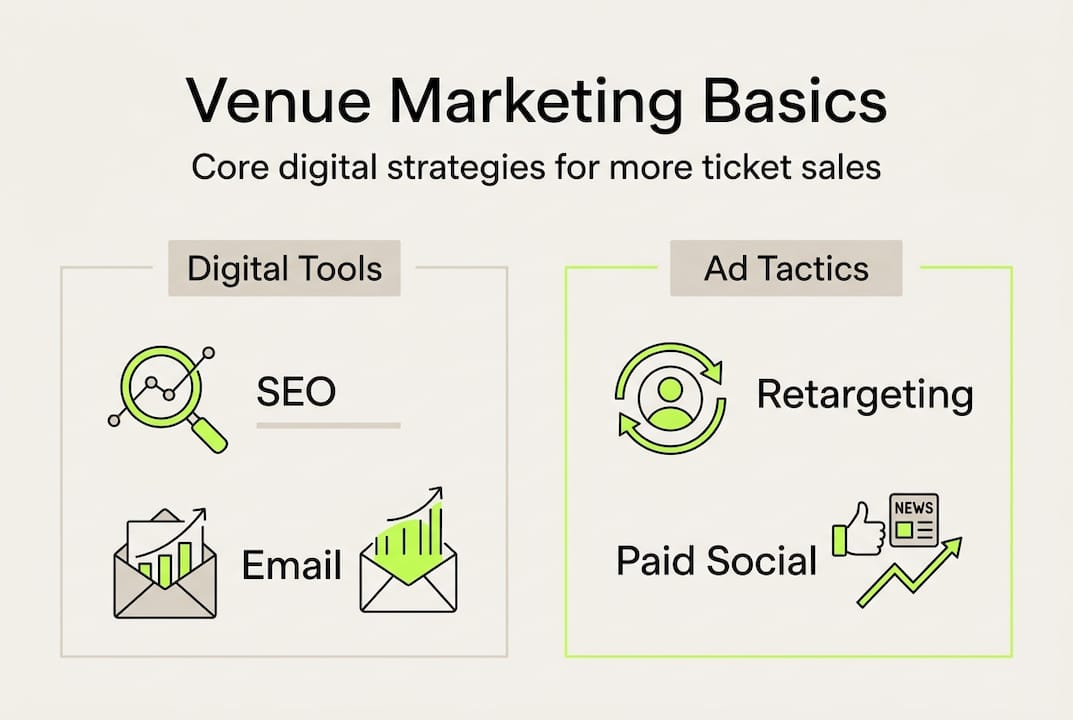
The core channels that matter for venues are:
- SEO (search engine optimization): Getting found when people search "event venue near me" or "concert hall in [city]"
- Social media: Building community, showcasing your space, and creating event buzz
- PPC (pay-per-click advertising): Paid ads on Google and Meta that target high-intent buyers
- Email marketing: Nurturing your existing audience with promotions, early bird offers, and event updates
- Content marketing: Blog posts, video walkthroughs, and photo galleries that build authority and drive organic traffic
As venue marketing strategies show, the goal isn't just traffic. It's qualified traffic that converts into ticket purchases and bookings.
"Digital marketing for venues is about reaching the right people, at the right moment, with the right message, across every channel they use to make decisions."
Traditional marketing, think print ads, flyers, and radio spots, reaches a broad audience with little control over who sees it or when. Digital flips that. You can target by location, interest, age, and even past behavior. When you're launching event ads, you're putting your message in front of people already looking for what you offer. That precision is what makes digital foundational for every modern venue.
Core strategies and best practices for venue digital marketing
With a solid understanding of digital marketing's relevance, let's look at the best practices that separate average venue marketing from high-performance campaigns.
1. Local SEO and Google My Business Most venue searches start with a location. Optimize for geo-targeted keywords like "event space in [city]" and make sure your Google My Business profile is complete, accurate, and loaded with photos. This is free visibility you can't afford to skip.
2. Mobile-first website with visual impact Your website needs to load fast and look great on a phone. High-quality photos and virtual tours are non-negotiable. Event marketing strategies confirm that optimized websites with strong visuals and Google My Business setup are among the highest-impact moves a venue can make.
3. Email campaigns for early bird and flash sales Email is still one of the highest-ROI channels available. Use it for early bird promotions, countdown sequences, and post-event follow-ups to keep your audience warm year-round.
4. Paid search and social ads for precision targeting Scattershot promotions waste budget. Paid ads let you target specific audiences based on location, interests, and intent. When optimizing venue campaigns, the difference between a good and great campaign often comes down to audience segmentation and creative testing.
5. Structured data and social proof Add schema markup to your event pages so Google displays rich results. Feature testimonials and reviews prominently. These trust signals convert browsers into buyers.
Pro Tip: Test early bird pricing and flash sales as separate ad sets. The data from key event marketing statistics shows early bird campaigns can boost ticket sales by 20%, and dynamic websites convert at 24.4% compared to just 11.6% for static sites.
| Strategy | Expected impact | Difficulty |
|---|---|---|
| Local SEO | High long-term visibility | Medium |
| Google My Business | Immediate local reach | Low |
| Paid ads | Fast, targeted ticket sales | Medium |
| Email campaigns | High ROI, repeat buyers | Low |
| Virtual tours | Higher booking conversion | Medium |
Exploring the right performance marketing platforms for your venue will help you match the right tools to each strategy.
Performance marketing: Results-driven approach for ticket sales
Once the foundational strategies are in place, the next level is leveraging performance marketing for truly trackable growth.
Performance marketing is a specific approach where you only pay for real results. Clicks. Leads. Sales. No more paying for impressions that never convert. As performance marketing basics explain, this model uses channels like PPC, social ads, and affiliate programs to drive measurable outcomes, making it ideal for venues that need to justify every dollar spent.
Here's how it stacks up against traditional marketing:
| Factor | Performance marketing | Traditional marketing |
|---|---|---|
| Payment model | Pay per result | Pay for exposure |
| Targeting | Precise, data-driven | Broad, demographic |
| Measurability | Real-time ROI tracking | Difficult to measure |
| Speed | Fast adjustments | Slow iteration |
| Best for | Ticket sales, bookings | Brand awareness |
The key metrics you need to track are CPC (cost per click), CPL (cost per lead), CPA (cost per acquisition), and overall ROI. These numbers tell you exactly what's working and what's draining budget. Understanding performance marketing ROI is the foundation of confident ad spend decisions.
For venues, the most powerful performance tactic is retargeting. Someone visits your event page, doesn't buy, and then sees your ad again on Facebook or Google. That second touchpoint is where most conversions happen.
Pro Tip: Set up retargeting audiences for anyone who visited your ticket page but didn't complete a purchase. This audience is already warm. They know you. A well-timed ad with a clear offer can recover 20 to 30% of those lost conversions. Getting familiar with performance marketing terms will help you read your campaign data with confidence.
When you understand performance vs traditional marketing, the case for shifting budget toward performance channels becomes obvious. The Salesforce breakdown puts it plainly: performance marketing aligns spend directly with outcomes, which is exactly what venue managers need.
Key metrics, benchmarks, and advanced tactics for venues
With results-driven marketing, having the right data at your fingertips changes everything. Here's how to measure what matters and level up your efforts.
The KPIs that top-performing venues track go beyond basic traffic numbers:
- Revenue per fan: Total revenue divided by attendance. Tracks how efficiently you're monetizing each visitor.
- Capacity utilization rate: What percentage of your venue fills per event. Industry leaders target 78% ticket sell-out for mid-size venues.
- Visit-to-registration rate: The average event attendance rate sits at 52%, with visit-to-registration averaging 21.5%.
- Mobile conversion rate: Over 50% of registrations now come from mobile devices. If your site isn't optimized for mobile, you're losing sales right now.
- Email open and click rates: These signal how engaged your existing audience is before you spend a dollar on ads.
| KPI | Industry benchmark | Top performer target |
|---|---|---|
| Ticket sell-out rate | 52% average attendance | 78% capacity |
| Visit-to-registration | 21.5% | 30%+ |
| Dynamic site conversion | 24.4% | 30%+ |
| Static site conversion | 11.6% | Upgrade recommended |
| Mobile registrations | 50%+ | Optimize for all screens |
Advanced venues are now integrating AI analytics tools to predict demand and adjust ad spend in real time. CRM integration is another game-changer. When your ticketing data connects to your marketing platform, you can build year-round funnels instead of scrambling event to event. Exploring event marketing KPIs gives you the external benchmarks to calibrate your own targets.
The goal is to boost ROI with performance marketing by treating every campaign as a learning opportunity. Each event generates data. Use it. A performance marketing step-by-step guide can help you build the right measurement framework from the ground up. For inspiration on what's possible, see how top venues are turning their space into a must-visit destination.
Integrating brand marketing, partnerships, and offline strategies
Venues wanting to stand out shouldn't put all their eggs in one basket. Integration is the secret weapon of savvy managers.

Digital is powerful. But the venues that consistently outperform their competitors blend digital with consistent branding, local partnerships, and select offline tactics. Your brand needs to look and feel the same whether someone finds you on Google, sees your Instagram story, or picks up a flyer at a local coffee shop.
Here are the integration opportunities worth prioritizing:
- Local business partnerships: Co-promote with nearby restaurants, hotels, and vendors. Cross-promotion expands your reach without extra ad spend.
- Vendor and supplier collaborations: Feature your preferred vendors in your content. They'll often share it with their own audiences, giving you free exposure.
- Repurposed event content: Every event you host is a content goldmine. Photos, video highlights, and testimonials can fuel your marketing for months. Repurposing event content as an evergreen funnel keeps your brand visible between events.
- Offline touchpoints: Signage, direct mail to local businesses, and community event sponsorships still carry weight, especially for building local trust.
- Year-round storytelling: Don't go silent between events. Use content to stay top of mind so your audience thinks of you first when they need a venue.
"The most successful venues we've worked with don't treat digital and offline as separate strategies. They treat them as one system, each channel reinforcing the others."
As performance marketing vs. traditional marketing research confirms, blending short-term performance tactics with long-term brand awareness consistently outperforms either approach alone. A strong performance marketing workflow ties all of these channels together into one coherent, measurable system.
Our take: Why most venues miss the true power of digital marketing
Here's the uncomfortable truth we see repeatedly: most venue managers treat digital marketing as a checklist, not a growth engine. They set up a Facebook page, run one ad before a big event, and call it done. Then they wonder why ticket sales are inconsistent.
The venues that win treat digital as an always-on system. They test creative constantly. They analyze what's working after every event. They build audiences year-round instead of starting from zero each time. They understand that a strong performance marketing workflow isn't a one-time setup. It's an ongoing discipline.
The real differentiator isn't budget. We've seen venues with modest ad spend dramatically outperform bigger competitors because they're agile. They test early bird pricing against standard pricing. They retarget warm audiences. They repurpose event footage into ads that run for months.
Make your team digital-first at every stage of event planning, not just in the two weeks before doors open. The venues that do this consistently are the ones that sell out.
Pro Tip: Review your campaign data within 48 hours of every event. The patterns you find will sharpen your next campaign faster than any marketing course.
Ready to transform your venue's marketing?
If you've made it this far, you already understand that digital marketing for venues isn't about doing more. It's about doing the right things with precision and consistency. We work with venue managers who are done guessing and ready to build paid ad systems that actually fill seats.
Our team specializes in Google Ads management for venues and Meta Ads management for events, from strategy and creative to launch, optimization, and reporting. No unnecessary meetings. Just campaigns that convert. If you're ready to see what a data-driven approach looks like for your specific venue, explore our full range of digital marketing solutions and let's build something that works.
Frequently asked questions
What channels are most effective for digital marketing for venues?
Local SEO, social media, paid ads, and email are the top-performing channels for most event venues, with geo-targeted keywords and Google My Business setup delivering some of the highest-impact results.
How does performance marketing help venues increase ticket sales?
Performance marketing pays only for results, making it ideal for venues that want to target high-intent buyers through PPC, social ads, and retargeting without wasting budget on broad exposure.
Which KPIs should venue managers track for digital marketing success?
Focus on bookings, revenue per fan, ticket sell-out rate, and visit-to-registration conversion. Top benchmarks show dynamic sites convert at 24.4% versus 11.6% for static sites, and mid-size venues target a 78% sell-out rate.
Does mobile optimization really impact ticket sales for venues?
Absolutely. Over 50% of registrations now happen on mobile devices, so a slow or poorly formatted mobile experience directly costs you ticket sales.
Should venues still use offline marketing tactics?
Yes. Blending offline tactics with digital channels and local partnerships consistently drives stronger long-term results than relying on digital alone.
Recommended
- Optimize venue campaigns: proven workflow for higher ticket sales
- Performance Marketing Team | Multi‑Channel Paid Ads
- How to Launch Event Ads That Drive Real Registrations
- Performance Marketing Team | Multi‑Channel Paid Ads
- Best Music Marketing Tools & Music Artist Platforms - Blog - Music24.com
- Zo zet je duurzaamheid in als marketingtool voor je event