
Build these four audiences before anything else: checkout starters, cart abandoners, product viewers, and past customers. Set a short window on the highest-intent audiences, exclude recent purchasers, and allocate budget there before expanding elsewhere. Retargeted visitors convert at materially higher rates than cold traffic, and that gap is almost entirely a function of which audiences you build, not how much you spend.
TL;DR:
- Building audiences based on high-intent actions like checkout and cart abandonment significantly improves conversion rates and should be prioritized over broader audiences.
- Using precise event signals and excluding recent purchasers prevents audience overlap, reduces waste, and ensures more relevant ad delivery.
- Tailoring creative messages and frequency caps to each audience tier enhances engagement and mitigates ad fatigue across remarketing campaigns.
- Adjust membership durations based on product purchase cycles and seasonality to avoid wasting impressions and missing key retargeting opportunities.
- Separating campaigns by audience intent and setting independent budgets helps control frequency, optimize spend, and maximize return on ad investment.
Table of Contents
- What Are Ecommerce Remarketing Audiences, and Why Do Most Underperform?
- What Audience Tiers Should You Build First, by Intent Level?
- How Do You Build Audiences That Don't Compete With Each Other?
- What Membership Duration Should Each Audience Use?
- Which Audiences Should You Exclude, and Why?
- What Creative and Sequencing Work Best for Each Audience?
- How Should You Structure Campaigns and Allocate Budget?
- What Should You Measure, and How Often Should You Optimize?
- How Does This Look in Practice?
- Our Take on Building Remarketing Audiences That Actually Convert
- Where to Learn More About Remarketing Setup and Cart Abandonment
- Get Remarketing Audiences Built and Managed for You
- Sources
What Are Ecommerce Remarketing Audiences, and Why Do Most Underperform?
Ecommerce remarketing audiences are segmented groups of past site visitors or customers that you target again with paid ads on Google, Meta, or YouTube, based on what they did (or didn't do) on your store. The mechanics run on tracking pixels or tags that fire when someone views a product, adds to cart, or completes checkout, feeding that behavior back to the ad platform as a list you can target or exclude.
Most cart abandonment ads fail for one reason: the audience behind them is too broad. A single "all website visitors" list mixes visitors with widely varying intent and treats them the same. That is not remarketing strategy. It is spray and pray with better targeting labels.
First-party signals matter more every year as cookie tracking degrades. Server-side tagging and CRM uploads (via Customer Match or Meta's Conversions API) now carry more weight than browser cookies alone, which means your GA4 event setup and CRM hygiene directly determine audience quality.
Dynamic remarketing adds another layer: it shows the exact product someone viewed, pulled live from your Merchant Center feed, rather than a generic banner. That requires your data layer to pass the right parameters:
- ecomm_prodid matching your Merchant Center product ID exactly
- pagetype identifying whether the visitor is on a product, cart, or purchase page
- A synced product feed refreshed on a schedule that matches your inventory changes
Get those wrong and dynamic ads either won't serve or will show mismatched products, which is worse than not running them at all, according to Google's own remarketing guidance.
What Audience Tiers Should You Build First, by Intent Level?
Rank your audiences by how close each visitor got to buying, then match your bid priority and creative to that intent. Here is the order that actually moves revenue:
- Checkout starters. These visitors entered payment or shipping details and left. Highest intent on the list, smallest audience size. Bid aggressively and lead creative with friction removal, things like "your cart is saved" or a one-click return path.
- Cart abandoners. They added a product but never reached checkout. Cart abandonment rates are high across ecommerce broadly, which is exactly why this tier deserves its own campaign instead of getting folded into a general retargeting pool. Creative here should mix a gentle nudge with a time-boxed incentive.
- Product viewers. They looked at a product page but never added to cart. Intent is real but softer. This is where dynamic remarketing earns its keep, showing the specific item they viewed alongside social proof like reviews or bestseller badges.
- Category browsers. Visitors who scanned a category page or ran a site search but never landed on a product. Treat this as an awareness-adjacent tier: broader creative, lower bids, longer windows.
- Past customers. People who already bought. Intent for a repeat purchase varies by product type, so this tier splits further into recent buyers (upsell and cross-sell) and lapsed buyers (win-back offers).
Tiers 1 and 2 deserve the tightest windows and highest bids. Tiers 3 through 5 are where volume lives, and where you scale spend once the top tiers are converting efficiently.
How Do You Build Audiences That Don't Compete With Each Other?
Every audience you create should answer four questions before it goes live. Skip this step and you end up bidding against yourself across five overlapping lists that all target the same person.
- Who is in this audience? Define the exact behavior or event, not a vague description like "engaged users."
- How recent is their activity? This sets your membership duration and directly affects how relevant your ad feels to them.
- Who gets excluded? Every high-intent audience needs a corresponding exclusion, usually recent purchasers or people already in a higher tier.
- What message fits this moment? An audience with no clear creative angle is a list you built out of habit, not strategy.
In GA4 and Meta, capture these signals as distinct events rather than lumping them into a single "engagement" tag: view_item, add_to_cart, begin_checkout, and purchase. Each event becomes its own audience trigger, which is what makes segmentation possible in the first place. A practitioner rule worth repeating here: micro-segmentation by behavior and recency consistently produces higher ROAS than one-size-fits-all lists, because the ad you show finally matches the visitor's actual position in the funnel.
Mutual exclusivity matters more than most marketers realize. If someone is in "checkout starters," they should not also be eligible for "product viewers," even though technically they viewed a product too. Build your exclusions so each person lands in exactly one tier at a time. And respect minimum list sizes. Google Ads generally needs a few hundred active users before it will serve, and Meta performs poorly on audiences under 1,000 for cold delivery.
Pro Tip: If your traffic volume is modest, resist the urge to build ten narrow audiences on day one. Start with the three that matter most, cart abandoners, product viewers, and past customers, and only fragment further once each one is profitable on its own.
What Membership Duration Should Each Audience Use?
Membership duration is the lookback window, how many days someone stays in an audience after their triggering action. Get this wrong in either direction and you either waste impressions on people who already moved on, or you miss people who were about to come back.
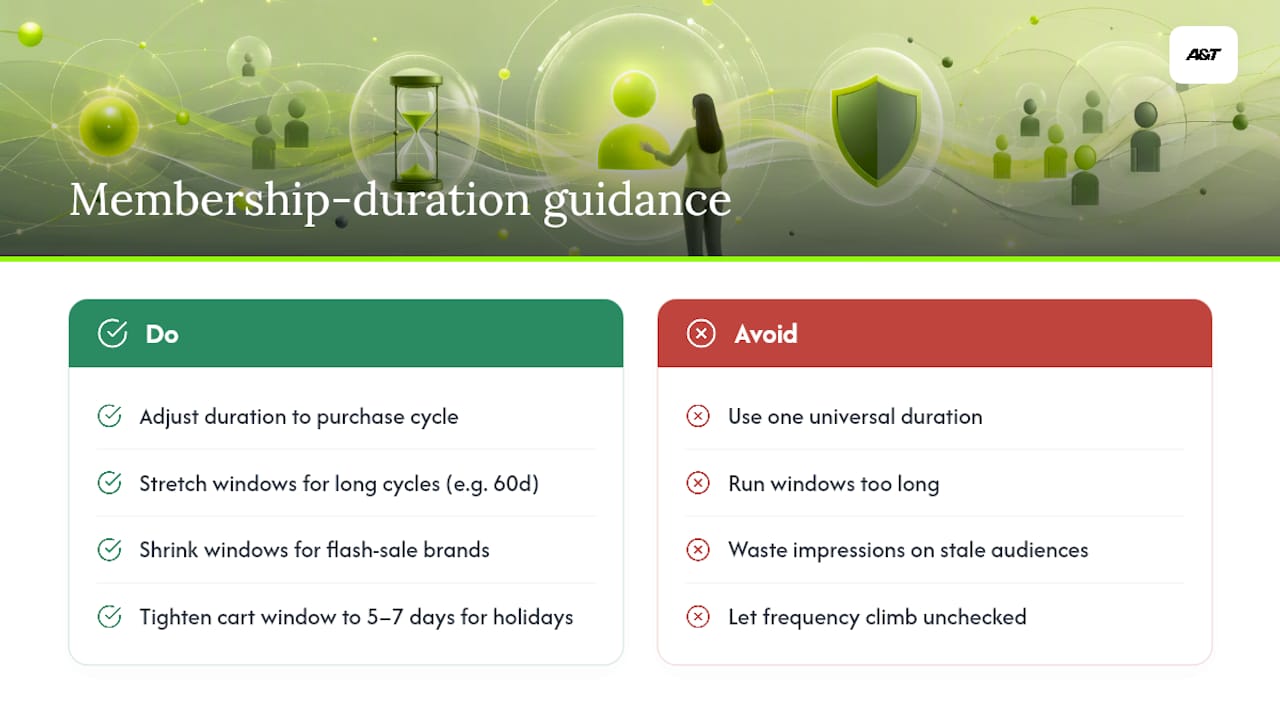
These ranges aren't fixed. A reusable segmentation checklist recommends adjusting duration by purchase cycle length and traffic volume, not applying one universal number across every store. A furniture retailer with a 60 day consideration cycle should stretch product-viewer windows accordingly. A flash-sale apparel brand should shrink them.
Seasonality changes this too. During a holiday sales spike, tighten your cart abandoner window to 5 to 7 days, since urgency is already baked into the season and a stale ad feels out of place. The risk of running windows too long is real: you end up advertising a product someone already forgot they looked at, and frequency climbs against an audience that stopped caring weeks ago.
Which Audiences Should You Exclude, and Why?
The fastest way to waste remarketing budget is showing an ad for a product someone already bought. Exclusions matter as much as inclusions, and most accounts under-invest in them.
- Exclude recent purchasers immediately. Use your confirmation or thank-you page as a success event, and remove that visitor from every active remarketing list within hours, not days.
- Exclude internal and low-value traffic. Support pages, login screens, careers pages, and staff IP ranges pollute your audience data and should never enter a remarketing pool.
- Exclude by CRM sync, not just pixel data. Upload your purchaser list through Customer Match so offline conversions and repeat orders get excluded even when pixel tracking misses the event.
- Exclude higher-tier members from lower-tier audiences. A checkout starter should never also appear in your general product-viewer campaign.
The practical setup here matters: make sure your ecomm_prodid values in the data layer match your Merchant Center feed exactly, and sync CRM purchaser lists on a schedule tight enough that yesterday's buyer isn't still seeing today's ad, a detail Google's remarketing documentation treats as foundational, not optional.
What Creative and Sequencing Work Best for Each Audience?
Match the message to the moment, not to your product catalog. A generic "shop now" banner does not belong in front of someone who already started checkout, and a friction-removal message is wasted on someone who never viewed a product page.
- Product viewers respond to social proof: reviews, ratings, and bestseller signals paired with the exact item they looked at through dynamic creative.
- Checkout starters need friction removed, fast. Free shipping reminders, saved-cart messaging, or a simple "complete your order" nudge outperform discount-first creative here.
- Cart abandoners are where urgency and modest discounts earn their place, a limited-time code or low-stock warning tends to convert better than a flat percentage-off blast.
- Past customers get upsell, cross-sell, or loyalty messaging. This is retention territory, not acquisition, and the tone should shift accordingly.
A workable cadence: show the first ad within an hour of the triggering event, follow up daily for three to four days, then taper off by day seven for high-intent tiers. Dynamic product creative should carry the top-of-funnel abandoner and viewer tiers; generic brand messaging works better for awareness-stage category browsers who have no single product to anchor the ad to.
Pro Tip: Rotate creative every 5 to 7 days on your highest-intent audiences. Uncapped frequency against the same static ad is one of the fastest ways to burn through a small, high-value list, and ad fatigue prevention tactics apply just as much to remarketing as they do to cold prospecting.
How Should You Structure Campaigns and Allocate Budget?
Separate campaigns by audience tier, not just by platform. Lumping checkout starters and category browsers into the same ad group means you cannot control frequency or bids independently, and one tier will always starve the other.
- Build one campaign per intent tier, with its own budget, bid strategy, and frequency cap, so a spike in cart abandoner volume doesn't quietly drain budget from your product-viewer campaign.
- Fund high-intent tiers first. Checkout starters and cart abandoners should get first call on budget until they show signs of saturation, rising frequency with flattening conversion rate.
- Shift surplus budget to mid-intent tiers. Once your top two tiers are efficient, product viewers and category browsers are where you find incremental scale.
- Layer RLSA on top of search. Remarketing Lists for Search Ads let you raise bids on branded or high-intent search terms specifically for people already in your remarketing pool, a warm searcher is worth more than a cold one on the exact same keyword.
- Use Customer Match for CRM-based bid layers. Past customers searching your brand name deserve a different bid than a first-time searcher, even on identical query text.
This structure also protects you from fragmenting budget too thin across platforms. A 3-3-3 framework, three core messages, three priority audiences, three channels, keeps most remarketing accounts disciplined instead of scattered across a dozen underfunded campaigns that never reach statistical significance.
What Should You Measure, and How Often Should You Optimize?
Track five numbers weekly: ROAS, CPA, conversion rate, frequency, and audience growth rate. Frequency is the one most accounts ignore until it's already a problem, and by the time CPA spikes, the fatigue usually started a week earlier.
- ROAS by tier, not blended across your whole remarketing account, since a blended number hides which tier is actually carrying performance.
- CPA trend over rolling 7-day windows, which catches creative fatigue faster than a monthly view.
- Conversion rate by landing page, since a remarketing click that lands on a slow or mismatched page kills intent you already paid to recapture.
- Frequency per audience, flagging anything above 6 to 8 impressions per week on a single high-intent list.
- Audience size trend, a shrinking cart abandoner list often signals a tracking or tagging problem before it shows up anywhere else.
If CPA is rising with flat conversions, run this diagnosis in order: check for audience overlap first (are two campaigns bidding on the same person?), then check creative frequency, then check landing page load speed and checkout friction. Cart abandonment remains a persistent, high-volume problem across ecommerce, which means even small improvements in your abandoner sequence compound fast at scale. Prioritize your test queue in this order: exclusions first (cheapest fix, biggest waste reduction), then membership windows, then creative variants last, since creative testing needs the cleanest possible audience to produce a reliable read.
How Does This Look in Practice?
A retail client selling a consumable product saw cart abandoner ROAS climb once we split "add to cart" from "checkout started" into separate campaigns with independent frequency caps, instead of one blended abandoner list. A telehealth client's biggest lift came from tightening the checkout-starter window to five days during a seasonal push, cutting wasted impressions on people who had already converted through another channel. An entertainment venue client rebuilt their exclusion logic around real-time CRM sync, which stopped ticket buyers from seeing ads for the show they'd already attended.
The pattern across every account we've touched is the same: the accounts wasting the most budget almost never have a creative problem first. They have an audience architecture problem, and the creative issues show up downstream of that.
Our process starts with the same audience-setup checklist covered above, then moves to a weekly measurement cadence built around the five KPIs listed earlier.
Our Take on Building Remarketing Audiences That Actually Convert
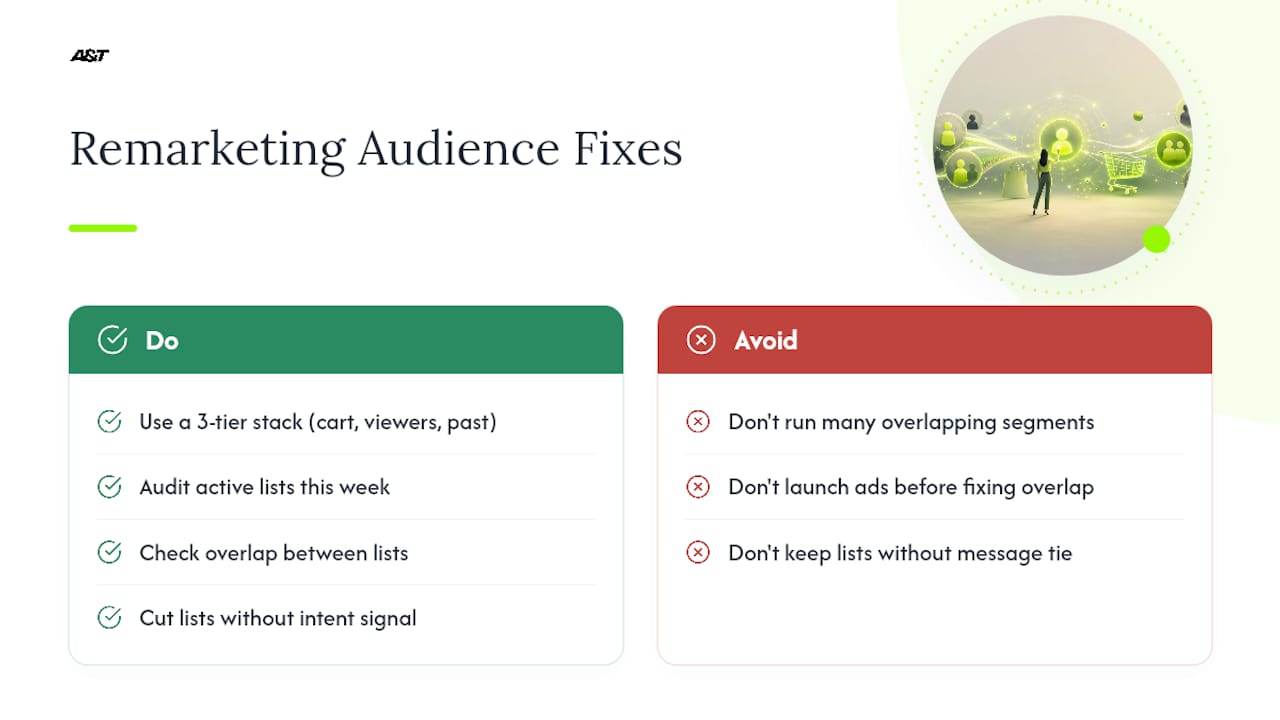
The instinct to build more audiences is usually wrong. We see accounts running fifteen overlapping segments when three, tight, well-excluded, properly sequenced, would outperform all fifteen combined. The 3-tier stack, cart abandoners, product viewers, and past customers, carries most accounts to profitability before any further segmentation adds real value.
What gets underestimated is exclusion discipline. Marketers spend hours perfecting creative for a cart abandoner ad while that same person sits in three other audiences getting hit from four directions. Fix the overlap before you touch the copy. Audit your current audience list this week: count how many active lists you're running, check for overlap between them, and cut anything that isn't tied to a specific intent signal and a specific message.
— Ann
Where to Learn More About Remarketing Setup and Cart Abandonment
For deeper technical setup, start with Google's guidance on dynamic remarketing tags and Merchant Center feed integration, which walks through the exact data-layer parameters covered earlier in this piece. For membership duration and exclusion logic by funnel stage, the audience setup checklist referenced above is worth bookmarking. Statista tracks ongoing cart abandonment rate data if you want current benchmarks for your own reporting, and the 5 C's framework is a useful check before committing spend to any new audience strategy.
Get Remarketing Audiences Built and Managed for You
Remarketing runs best with tiered audiences, tight exclusions, and creative sequencing matched to intent, avoiding months of trial and error common to many in-house teams. If you sell online and your cart abandonment ads aren't working, the usual cause isn't your discount code. It's an audience structure that was never built correctly in the first place.
Our Google Ads management service handles the audience architecture, RLSA layering, and dynamic remarketing feed setup covered above, while our Meta ads management team builds the same tiered structure for Facebook and Instagram catalog retargeting. Consider reaching out for an account review to identify overlapping audiences and budget leakage before spending further.
Sources
- Retargeting & Remarketing: Converting Visitors into Customers - 2026 Guide
- Remarketing audience setup: segments, membership duration and exclusions by funnel stage
- The 5 C's of ecommerce marketing
- Online shopping cart abandonment rate worldwide