
Use Meta's Creative Testing feature when you have a clear hypothesis and enough conversion volume to trust the result. It compares 2 to 5 genuinely different ad variants with delivery split evenly between them, running on the Highest Volume bid strategy and a daily budget. Set aside a limited slice of your campaign budget for the test, commonly cited as a limited portion of budget, and aim for enough conversions per variant to reach stable results. Anything smaller is a directional read, not proof.
TL;DR:
- Use Meta's creative testing only for substantial conversion volume and when you have a clear hypothesis with distinctly different ad variants.
- Limit your test to a small portion of your campaign budget, ensuring each variant reaches at least 50 conversions per week for reliable results.
- Choose the native Meta tool over manual A/B testing or dynamic creative when testing finished concepts with controlled variables and the Highest Volume bid strategy.
- Focus on testing one variable at a time through radically different concepts, prioritizing broad creative "jobs" like hook, proof, or demo before micro-optimizing.
- Avoid small budgets, short testing windows, and changes in multiple variables simultaneously, as these common mistakes cause noisy, unreliable results.
Table of Contents
- What Is Facebook Creative Testing, and How Does Setup Work?
- Meta Creative Testing vs Manual A/B Tests vs Dynamic Creative
- How Do You Design a Test That Actually Produces a Winner?
- How Much Budget and Time Does a Reliable Test Need?
- Reading Results: What to Scale, What to Kill, What to Rerun
- Common Creative Testing Mistakes That Waste Budget
- How Atdigiagency Approaches Creative Testing for Clients
- Why the Standard Advice on Creative Testing Falls Short
- Get Managed Facebook Creative Testing Without the Guesswork
- Sources
What Is Facebook Creative Testing, and How Does Setup Work?
Facebook creative testing, run through Meta's native Creative Testing tool, lives right inside the standard ad creation flow. You do not need a separate product or a third party dashboard. Meta duplicates your original ad into test variants and aims to split spend evenly across them, and reports results in the Experiments area of Ads Manager, according to Jon Loomer Digital's breakdown of the feature.
Here is the actual setup sequence:
- Build your ad as normal, then look for the "Set up test" option at the ad level, not the campaign level.
- Choose Highest Volume as your bid strategy. Meta blocks Cost Cap and ROAS goals for creative tests, so don't waste time trying to add one.
- Set a daily budget. Lifetime budgets are not supported for this tool.
- Create between two and five variants. Meta duplicates the original ad automatically, and you edit each duplicate into a distinct creative concept.
- Pick your test metric (cost per result is the most common choice) and set your test duration.
- Publish, then monitor results in the Experiments tab rather than the standard Ads Manager reporting view.
Before you hit publish, run this quick check:
- Confirm every variant shares the same campaign objective and conversion event.
- Verify your pixel or Conversions API tracking fires identically across all variants.
- Make sure each duplicate is edited into something meaningfully different, not a cosmetic tweak.
- Double check your daily budget can realistically support the conversion volume you need.
Meta's own help documentation on setting up a creative test walks through this exact workflow, and it's worth bookmarking before your first run.
Meta Creative Testing vs Manual A/B Tests vs Dynamic Creative
Choosing the right method depends on what you're actually trying to learn, not just what's fastest to launch.
- Meta's native Creative Testing fits best when you want a clean, evenly split comparison between a small set of finished concepts and you're comfortable with Highest Volume bidding.
- Manual A/B testing through separate ad sets gives you full control over audience, placement, and bid strategy. It's the right call when your hypothesis involves anything beyond the creative itself, since Meta's own A/B testing guidance recommends changing only one variable at a time for a clean read.
- Dynamic Creative mixes and matches headlines, images, and copy automatically. It's excellent for fast idea discovery across dozens of combinations, but it makes isolating a single winning variable much harder, a tradeoff Extuitive's comparison of testing methods lays out clearly.
Pro Tip: Use Dynamic Creative for early-stage discovery when you have five or more rough concepts and no strong hypothesis yet. Once a pattern emerges, confirm it with a controlled Meta Creative Test or a manual A/B split.
If you need statistical confidence for a scaling decision, manual A/B or native creative testing wins. If you need speed and volume of ideas, Dynamic Creative wins. Rarely do you need all three running at once.
How Do You Design a Test That Actually Produces a Winner?
Most failed creative tests fail before they launch, in the design phase. The fix is discipline: one hypothesis, one variable, everything else held constant.
Start by writing down what you believe and why. Something like: "A demo-style hook will outperform a testimonial hook because our audience hasn't seen the product in action yet." That single sentence becomes your primary variable. Audience, landing page, offer, and placement stay fixed. If you change the hook and the CTA button color in the same test, you'll never know which one moved the needle.
Go big before you go small. Round one of any test should pit radically different concepts against each other, not micro-variants of the same idea. A useful framework is testing across creative "jobs":
- Hook-driven: leads with a pattern-interrupt visual or bold claim in the first three seconds.
- Proof-driven: leads with a testimonial, review screenshot, or before-and-after result.
- Demo-driven: leads with the product or service in actual use.
Test one job against another in round one. Save headline tweaks and button color for round three, once you already know which creative direction wins.
Format matters too, and each one carries different production expectations:
- Video: 15 to 30 seconds performs well for cold audiences; front-load the hook in the first 3 seconds since that's where most drop-off happens.
- Single image: works well for proof-driven concepts like reviews or comparison graphics; keep text overlay minimal.
- Carousel: strong for demo-driven or multi-benefit messaging where sequence matters.
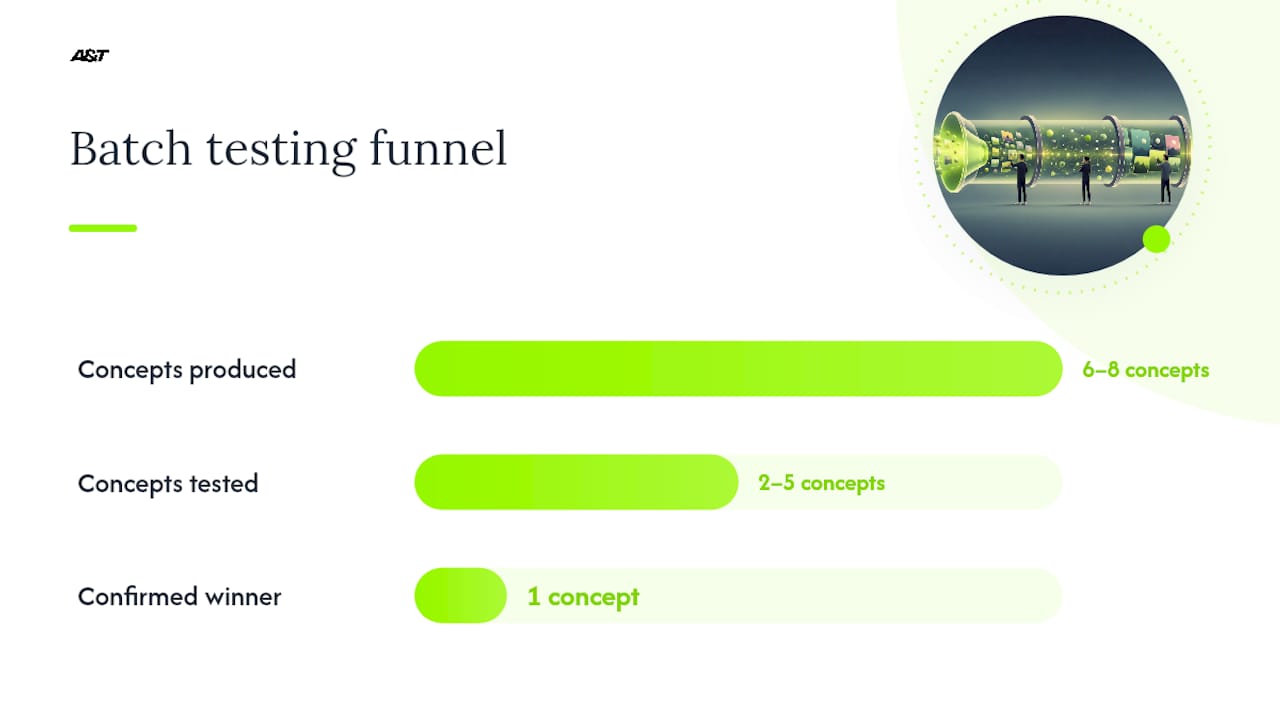
Pro Tip: Treat every test as a batch, not a one-off. Produce 6 to 8 concepts at once, run the strongest 2 to 5 through Meta's tool, then iterate on whichever one wins rather than starting from scratch next round. This is exactly how creative testing at scale actually works, according to Jon Loomer's breakdown of the batch approach.
Once you have a clear winner, run a confirmatory test before you commit real budget to scaling. It's a small extra step that catches false positives before they get expensive.
How Much Budget and Time Does a Reliable Test Need?
The 50-conversion threshold. Meta's algorithm generally needs a sufficient volume of optimized conversion events per ad set, per week, to exit the learning phase and deliver stable results, according to guidance from the Modern Marketing Institute. Tests that fall short of that volume tend to produce noisier, less trustworthy signals.
Meta recommends capping test spend at a portion of your overall campaign budget, commonly cited as a limited portion of budget, so the rest of your account keeps delivering normally while the test runs in parallel.
Work backward from your expected cost per result to set duration. If your typical cost per lead runs $15 and you need a sufficient volume of conversions per variant, that's a significant amount per variant, or a significant total amount for a multi-variant test. If your daily budget can't hit that within a reasonable window, either cut the variant count or extend the test length rather than declaring a winner early.
Small budgets still have a place, just not for statistical proof. A $10 per day budget can generate a few clicks daily depending on your industry, which is enough for directional signal on one audience and one or two creatives, but not enough to reach the volume needed for confident scaling decisions, per WhatNWhy's breakdown of $10-a-day testing.
- Directional test (small budget): expect a hunch, not a verdict. Use it to eliminate obviously weak concepts.
- Statistically meaningful test: budget for the full 50-conversion threshold per variant before trusting the result.
- Ambiguous middle ground: extend the test rather than cutting it short. More days beats more guessing.
Reading Results: What to Scale, What to Kill, What to Rerun
Pick one test metric before launch, usually cost per result, cost per click, or conversion rate, and stick with it through the whole test. Jumping metrics mid-test is how teams talk themselves into the wrong winner.
Look for a pattern that holds across several days, not a single strong day buried in noise. A variant that wins on day two but fades by day five is not a winner yet.
Once you have a genuine, repeatable winner, work through this sequence:
- Pause the losing variants immediately to stop wasting spend.
- Pull the winning concept into a new iteration batch, testing smaller variations of what worked (different hook length, alternate proof point).
- Run a confirmatory test or a small live rollout before committing your full budget.
- Scale gradually, in roughly 20% budget steps, watching for the campaign to re-enter learning phase after each increase.
- Check downstream metrics, not just click or lead volume, to confirm the quality holds as you scale.
If results stay ambiguous after a full run:
- Extend the test window rather than forcing a call on thin data.
- Increase daily budget temporarily to reach your conversion threshold faster.
- Move to a manual A/B split if you suspect an outside factor (audience overlap, placement mix) is muddying the read.
Common Creative Testing Mistakes That Waste Budget
Most wasted test spend traces back to a handful of repeat mistakes.
- Testing too many variables at once. Changing the hook, the CTA, and the thumbnail in the same variant tells you nothing about which one mattered.
- Underfunding the test. A campaign that never reaches roughly a sufficient volume of conversions per variant per week stays stuck in learning, and every number it produces is noisier than it looks.
- Broken or inconsistent tracking. If your pixel or Conversions API fires differently across variants, your "winner" might just be a tracking artifact.
- Launching before every variant clears ad review. A test that starts with one ad still pending approval skews delivery from hour one.
- Reacting to a single strong day. Short-term delivery swings are normal; a real winner holds up over the full test window, not one lucky afternoon.
How Atdigiagency Approaches Creative Testing for Clients
We run creative testing as a cadence, not a one-off event. A typical cycle starts with a hypothesis-first ideation batch, usually 6 to 8 genuinely distinct concepts, not variations on a theme. We build a production checklist for each format (video, static, carousel) so nothing ships half-finished into a live test.
From there, we run a controlled test for an appropriate duration using Meta's native tool or a dedicated ad set, depending on the client's objective, and follow it with one or two confirmatory tests before touching scale. Budget increases stay capped at a limited portion per step to avoid tripping the campaign back into learning phase.
For teams that want the full framework in writing, our guide on testing ad creatives for better results breaks down the batch structure in more detail, and our notes on Facebook campaign best practices cover how to structure budgets so a test doesn't cannibalize your main account delivery.
Why the Standard Advice on Creative Testing Falls Short
Most creative testing advice treats the process as a technical feature walkthrough: click here, set this budget, wait for a winner. That's incomplete. The actual failure point in almost every underperforming test is upstream of Ads Manager, in the hypothesis itself. Teams launch five variants that are cosmetically different but strategically identical, then wonder why the "winner" barely beats the loser.
The 50-conversion threshold gets treated as a nice-to-have benchmark, when it should function as a gate. If your budget can't realistically reach that volume within your test window, you don't have a test. You have an opinion with a spend limit attached.
What I'd prioritize first: write the hypothesis before opening Ads Manager, and kill any variant round that's really just five versions of the same idea. Batch production of genuinely different concepts beats micro-optimization every time, and it beats it earlier in the process than most teams expect.
— Ann
Get Managed Facebook Creative Testing Without the Guesswork
Running a disciplined creative testing cadence takes production capacity most in-house teams don't have room for between everything else on the calendar. We build and manage that cadence directly: hypothesis-driven test batches, format-specific creative production, and staged scaling once a winner clears its confirmatory round.
That's the real difference for a business owner coming out of this article. What you may not have is a team that can produce six distinct concepts a week and manage the Ads Manager mechanics correctly every single time. That's what our Meta Ads management service handles for clients across telehealth, retail, and entertainment.
If you're weighing test metrics against broader account goals, our partners at Baby Love Growth cover conversion rate optimization tactics that pair well with creative testing once you're past the discovery phase.
Ready to hand off the testing cycle? Reach out about Meta Ads management and we'll map out your first test batch.
Sources
- Creative Testing Feature for Meta Ads - Jon Loomer Digital
- Set Up a Creative Test in Meta Ads Manager
- Is 10 dollars a day enough for Facebook ads?
- 7 reasons your Meta ads are stuck in the learning phase (Modern Marketing Institute)
- Meta Ads Creative Testing: How It Works - Extuitive