
TL;DR:
- Most marketers rely on manual adjustments, but automation driven by machine learning offers faster, more accurate bid optimizations. It processes vast data signals across devices, locations, and audiences, giving campaigns a competitive edge. Proper setup, ongoing oversight, and strategic focus are essential to harness automation's full ROI potential.
Most marketing managers still believe that staying hands-on with every bid adjustment, keyword tweak, and budget shift is the best way to protect their ad spend. That belief made sense five years ago. Today, it's holding you back. PPC campaigns now generate thousands of data signals per hour across devices, locations, audiences, and intent levels. No human team can process that volume fast enough to act on it meaningfully. Automation, powered by machine learning, operates at a speed and scale that gives your campaigns a genuine edge. This guide breaks down how PPC automation works, where it delivers real ROI, and how to stay in control without getting buried in manual tasks.
Table of Contents
- Why automation is reshaping PPC management
- What automation really does in PPC: An inside look
- Smart bidding and automated rules: Google Ads vs Meta Ads
- Best practices: Safeguarding your ROI with automation
- The real power of automation: Focus on strategy, not busywork
- Partnering for peak performance in PPC automation
- Frequently asked questions
Key Takeaways
| Point | Details |
|---|---|
| Automation enables real-time optimizations | Machine learning tools instantly adjust bids, saving time and maximizing returns. |
| Google and Meta excel at different automation tasks | Google uses Smart Bidding for bidding goals while Meta automates budget and ad set decisions. |
| Data and oversight are still critical | Automation works best with clean tracking and human reviews to prevent costly mistakes. |
| Expert support strengthens automation results | Partnering with PPC specialists can help tailor automation to your business and market. |
Why automation is reshaping PPC management
The paid advertising landscape has shifted dramatically. Auctions happen in milliseconds. Audiences shift behavior daily. Costs fluctuate based on seasonality, competition, and user intent signals that are nearly impossible to track manually across a full account. If you're still relying on scheduled bid changes and weekly optimization sessions, you're already reacting to yesterday's data.
Manual PPC optimization simply cannot keep pace. A skilled analyst reviewing campaigns once a day is working with a snapshot. Meanwhile, your competitors running optimizing Google Ads ROI strategies with automated systems are making thousands of micro-adjustments per campaign, per hour. That's not a small gap. That's a structural disadvantage.
Modern automation changes the equation entirely. Machine learning models ingest far more signals than any human can track simultaneously: device type, geographic location, time of day, search query specifics, audience segments, historical performance patterns, and even predicted conversion likelihood. These signals combine in real time to inform smarter bidding decisions.
"Automation in PPC primarily involves Smart Bidding strategies in Google Ads and automated rules in Meta Ads, using machine learning for real-time bid adjustments based on signals like device, location, time, and user intent to optimize for conversions or ROAS."
Smart Bidding and automated rules are now standard in both Google Ads and Meta Ads. They're not experimental features reserved for enterprise-level budgets. They're the foundational tools that determine whether your campaigns stay competitive or fall behind. For practical guidance on setting these up correctly from the start, the advanced Google Ads tips in our blog walk through the specifics.
Key forces making automation essential today:
- Auction complexity has increased with more ad formats and audience layers
- First-party data integration allows smarter personalization at scale
- Rising CPCs (cost per clicks) make every bid decision more consequential
- Cross-device behavior means more signals per user journey than ever before
What automation really does in PPC: An inside look
Understanding the mechanics helps you use these tools confidently instead of treating them like a black box. Let's look at what actually happens when automation runs in Google Ads and Meta Ads.
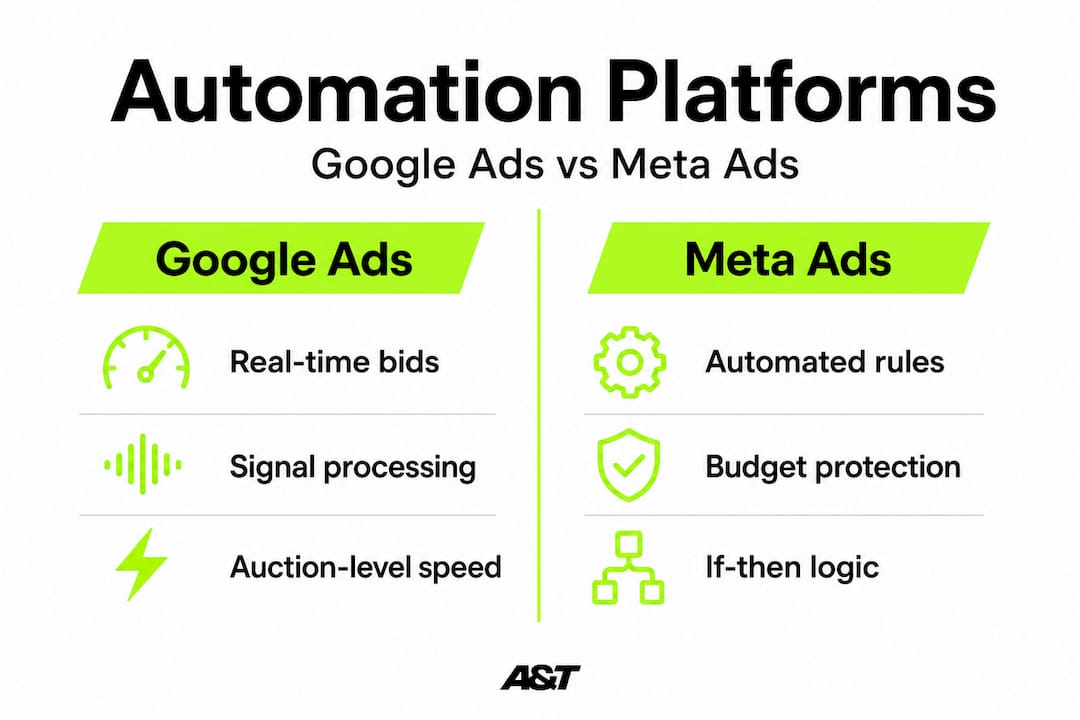
In Google Ads, automated bidding works at the individual auction level. Every time a search query triggers your ad, Google's system evaluates dozens of real-time signals and adjusts your bid accordingly. Someone searching from a high-intent location late in a conversion window might receive a higher bid. A repeat visitor close to making a purchase gets prioritized. This level of contextual bidding is impossible to replicate manually, even with the most granular bid adjustments you can apply in a standard campaign.
Smart Bidding strategies like Target CPA (cost per acquisition) and Target ROAS (return on ad spend) train on your conversion data. The more quality conversion data your campaigns generate, the more accurate and efficient these models become. That's why clean conversion tracking is non-negotiable before you switch any campaign to automated bidding.
On the Meta side, optimizing ad spend efficiency looks different. Meta's automated rules operate on an if-then logic system. You define a condition, and the system acts when that condition is met. This covers budget increases, ad set pausing, bid adjustments, and notifications. It's less about real-time auction signals and more about enforced rules that protect your budget and scale what's working.
Scaling Google Ads campaigns and scaling Meta campaigns both require understanding these distinct approaches. Google's automation is probabilistic and predictive. Meta's automation is conditional and rules-based. They solve different problems and work best in combination when you're running cross-platform campaigns.
Here's a comparison of what each platform automates:
| Feature | Google Ads automation | Meta Ads automation |
|---|---|---|
| Bid adjustments | Real-time, auction-level | Rule-triggered, periodic |
| Audience optimization | Smart signals and intent data | Interest and behavior targeting |
| Budget management | Campaign-level smart budget | Rule-based budget scaling |
| Creative testing | Responsive search ads | Dynamic creative, A/B rules |
| Conversion focus | Target CPA, Target ROAS | CPA protection rules |
Pro Tip: Before activating any Smart Bidding strategy, confirm your conversion tracking is firing correctly on every relevant action. A campaign optimizing toward incomplete or duplicate conversion data will learn the wrong patterns and waste spend quickly.
Smart Bidding uses machine learning to make auction-level bid decisions at a speed no manual system can match. Meanwhile, Meta's automated rules let you set if-then conditions to pause underperformers, scale winners, and guard against frequency issues or CPA spikes that would otherwise eat into your margins.
The efficiency gains here are real. When automation handles routine bid management and basic budget protection, your team's time shifts to creative strategy, audience research, and campaign architecture. That's where human judgment still creates the biggest competitive advantage.

Smart bidding and automated rules: Google Ads vs Meta Ads
Now, let's break down how Google and Meta approach automation side by side. This comparison helps you decide where to apply which approach based on your campaign objectives.
Smart Bidding in Google Ads uses machine learning to optimize bids for each individual auction. You set the goal, and the system figures out how to reach it. The four main Smart Bidding strategies each serve a specific purpose:
- Target CPA: Optimizes for conversions at a specific cost. Best when you have a clear acceptable cost per lead or sale and at least 30 conversions per month for reliable learning.
- Target ROAS: Optimizes for revenue return on your spend. Ideal for e-commerce campaigns where average order values vary and you need value-based bidding.
- Maximize conversions: Spends your entire budget to get as many conversions as possible. Good for campaigns in early learning phases with no hard CPA constraint.
- Maximize conversion value: Prioritizes higher-value conversions over sheer volume. Powerful when you have differentiated product margins or lead quality tiers.
On the Meta side, automated rules work differently, using explicit conditions you define. Here's how savvy Meta advertisers use them in practice:
- Pause any ad set where the CPA exceeds your target by 20% for three consecutive days
- Increase the budget by 15% on ad sets that hit a ROAS above your threshold for two days running
- Send an alert when frequency exceeds a defined threshold per week
- Automatically turn off ads with click-through rates below a minimum benchmark
For understanding the full range of what Meta can do for your campaigns, the Meta Ads strategies explained breakdown is worth reviewing. And if you want a structured way to implement both platforms, our ad optimization checklist covers the key steps in order.
| Comparison factor | Google Smart Bidding | Meta automated rules |
|---|---|---|
| Decision speed | Millisecond, auction-level | Scheduled intervals (hourly or daily) |
| Learning requirement | Needs conversion history | Works from day one with defined rules |
| Best use case | Search, Shopping, Performance Max | Social campaigns, retargeting, scaling |
| Human input needed | Goal-setting and monitoring | Rule design and condition thresholds |
| Risk of error | Low with clean data | Medium, depends on rule logic accuracy |
The takeaway: Neither platform's automation is inherently superior. Google's strength is real-time signal processing. Meta's strength is flexible budget management through your defined logic. A well-run paid advertising strategy uses both, adapted to each platform's strengths.
Best practices: Safeguarding your ROI with automation
Despite their power, automated systems are not set-and-forget. That's one of the most dangerous misconceptions we see. Marketers activate Smart Bidding or a set of Meta rules and then step away, assuming the system will self-correct. It won't. Not without the right guardrails in place.
Here's how to use automation wisely and keep your ROI protected:
- Start with clean data. Conversion tracking must be accurate before automation can perform. Gaps, duplicates, or incorrect event firing will corrupt the learning process entirely. Verify your tracking setup thoroughly before switching any campaign to an automated bidding strategy.
- Test new rules in alert-only mode. Before you let an automated rule execute budget or bid changes, run it in notification-only mode for one to two weeks. This shows you exactly what the rule would have done, giving you a chance to catch flawed logic before it costs you money.
- Set hard budget caps. Automated systems can increase spend when they see opportunity. That's useful, but only within defined limits. Always set maximum daily budgets that reflect your actual financial boundaries.
- Schedule monthly performance reviews. Monthly reviews prevent drift as algorithms update and market conditions shift. What worked in Q1 may not be appropriate by Q3. Review your automation settings alongside performance data on a regular cadence.
- Segment campaigns by objective. Don't ask one automated strategy to serve multiple conflicting goals. A campaign optimizing for lead volume will behave differently than one optimizing for lead quality. Keep your objectives clean and specific.
Our campaign optimization tips go deeper on how to structure these review processes, but the core principle is simple: automation performs best when it has clear goals, clean data, and active human oversight.
Statistic to note: Accounts that implement proper conversion tracking before activating Smart Bidding consistently see stronger results. Google's own data shows that Smart Bidding strategies work significantly better in accounts with at least 50 conversions per month, because the models have enough signal to optimize reliably rather than guess.
Pro Tip: Create a simple automation log. Every time you activate, modify, or pause an automated rule or bidding strategy, document what changed and why. When performance shifts unexpectedly, this log saves hours of troubleshooting time.
The real power of automation: Focus on strategy, not busywork
Here's a perspective that most automation guides skip entirely: the biggest ROI from PPC automation doesn't come from slightly lower CPAs or marginally better ROAS numbers. It comes from what you do with the time you reclaim.
We've worked with marketing managers and business owners across highly competitive sectors. The ones who extract the most value from automation aren't the ones obsessing over every bid setting. They're the ones who shifted their attention upward. They use freed-up time to rethink their creative approach, build better landing page experiences, test new audience structures, or develop smarter cross-channel strategies.
Automation handles the repetitive, data-intensive work that used to consume hours of weekly attention. Bid management, frequency monitoring, budget pacing, performance alerts: all of it runs in the background. That should free you to ask bigger questions. Are we targeting the right audiences? Is our offer compelling enough? Does our funnel convert as well as our ads do?
The teams that lose out with automation are those who treat it as a passive system and disengage. Automation amplifies whatever direction you've set. If your campaign strategy is strong, automation scales that strength efficiently. If your strategy has gaps, automation will spend your budget optimizing toward the wrong outcome at a faster rate than any manual campaign would.
This is where ROI-driven campaign management thinking becomes critical. Automation is a force multiplier, not a strategy replacement. The human job shifts from doing to directing. That's a better use of skilled marketing judgment, and it produces better business outcomes.
The marketers who worry most about "losing control" to automation are often the ones spending the most time on low-leverage tasks. Reframe it: you're not losing control, you're elevating where your control is applied.
Partnering for peak performance in PPC automation
Automation creates the opportunity for better results. But the configuration, oversight, and strategy behind it still determine whether you win or waste budget. That's where expert support makes a measurable difference.
At A&T Digital Agency, we help businesses set up automation the right way from day one. We design Google Ads automation support systems built on clean tracking, well-structured campaigns, and bidding strategies matched to real business goals. On the social side, our Meta Ads management services combine intelligent rule-based automation with creative strategy to keep your campaigns scaling without runaway spend. If you're ready to stop guessing and build paid ad systems that actually perform, explore our full-funnel paid ads solutions and let's talk about what's possible for your campaigns.
Frequently asked questions
What is automation in PPC advertising?
Automation in PPC uses machine learning and conditional rules to adjust bids, manage budgets, and optimize ads in real time based on performance signals, removing the need for constant manual intervention.
Are automated rules safe for small PPC budgets?
Yes, when configured correctly. Automated rules can protect smaller budgets by pausing underperforming ads and scaling only the ad sets delivering acceptable CPA or ROAS results.
How do I avoid mistakes with PPC automation?
Start by verifying your conversion tracking is accurate, then run any new automated rules in alert-only mode before letting them execute, and review overall performance monthly to catch any drift.
Should I use manual bidding or automation in Google Ads?
For most campaigns with sufficient conversion data, Smart Bidding outperforms manual bidding because it processes more real-time signals per auction than any human-managed system can match.