
The fastest ways to increase event conversions right now
Every event marketer faces the same frustrating gap: strong traffic, weak registrations. The fix is not more ad spend. It is removing friction at every stage of the attendee journey, from the first impression to the confirmation email.
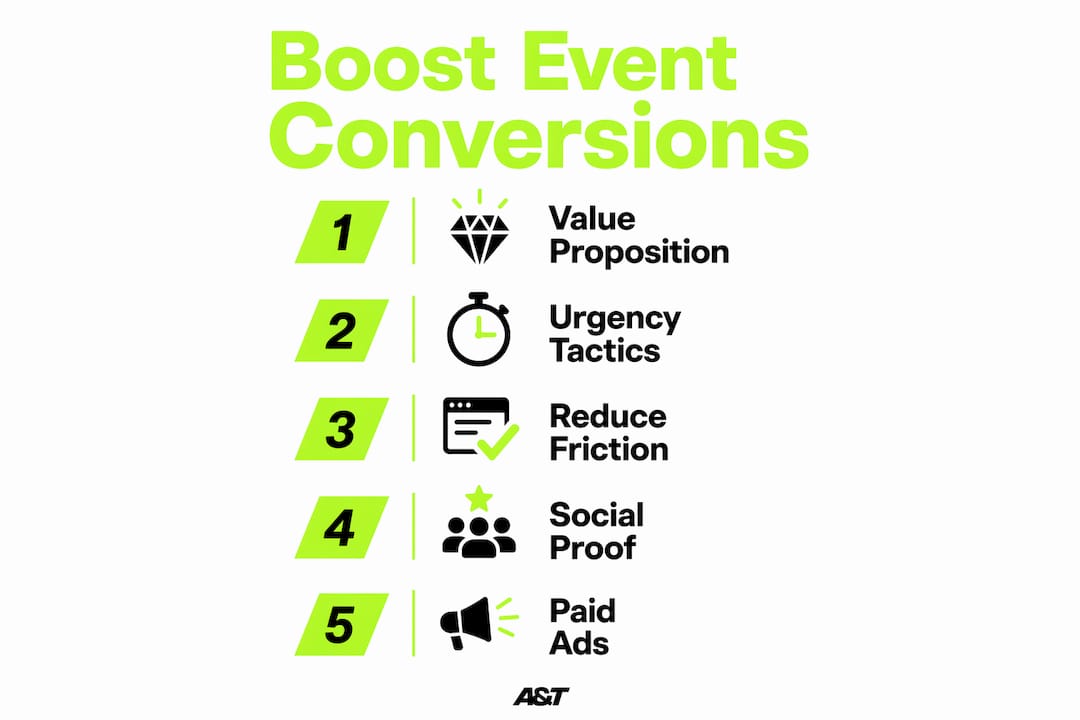
Here is what actually moves the needle:
- Simplify your registration form. Cutting unnecessary fields drastically increases conversions. Every unnecessary field is a quiet exit ramp.
- Lead with value, not logistics. Your landing page hero should answer "what, when, where, why me, how much" before the visitor ever sees a form field.
- Segment your email campaigns. Generic blasts underperform. Segmented, targeted campaigns can increase revenue by 28% through better conversion and upsell.
- Use urgency that is real. Early bird pricing and limited seats work when they are genuine. Fake scarcity erodes trust fast.
- Send a reconfirmation email 24–48 hours before the event. This single tactic helps reduce no-shows significantly.
- Integrate your event data with your CRM. Post-event tracking of referrals, renewals, and upsells often reveals downstream value 5X–10X the immediate ticket revenue.
- Run paid ads with audience-matched creative. Google Ads and Meta campaigns tied to specific attendee segments outperform broad targeting every time.
These are not theories. They are the levers that separate a 2–3% registration rate from a 10–20% one on identical traffic.
Pre-event marketing that actually drives attendance
Getting registrants starts well before your landing page loads. The event marketing strategies you deploy in the weeks before launch determine the quality and volume of everyone who shows up to register.
Build a compelling value proposition first. Before you write a single ad or email, answer one question: why should this specific person attend this specific event right now? Vague answers produce vague results. Concrete outcomes, named speakers, and measurable takeaways give your audience a reason to act.
Segment your outreach. A first-time attendee needs different messaging than a returning one. A C-suite prospect responds to different proof points than a practitioner. Segmented campaigns consistently outperform one-size-fits-all sends, and the revenue lift from better targeting compounds across your entire funnel.
Tactics that work together:
- Email sequences with intent-based segmentation. Send early-bird offers to past attendees, benefit-focused copy to cold lists, and social proof to warm leads who have visited your page but not registered.
- Retargeting campaigns. Visitors who leave without registering are your highest-intent audience. A well-structured Meta or Google retargeting campaign brings them back at a fraction of the cost of acquiring new traffic.
- Influencer and speaker amplification. Your speakers have audiences that trust them. Give them shareable assets and a clear ask. Their endorsement carries more weight than any paid impression.
- A/B test your messaging early. Test subject lines, headlines, and CTA copy before you scale. A subject line that drives a 28% open rate versus an 18% one can translate to meaningfully more registrations without spending another dollar.
- SEO-optimized event pages. Target long-tail queries your audience actually searches. An event page that ranks organically for "B2B SaaS marketing conference 2026" captures intent-driven traffic at zero marginal cost.
Pro Tip: Start urgency tactics at least three weeks out, not the day before. Early bird deadlines and seat limits work best when your audience has time to deliberate and decide, not when they feel ambushed.
The goal at this stage is not just volume. It is qualified registrants who are likely to show up and take action after the event.
Optimizing registration to remove friction and boost completions
Most event registration drop-off is not a lack of interest. It is friction. The form is too long, the page loads slowly on mobile, or the price appears as a surprise at checkout. Fix those problems and you recover registrations from people who already wanted to attend.
Field count is the single biggest lever. Reducing form fields drastically increases conversion rates, with each additional unnecessary field lowering completion noticeably. The test for every field is simple: will the event fail for this person if you do not ask this right now? If the answer is no, move it to a post-registration follow-up.

| Form fields | Estimated conversion impact |
|---|---|
| 3 fields | Highest completion, minimal data |
| 5 fields | Recommended balance for most events |
| 8–10 fields | Measurable drop-off begins |
| — | Completion rates decline sharply; global abandonment averages high rates |
Design for mobile first. Over half of registrations happen on phones. A multi-column desktop form reflowed onto a small screen is one of the top abandonment causes. Use a single-column layout, large tap targets, and enable browser autofill for name and email. The fewer keystrokes required, the higher the completion rate.
Additional tactics that lift completions:
- Open with a low-commitment question. Starting a conversational flow with a simple preference question rather than immediately asking for an email can lift conversion rates by 8–14 points. The first action should cost the registrant nothing.
- Use inline validation. Show errors next to the field as they happen, in plain language. Never wipe entered data on a failed submit.
- Skip forced account creation. Requiring a password before registration is a reliable conversion killer. Offer account creation after the ticket is confirmed, as a convenience.
- Show the full price before the form. Hidden fees are a top abandonment cause. Transparency at this stage builds trust, not hesitation.
- Use staged qualification. Capture name, email, and ticket type first. Collect role, company size, and session preferences in a conditional follow-up once the registrant is committed.
A well-designed landing page converts 10–20% of visitors, compared to just 2–3% for poor designs, yielding a 5–7x difference on the same traffic. The page itself is a decision system, not a decorated form. It needs to balance audience fit clarity, logistics transparency, and trust signals in one coherent flow. For more on conversion tactics that work, the principles that apply to e-commerce checkout apply directly here.
Pro Tip: Place social proof, such as past attendee counts and testimonials, near your registration CTA, not isolated at the bottom of the page. Trust signals near commitment points reduce hesitation where it matters most.
During and after the event: turning registrations into real ROI
Getting someone to register is step one. Getting them to show up, engage, and convert into a long-term customer is where event ROI actually lives.
Reduce no-shows with commitment and personalization. Paid events typically have lower no-show rates compared to free events, reflecting differences in financial and social commitment. The gap comes down to financial or social commitment. Even a small refundable deposit or a public RSVP shifts behavior. Pair that with a reconfirmation email 24–48 hours out that references why the registrant signed up, and you have a powerful combination.

Capturing intent at registration is what makes personalized reminders possible. One open question at sign-up, "What do you most want to get out of this event?", gives you the segmentation data to send reminders that feel relevant rather than generic. That shift alone drives measurably higher attendance.
Post-event strategies that extend conversion value:
- Send a targeted post-event survey. NPS and open-ended feedback surface what worked and what did not. This data feeds your next event's messaging and agenda directly.
- Share attendee testimonials and social proof. Real quotes from named attendees, collected immediately after the event while enthusiasm is high, become your most credible pre-registration asset for the next cycle.
- Integrate event data into your CRM. Tracking which attendees became customers, renewed contracts, or referred others reveals the true downstream value of your event program. Organizations that treat events as integrated marketing systems report a significantly better ability to demonstrate ROI.
- Segment your post-event follow-up. A hot lead who attended three sessions needs different nurture than someone who registered but did not show. Tailor your follow-up accordingly.
The downstream value of a well-run event program often greatly exceeds immediate revenue when you track referrals, renewals, and upsell opportunities through CRM integration. Most event teams never measure this. The ones that do build a compelling business case for continued investment.
Using paid ads and data to maximize event conversion rates
Traffic without conversion data is just spending. The event marketers who consistently win are the ones who close the loop between ad performance, registration behavior, and downstream outcomes.
Deploy Google Ads and Meta campaigns with audience precision. Broad targeting wastes budget. Audience segments built around job title, industry, past event attendance, and behavioral signals produce registrations at a fraction of the cost of untargeted campaigns. Retargeting landing page visitors who did not convert is often the highest-ROAS tactic in your entire event marketing mix. For a proven framework on launching event ads that drive real registrations, the approach starts with audience definition, not creative.
Use data to forecast and refine. Data-driven event marketing can significantly reduce attendee acquisition costs by identifying high-performing channels and cutting waste. AI-powered analytics tools analyze historical registration patterns, predict attendance rates, and surface which audience segments are most likely to convert. This shifts planning from intuition to informed projection. For a deeper look at how analytics drive better ROI, the same principles that apply to paid campaigns apply directly to event funnels.
Key tactics for paid and data-driven event marketing:
- Track registration conversion rate as your headline metric. For B2B events, anything above 25% on warm traffic signals effective messaging and a clean user experience. Below that threshold, the problem is usually the registration UX, not the traffic volume.
- A/B test creative and CTA copy continuously. Test one variable at a time: headline framing, button copy, offer structure. Small changes compound. Shifting from "Register Now" to "Save My Spot" has driven click-through lifts of over 30% in documented campaigns.
- Use UTM parameters on every inbound link. Without attribution, you cannot tell which channel is driving registrations. UTM-tagged links feed your analytics and let you reallocate budget toward what is working in real time.
- Audit your funnel weekly during active campaigns. Check spend, clicks, conversions, and cost per registration on a set schedule. If an ad is underperforming after a reasonable test window, adjust the creative or targeting before the campaign loses momentum.
- Connect ad data to CRM outcomes. The real measure of a paid campaign is not cost per registration. It is cost per attendee who converted into a customer. That number requires CRM integration and a longer attribution window, but it is the figure that justifies your budget to leadership.
For event marketers who want to optimize campaign performance with data at every stage, the discipline is the same whether you are running a webinar series or a flagship conference: measure what matters, cut what does not, and scale what works.
When you are ready to put serious paid media behind your next event, Atdigiagency's Google Ads management team builds and runs performance campaigns designed to drive registrations at measurable cost, with full attribution from first click to confirmed attendee. We also run Meta Ads campaigns built around the audience segments that actually show up.
Key Takeaways
Increasing event conversions requires optimizing registration friction, pre-event targeting, and post-event data integration across every stage of the attendee journey.
| Point | Details |
|---|---|
| Cut form fields aggressively | Reducing registration form fields from 11 to 4 can increase conversion rates by up to 120%, with each additional unnecessary field lowering conversion by 5–10%. Cap required fields at 5 for best results. |
| Reconfirm before the event | A reconfirmation email 24–48 hours out can improve show-up rates by roughly 30%. |
| Target paid ads by audience segment | Data-driven event marketing can significantly reduce attendee acquisition costs versus broad targeting. |
| Track registration conversion rate | For B2B events, tracking registration conversion rates above 25% indicates effective messaging and a clean registration experience. |
| Integrate event data with your CRM | Downstream value from referrals and renewals often exceeds immediate revenue by 5X–10X. |