
You launch a digital campaign, watch the numbers roll in, and wonder if you're actually making money or just spending it. Many marketing managers and business owners struggle to connect campaign activity with real business outcomes, leaving them uncertain about which efforts truly drive ROI. Without accurate measurement, you risk pouring budget into underperforming channels while missing opportunities to scale what works. This guide walks you through a practical framework for measuring campaign results effectively, helping you make data-driven decisions that maximize your marketing return.
Table of Contents
- Key Takeaways
- Identify key metrics and prerequisites for measurement
- Step-by-step process to measure campaign results effectively
- Common measurement mistakes and how to avoid them
- How to interpret campaign results and apply insights to improve ROI
- Boost your campaign success with expert support
- Frequently asked questions
Key Takeaways
| Point | Details |
|---|---|
| Define goals and metrics | Start by defining your campaign goal in concrete terms and choose metrics that directly reflect progress toward that objective. |
| Numerical success criteria | Define numerical targets such as $50,000 in attributed revenue at a maximum 3:1 ROAS. |
| Centralized data dashboard | Create a centralized dashboard that pulls data from all channels into one view for ongoing performance checks. |
| Test and verify tracking | Test your tracking setup before launch by completing test purchases or form submissions to verify data accuracy. |
Identify key metrics and prerequisites for measurement
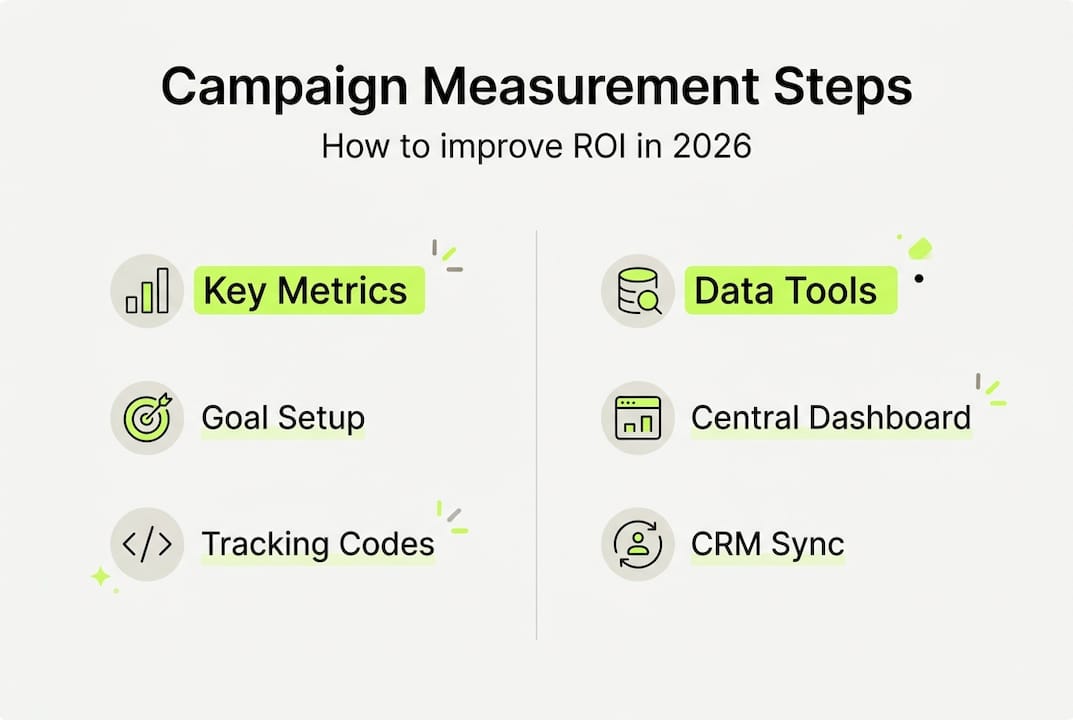
Before you can measure anything meaningful, you need clarity on what success looks like for your specific campaign. A lead generation campaign for a telehealth service requires completely different metrics than an e-commerce product launch. Start by defining your primary campaign goal in concrete terms: are you driving sales, generating qualified leads, building brand awareness, or encouraging specific user actions?
Once your goal is clear, select metrics that directly indicate progress toward that objective. For sales-focused campaigns, track return on ad spend, cost per acquisition, and conversion rate. Lead generation campaigns require cost per lead, lead quality scores, and lead-to-customer conversion rates. Engagement campaigns need reach, engagement rate, and brand lift metrics. Choosing the right metrics and setting up proper tracking prevents you from drowning in vanity metrics that look impressive but don't connect to business outcomes.
Your measurement infrastructure determines data quality. Implement tracking pixels on your website for all advertising platforms you use, ensuring they fire correctly on key pages like checkout confirmations and form submissions. Connect Google Analytics or your preferred analytics platform to capture user behavior across your site. Set up conversion tracking in each ad platform's native system, and verify that revenue values pass through correctly for e-commerce transactions.
Data accuracy requires integration across platforms. Your CRM should connect with your ad platforms to track the full customer journey from first click to final purchase. For telehealth and e-commerce businesses with longer sales cycles, this integration becomes critical for understanding which touchpoints actually influence conversions. Test your tracking setup thoroughly before launching campaigns by completing test purchases or form submissions and confirming that data appears correctly in all systems.
Create a centralized dashboard that pulls data from all your marketing channels into one view. This might be a Google Data Studio report, a spreadsheet with API connections, or a dedicated marketing analytics platform. The goal is ongoing access to metrics without logging into five different platforms every time you need to check performance.
Pro Tip: Document your tracking setup in a shared document including pixel IDs, conversion event names, and attribution windows. When team members change or you need to troubleshoot discrepancies, this documentation saves hours of detective work.
Step-by-step process to measure campaign results effectively
Accurate measurement starts before your campaign goes live. Define your success criteria in specific, numerical terms: not "increase sales" but "achieve $50,000 in attributed revenue at a maximum 3:1 ROAS." Document these benchmarks so you can objectively evaluate performance later without moving goalposts. Establish your measurement timeframe based on your typical sales cycle, remembering that immediate results rarely tell the full story for higher-consideration purchases.
Collect data systematically from every advertising channel you're running. Set a regular cadence for data pulls, whether daily for high-spend campaigns or weekly for smaller tests. Export raw data rather than relying solely on platform dashboards, as platforms sometimes adjust historical data or change their reporting interfaces. Store this data in a consistent format that allows you to compare performance across time periods and channels.
Attribution determines which marketing touchpoints receive credit for conversions. Last-click attribution gives all credit to the final interaction before purchase, while first-click attributes to the initial touchpoint. Multi-touch models distribute credit across the customer journey. Choose an attribution model that reflects your actual marketing strategy. If you run awareness campaigns that prime customers for later conversion, last-click will systematically undervalue those efforts. Following a structured process ensures you capture the full picture of campaign impact.

Calculate your core profitability metrics using complete cost and revenue data. For ROAS, divide total attributed revenue by total ad spend. For ROI, subtract total costs from total revenue, divide by total costs, and multiply by 100 for a percentage. Include all costs in your calculations: not just media spend but also creative production, landing page development, and management time or agency fees. Incomplete cost accounting makes campaigns look more profitable than they actually are.
Here's how different measurement approaches compare:
| Measurement approach | Best for | Limitation |
|---|---|---|
| Platform native reporting | Quick performance checks | Each platform claims maximum credit |
| Google Analytics | Cross-channel user behavior | Requires proper UTM tagging |
| CRM attribution | Full customer journey | Implementation complexity |
| Marketing mix modeling | Long-term strategic planning | Requires significant historical data |
| Incrementality testing | Proving true lift | Resource intensive |
Adjust your measurement approach based on what you learn. If you discover significant discrepancies between platform reporting and actual revenue, investigate tracking gaps or attribution issues. When external factors like seasonality or competitor actions affect results, note these in your analysis so you don't misattribute performance changes to your own actions.
Pro Tip: Create a weekly scorecard that tracks your top three metrics against benchmarks. This habit of regular review catches problems early and builds institutional knowledge about what normal performance looks like for your business.
Common measurement mistakes and how to avoid them
Vague goal setting undermines everything downstream. "Increase brand awareness" or "get more customers" doesn't give you a clear target to measure against. Without specific numerical goals, you can't determine if a campaign succeeded or failed. Set concrete targets with timeframes: "Generate 200 qualified leads at under $75 cost per lead within 60 days." This specificity enables objective performance evaluation.
Multichannel attribution grows complex quickly, and oversimplified approaches distort reality. Relying exclusively on last-click attribution in a multi-channel strategy systematically undervalues top-of-funnel activities. A customer might discover your telehealth service through a Facebook ad, research on Google, and finally convert through a retargeting ad. Giving all credit to that final retargeting impression ignores the essential role of earlier touchpoints. Use attribution models that reflect how customers actually move through your funnel.
Data quality issues poison analysis. Broken tracking pixels, misconfigured conversion events, or gaps in your measurement setup mean you're making decisions based on incomplete information. A surprisingly common mistake is forgetting to exclude internal traffic, which artificially inflates engagement metrics. Regularly audit your data collection to catch these issues before they corrupt months of campaign decisions.
External factors influence campaign performance, but marketers often forget to account for them. Seasonal fluctuations, economic conditions, competitor actions, and even weather can impact results. A campaign that performs poorly during a slow season might actually be quite effective relative to baseline demand. Avoiding measurement errors requires considering context rather than treating metrics in isolation.
"The most dangerous measurement mistake is optimizing for metrics that don't connect to business outcomes. You can achieve a perfect click-through rate while generating zero profitable customers."
Neglecting continuous optimization based on data wastes the entire point of measurement. Some marketers set up tracking, launch campaigns, and then ignore the data until the campaign ends. This approach misses opportunities to improve performance mid-flight. Review your metrics regularly and make adjustments when you spot problems or opportunities. Pause underperforming ad sets, increase budget on winners, and refine targeting based on what the data reveals about your best customers.
Another critical mistake is comparing metrics across incompatible timeframes or campaign types. Comparing a two-day flash sale's conversion rate to a month-long awareness campaign's conversion rate tells you nothing useful. Ensure your comparisons are apples to apples: same attribution windows, same audience definitions, and similar campaign objectives.
How to interpret campaign results and apply insights to improve ROI
Comparative analysis reveals which channels and campaign types deliver the best cost-effectiveness for your business. Calculate cost per acquisition and ROAS for each traffic source, then rank them by profitability. This ranking immediately shows where to allocate more budget and where to cut back. For e-commerce businesses, Google Shopping campaigns might deliver lower-cost conversions than Facebook prospecting, while telehealth services might find Facebook's detailed targeting more effective for reaching specific patient demographics.
Identify underperforming elements systematically. Look beyond channel-level performance to examine individual campaigns, ad sets, and even specific ads or keywords. A channel that looks mediocre overall might contain a few stellar performers dragged down by many poor ones. Pause or restructure the underperformers while scaling the winners. This granular optimization compounds small improvements into significant ROI gains.
Use performance data to refine audience targeting. Analyze demographic, geographic, and behavioral characteristics of your best converters. If customers aged 35 to 44 convert at twice the rate of other age groups, shift budget toward that segment. For telehealth campaigns, you might discover that certain conditions or specialties drive much higher patient lifetime value, informing both targeting and creative strategy. Insightful interpretation of data transforms raw numbers into strategic direction.
Creative performance analysis often reveals surprising patterns. The ad you thought would win based on your marketing intuition might underperform compared to a simpler, more direct approach. Track performance by creative theme, format, and messaging angle. When you identify winning creative patterns, produce more variations on those themes rather than constantly reinventing your approach.
Here's how different optimization approaches compare:
| Optimization focus | Impact timeline | Effort required |
|---|---|---|
| Pause worst performers | Immediate | Low |
| Adjust bids and budgets | 1-2 weeks | Low |
| Refine audience targeting | 2-4 weeks | Medium |
| Test new creative approaches | 4-8 weeks | High |
| Restructure campaign architecture | 4-8 weeks | High |
Set performance benchmarks based on your historical data and industry standards. Track your metrics over time to establish what "normal" looks like for your business across different seasons and campaign types. These benchmarks help you quickly identify when something is working exceptionally well or needs immediate attention. For new campaign types without historical benchmarks, use industry averages as a starting point while building your own baseline.
Continuous testing drives ongoing improvement. Run structured A/B tests on landing pages, ad creative, audience segments, and bidding strategies. Test one variable at a time so you can isolate what actually drives performance changes. Small incremental improvements from regular testing compound into substantial ROI increases over months and years.
Document your learnings in a shared knowledge base. When you discover that video ads outperform static images for your telehealth service, or that certain product categories drive higher repeat purchase rates in your e-commerce store, record these insights. This institutional knowledge prevents you from re-learning the same lessons and helps new team members get up to speed quickly.
Boost your campaign success with expert support
Measuring and optimizing campaign performance requires specialized expertise and dedicated time that many growing businesses struggle to maintain in-house. Working with a performance marketing team gives you access to professionals who live and breathe campaign optimization across multiple clients and industries. They bring proven frameworks, testing methodologies, and platform expertise that would take years to develop internally.
Multi-channel paid advertising demands platform-specific knowledge that extends beyond basic campaign setup. Google Ads management specialists understand the nuances of search intent, shopping feed optimization, and YouTube video targeting. Meta ads management experts know how to leverage Facebook and Instagram's detailed targeting capabilities for e-commerce and telehealth campaigns. Data-driven campaign optimization from experienced professionals accelerates your path to profitable growth. Learn more about how AT Digi Agency helps businesses like yours maximize marketing ROI through strategic, performance-focused campaign management.
Frequently asked questions
How do I know which campaign metrics matter most?
Your metrics should directly support your specific business goals rather than tracking everything available. Focus on actionable KPIs that connect to revenue or lead generation outcomes. For sales campaigns, prioritize ROAS and customer acquisition cost. For lead generation, track cost per qualified lead and lead-to-customer conversion rate. Analytics in advertising helps you identify which numbers actually matter for your business model.
What is the best way to attribute conversions in multi-channel campaigns?
Attribution models should reflect your actual customer journey and marketing strategy. Last-click attribution works for direct response campaigns with short consideration cycles, while multi-touch models better capture complex B2B or high-consideration purchases. Ensure consistent tracking across all channels using UTM parameters and integrated conversion tracking. Step by step campaign setup guides you through proper attribution configuration for accurate measurement.
How often should I review and adjust my campaign measurements?
Review frequency depends on campaign spend and sales cycle length. High-budget campaigns benefit from daily monitoring to catch issues quickly, while smaller tests can be reviewed weekly. Monthly deep-dive analysis helps identify longer-term trends and optimization opportunities. Adjust your measurement approach when you discover tracking gaps or when business conditions change significantly. Regular optimization based on data review compounds performance improvements over time.