
Most marketing managers believe they're making data-driven decisions, but many still rely on vanity metrics like clicks and impressions that tell only part of the story. The truth is, effective analytics go far beyond surface-level engagement numbers. For small to medium-sized e-commerce and healthcare companies, understanding how to leverage the right analytics can transform campaign performance and deliver measurable ROI improvements. This guide will show you how to shift from vanity metrics to revenue-focused analytics, choose the right attribution models, and set KPIs that actually drive business growth.
Table of Contents
- Key Takeaways
- Understanding analytics: from vanity metrics to revenue impact
- Decoding attribution models to measure true campaign contribution
- Setting KPIs and optimizing campaigns for ROI-driven marketing
- Integrating analytics platforms for comprehensive campaign measurement
- Optimize your campaigns with expert performance marketing support
- Frequently asked questions about analytics in campaigns
Key Takeaways
| Point | Details |
|---|---|
| Shift to revenue metrics | Prioritize revenue metrics such as CAC, lifetime value, conversion rate, and LTV to CAC ratio to tie marketing to business results. |
| Multi touch attribution | Use time decay and position based attribution to credit multiple touchpoints along the customer journey rather than relying on last click. |
| Tagging and CRM readiness | Ensure GA4, GTM, and CRM integrations are properly configured to capture the full customer journey from first touch to conversion. |
| KPIs aligned to goals | Set KPIs that reflect business goals and optimize campaigns weekly to improve ROI on high performing channels. |
Understanding analytics: from vanity metrics to revenue impact
The shift from vanity metrics to revenue-focused analytics represents a fundamental change in how you measure campaign success. Vanity metrics include clicks, impressions, page views, and social media engagement. These numbers look impressive in reports but rarely connect directly to business outcomes. Revenue metrics, on the other hand, include customer acquisition cost (CAC), lifetime value (LTV), conversion rate, and revenue per customer. These metrics directly tie your marketing efforts to financial performance.
For small to medium-sized businesses, this distinction becomes critical when budgets are tight and every dollar counts. Prioritizing GA4, GTM, CRM integration helps you shift from vanity to revenue metrics effectively. Google Analytics 4 (GA4) serves as your data collection engine, capturing user behavior across your website and apps. Google Tag Manager (GTM) simplifies tag deployment and tracking code management without constant developer involvement. Your CRM system ties everything together by connecting marketing touchpoints to actual customer relationships and revenue.
The LTV:CAC ratio stands as one of the most important metrics for campaign effectiveness. A healthy ratio exceeds 3:1, meaning each customer generates at least three times what you spent to acquire them. When you track this metric consistently, you can quickly identify which campaigns deliver sustainable growth versus those that drain resources. Many marketing managers struggle because they optimize for clicks or impressions without understanding whether those interactions lead to profitable customers.
Pro Tip: Before diving into complex analytics, ensure your tagging and CRM setup are properly configured. Reliable data streams form the foundation for every insight you'll gain. Spend time validating that your tracking captures the full customer journey from first touch to conversion.
The challenge with relying solely on engagement metrics is they create a false sense of success. A campaign might generate thousands of clicks but convert poorly, resulting in wasted ad spend. By integrating your analytics platforms and focusing on revenue metrics, you gain visibility into what actually drives business results. This approach helps you make decisions that optimize ad campaigns for ROI rather than just generating activity.
Decoding attribution models to measure true campaign contribution
Attribution models determine how credit for conversions gets distributed across marketing touchpoints. The model you choose dramatically affects how you perceive channel performance and allocate budget. Last-click attribution, the simplest model, assigns 100% credit to the final touchpoint before conversion. While easy to implement, this approach ignores the entire customer journey leading to that final click.
Time-decay attribution gives increasing credit to touchpoints closer to conversion, acknowledging that recent interactions often have more influence. Position-based attribution (also called U-shaped) assigns 40% credit each to first and last touches, with the remaining 20% distributed among middle interactions. This model recognizes both the importance of initial awareness and final conversion drivers.
Attribution approaches vary between tactical digital methods and strategic marketing mix modeling (MMM). Tactical attribution works well for digital channel optimization, while MMM provides strategic insights across all marketing activities including offline channels. Last-click attribution consistently underestimates the value of awareness and consideration-stage touchpoints, leading to underinvestment in top-of-funnel activities.
| Attribution Model | Scope | Best Use Case | Limitation |
|---|---|---|---|
| Last-click | Single touchpoint | Simple campaigns, direct response | Ignores customer journey |
| Time-decay | Multi-touch digital | Longer sales cycles | May overweight recent touches |
| Position-based | Multi-touch digital | Balanced view of journey | Arbitrary middle-touch weighting |
| Marketing Mix Modeling | Cross-channel strategic | Budget allocation decisions | Requires significant data volume |
For e-commerce businesses with shorter sales cycles, time-decay or position-based models often provide the most actionable insights. Healthcare companies with longer consideration periods benefit from position-based attribution that acknowledges the importance of initial educational content alongside final conversion drivers. The key is matching your attribution approach to your actual customer journey complexity.

Pro Tip: Don't rely on a single attribution model. Combine tactical attribution for channel-level optimization with MMM for strategic budget allocation decisions. This dual approach gives you both granular insights and big-picture perspective.
Understanding attribution helps you avoid common mistakes like cutting budget from channels that assist conversions without getting last-click credit. Social media and display advertising often play crucial awareness roles that last-click attribution completely misses. By implementing more sophisticated attribution, you can boost ROI through proven tactics that account for the full customer journey.
Setting KPIs and optimizing campaigns for ROI-driven marketing
Effective KPI selection starts with clear business goals. Your KPIs should directly connect marketing activities to outcomes that matter for your company's growth. For e-commerce businesses, this might mean focusing on revenue per session, average order value, and customer retention rate. Healthcare companies often prioritize cost per qualified lead, appointment booking rate, and patient lifetime value.
Establishing a regular review cadence ensures you catch performance trends early. Weekly and monthly reviews allow ROI-driven managers to reallocate budgets toward high-performing channels quickly. Weekly reviews should focus on tactical adjustments like bid changes, ad creative rotation, and audience refinement. Monthly reviews provide the perspective needed for strategic decisions about channel mix and budget allocation.
Here's a proven process for KPI-driven optimization:
- Define 3-5 primary KPIs aligned with your business objectives
- Set realistic targets based on historical performance and industry benchmarks
- Establish weekly monitoring for leading indicators (traffic, click-through rate, engagement)
- Conduct monthly deep dives into lagging indicators (revenue, CAC, LTV)
- Document learnings and adjust strategy based on performance trends
- Reallocate 10-20% of budget monthly toward top-performing channels
Search and email marketing consistently deliver strong ROI for most businesses because they target users with demonstrated intent. When your analytics reveal these channels outperforming others, gradually shift budget from lower-performing channels. This doesn't mean abandoning awareness channels entirely, but rather finding the optimal mix that balances customer acquisition with efficient spending.
Common pitfalls in KPI selection include tracking too many metrics, choosing metrics you can't influence, and setting targets without baseline data. Avoid vanity KPIs that look good in reports but don't connect to revenue. Focus on metrics you can actually improve through campaign optimization. Start with conservative targets and adjust as you gather performance data.
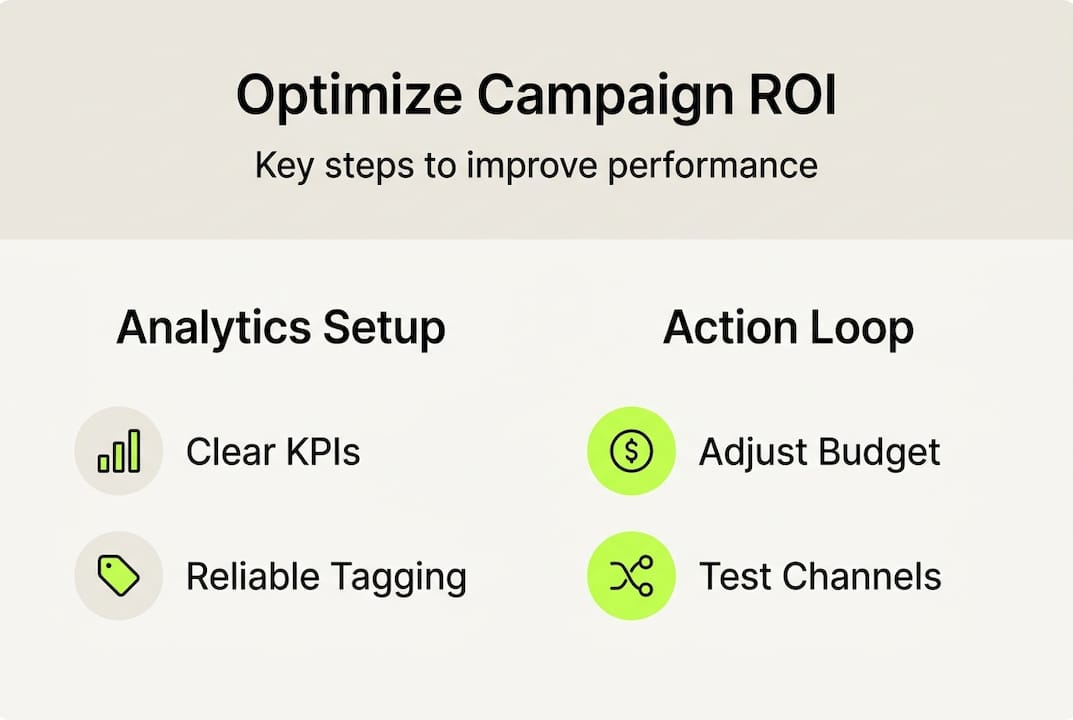
The power of this approach lies in creating a feedback loop between measurement and action. When you track ad performance metrics for ROI, you gain the insights needed to make confident optimization decisions. Combined with strategic planning, this process transforms analytics from a reporting exercise into a growth engine.
Integrating analytics platforms for comprehensive campaign measurement
Platform integration creates a unified view of campaign performance by connecting data across your marketing technology stack. GA4 provides the analytics foundation, tracking user behavior, conversion paths, and engagement metrics. GTM acts as the deployment layer, managing tracking tags without requiring code changes for every new implementation. Your CRM system captures the business outcome data that connects marketing activities to revenue.
Successful integration requires careful planning and execution. Start by mapping the customer journey and identifying key touchpoints you need to track. Implement consistent naming conventions across platforms to ensure data aligns properly. Set up automated data flows between systems to minimize manual work and reduce errors. Regular audits verify that tracking remains accurate as your campaigns and website evolve.
| Platform | Primary Function | Integration Benefit | Common Pitfall |
|---|---|---|---|
| GA4 | Behavior tracking and analysis | Complete user journey visibility | Complex setup, learning curve |
| GTM | Tag management and deployment | Faster implementation, fewer errors | Tag conflicts, firing issues |
| CRM | Customer data and revenue tracking | Revenue attribution, LTV calculation | Data silos, incomplete records |
Data consistency across platforms ensures your reports tell a coherent story. When GA4 shows 100 conversions but your CRM records 85, you need to investigate the discrepancy. Common causes include tracking delays, different conversion definitions, or technical implementation issues. Prioritizing proper integration helps SMEs shift effectively from vanity to revenue metrics.
Building a layered analytics approach means using each platform for its strengths. Use GA4 for understanding user behavior patterns and identifying optimization opportunities. Leverage GTM to quickly deploy new tracking as campaigns evolve. Rely on your CRM for definitive revenue data and customer lifetime value calculations. This layered strategy provides both the granular insights needed for tactical optimization and the business-level metrics required for strategic decisions.
Technical challenges often arise during integration. Cookie consent requirements affect tracking accuracy. Cross-domain tracking requires careful setup. Mobile app data needs separate configuration. Address these challenges systematically by documenting your setup, testing thoroughly, and maintaining clear communication between marketing and technical teams.
The investment in proper integration pays dividends through better decision-making. When you can see which campaigns drive not just conversions but high-value customers, you optimize very differently. Performance marketing tools work best when properly integrated, and following a step-by-step implementation guide ensures you build a solid foundation.
Optimize your campaigns with expert performance marketing support
Understanding analytics is essential, but implementing and optimizing data-driven campaigns requires ongoing expertise and attention. Professional performance marketing support helps you move from theory to results faster. Agencies specializing in multi-channel paid ads bring experience across industries, allowing them to spot opportunities and avoid common pitfalls.
Expert campaign management combines strategic thinking with tactical execution. This includes setting up proper tracking, choosing the right attribution models, optimizing ad creative and targeting, and continuously testing new approaches. When you partner with specialists who focus on ROI-driven results, you gain access to proven frameworks and tools that accelerate your growth.
The key is finding partners who align with your business goals and communicate transparently about performance. Look for agencies that emphasize tracking ad performance metrics and demonstrate clear ROI from their campaigns. The right support helps you scale what works while maintaining efficiency.
Frequently asked questions about analytics in campaigns
What KPIs should I prioritize for e-commerce versus healthcare campaigns?
E-commerce campaigns should focus on revenue per session, average order value, customer acquisition cost, and repeat purchase rate. Healthcare campaigns typically prioritize cost per qualified lead, appointment booking rate, patient acquisition cost, and lifetime patient value. Both industries benefit from tracking conversion rate and return on ad spend.
How do I decide which attribution model fits my campaign best?
Your attribution model should match your sales cycle length and channel complexity. Short sales cycles with few touchpoints work well with last-click or time-decay models. Longer consideration periods with multiple channels benefit from position-based or data-driven attribution. Start simple and add complexity as you gather more data.
What are the top challenges integrating GA4, GTM, and CRMs?
The biggest challenges include maintaining data consistency across platforms, managing cookie consent requirements, setting up cross-domain tracking correctly, and ensuring CRM data flows back to analytics tools. Technical implementation requires coordination between marketing and development teams. Regular audits help catch tracking issues before they corrupt your data.
How often should I review analytics to optimize campaigns effectively?
Review leading indicators like traffic and engagement weekly to catch trends early and make tactical adjustments. Conduct monthly deep dives into revenue metrics, attribution, and channel performance for strategic decisions. Quarterly reviews should assess overall marketing strategy and major budget allocation. This cadence balances responsiveness with strategic perspective.