
TL;DR:
- A well-structured marketing funnel guides prospects from awareness to purchase effectively.
- Diagnosing and fixing leaks at each funnel stage increases conversions and revenue.
- Retargeting and AI tools optimize the funnel by re-engaging warm leads and identifying ready buyers.
You're driving traffic. Your ads are running. But leads trickle in slowly, and sales feel harder than they should. Sound familiar? The problem usually isn't your product or your budget. It's your funnel. Most small and medium-sized businesses invest in getting people to their website but skip the strategic layer that turns visitors into buyers. A well-structured marketing funnel is the system that bridges that gap. In this guide, we break down each funnel stage, show you where most businesses lose prospects, and give you actionable steps to fix it.
Table of Contents
- What is a marketing funnel and why it matters
- Breaking down the funnel: TOFU, MOFU, and BOFU explained
- Diagnosing funnel leaks and drop-offs
- Optimizing your funnel: Retargeting, transparency, and AI shortcuts
- The real secret to converting more leads: What experts rarely tell you
- Drive more conversions with pro funnel support
- Frequently asked questions
Key Takeaways
| Point | Details |
|---|---|
| Funnel stages matter | Understanding each funnel stage helps optimize every part of your marketing journey. |
| Identify and fix leaks | Regular analysis shows you where potential customers drop out so you can improve results fast. |
| Use retargeting and transparency | Retargeting and clear pricing strategies help recover lost leads and sales. |
| Leverage smart tech | AI tools can shortcut the funnel and deliver higher quality conversions. |
What is a marketing funnel and why it matters
A marketing funnel is a model that maps the journey a prospect takes from first hearing about your business to making a purchase. Think of it as a visual framework. Wide at the top where many people enter, narrow at the bottom where buyers emerge. Every business has a funnel, whether they know it or not. The question is whether yours is working for you or against you.
The funnel breaks into three core stages:
- TOFU (Top of Funnel): Awareness. People discover your brand through ads, search, or social content. The goal here is reach and visibility.
- MOFU (Middle of Funnel): Consideration. Prospects are evaluating options. They might download a guide, sign up for a webinar, or engage with your email sequence.
- BOFU (Bottom of Funnel): Conversion. This is where decisions happen. Demos, free trials, pricing pages, and purchase flows live here.
For small and medium-sized businesses, understanding this structure is critical. Without it, you end up pouring budget into one stage while neglecting others. You might run great awareness ads but have no nurture sequence. Or you might have a solid email list with no clear path to purchase.
"Key metrics vary by stage: TOFU tracks impressions and traffic; MOFU measures leads and engagement; BOFU focuses on conversions and sales. Funnel analysis helps you spot where prospects drop off before converting."
Understanding ad funnel impact on your revenue starts with knowing which stage is underperforming. The most common pitfall? Businesses obsess over traffic (TOFU) while ignoring the middle and bottom where money is actually made.
Breaking down the funnel: TOFU, MOFU, and BOFU explained
With a clear view of the funnel's purpose, let's look at what happens at each stage and how to move prospects through them intentionally.
| Stage | Primary Goal | Typical Tactics | Key Metrics |
|---|---|---|---|
| TOFU | Build awareness | Paid ads, SEO, social content | Impressions, traffic, reach |
| MOFU | Build trust and interest | Email nurture, lead magnets, retargeting | Leads, open rates, engagement |
| BOFU | Drive conversions | Sales pages, demos, offers | Conversions, revenue, ROI |
Here's a simple numbered framework for moving prospects through each stage:
- Attract at TOFU. Run targeted Google Ads or Meta campaigns to reach your ideal audience. Focus on problem-aware messaging.
- Capture at MOFU. Offer something valuable, like a checklist, free audit, or webinar, in exchange for contact info. This is your lead magnet.
- Nurture at MOFU. Follow up with an email sequence that builds credibility and addresses objections. Most businesses skip this step entirely.
- Convert at BOFU. Present a clear, low-friction offer. Make it easy to say yes with strong social proof and transparent pricing.
- Analyze and iterate. Review your funnel drop-off data regularly to find where prospects are exiting and why.
What most businesses neglect at MOFU is consistent follow-up. A prospect who downloaded your lead magnet isn't ready to buy yet. They need three to seven touchpoints before they trust you enough to convert. Understanding performance marketing basics helps you build those touchpoints with purpose.

Pro Tip: Set up funnel analytics in Google Analytics 4 or your CRM to track stage-by-stage conversion rates. Even a rough view of where people drop off tells you exactly where to focus your energy first.
Diagnosing funnel leaks and drop-offs
Now that you understand funnel stages, it's time to address the most common challenge: funnel leaks. A funnel leak is any point where a prospect exits the journey before converting. They came in, showed interest, and then disappeared. That's a leak.
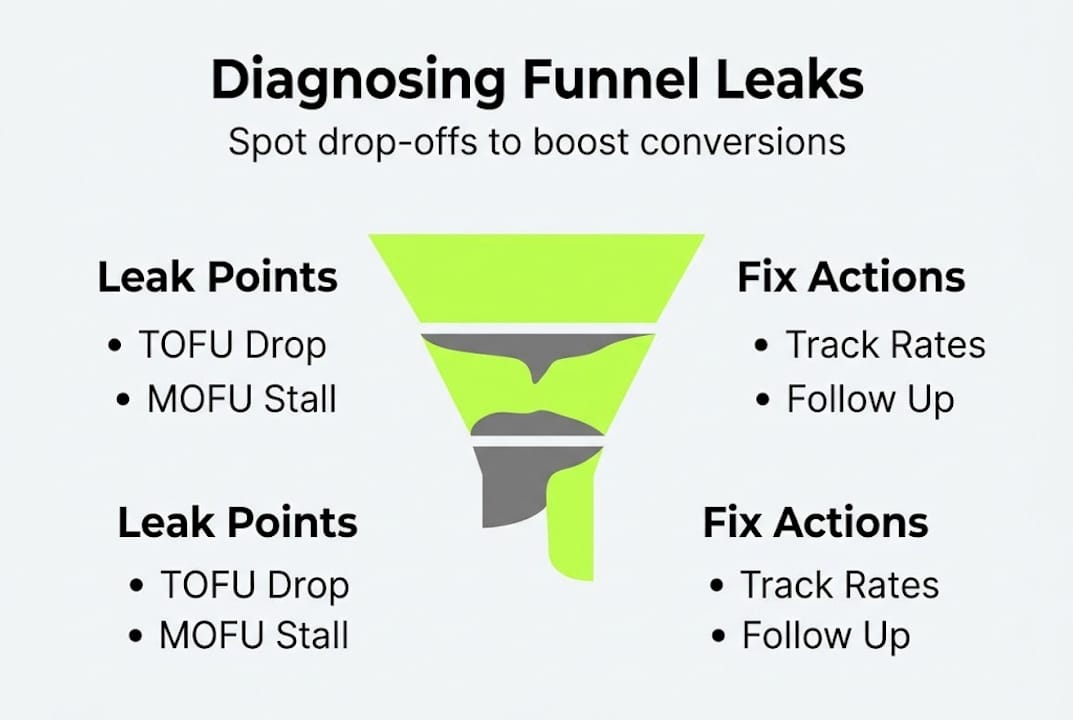
Leaks happen at every stage, but the symptoms look different depending on where they occur.
| Leak Location | Symptom | Likely Cause |
|---|---|---|
| TOFU to MOFU | High traffic, low lead capture | Weak offer, poor landing page |
| MOFU to BOFU | Leads go cold, low email engagement | Irrelevant content, no clear next step |
| BOFU | High cart abandonment, low close rate | Pricing friction, trust deficit |
To diagnose drop-offs accurately, look at these key indicators:
- Traffic gaps: Are people landing on your pages but bouncing immediately? Check page load speed and message match between your ad and landing page.
- Poor conversion rates: If your landing page converts below 2%, the offer or copy needs work.
- Audience mismatch: Are you attracting the wrong people at TOFU? Misaligned targeting wastes budget and floods your funnel with unqualified leads.
The top three reasons for high cart abandonment and what to do first:
- Unexpected costs at checkout. Shipping fees, taxes, or fees that appear late in the process kill conversions. Show total cost early.
- Lack of trust signals. Missing reviews, guarantees, or security badges make buyers hesitate. Add them above the fold.
- Complicated checkout flow. Every extra field or step increases abandonment. Audit your checkout and cut anything unnecessary.
Understanding ad funnel performance at each stage gives you the data you need to stop guessing and start fixing.
Optimizing your funnel: Retargeting, transparency, and AI shortcuts
Knowing what's broken is only half the battle. Here's how to make your funnel work smarter.
- Plug TOFU leaks with better targeting. Refine your audience parameters in Google Ads and Meta. Use lookalike audiences based on your existing buyers, not just broad interest categories.
- Recover MOFU drop-offs with retargeting. Retargeting is one of the highest-ROI tactics available. Someone who visited your pricing page but didn't convert is a warm lead. Serve them a specific ad that addresses their likely objection.
- Fix BOFU friction with transparent pricing. Hidden fees and vague pricing create hesitation. Businesses that display clear pricing consistently see higher close rates.
- Use AI to identify ready-to-buy segments. Modern ad platforms use machine learning to find users who are already in buying mode. This lets you target BOFU-ready prospects directly, sometimes skipping the nurture phase entirely.
Cart abandonment sits at 70% across most industries. That means seven out of ten people who reach your checkout leave without buying. Retargeting those users with a simple reminder ad or a small incentive can recover a significant portion of that lost revenue.
For retargeting for conversions, the key is message specificity. A generic retargeting ad underperforms. An ad that speaks directly to what the prospect viewed, like a specific product or service page, dramatically outperforms. Learn how to boost ROI with retargeting by matching your ad creative to the exact stage the prospect left at.
Pro Tip: Start with one fix at a time. Clarifying your pricing page alone can lift conversions by double digits without touching your ad spend.
The real secret to converting more leads: What experts rarely tell you
Here's what most funnel guides won't say: the classic linear funnel is a useful model, not a description of reality. Real customers jump stages. They might see one ad, go directly to your pricing page, and buy the same day. Or they might spend three months in MOFU before finally converting. Treating every prospect the same way wastes opportunity.
The businesses that consistently outperform their competitors run continuous A/B tests on every stage. Not just landing pages, but email subject lines, ad creative, offer framing, and checkout flows. Testing beats theorizing every time.
We also believe the funnel should be treated as a dynamic loop, not a straight line. After conversion, the relationship continues. Upsells, referrals, and loyalty programs feed new prospects back into the top. Segmenting your audience by behavior, not just demographics, lets you personalize messaging in ways that dramatically lift engagement.
For ready-to-buy segments, skip the nurture and go straight to BOFU. Explore proven ROI marketing tactics that align with where your audience actually is, not where you assume they are.
Drive more conversions with pro funnel support
Optimizing your marketing funnel is one of the most reliable ways to grow leads and revenue without simply spending more on ads. But diagnosing leaks, building nurture sequences, and running retargeting campaigns takes time and expertise most business owners don't have on hand.
We work with small and medium-sized businesses to analyze their full funnel, identify the biggest drop-off points, and build paid ad systems that move prospects from awareness to conversion efficiently. From multi-channel ad management to full-funnel campaign strategy, we handle the execution so you can focus on running your business. Visit A&T Digital Agency to see how we can help you turn more clicks into customers.
Frequently asked questions
What are the main stages of a marketing funnel?
The main stages are TOFU (awareness), MOFU (consideration), and BOFU (conversion), each with specific goals and stage-specific metrics like impressions, leads, and sales.
How can I tell where my funnel is leaking?
Analyze each stage's conversion rates and look for sharp drop-off points where prospects stop engaging, which usually signals a trust or relevance problem.
What's the best way to reduce cart abandonment?
Use retargeting ads, simplify your checkout process, and display pricing clearly upfront, since 70% cart abandonment is often driven by unexpected costs or friction.
How is AI changing the marketing funnel?
AI identifies and targets BOFU-ready prospects directly, sometimes bypassing earlier funnel stages entirely for faster, more efficient conversions.