

Many retail marketers believe remarketing is just about chasing cart abandoners with generic discount codes. That’s a costly misconception. Effective remarketing recaptures interested customers at multiple touchpoints, personalizes messaging based on behavior, and transforms casual browsers into loyal buyers. For small to medium retail businesses, remarketing strategies can increase conversion rates by 150% while reducing customer acquisition costs. This guide reveals how to leverage remarketing to boost retention, drive sales, and build sustainable growth in competitive e-commerce markets.
Table of Contents
-
Measuring Impact And Optimizing Retail Remarketing Campaigns
-
Leverage Expert Remarketing Management To Boost Your Retail Growth
Key takeaways
| Point | Details |
|---|---|
| Remarketing recaptures interest | Targeting previous visitors increases conversion rates significantly compared to cold traffic. |
| Personalization drives ROI | Tailored ad campaigns based on user behavior deliver higher engagement and better returns. |
| Multi-channel approach wins | Combining display, social, and email remarketing expands reach and reinforces messaging. |
| Data optimization is essential | Tracking key metrics and continuous testing maximize remarketing campaign performance. |
| Long-term retention matters | Strategic remarketing builds customer loyalty beyond immediate sales conversions. |
Understanding remarketing and its role in retail
Remarketing targets potential customers who previously engaged with your brand but didn’t complete a purchase. In retail, this means reconnecting with visitors who browsed products, added items to cart, or explored category pages without converting. These warm audiences already know your brand, making them far more valuable than cold prospects.
Retail remarketing addresses specific customer behaviors throughout the sales funnel. A visitor who viewed running shoes three times shows clear purchase intent. Someone who abandoned a cart with $200 worth of skincare products needs a different message than a first-time browser. Remarketing lets you match messaging to these distinct stages, moving customers from awareness to consideration to final purchase.
The strategy works particularly well for retail because shopping journeys rarely happen in one session. Customers research, compare prices, read reviews, and return multiple times before buying. Remarketing keeps your products visible during this decision process, building brand recall when competitors fight for attention.
Key benefits for retail marketers include:
-
Reduced cart abandonment through timely reminders and incentives
-
Higher conversion rates from warm audiences versus cold traffic
-
Improved customer lifetime value through repeat purchase campaigns
-
Better budget efficiency by focusing spend on interested prospects
-
Enhanced brand loyalty through consistent, relevant touchpoints
Combining remarketing with performance marketing benefits creates a powerful system for sustainable retail growth. You’re not just chasing one-time sales but building relationships that drive repeat revenue. The data you gather from remarketing campaigns also informs broader marketing strategies, revealing which products resonate, which messaging converts, and where customers drop off.
Key remarketing strategies to increase retail conversions
Segmentation forms the foundation of successful retail remarketing. Divide your audience based on specific actions: product viewers, cart abandoners, past purchasers, high-value browsers, and engaged email subscribers. Each segment needs tailored messaging that speaks to their relationship with your brand.
Dynamic product ads showcase exactly what customers viewed, creating personalized shopping experiences at scale. If someone browsed blue winter jackets, show them those jackets plus complementary items like scarves or boots. This relevance dramatically improves click-through rates compared to generic brand ads. Personalized ad campaigns deliver measurably better retail marketing ROI.
Timing and frequency control prevent ad fatigue while maintaining visibility. Here’s an effective sequence:
-
Day 1-3 after site visit: Show product reminder ads with educational content
-
Day 4-7: Introduce social proof like reviews or bestseller badges
-
Day 8-14: Offer limited-time incentives or free shipping
-
Day 15-30: Showcase related products or new arrivals
-
Beyond 30 days: Shift to brand awareness or seasonal campaigns
Multi-channel remarketing reinforces your message across platforms where customers spend time. Display ads reach them while browsing news sites. Social media ads appear in Facebook and Instagram feeds. Email remarketing delivers personalized product recommendations directly to inboxes. This coordinated approach increases touchpoints without overwhelming any single channel.

Continuous testing optimizes every campaign element. Test ad creative variations, different value propositions, audience segments, bidding strategies, and landing page designs. Run A/B tests on headline copy, image styles, call-to-action buttons, and promotional offers. Small improvements compound into significant performance gains.
Pro Tip: Create exclusion lists to prevent showing ads to recent purchasers of the same product. Instead, shift them to cross-sell campaigns featuring complementary items. This prevents wasted spend and improves customer experience.
Implementing proven remarketing tactics requires consistent monitoring and adjustment. What works for winter apparel may fail for electronics. Test ruthlessly, scale winners, and cut losers quickly. Your remarketing system should evolve with customer behavior and seasonal trends.
Layering Meta ads remarketing with Google display campaigns creates comprehensive coverage. Meta excels at social engagement and visual storytelling. Google captures intent-driven searches and browsing behavior. Together, they address different customer mindsets throughout the purchase journey.
Tools and platforms that empower retail remarketing success
Google Ads provides robust remarketing capabilities through display network, search remarketing lists, and YouTube video ads. The platform excels at reaching customers across millions of websites and apps. Audience segmentation options let you target by page visits, time on site, specific product views, and conversion actions. Dynamic remarketing automatically generates ads featuring products customers viewed, streamlining campaign creation.
Meta Ads (Facebook and Instagram) delivers powerful social remarketing through custom audiences and lookalike targeting. Upload customer lists, create website visitor audiences, or target engagement with your social content. The visual nature of Meta platforms suits retail perfectly, showcasing products in feeds, stories, and reels. Shopping integrations let customers browse and purchase without leaving the platform.
| Platform | Best For | Key Features | Retail Advantage |
|---|---|---|---|
| Google Ads | Intent-driven remarketing | Display network, RLSA, dynamic ads | Massive reach across web properties |
| Meta Ads | Social engagement | Custom audiences, visual formats, shopping | High engagement, native commerce |
| Email platforms | Direct communication | Automated sequences, personalization | Owned channel, detailed tracking |
| CRM systems | Customer data management | Segmentation, lifecycle tracking | Unified customer view |
Marketing automation tools like Klaviyo, Omnisend, or Mailchimp handle email remarketing with triggered campaigns based on customer behavior. Abandoned cart sequences, browse abandonment emails, and post-purchase follow-ups run automatically. Integration with your e-commerce platform ensures real-time data synchronization.
CRM systems centralize customer data, enabling sophisticated segmentation across all remarketing channels. Track purchase history, browsing patterns, email engagement, and customer lifetime value in one place. This unified view powers personalized messaging that resonates with individual customers.
Data analytics platforms measure remarketing performance and identify optimization opportunities. Google Analytics tracks conversion paths, showing how remarketing touchpoints contribute to sales. Platform-specific dashboards in Google Ads and Meta Ads Manager provide campaign metrics. Third-party tools like Supermetrics or Funnel.io consolidate data for comprehensive reporting.
Selecting the right marketing platforms enhances remarketing efficiency and campaign management. Start with core platforms where your customers spend time, then expand as you scale. Integration capabilities matter; tools should share data seamlessly to create cohesive customer experiences.
Pro Tip: Implement server-side tracking alongside pixel-based tracking to maintain data accuracy as privacy regulations evolve. This future-proofs your remarketing infrastructure against browser restrictions and cookie limitations.
For retail businesses seeking comprehensive solutions, digital marketing services can integrate multiple platforms into unified strategies. The key is choosing scalable tools that grow with your business while maintaining manageable complexity.
Combining Google Ads for retail remarketing with Meta Ads remarketing tools creates a foundation for multi-channel success. Layer in email automation and CRM integration to build a remarketing system that drives consistent results.
Measuring impact and optimizing retail remarketing campaigns
Click-through rate (CTR) reveals how compelling your ad creative and messaging are to remarketing audiences. Low CTR indicates poor relevance or creative fatigue. Benchmark against industry standards, but focus on improving your own baseline. Test new images, headlines, and offers to boost engagement.
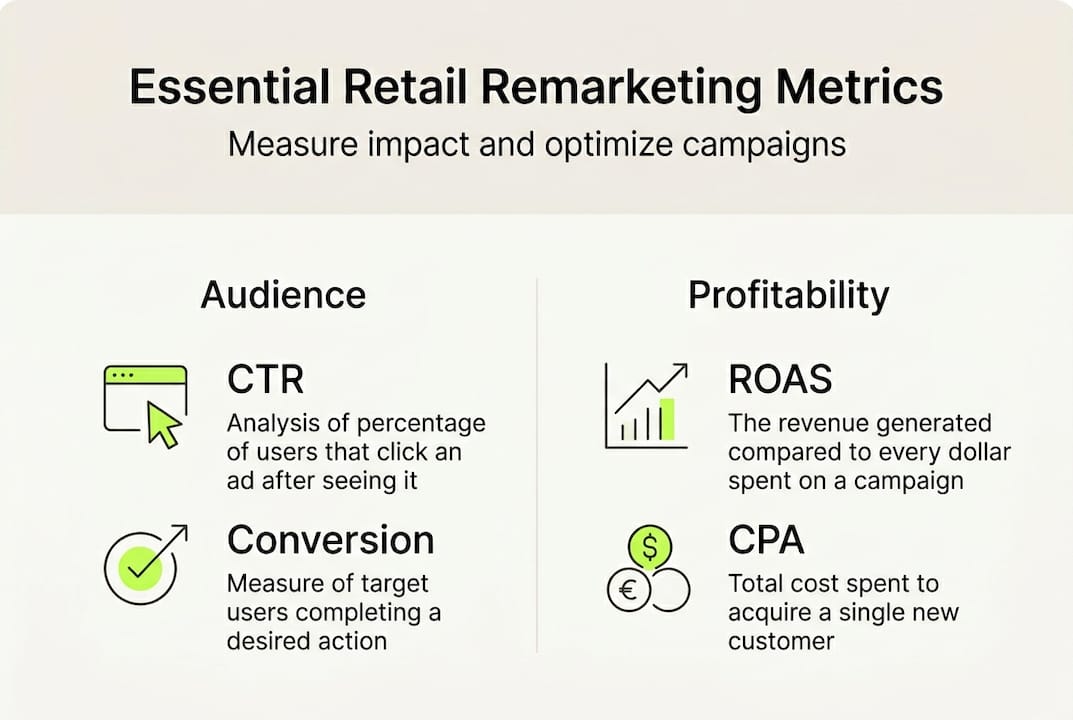
Conversion rate measures how effectively remarketing traffic completes desired actions. High CTR with low conversion rate suggests landing page issues or misaligned expectations. Ensure your landing pages match ad promises and provide frictionless checkout experiences. Remove unnecessary form fields and streamline the purchase path.
Cost per acquisition (CPA) determines remarketing profitability. Calculate total campaign spend divided by conversions. Compare CPA across segments to identify your most efficient audiences. Shift budget toward lower CPA segments while testing improvements for higher-cost groups.
Return on ad spend (ROAS) shows revenue generated per dollar invested. Retail remarketing should deliver ROAS of 4:1 or higher, though this varies by product margins and customer lifetime value. Tracking relevant metrics predicts remarketing campaign success and ROI. Calculate ROAS by dividing revenue from remarketing by total ad spend.
Customer lifetime value (CLV) extends measurement beyond initial conversions. Remarketing should increase repeat purchase rates and average order values over time. Track how remarketing audiences behave in subsequent months compared to non-remarketed customers.
Key optimization tactics:
-
Run A/B tests on ad creative every two weeks to maintain freshness
-
Analyze conversion funnel drop-off points using Google Analytics
-
Adjust bid strategies based on device, location, and time-of-day performance
-
Exclude converted customers from acquisition campaigns to prevent overlap
-
Increase budgets for high-ROAS segments during peak shopping periods
| Metric | Target Range | Optimization Action |
|---|---|---|
| CTR | 0.5% to 2% | Test new creative, refine targeting |
| Conversion Rate | 2% to 5% | Improve landing pages, simplify checkout |
| CPA | Below 30% of AOV | Shift budget to efficient segments |
| ROAS | 4:1 or higher | Scale winning campaigns, cut losers |
Regular reporting creates accountability and reveals trends. Weekly reviews catch performance drops quickly. Monthly deep dives identify seasonal patterns and long-term opportunities. Quarterly strategic assessments ensure remarketing aligns with broader business goals.
Segment analysis uncovers hidden insights. Compare performance across product categories, customer demographics, and behavior types. You might discover cart abandoners convert better on mobile while product viewers prefer desktop. Use these insights to refine targeting and creative.
Budget allocation should follow performance data ruthlessly. If dynamic product ads deliver 6:1 ROAS while generic brand ads return 2:1, shift spend accordingly. Reserve a small testing budget for new strategies, but let proven winners capture the majority of investment.
Maximizing remarketing ROI requires disciplined measurement and continuous optimization. Set clear benchmarks, track progress consistently, and make data-driven decisions. The retailers who win treat remarketing as an evolving system, not a set-it-and-forget-it tactic.
Leverage expert remarketing management to boost your retail growth
Building effective remarketing systems demands specialized expertise, ongoing optimization, and significant time investment. Many retail marketing managers juggle multiple priorities, making it challenging to extract maximum value from remarketing campaigns. Partnering with specialists who live and breathe paid advertising can transform your results.
A&T Digital Agency manages comprehensive remarketing campaigns across Google Ads and Meta platforms, creating customized strategies that align with your retail business goals. Our team handles everything from audience segmentation and creative development to bid optimization and performance reporting. We’ve helped retail clients achieve ROAS improvements of 200% or more through strategic remarketing.
Our approach combines data-driven targeting with compelling creative that resonates with your customers. We continuously test, analyze, and refine campaigns to maximize every advertising dollar. You get the benefit of enterprise-level expertise without the overhead of building an in-house team.
Ready to turn website visitors into loyal customers? Explore our Google Ads management services and Meta Ads management solutions to see how professional remarketing drives retail growth. Our multi-channel paid ads services integrate remarketing across platforms for maximum impact.
Frequently asked questions
What is remarketing in retail and why does it matter?
Remarketing in retail targets past website visitors with tailored ads designed to bring them back and complete purchases. It matters because these warm audiences already showed interest in your products, making them significantly more likely to convert than cold traffic. Remarketing reduces wasted ad spend by focusing budget on prospects who demonstrated buying intent. The strategy also builds brand recall during the research phase when customers compare options across multiple retailers.
How can small retail businesses implement remarketing effectively?
Start with simple segmentation separating cart abandoners from product viewers, then create dynamic ads on Google and Meta showing products they browsed. Performance marketing tactics work for businesses of all sizes when executed strategically. Leverage cost-effective tools like Google Ads remarketing lists and Meta custom audiences, which have low minimum spends. Focus on one or two platforms initially, master the basics, then expand to additional channels as you scale.
Which metrics should retail marketers focus on to assess remarketing success?
Focus on click-through rate, conversion rate, return on ad spend, cost per acquisition, and customer lifetime value as your core remarketing metrics. These indicators provide a clear picture of campaign effectiveness from initial engagement through long-term customer value. Track how remarketing audiences perform compared to cold traffic to quantify the strategy’s impact. Monitor sales success metrics consistently to identify trends and optimization opportunities before they impact revenue.
What common mistakes should retailers avoid in their remarketing campaigns?
Avoid overexposure that causes ad fatigue by capping frequency to three to five impressions per user per day. Don’t lump all website visitors into one audience; proper segmentation based on behavior dramatically improves results. Ignoring data analysis leads to wasted spend on underperforming campaigns that could be optimized or eliminated. Regularly test and refresh creative assets to maintain engagement, as even successful ads lose effectiveness over time. Following remarketing best practices prevents these costly errors and accelerates campaign performance.