
Many marketing managers at small to medium-sized businesses waste thousands monthly on poorly targeted ads, ineffective campaigns, and unclear performance data. Yet the solution is straightforward: a structured, data-driven approach to auditing, allocating, and refining your ad spend can reclaim up to 30% of wasted budget and turn it into measurable growth. This guide walks you through the prerequisites, step-by-step process, common pitfalls, and realistic outcomes you can expect when optimizing your advertising investments.
Table of Contents
- Prerequisites: What You Need Before Optimizing Ad Spend
- Step 1: Auditing and Assessing Current Ad Spend
- Step 2: Crafting a Data-Driven Budget Allocation Strategy
- Step 3: Continuous Campaign Optimization and Testing
- Common Mistakes to Avoid in Ad Spend Optimization
- Expected Outcomes and Measuring Success
- Optimize Your Ad Spend with Expert Performance Marketing Services
- FAQ
Key Takeaways
| Point | Details |
|---|---|
| Prerequisites | Audit current spend and understand key metrics like CPA, ROAS, and CLTV before optimizing. |
| Optimization Process | Follow audit, strategic allocation, continuous testing, and weekly refinement cycles. |
| Common Mistakes | Avoid over-optimization through daily changes and neglecting mobile user experience. |
| Expected Outcomes | Achieve 15-30% conversion increases and 15-25% CPA reductions within 6-8 weeks. |
Prerequisites: What You Need Before Optimizing Ad Spend
Before you can improve ad performance, you need a clear picture of where your money goes and what results you get. Jumping into optimization without baseline data is like driving blindfolded. Start with a full audit of your current ad spend across all platforms to identify inefficiencies and hidden budget drains.
Understand the core performance metrics that drive ROI decisions. Cost Per Acquisition (CPA) tells you how much you pay to gain one customer. Return on Ad Spend (ROAS) reveals how much revenue each ad dollar generates. Customer Lifetime Value (CLTV) shows the total profit you can expect from a customer relationship. Gather baseline campaign data for benchmarking and understand key metrics such as CPA, ROAS, and CLTV to establish a reference point.
You also need reliable tracking infrastructure. Set up Google Analytics 4 or equivalent analytics platforms to capture accurate conversion data. Without proper tracking, you cannot measure what works or make informed budget decisions. Configure conversion tracking for all key actions: form submissions, purchases, phone calls, and email signups.
Collect at least two to four weeks of baseline performance data before making major changes. This gives you a statistically meaningful comparison point. Document current conversion rates, average CPA, ROAS by platform, and top-performing audience segments. These benchmarks become your success yardstick as you refine campaigns.
Essential tools and data you need include:
- Platform-specific analytics dashboards for Google Ads and Meta Ads Manager
- Third-party tracking tools for cross-platform attribution and deeper insights
- Historical performance reports covering at least 30 days of campaign activity
- Clear documentation of current audience targeting parameters and ad creative variants
- Budget allocation records showing spend distribution across campaigns and platforms
When you track ad performance metrics consistently, you create a foundation for smart optimization decisions that compound over time.
Step 1: Auditing and Assessing Current Ad Spend
Your audit uncovers exactly where money leaks from your campaigns. Review performance data across all advertising platforms you use. Look at spend per campaign, conversion rates, CPA, and ROAS for each audience segment and ad group. This granular view reveals which campaigns deliver results and which drain budgets without returns.
Identify budget waste systematically. A thorough audit can identify up to 30% wasted ad budget worth reallocating for better ROI. Common sources of waste include broad keyword targeting that attracts irrelevant clicks, poorly segmented audiences that include unqualified prospects, and ads that run during low-conversion time periods. Quantify the percentage of your budget going to campaigns with CPA above your target threshold.

Assess ad relevance and audience segmentation quality. Are your ads speaking directly to customer pain points? Do your landing pages match ad messaging and intent? Misalignment between ad copy, targeting, and landing page experience drives up costs and tanks conversion rates. Review quality scores on Google Ads and relevance scores on Meta platforms as diagnostic signals.
Document everything you find. Create a spreadsheet listing each campaign with current spend, conversions, CPA, ROAS, and a flag for underperformers. This becomes your roadmap for reallocation. Mark campaigns spending more than 20% above your target CPA as candidates for immediate adjustment or pause.
Follow this audit process:
- Export performance reports from each advertising platform covering the past 30 to 60 days
- Calculate CPA and ROAS for every campaign and ad group to spot outliers
- Identify campaigns with conversion rates below platform averages or your historical benchmarks
- Review audience targeting settings to find overly broad or misaligned segments
- Check ad creative performance to see which messages and formats drive engagement
- Document baseline metrics in a centralized dashboard for ongoing comparison
Pro Tip: Combine platform analytics with third-party attribution tools to get a complete picture of customer journey touchpoints. Platform-reported conversions often miss cross-device behavior and assisted conversions that contribute to final sales.
When you optimize ad campaigns for ROI, start with data, not assumptions. Your audit provides the evidence needed to make confident digital ad spend management decisions that drive measurable improvements.
Step 2: Crafting a Data-Driven Budget Allocation Strategy
With audit insights in hand, you can allocate budgets strategically instead of spreading money evenly across all platforms. Applying a 60/40 budget split between Google Ads and Meta campaigns often yields best ROI for SMBs in competitive industries. Google Ads captures high-intent search traffic ready to convert, while Meta platforms excel at awareness and mid-funnel engagement.
This baseline allocation should flex based on your specific performance data. If your audit shows Meta campaigns delivering 40% lower CPA than Google, shift more budget there. If seasonal trends show search volume spikes in certain months, plan to increase Google Ads spend accordingly. Data should drive every allocation decision.
Maintain consistent messaging across all platforms even as you adjust budgets. A prospect who sees your Google search ad and later encounters your Meta retargeting ad should experience a cohesive brand story. Inconsistent messaging confuses prospects and weakens campaign effectiveness. Coordinate creative assets, value propositions, and calls to action across channels.
Adjust budgets seasonally and according to your sales cycles. Most industries have peak demand periods when increased ad spend drives disproportionate returns. Retail spikes during holidays, B2B services see higher intent at fiscal year-end, and local services surge during specific weather seasons. Build these patterns into your allocation strategy to maximize efficiency.
Consider automation tools to manage bids and reduce manual workload. Smart bidding strategies on Google Ads and automatic placements on Meta platforms use machine learning to optimize in real time. Start with manual campaigns to establish baselines, then gradually introduce automation as you gain confidence in platform algorithms.
Key allocation principles include:
- Start with a 60% Google Ads and 40% Meta baseline, then adjust based on actual CPA and ROAS performance
- Reserve 10 to 15% of total budget for testing new platforms, audiences, and creative variants
- Increase spend on campaigns consistently delivering CPA below target and ROAS above goals
- Reduce or pause campaigns with CPA exceeding target by more than 25% after optimization attempts
- Plan budget increases during known high-conversion periods based on historical data
Pro Tip: Review your budget allocation strategies monthly, not just when launching new campaigns. Performance shifts as competition changes, audience behavior evolves, and platform algorithms update. Monthly reviews keep your allocation aligned with current realities.
Understanding performance marketing terminology helps you communicate allocation strategies clearly with stakeholders and make faster decisions when opportunities arise.
Step 3: Continuous Campaign Optimization and Testing
Optimization is not a one-time event but an ongoing cycle of testing, measuring, and refining. Set a weekly schedule for bid adjustments and campaign reviews. This cadence gives platform algorithms enough time to stabilize while keeping you responsive to performance trends. Implementing weekly optimization cadences and A/B testing helps reduce CPA by 15-25%.
Use A/B testing to systematically improve creative, messaging, and targeting parameters. Test one variable at a time so you can isolate what drives results. Run ad copy variant A against variant B with identical targeting and budgets. After gathering statistically significant data, implement the winner and test the next variable.
Monitor key metrics such as CPA and ROAS trends closely. Look for week-over-week changes that signal improving or declining performance. A sudden CPA spike might indicate increased competition, declining ad relevance scores, or audience fatigue. Investigate immediately rather than letting costs spiral.
Avoid daily changes that prevent over-optimization and algorithm destabilization. Platforms need time to learn and optimize delivery. When you make daily adjustments, you reset the learning process and often increase costs. Unless you see a critical issue like budget overspend or complete campaign failure, stick to weekly optimization reviews.
Structure your testing workflow:
- Choose one element to test: ad copy, headline, image, audience segment, or bidding strategy
- Create two variants that differ in only that one element to isolate impact
- Run both variants simultaneously with equal budget splits for at least one week
- Analyze results using statistical significance calculators to confirm winners
- Implement the winning variant and archive or pause the loser
- Document learnings and select the next test element from your priority list
Common A/B test elements that drive meaningful improvements:
- Ad copy variants emphasizing different benefits or pain points
- Audience segments comparing broad versus narrow targeting parameters
- Bidding strategies testing manual CPC versus automated target CPA
- Landing page experiences with different layouts, forms, or calls to action
- Ad creative formats comparing static images versus video versus carousel ads
Pro Tip: Use holdout groups when testing major changes. Keep 10 to 20% of your budget running the original campaign while you test the new variant. This protects you from performance drops if the test fails and gives you a clean comparison.
Proper ad campaign setup from the start makes ongoing optimization smoother. When you track ad performance consistently, you build a data library that informs faster, smarter optimization decisions over time.
Common Mistakes to Avoid in Ad Spend Optimization
Even experienced marketers fall into traps that undermine optimization efforts. Poor audience segmentation inflates costs and reduces campaign effectiveness. Targeting too broadly wastes budget on unqualified clicks. Targeting too narrowly limits reach and drives up costs through excessive competition. Find the balance through testing and data analysis.
Over-optimization through daily campaign tweaks is surprisingly common and costly. Making frequent adjustments prevents platform algorithms from stabilizing and learning optimal delivery patterns. This destabilization can increase CPA by up to 18% compared to weekly optimization schedules. Resist the urge to tinker daily, even when you see short-term fluctuations.
Ignoring mobile user experience cuts engagement rates dramatically. Ignoring mobile optimization leads to 50% lower engagement rates, severely impacting paid campaign ROI. More than 60% of paid ad clicks come from mobile devices in most industries. If your landing pages load slowly, display poorly, or require excessive scrolling on mobile, you throw away half your ad spend.
Mobile users who encounter poor page experiences bounce within three seconds, wasting your ad dollars and tanking your quality scores across platforms.
Inconsistent messaging across platforms weakens overall campaign impact. A prospect who sees a discount offer in your Google ad but finds no mention of it on your landing page loses trust immediately. Align your ad copy, landing page headlines, and calls to action across every touchpoint. Consistency builds credibility and improves conversion rates.
Neglecting negative keywords on search campaigns drains budgets quickly. Without regular negative keyword reviews, your ads appear for irrelevant searches that will never convert. Review search term reports weekly and add non-converting terms to your negative keyword lists.
Critical mistakes that sabotage optimization:
- Making daily bid adjustments instead of allowing weekly learning cycles
- Failing to mobile-optimize landing pages despite mobile traffic dominance
- Using the same generic ad copy across vastly different audience segments
- Ignoring platform quality and relevance score warnings that signal rising costs
- Launching campaigns without conversion tracking properly configured
- Pausing campaigns prematurely before gathering statistically significant data
When you optimize Google Ads ROI, avoid these pitfalls by building systematic processes that prevent common errors. Apply the same discipline to Meta ads strategies for ROI to ensure consistent performance across all platforms.
Expected Outcomes and Measuring Success
Set realistic expectations for optimization timelines and results. The typical timeframe for noticeable ROI improvements is six to eight weeks after implementing optimization strategies. Platform algorithms need time to learn, test variants require sufficient data, and audience behavior patterns take time to emerge. Expect gradual improvement rather than overnight transformation.
Conversion rates can increase by 15 to 30% with properly optimized campaigns. This improvement comes from better audience targeting, more relevant ad creative, improved landing page experiences, and smarter budget allocation. The exact increase depends on your starting point. Campaigns with significant waste or poor targeting see larger gains.
Cost Per Acquisition typically decreases by 15 to 25% through continuous optimization adjustments. Lower CPA results from eliminating wasted spend, improving quality scores, and focusing budgets on high-performing segments. Again, campaigns starting with higher inefficiency see more dramatic reductions.
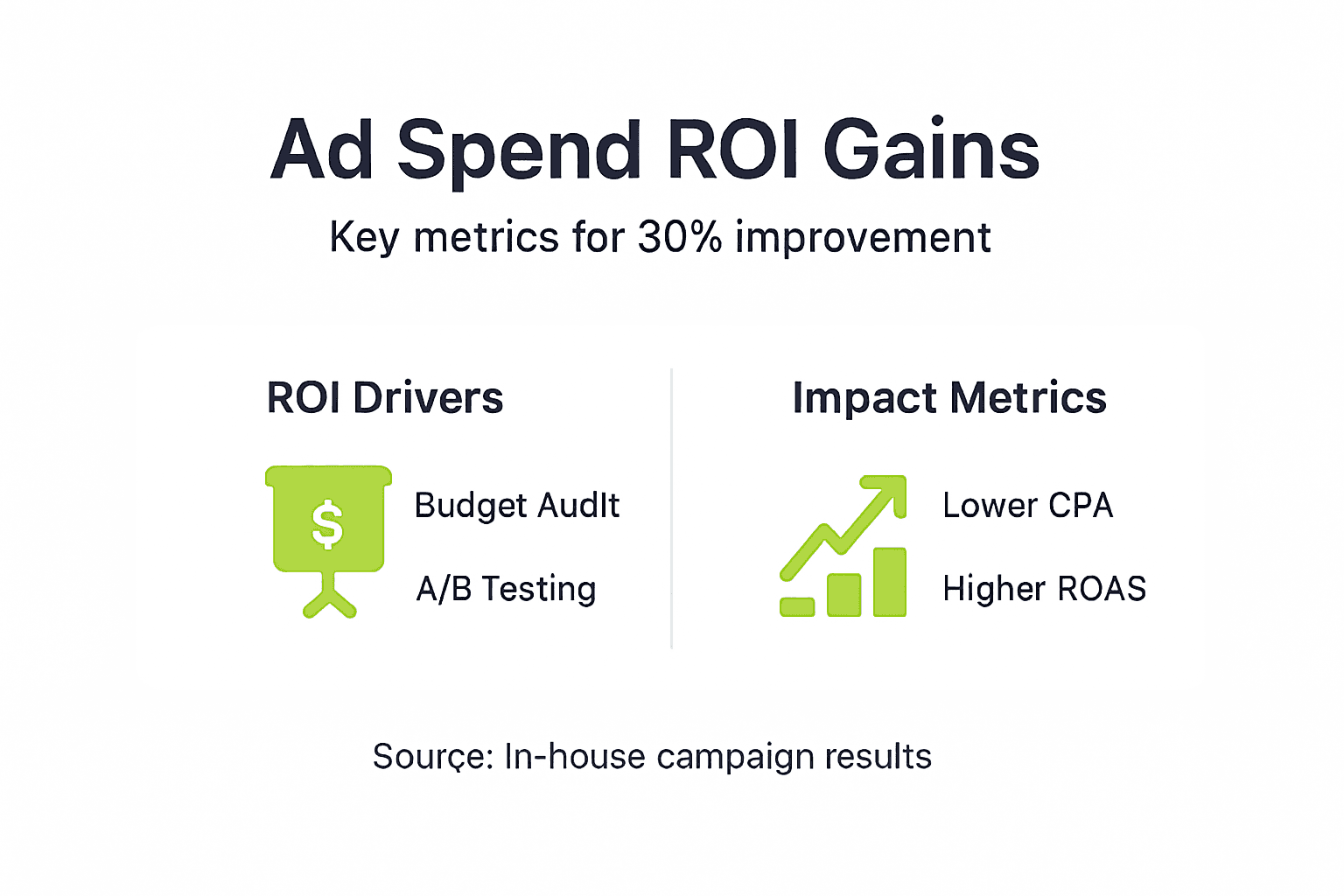
Return on Ad Spend improvements of 15 to 20% are achievable with smart budget allocation and testing. Expect 15-30% increase in conversion rates and 15-25% CPA reduction within 6-8 weeks of consistent optimization. Higher ROAS comes from the compound effect of more conversions at lower costs.
| Metric | Baseline | Optimized | Improvement |
|---|---|---|---|
| Conversion Rate | 2.5% | 3.2% | +28% |
| Cost Per Acquisition | $85 | $65 | -24% |
| Return on Ad Spend | 3.2x | 3.8x | +19% |
Track these key performance indicators regularly:
- Weekly CPA trends to catch cost increases early
- Monthly ROAS by platform and campaign to guide budget allocation
- Conversion rate changes by audience segment to refine targeting
- Quality and relevance scores as leading indicators of future cost changes
- Customer Lifetime Value by acquisition channel to inform long-term strategy
Measure success against your documented baselines, not industry benchmarks. Your starting point, industry competitiveness, and business model create unique circumstances. A 20% CPA reduction from $100 to $80 matters more than hitting an arbitrary industry average.
Remember that optimization is ongoing, not a destination. Markets shift, competitors adjust, and customer behavior evolves. The campaigns delivering great results today will need refinement next quarter. Build optimization into your regular workflow rather than treating it as a special project.
Understanding performance marketing ROI terms helps you set accurate success benchmarks and communicate results clearly to stakeholders.
Optimize Your Ad Spend with Expert Performance Marketing Services
You now have a framework for optimizing ad spend, but implementing it consistently while managing other business priorities is challenging. Our team specializes in multi-channel paid advertising for SMBs in competitive markets, handling everything from audits through ongoing optimization. We apply the data-driven strategies covered in this guide daily, helping clients reclaim wasted budgets and maximize returns.
We manage Google Ads and Meta campaigns with a focus on measurable growth: lower CPA, higher ROAS, and increased conversions that drive real revenue. Our approach combines strategic planning, continuous testing, and weekly optimization cycles that prevent costly mistakes while accelerating results. Learn more about our comprehensive performance marketing step-by-step guide and review our performance marketing terminology resource. Discover how our Google Ads management services can transform your ad spend into consistent growth.
FAQ
What is the first step in optimizing ad spend?
The first step is conducting a thorough audit of current ad spend across all platforms to identify inefficiencies and establish baseline performance metrics. This audit reveals where budget waste occurs and creates benchmarks for measuring future improvements.
How often should I adjust my ad campaigns to avoid over-optimization?
Weekly adjustments are recommended to allow platform algorithms sufficient time to stabilize and optimize delivery. Daily changes disrupt the learning process and can increase CPA by up to 18% compared to weekly optimization schedules.
What are the key metrics to monitor after optimizing ad spend?
Monitor Cost Per Acquisition, Return on Ad Spend, conversion rates, and Customer Lifetime Value consistently. These metrics together provide a complete picture of campaign efficiency and long-term profitability.
How long does it take to see results from ad spend optimization?
Expect noticeable improvements within six to eight weeks of implementing optimization strategies. This timeframe allows platform algorithms to learn, provides sufficient data for statistical significance, and accounts for testing cycles.
What percentage of ad budget is typically wasted before optimization?
Most SMB campaigns waste 20 to 30% of their ad budgets on poor targeting, irrelevant placements, and inefficient bidding strategies. A thorough audit often identifies this waste, which can then be reallocated to higher-performing campaigns.
Recommended
- Performance Marketing Team | Multi‑Channel Paid Ads
- Performance Marketing Team | Multi‑Channel Paid Ads
- Performance Marketing Team | Multi‑Channel Paid Ads
- Performance Marketing Team | Multi‑Channel Paid Ads
- Digital Advertising Media: Boosting Business Growth Online - Jarrod Harman
- Step-by-Step Guide to Measuring LinkedIn ROI Success - Kawaak