

Are you watching your Google Ads and Meta budgets drain into underperforming campaigns? You're not alone. Research shows that failing to pause underperforming ads wastes up to 30% of digital ad budgets for SMBs. This guide provides a systematic, data-driven approach to optimize your ad spend and maximize ROI across both platforms in 2026.
Table of Contents
- Prerequisites: What You Need Before Starting
- Step 1: Define Clear Campaign Objectives and KPIs
- Step 2: Budget Allocation and Bid Management
- Step 3: Audience Targeting and Refinement
- Step 4: Continuous Performance Monitoring and Optimization
- Troubleshooting and Common Mistakes to Avoid
- Expected Results and Outcomes from Optimization
- Alternative Approaches and Tradeoffs
- Optimize Your Ad Spend with Our Expert Team
- Frequently Asked Questions
Key Takeaways
| Point | Details |
|---|---|
| Foundation First | Proper conversion tracking and compliance setup are mandatory before optimizing ad spend. |
| Clear Goals Drive Results | Define specific KPIs and ROAS targets aligned with your business objectives. |
| Strategic Refinement Wins | Budget reallocation, bid adjustments, and audience segmentation reduce waste and improve performance. |
| Continuous Monitoring Required | Weekly reviews and A/B testing prevent budget drain and sustain ROI gains. |
| Avoid Common Pitfalls | Premature quitting and poor performing ad retention kill optimization efforts. |
Prerequisites: What You Need Before Starting
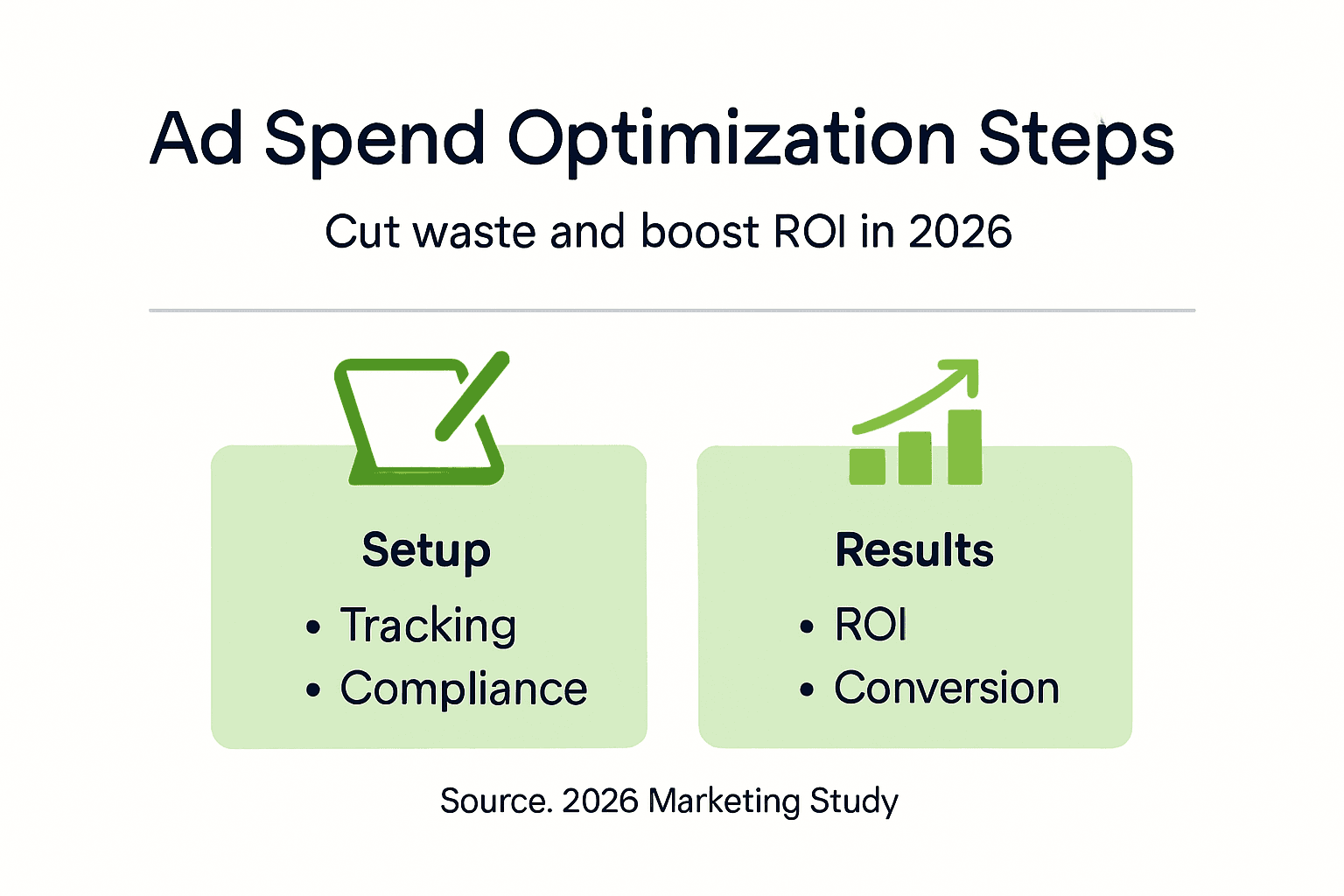
Before diving into optimization tactics, you need a solid foundation. Without accurate data and proper compliance, your optimization efforts will be guesswork at best and costly mistakes at worst.
Start with conversion tracking. Implementing conversion tracking on both platforms increases ROI optimization accuracy by up to 40% for SMBs in e-commerce and healthcare. This means tracking every meaningful action: purchases, form submissions, phone calls, and appointment bookings. Set up Google Analytics 4, Google Ads conversion tracking, and Meta Pixel to capture the full customer journey.
Healthcare businesses face additional compliance requirements. You must adhere to HIPAA regulations when collecting patient data through ads. This includes secure landing pages, encrypted data transmission, and clear privacy policies. Meta and Google both have strict healthcare advertising policies that require certification before running certain campaigns.
Your analytics stack should include Google Ads Manager, Meta Ads Manager, and a unified dashboard that consolidates data from both platforms. Tools like Google Data Studio or third-party platforms help you spot trends across channels without switching between interfaces constantly.
Finally, review at least 60-90 days of historical campaign data. Identify your baseline metrics: average cost per click (CPC), conversion rate, cost per acquisition (CPA), and ROAS. These benchmarks inform your optimization targets and help you measure improvement accurately.
Pro Tip: Document your current tracking setup in a spreadsheet before making changes. This creates a reference point if tracking breaks during optimization, making troubleshooting faster.
If you're just setting up ad campaigns for the first time, complete your foundation setup before moving to optimization. Rushing into optimization without proper tracking is like driving blindfolded.
Step 1: Define Clear Campaign Objectives and KPIs
Optimization without clear objectives wastes time and money. Your goals determine which metrics matter and which tactics to prioritize.

Start by distinguishing between revenue goals and lead generation goals. E-commerce businesses typically focus on direct revenue and ROAS. Healthcare practices often prioritize qualified leads and appointment bookings. Your optimization approach differs significantly based on this fundamental distinction.
Set realistic ROAS benchmarks for your vertical. E-commerce campaigns often target 300-400% ROAS after optimization, while healthcare lead generation might aim for $50-150 cost per qualified lead depending on service value. These targets should reflect your profit margins and customer lifetime value.
Align your KPIs with business objectives, not vanity metrics. Clicks and impressions don't pay bills. Focus on conversion rate, CPA, customer acquisition cost (CAC), and return on ad spend. If your business goal is expanding into a new market, your KPI might be qualified leads in that geography rather than immediate ROAS.
Segment campaigns by objective to streamline measurement. Create separate campaigns for brand awareness, consideration, and conversion. This structure makes it obvious which campaigns drive results and which need adjustment. Mixed-objective campaigns muddy the data and slow optimization.
Key objectives to consider:
- Revenue growth: Target specific ROAS thresholds
- Lead volume: Set cost per lead targets based on close rates
- Market expansion: Track geographic performance and cost efficiency
- Customer retention: Measure repeat purchase rates and lifetime value
For deeper guidance on defining campaign objectives and KPIs, review frameworks that align ad performance with business growth targets. Clear objectives transform scattered efforts into focused optimization that moves your bottom line.
Step 2: Budget Allocation and Bid Management
How you distribute your budget across campaigns and manage bids directly impacts ROI. Smart allocation puts money where it performs, not where it started.
Implement dynamic budget allocation based on weekly performance data. If your retargeting campaigns deliver 500% ROAS while cold traffic campaigns struggle at 150% ROAS, shift more budget to retargeting. Review performance every seven days and reallocate 10-20% of budget from low performers to high performers.
Decide between manual and automated bidding strategically. Automated strategies like Target ROAS and Maximize Conversions work well once you have sufficient conversion data (typically 30+ conversions per month). They save time and react faster to auction dynamics. However, they can overspend if not monitored. Manual bidding gives you precise control but demands constant attention and expertise.
Apply bid adjustments by device, location, and time of day. If mobile users convert at half the rate of desktop users, reduce mobile bids by 30-50%. If customers in urban areas deliver better ROAS, increase location bids there by 20-40%. If conversions spike between 6-9 PM, raise bids during those hours.
Set ROAS targets that account for your profit margins. A 300% ROAS sounds great until you realize your margins only support 250% to break even. Calculate your breakeven ROAS first, then target 50-100% above that for profitability.
Budget allocation checklist:
- Allocate 60-70% to proven high performers
- Reserve 20-30% for testing new audiences and creatives
- Keep 10% emergency buffer for seasonal spikes
- Review allocation weekly, not monthly
Learn more about effective budget allocation and bid strategies that balance automation benefits with hands-on control for maximum efficiency.
Step 3: Audience Targeting and Refinement
Reaching the right people at the right time slashes CPA and improves conversion quality. Broad targeting burns budget on unqualified traffic.
Segment your audiences using demographic and behavioral data. For e-commerce, segment by past purchase behavior, browsing history, and cart abandonment. For healthcare, segment by health interests, age groups relevant to your services, and geographic proximity to your practice. Detailed segments let you tailor messaging and bids for each group.
Use lookalike audiences and retargeting to boost relevance and performance. Create lookalike audiences from your best customers (top 10% by revenue or engagement). These audiences share characteristics with your proven buyers, improving conversion likelihood. Retarget website visitors who didn't convert, offering specific incentives based on their behavior.
Prioritize compliance in healthcare audience targeting. HIPAA restricts using health data for targeting without consent. Avoid interest targeting based on specific conditions. Use broader wellness categories and geographic targeting instead. Review Meta's and Google's healthcare advertising policies quarterly, as they update frequently.
Test multiple audience sets simultaneously to identify winners. Run three to five audience variations per campaign with identical creatives and landing pages. After two weeks and at least 1,000 impressions per audience, compare CPA and conversion rates. Scale winners, pause losers.
Pro Tip: Create exclusion audiences for recent converters to avoid wasting budget remarketing to people who already bought. This simple step can cut wasted spend by 15-20%.
Explore advanced audience targeting tactics that combine first-party data with platform algorithms for superior targeting precision and lower acquisition costs.
Step 4: Continuous Performance Monitoring and Optimization
Optimization isn't a one-time event. It's an ongoing process of testing, measuring, and refining that compounds ROI gains over time.
Conduct weekly campaign performance reviews. Check your dashboard every Monday morning. Look for campaigns with rising CPAs, falling conversion rates, or declining ROAS. Identify patterns: Did a specific ad stop performing? Has audience fatigue set in? Is competition driving up costs? Weekly reviews catch problems before they drain significant budget.
Employ A/B testing for ad creatives and audience segments systematically. Test one variable at a time: headline, image, call to action, or audience. Run tests for at least two weeks or until you reach statistical significance (typically 100+ conversions per variation). Winning creatives can improve conversion rates by 20-50%.
Use unified dashboards that integrate data from Google Ads, Meta Ads, and your CRM. Fragmented data leads to missed insights. A unified view shows which platform drives better quality leads or higher lifetime value customers. This insight guides budget allocation between platforms.
Adjust bids and budgets dynamically based on measured trends. If Saturday shows 40% higher conversion rates, increase Saturday bids by 30%. If a previously strong audience segment shows declining performance for three weeks straight, reduce its budget by 50% and test new segments.
Optimization schedule:
- Daily: Check spend pacing and pause obvious poor performers
- Weekly: Review KPIs, adjust bids, reallocate budgets
- Biweekly: Launch new A/B tests, analyze completed tests
- Monthly: Deep dive into trends, refresh creative assets
| Metric | Check Frequency | Action Threshold |
|---|---|---|
| CPA | Daily | 20% above target |
| ROAS | Weekly | 15% below target |
| CTR | Weekly | 50% drop week over week |
| Conversion Rate | Weekly | 25% decline |
Research indicates that nearly 22% of SMBs quit optimizing campaigns within the first month, missing out on significant ROI gains. Consistency matters more than perfection. Small weekly improvements compound into major performance lifts over quarters.
Dive deeper into continuous performance optimization frameworks and learn how tracking performance metrics systematically prevents budget waste and accelerates growth.
Troubleshooting and Common Mistakes to Avoid
Even experienced marketers fall into optimization traps that kill ROI. Recognizing these pitfalls helps you avoid expensive mistakes.
Not pausing poor performing ads is the biggest budget drain. If an ad delivers 50% higher CPA than your target for two consecutive weeks, pause it. No exceptions. Hoping it will improve wastes money that could fund better performers. Set clear performance thresholds and pause ruthlessly when ads miss them.
Quitting optimization prematurely sabotages results. Most SMBs expect immediate wins. Reality: optimization takes 60-90 days to show meaningful results. Algorithms need time to learn. Audiences need exposure. Tests need data. Commit to three months minimum before judging success.
Lack of cross-platform data integration creates blind spots. You might think Google Ads underperforms Meta, but if Google drives higher lifetime value customers, it's actually more valuable. Integrate CRM data with ad platforms to see the full picture. Make decisions based on customer value, not just immediate ROAS.
Non-compliance with healthcare advertising policies risks account suspension and legal penalties. Review policy updates quarterly. Get certified for healthcare advertising on both platforms. Use compliant language in ads and landing pages. One violation can shut down your entire account.
Critical mistakes to avoid:
- Changing too many variables simultaneously (ruins test validity)
- Ignoring mobile performance differences
- Setting budgets based on arbitrary numbers instead of opportunity
- Forgetting to exclude converting users from retargeting
- Neglecting negative keyword lists in Google Ads
"The campaigns that fail aren't usually the ones with bad strategy. They fail because nobody paused the obvious losers fast enough." - Performance Marketing Insight
Review common optimization mistakes that even experienced marketers make, and understand the budget waste statistics that highlight why disciplined optimization matters for your bottom line.
Expected Results and Outcomes from Optimization
Setting realistic expectations keeps you motivated through the optimization process and helps you measure success accurately.
Optimization programs require at least 90 days to deliver meaningful, sustainable results. The first 30 days focus on foundation: fixing tracking, testing audiences, and gathering baseline data. Days 31-60 involve implementing changes and running tests. Days 61-90 show clear performance improvements as winning combinations scale.
ROI improvements average 15-25% after proper optimization. E-commerce campaigns often see faster gains due to shorter sales cycles. Healthcare lead generation takes longer but delivers more stable, predictable performance. These improvements compound over time with continued optimization.
Conversion rates typically increase 20%+ with ongoing A/B testing and audience refinement. Better targeting puts your ads in front of more qualified prospects. Improved creatives resonate stronger with your audience. Optimized landing pages remove friction from the conversion path. Each element contributes incremental gains that multiply together.
Compliance adherence mitigates costly risks beyond just avoiding penalties. Compliant campaigns build trust with your audience, particularly in healthcare where privacy concerns run high. This trust translates to higher conversion rates and better quality leads.
| Timeline | Expected Outcome | Key Metric Improvement |
|---|---|---|
| 30 Days | Foundation set, tests launched | Tracking accuracy improves to 95%+ |
| 60 Days | Initial wins identified, scaled | CPA decreases 10-15% |
| 90 Days | Sustainable performance lift | ROAS increases 15-25% |
| 6 Months | Compounding improvements | Conversion rate up 20-30% |
Patience and persistence separate campaigns that plateau from those that scale profitably. Trust the process, measure relentlessly, and optimize continuously.
Alternative Approaches and Tradeoffs
No single optimization approach fits every business. Understanding alternatives and their tradeoffs helps you choose the right strategy for your situation.
Automated bidding strategies offer efficiency but require oversight. Google's Target ROAS automation improved campaign efficiency by 18% but needs ongoing manual adjustments to prevent overspending. Automation works best when you have consistent conversion volume (50+ per month) and clear ROAS targets. It fails when conversion tracking has errors or when campaigns lack sufficient data.
Manual bidding provides precise control at the cost of time and expertise. You can react to competitive changes instantly and adjust bids based on nuanced insights algorithms miss. However, manual bidding demands daily attention and deep platform knowledge. Most SMBs lack resources for truly effective manual management at scale.
Multi-platform optimization accelerates learning but increases complexity. Running both Google Ads and Meta Ads simultaneously lets you compare performance, diversify traffic sources, and reach customers across their journey. The downside: you need larger budgets to test effectively on both platforms and more sophisticated attribution to understand which platform deserves credit for conversions.
Single-platform focus simplifies management and concentrates budget for faster learning. If you have limited resources (under $3,000 monthly ad spend), focusing on one platform until you master it often delivers better results than splitting budget across both. Choose based on where your customers spend time and which platform aligns with your sales cycle.
| Approach | Best For | Main Advantage | Key Risk |
|---|---|---|---|
| Automated Bidding | High conversion volume | Time efficiency, rapid optimization | Overspending without monitoring |
| Manual Bidding | Experienced marketers, lower volume | Precise control | Time intensive, requires expertise |
| Multi-Platform | Budgets over $5K/month | Diversification, cross-channel insights | Increased complexity |
| Single Platform | Budgets under $3K/month | Faster learning, simplified management | Limited reach, platform dependency |
Balance automation benefits against the need for human oversight. Let algorithms handle bid adjustments and budget pacing, but retain strategic control over audience selection, creative direction, and overall campaign structure. This hybrid approach captures efficiency gains while preventing runaway spending.
Explore the automated vs manual bidding tradeoffs in depth to make informed decisions that match your team's capabilities and business goals.
Optimize Your Ad Spend with Our Expert Team
You now have a proven framework for optimizing Google Ads and Meta ad spend. But implementing these strategies while running your business is challenging.
Our team specializes in performance marketing for e-commerce and healthcare SMBs. We've optimized campaigns across both platforms, delivering measurable ROI improvements for businesses just like yours. We handle the daily monitoring, testing, and optimization while you focus on serving customers.
We offer tailored Google Ads management and Meta Ads management services designed specifically for SMB budgets and goals. Our approach combines strategic planning with hands-on execution, ensuring every dollar works harder for your business.
Ready to cut wasted spend and boost ROI? Our performance marketing expertise turns optimization frameworks into revenue growth. Get a personalized campaign audit and discover where your biggest opportunities lie.
Frequently Asked Questions
What is the minimum ad spend recommended for effective optimization?
Start with at least $1,500-2,000 monthly per platform to generate enough data for meaningful optimization. Lower budgets take longer to reach statistical significance in tests. If your total budget is under $3,000 monthly, focus on one platform initially rather than splitting across both.
How often should I update or review my ad campaigns?
Review performance weekly at minimum. Check daily for obvious issues like broken tracking or paused campaigns. Launch new A/B tests every two weeks. Refresh creative assets monthly to combat audience fatigue. Quarterly, conduct deep strategic reviews to assess overall direction and competitive positioning.
Can small healthcare SMBs comply easily with digital ad regulations?
Yes, with proper preparation. Complete platform-specific healthcare advertising certifications on Google and Meta. Use compliant language that avoids condition-specific targeting. Ensure landing pages have clear privacy policies and HIPAA-compliant data handling. Work with a compliance consultant if you're unsure about specific regulations.
Is it better to focus on Google Ads or Meta Ads exclusively?
It depends on your audience and sales cycle. Google Ads works better for high-intent searches when people actively seek solutions. Meta Ads excels at awareness and consideration stages, reaching people before they search. If budget allows, use both strategically. With limited budgets under $3,000 monthly, master one platform first.
How do I measure the success of retargeting campaigns?
Track view-through conversions and assisted conversions, not just last-click attribution. Retargeting typically shows lower CPA than cold traffic campaigns. Compare conversion rates of retargeted users versus new users. Successful retargeting should convert at 2-3x the rate of cold traffic while maintaining profitable CPA.
What should I do if my ROAS suddenly drops?
First, verify tracking hasn't broken. Check that conversion pixels fire correctly. Next, review recent changes to campaigns, audiences, or bids. Look for increased competition or seasonal factors affecting demand. If no obvious cause appears, pause lowest performers immediately and reallocate budget to stable campaigns while you investigate further.
Recommended
- Performance Marketing Team | Multi‑Channel Paid Ads
- Performance Marketing Team | Multi‑Channel Paid Ads
- Performance Marketing Team | Multi‑Channel Paid Ads
- Performance Marketing Team | Multi‑Channel Paid Ads
- 7 Key Trends Shaping the Future of Video Advertising
- 2025 Mobile App Market Analysis: Lower Downloads, Higher Consumer Spending