
Performance Max deserves a spot in most Google Ads accounts running e-commerce or lead generation with real conversion volume, but only after you fix conversion tracking and enable brand exclusions first. Skip those two steps and you're feeding a machine-learning system bad data and letting it eat your own branded traffic. Do them, then build asset groups by product or intent, and Performance Max tends to earn its budget within a few weeks. The rest of this guide shows exactly how.
TL;DR:
- Ensuring conversion tracking is accurate and brand exclusions are enabled before launching Performance Max is crucial to prevent data quality issues and brand cannibalization.
- Structuring asset groups around specific buying decisions and segmenting feeds by margins or seasonality improves learning speed and campaign relevance.
- Using a full asset library, including videos, and testing creative variations helps optimize performance and avoid weak ad assets that hinder algorithm learning.
- Separating audience signals by funnel stage and obstacle, such as prospecting versus remarketing, helps improve targeting and campaign efficiency.
- Conducting holdout tests and monitoring non-branded ROAS are essential to measure true incremental conversions rather than relying on potentially cannibalized brand search traffic.
Table of Contents
- Performance Max Strategy Checklist: Quick Wins Before You Launch
- Which Business Goals Actually Fit a Performance Max Campaign?
- How Should You Structure Asset Groups for Performance Max?
- What Creative Assets Does Performance Max Actually Need?
- Which Audience Signals Should You Feed Performance Max?
- Which Bid Strategy Fits Your Performance Max Campaign?
- Is Performance Max Cannibalizing Your Brand Search?
- Which Performance Max Reports Actually Matter?
- Troubleshooting Common Performance Max Problems
- How Atdigiagency Approaches a Performance Max Launch
- What the Data Actually Tells Us About Performance Max in 2026
- Get Expert Help Running Performance Max Campaigns
- Sources
Performance Max Strategy Checklist: Quick Wins Before You Launch
Before you touch bidding or creative, run this list. It takes 10 to 20 minutes and prevents most of the early waste we see in new accounts.
- Set a budget floor. Aim for daily spend at 10 to 20 times your target CPA so the algorithm has enough signal to work with.
- Confirm conversion actions are firing correctly and mapped to actual revenue events, not just page views or clicks.
- Check that your business goal matches the campaign objective (online sales versus lead generation) inside the PMax settings.
- Verify asset minimums are met, not just technically allowed. Google's guidance calls for a full library, and thin asset groups get throttled.
- Enable brand exclusions immediately, before the campaign spends a dollar.
- Open the channel performance view in reporting so you have a baseline before the algorithm starts shifting spend across Search, Display, YouTube, and Shopping surfaces.
Miss any one of these and you're troubleshooting blind later.
Which Business Goals Actually Fit a Performance Max Campaign?
Performance Max works best when three things line up: you have a product feed or clear conversion actions, you already generate consistent conversions, and your customers plausibly convert across more than one Google surface. A local service business with five leads a month and no feed is a weak fit. A retailer with a Merchant Center feed and steady order volume is a strong one.
Conversion tracking has to be exact before launch. Set up value rules so a $200 order and a $20 order aren't treated identically, and where margins vary by product line, feed margin-aware conversion values rather than raw revenue. Google's own reporting shows advertisers adopting Performance Max see an average 27% increase in conversions or conversion value at similar CPA or ROAS, but that lift depends entirely on the quality of the data you hand the system.
Give the campaign a full conversion cycle, usually two to six weeks depending on your sales cycle, before judging results. Google's guidance is blunt about the exploration phase: changing budgets, bids, or major assets mid-learning resets the clock and extends the inefficient stretch you're trying to avoid.
How Should You Structure Asset Groups for Performance Max?
Theme each asset group around one buying decision, not one product SKU. Group by product category, funnel stage, or margin tier so the algorithm isn't trying to learn five different customer journeys inside a single group.
- Split high-margin and low-margin product lines into separate asset groups so bidding doesn't average toward the middle.
- Use one campaign with multiple asset groups when categories share a budget and audience overlap; spin up a separate campaign only when you need distinct budgets, geographic targeting, or bidding strategies.
- Name asset groups by category and intent (for example, "Running Shoes, Prospecting" versus "Running Shoes, Remarketing") so reporting stays readable months later.
- Segment your feed with custom labels tied to margin or seasonality so asset groups can pull the right products automatically.
- Attach distinct audience signals to each group. A group targeting cold prospects should not share signals with a group aimed at cart abandoners.
Clean structure does two things: it speeds up learning because each group has a narrower job, and it keeps branded traffic from leaking into asset groups built for cold prospecting.
What Creative Assets Does Performance Max Actually Need?
Google's optimization guidance recommends filling out a full asset library, including headlines, descriptions, images in multiple aspect ratios, and at least one video. Skip the video and the system generates one from your images and text, and it usually looks like it.
Build creative that mirrors an actual purchase journey: an awareness-stage image or clip showing the product in use, a mid-funnel asset highlighting a specific benefit or offer, and a bottom-funnel asset with a clear call to action. Keep branded language out of prospecting-focused assets. If someone hasn't heard of your business yet, leading with your company name instead of the product benefit wastes the impression.
Test combinations deliberately. Swap one variable at a time, whether that's the primary image or the lead headline, and give each version enough impressions before drawing conclusions. Our ad optimization checklist walks through a similar testing cadence for tracking which creative elements actually move performance.
Which Audience Signals Should You Feed Performance Max?
Audience signals guide the algorithm toward likely converters; they don't restrict where ads show, which trips up advertisers used to traditional targeting. Customer Match lists, remarketing audiences, custom intent segments, and lookalike audiences all work as starting points the system refines from, not hard boundaries.
Prioritize prospecting signals when the goal is new customer acquisition, and lean on remarketing signals in asset groups built for cart recovery or repeat purchases. Mixing the two inside one asset group blurs the learning signal and slows things down.
First-party data, especially Customer Match lists built from your CRM or purchase history, tends to outperform generic interest-based signals. But layering a remarketing list into every asset group, including ones meant for cold prospecting, is a common way brand cannibalization creeps in. Keep signal types separated by funnel stage the same way you separate asset groups.
Which Bid Strategy Fits Your Performance Max Campaign?
Maximize conversions works for new campaigns with limited conversion history since it removes a target constraint while the system learns. Once you have enough volume, typically 30 or more conversions in a recent 30-day window, switch to Target CPA or Target ROAS depending on whether you're optimizing for volume or margin.
Budget matters more than most advertisers assume. A daily spend below 10 times your target CPA rarely generates enough signal for the algorithm to optimize well, and 15 to 20 times is safer for volatile categories.
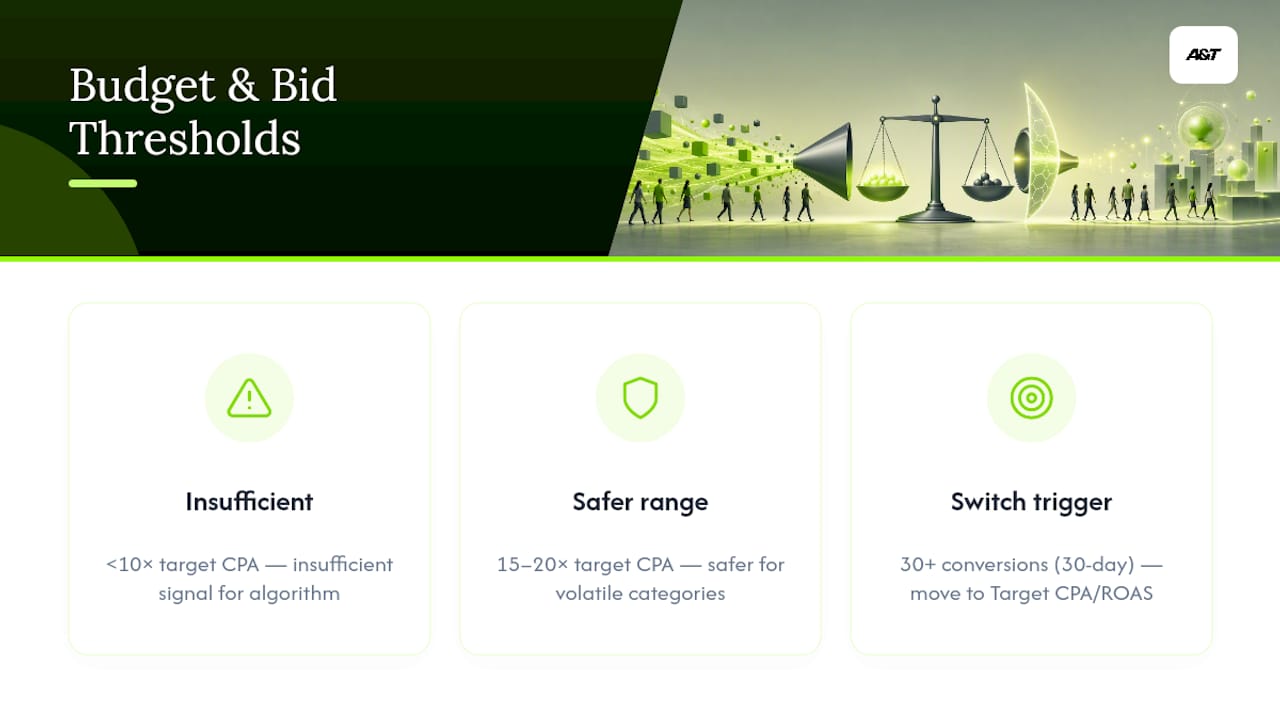
Larger jumps push the campaign back into a learning-like state and efficiency dips for days or weeks. The same caution applies to CPA and ROAS targets: tightening a target too aggressively while scaling budget usually causes a spend cliff rather than a smooth increase. For seasonal pushes, Performance Planner lets you simulate budget and bid changes before committing real spend.
Is Performance Max Cannibalizing Your Brand Search?
Blended ROAS often looks great on a Performance Max campaign specifically because it's capturing branded searches that would have converted anyway, often at a fraction of the cost of a cold prospecting click. That's not incremental growth. It's your own brand equity getting relabeled as PMax performance.
- Enable brand exclusions inside the PMax campaign settings the day you launch.
- Run a dedicated brand-only Search campaign using exact match on your core brand terms, so you retain control over that traffic.
- Strip branded terms and logos from PMax creative assets, especially in prospecting-themed asset groups.
- Run a pause or holdout test, cutting PMax spend in a matched geography for 7 to 14 days, then comparing branded CPC and conversions against a control region to confirm leakage.
Practitioner data backs this pattern: reporting on agency accounts shows PMax quietly absorbing branded search budgets when exclusions aren't in place, and mid-sized direct-to-consumer accounts spending $15,000 to $100,000 a month are especially exposed since they run both brand Search and PMax simultaneously without strong separation.
Pro Tip: Compare branded impression share during your PMax pause window against the same days a month earlier, not just against the days right before the pause. Seasonality skews the comparison more than people expect.
Which Performance Max Reports Actually Matter?
Three reports carry the real signal: the Insights tab, the channel performance view, and the asset-combination report showing which creative pairings the system favors. Search term insights round it out by revealing whether the algorithm is chasing branded queries you already own.
To calculate true incremental ROAS, separate branded from non-branded conversions using the search term insights data, then recalculate ROAS on the non-branded slice alone. That number tells you what PMax is actually adding rather than what it's reallocating from brand. Channel and asset reporting has improved substantially, but direct channel-level budget control still doesn't exist. Assets and audience signals remain your only real levers.
Check weekly impression share and conversion unit economics (cost per conversion relative to average order value) as your ongoing control metrics, not just total conversion volume.
Troubleshooting Common Performance Max Problems
- Underspend: raise the budget in a single 20 to 30% step and confirm conversion tracking isn't blocking eligible auctions.
- High CPA with low volume: check asset strength first; a "poor" rating often means the system lacks enough creative variety to find winning combinations.
- Suspected cannibalization: run the pause test described above before making structural changes.
- Low creative strength lingering after fixes: add video assets, since Google's own guidance ties strength scores closely to asset completeness.
Iterate on assets and signals before pausing the campaign entirely. Google's Ask Advisor tool can help diagnose sudden spend or performance shifts without guessing.
How Atdigiagency Approaches a Performance Max Launch
Every Performance Max build we run starts the same way: a discovery pass on the account's conversion setup, brand exclusions turned on before spend starts, a full asset library built around the actual customer journey, and a holdout test scheduled from day one rather than bolted on after someone notices branded leakage. We measure success on non-branded incremental ROAS, not the blended number the platform shows by default. That discipline is the difference between a campaign that looks good in a screenshot and one that actually grows revenue.
What the Data Actually Tells Us About Performance Max in 2026
The conventional advice on Performance Max treats it like a black box you either trust completely or avoid entirely. Neither position holds up. The system responds predictably to the inputs you control: conversion data quality, asset completeness, and signal segmentation. Advertisers who treat it as fully automated and walk away get mediocre, cannibalized results. Advertisers who fight the automation with constant manual overrides break the learning phase and get worse ones.
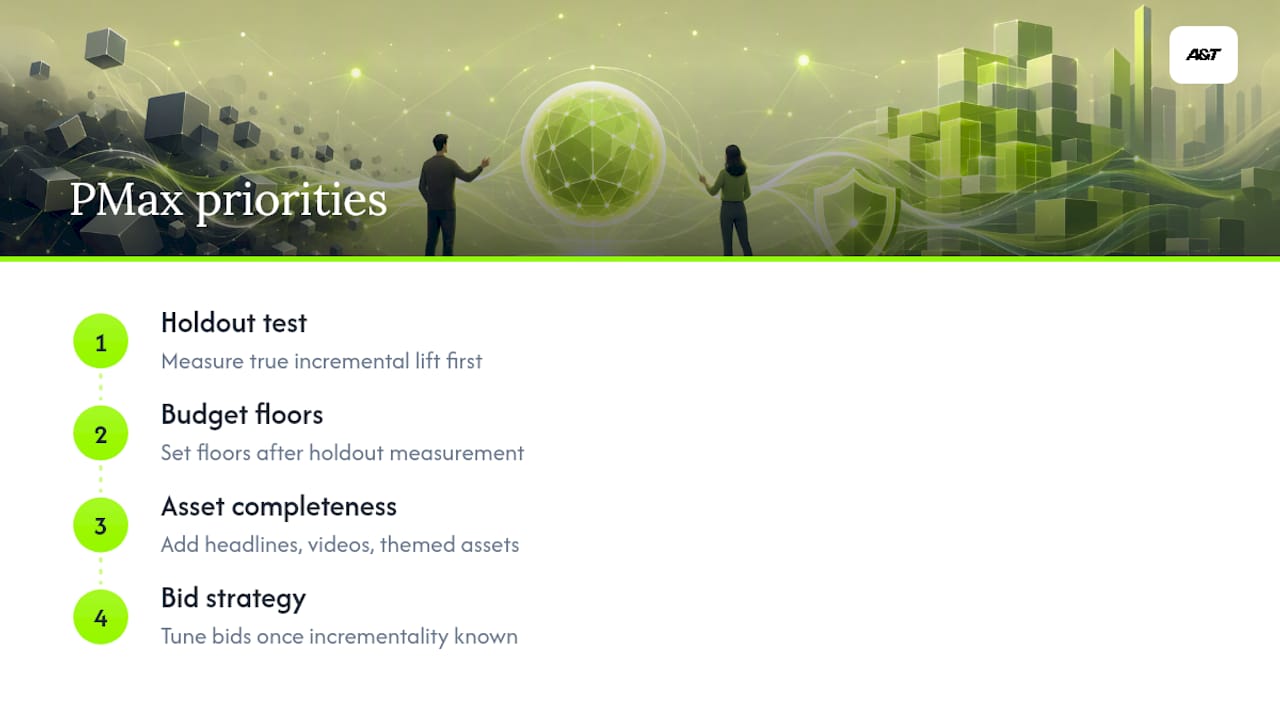
What's overrated is the panic around Performance Max "taking over" an account's Search budget. That's a structural risk you can measure and mostly neutralize with brand exclusions and a dedicated brand Search campaign, not a reason to avoid the channel. What's underrated is how much of PMax's failure mode traces back to lazy asset libraries rather than the algorithm itself. A campaign with three headlines and no video was never going to perform, no matter how sophisticated the bidding strategy behind it.
If you prioritize one thing first, make it the holdout test. Everything else, budget floors, asset themes, and bid strategy are easier to get right once you know how much of your reported PMax performance is actually incremental.
— Ann
Get Expert Help Running Performance Max Campaigns
Reading through brand exclusion settings and asset-combination reports is one thing. Doing it correctly across a live account with real budget on the line is another. An expert agency can help you avoid guessing with Performance Max by running discovery audits, setting up holdout tests, building asset libraries to Google's specifications, and monitoring non-branded ROAS on an ongoing basis so you're not relying on a blended number that flatters itself.
If your account shows signs of branded leakage or your creative strength has stalled at "average," start with a diagnostic. Our Google Ads management service covers PMax setup, feed audits, and ongoing optimization, and our guide on optimizing Google Ads ROI breaks down the fundamentals we check first. Reach out and we'll tell you exactly what we'd fix in your account.
Sources
- Use Performance Max to increase your conversions and conversion value
- Google Performance Max is quietly cannibalizing brand search budgets
- Performance Max explained: when PMax wins and when it doesn't