
The most effective retail brand differentiation ad examples share one trait: they lead with a specific creative idea rooted in customer insight, not a generic product claim. Experiential in-store activations, retail media on-site formats, and social creator partnerships consistently outperform standard display because they give shoppers a reason to pay attention. Here are the highest-impact examples:
- Social creator activations (TikTok/Reels): native storytelling that earns attention instead of buying it
- Retail media on-site ads (Amazon Responsive eCommerce, Target Roundel, Walmart Connect): first-party data plus product-level assets that convert browsers into buyers
- Email and CRM lifecycle sequences: private-label spotlights and scarcity messages that reinforce brand promise at every stage
- In-store experiential activations: sensory moments that generate organic social content and paid media fuel
- OOH and print: single-minded messages that build distinctiveness at scale
- Programmatic and dynamic display: feed-driven creative that surfaces the right product to the right shopper
Your single next step: pick one channel from the list above, audit your creative assets against the checklist in that section, and run a 30-day pilot before committing to a full rollout.
Table of Contents
- 1. Social and creator-driven ads that set retail brands apart
- 2. Retail media and on-site ad formats that use your data advantage
- 3. Email and CRM examples that reinforce a differentiated brand promise
- 4. In-store activations that create shareable brand moments
- 5. Outdoor, print, and OOH ads that build distinctiveness at scale
- 6. Online display, programmatic, and native ads that replicate retail differentiation
- 8. Legal and compliance considerations for retail advertising in the U.S.
- Key Takeaways
- What most retail marketers get wrong about differentiation
- Atdigiagency builds the paid campaigns behind retail differentiation
- Useful sources and further reading
1. Social and creator-driven ads that set retail brands apart
Creator-led social is where retail differentiation happens fastest right now. A small brand with a sharp product story and the right creator can outperform a national chain running polished broadcast-style ads, because the platform rewards authenticity over production value.
What works and why. Sephora's approach to TikTok and Instagram Reels centers on micro-creator partnerships where beauty enthusiasts film real AR try-on sessions using Sephora's virtual tools. The creative principle is product-first demonstration: the viewer sees the product working on a real face, not a model in a studio. That removes the "will this work for me?" friction that kills conversion. For a small regional beauty retailer, the same principle applies with a $500 creator brief and a 60-second Reel.
Home Depot runs creator content that shows weekend project transformations, pairing a specific SKU with a tangible outcome. The differentiation is specificity: "this $38 stain turns a beat-up deck into something you'd see in a magazine" beats "shop our outdoor collection" every time. The creative principle is outcome-first storytelling, and it works because it answers the shopper's actual question before they ask it.
For national chains, creator content scales through paid amplification: take the top-performing organic creator post and run it as a Meta Ads dark post targeted to lookalike audiences. For smaller retailers, one creator with 15,000 highly engaged local followers often outperforms a national creator with 500,000 passive ones.
Stat to benchmark against: Creator-led retail campaigns on TikTok consistently generate higher view-through rates than standard brand video because the format matches how users already consume content on the platform.
Pro Tip: When briefing a creator, give them three non-negotiables (product name, one key benefit, one CTA) and let them write the rest. Creators who sound like themselves convert better than creators reading a brand script. Then repurpose the top-performing clip as a paid placement with a direct-response overlay.
2. Retail media and on-site ad formats that use your data advantage
On-site retail media ads outperform generic display because they operate where purchase intent is already high and they pull from first-party product data that generic networks cannot access. According to TripleLift, brands that force standard display creative into retail media see weaker outcomes than those that build retail-specific assets from the ground up.
Amazon Sponsored Brands and Responsive eCommerce Ads automatically assemble product images, prices, ratings, and promotional flags into a single unit. The differentiation comes from asset quality: a product with five high-resolution images, 200+ reviews, and a "10% off" badge will outperform an identical product with one image and no social proof, even at the same bid. Target Roundel's promoted placements work on the same logic, surfacing products to shoppers already browsing a relevant category. Walmart Connect adds a layer of in-store behavioral data, letting brands reach shoppers whose cart history signals purchase readiness.
Sephora's on-site placements go further by integrating AR try-on data: a shopper who used the virtual try-on tool for a foundation shade is served a retargeted on-site unit featuring that exact shade with a one-tap add-to-cart. That closed loop between experience and purchase is what separates retail media from standard programmatic.
| Format | Required assets | Data inputs | Key KPIs |
|---|---|---|---|
| Amazon Responsive eCommerce Ads | 5+ product images, headline, brand logo | Price, ratings, promo flags, ASIN feed | Add-to-cart rate, ROAS, conversion rate |
| Target Roundel promoted placement | Product image, short copy, CTA | Category affinity, loyalty data | Sell-through rate, click-to-purchase |
| Walmart Connect on-site | Product image, price, badge | Purchase history, in-store behavior | Conversion rate, incremental sales lift |
| Kroger in-store audio / retail media | Audio script (15–30 sec), product image | Loyalty card purchase data | In-store search rate, category lift |
Readiness checklist before activating retail media:
- Audit your product feed: every SKU needs a clean image, accurate price, and current inventory status
- Confirm ratings are above 4.0 before spending on promoted placements (low ratings visible in the ad unit actively suppress conversion)
- Set up promo flags in the feed at least 48 hours before a campaign goes live
- Define your KPI hierarchy: sell-through and add-to-cart rate first, ROAS second
3. Email and CRM examples that reinforce a differentiated brand promise
Email is where brand differentiation compounds over time. A single campaign rarely moves the needle; a well-structured lifecycle sequence does. The retailers that win in email treat each send as a chapter in a brand story, not a standalone promotion.
Welcome sequence. Pottery Barn's welcome email doesn't lead with a discount. It opens with a room-design story, introduces the brand's "timeless quality" positioning, and then offers a first-purchase incentive on the third email. The creative principle is trust before transaction: by the time the offer arrives, the subscriber already understands what makes Pottery Barn different from a generic furniture retailer.
Private-label spotlight. Private-brand sales reached $271 billion in 2024, and the retailers capturing that share are the ones actively communicating private-label quality in email. A subject line like "Our store-brand olive oil beat three national brands in a blind taste test" outperforms "Save 20% on pantry staples" because it gives the reader a reason to believe, not just a reason to click.
Cart abandonment with a differentiator hook. Instead of "You left something behind," try "Still thinking about [product]? Here's what makes it different from anything else you'll find." That framing turns a recovery email into a brand-positioning moment.
Stat callout: Retailers using segmented, lifecycle-triggered email sequences report higher conversion rates than those sending broadcast promotions, because the message matches the shopper's stage in the purchase journey.
For small retailers with lists under 5,000, a three-email welcome sequence plus a cart abandonment flow is enough to start. Enterprise retailers with a full CRM stack should layer in post-purchase cross-sell sequences tied to purchase category, using ad personalization tactics to match product recommendations to individual browse history.
A CRM sequence from brief to first send typically takes 3–4 weeks: one week for copy and design, one week for QA and list segmentation, one week for platform setup and testing, then launch.
Pro Tip: Write your cart abandonment email as if you're a knowledgeable friend explaining why the product is worth it, not a system reminding someone they forgot to check out. That tone shift alone can lift click-through rates meaningfully.
4. In-store activations that create shareable brand moments
Physical retail is a creative asset most brands underuse. A well-designed in-store activation generates foot traffic, earns organic social content, and produces video and photo assets that fuel paid campaigns for weeks afterward.
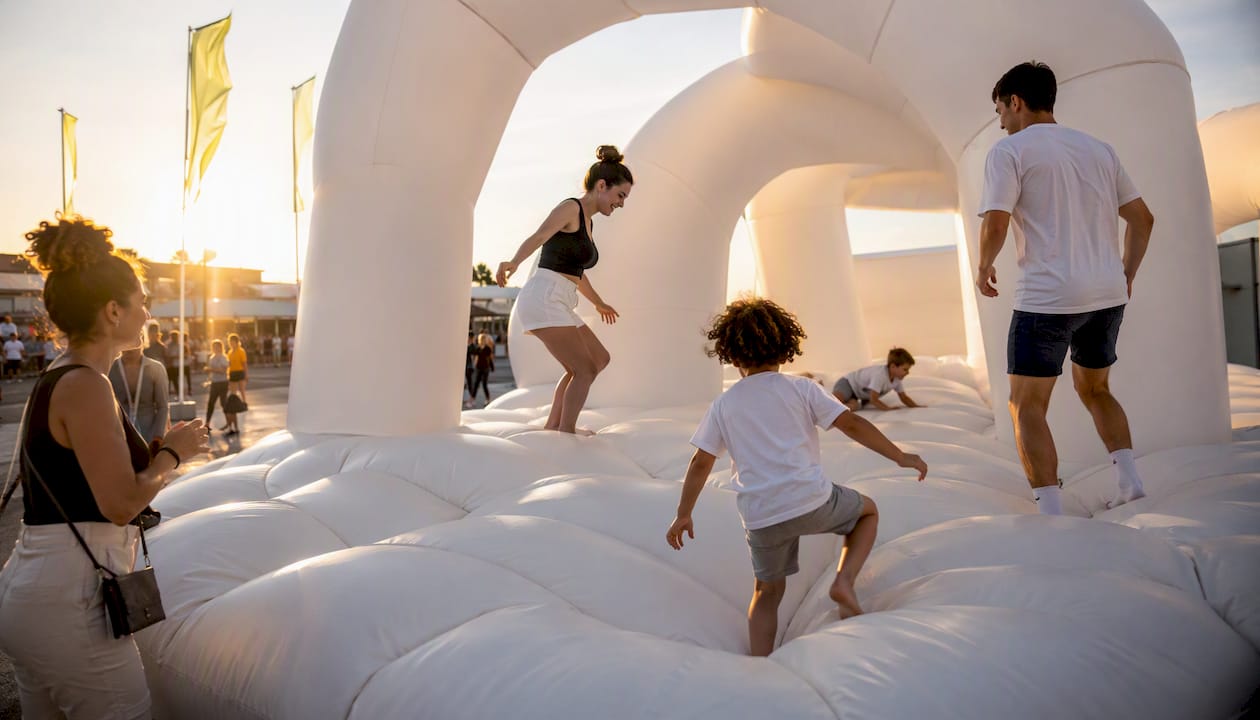
Craft's "Walk the Sky" bouncy-store experience replaced traditional shoe displays with an inflatable, immersive environment where shoppers experienced the shoe's cushioning technology with their whole body. The activation created a memorable sensory moment that communicated the product's core benefit more effectively than any product description could. Shoppers filmed themselves, posted to social, and the brand captured that content for paid amplification.
Primark's "Kim Parr" fictional premium label took a different approach. The retailer created a fictional high-end fashion brand, dressed a pop-up store in premium fixtures and lighting, and invited shoppers to experience the collection before revealing it was Primark's own product. The reveal moment shifted perception of quality and price-value in a way that no standard promotional ad could achieve.
Both activations share the same creative principle: let the product experience do the persuading, then capture that moment for paid media.
Production checklist for an in-store activation:
- Secure permits and landlord/mall approval at least 6 weeks in advance
- Brief a photographer and videographer to capture content specifically for paid social formats (9:16 vertical, 1:1 square, 16:9 horizontal)
- Staff the activation with brand-trained team members who can explain the product story
- Set up a measurement baseline: foot traffic count, social mention tracking, and a promo code tied to the activation
- Build a safety plan for high-traffic or interactive installations (load limits, crowd management, emergency exits)
Budget signals: a local pop-up activation runs $5,000–$25,000 depending on build complexity. A national touring activation with custom fabrication can reach $150,000+. The paid media amplification budget should be at least equal to the production cost to maximize the content's reach.
Cultural partnerships can extend activation reach significantly. Splash Blast's campaign with T-Pain as "Master of Splashermonies" shows how a music-driven celebrity tie-in creates local energy and press attention that a standard POS display never could.
Pro Tip: Shoot a 15-second "reveal moment" clip during every activation. That single clip, cut for TikTok and Reels, typically outperforms any studio-produced ad you'll run that quarter because it carries genuine surprise.
5. Outdoor, print, and OOH ads that build distinctiveness at scale
OOH works when it does one thing: communicates a single differentiating idea so clearly that a driver at 45 mph gets it. The brands that fail in OOH try to say three things. The brands that win say one thing, boldly.
IKEA's OOH campaigns consistently demonstrate this. A billboard showing a single product in a real home setting, with one line of copy that reframes the product's value ("The sofa your family will fight over"), does more brand work than a catalog spread. The creative principle is contextual specificity: place the product in the shopper's life, not in a white-box studio.
For regional retailers, geographic specificity is the OOH differentiator. A billboard in Chicago that references a local neighborhood or a seasonal moment ("Ready for the first Cubs game of the season?") outperforms a generic national creative because it signals that the brand belongs here.
Budget and timeline signals:
- Local transit poster or bus shelter: $1,500–$5,000 per month, 2–3 weeks production lead time
- Regional billboard (static): $2,000–$15,000 per month depending on market, 3–4 weeks lead time
- Premium digital OOH (Times Square, major transit hubs): $25,000–$100,000+ per week
Measuring OOH impact requires a combination of methods: unique promo codes on print materials, dedicated landing page URLs, and geo-lift studies that compare online search and conversion rates in markets with OOH versus control markets. Digital OOH platforms increasingly offer impression counts and reach estimates tied to mobile device data.
Cross-channel retail advertising examples show that OOH performs best when it runs alongside a social or search campaign in the same market, creating a frequency effect that neither channel achieves alone.
The single biggest OOH mistake: adding a QR code, a website URL, a phone number, and a tagline to a billboard. Pick one. The QR code or the URL. Not both.
6. Online display, programmatic, and native ads that replicate retail differentiation
Programmatic is where retail differentiation often breaks down. Brands spend heavily on targeting precision and then run creative that looks identical to every other retailer in the category. The fix is feed-driven dynamic creative that surfaces the specific product, price, and differentiator most relevant to each shopper.
Dynamic product ads built from a live product feed automatically pull in current price, inventory status, and promotional flags. A shopper who browsed a specific Pottery Barn rug sees that exact rug in a retargeted display unit, with the current price and a "Low stock" badge if inventory is running low. That specificity is what separates a converting ad from a wallpaper impression.
Native placements work differently: they match the editorial context of the page. A home improvement article running a native ad for Home Depot's tool rental program converts better than a standard banner because the reader's mindset already aligns with the product category.
| Format | Image specs | Copy fields | Feed requirements | Promo flags |
|---|---|---|---|---|
| Dynamic product retargeting | — | Headline (25 chars), description (90 chars) | Product ID, price, URL, image URL, availability | Sale price, badge text |
| Native sponsored content | — | Headline (short), body (concise) | Category, brand name, landing URL | Optional discount label |
| Responsive display ad | Multiple sizes auto-generated | 5 headlines, 5 descriptions, logo | Product images (high resolution) | Promotion extension |
Adaptation checklist:
- Small retailer with a limited feed (under 500 SKUs): prioritize your top 20 products by margin and build hand-crafted dynamic templates for those SKUs rather than running a full catalog feed
- Mid-size retailer: run a full feed but segment campaigns by category so budget concentrates on high-intent categories
- Enterprise retailer: layer contextual targeting on top of feed-based retargeting to reach new shoppers who haven't visited your site yet
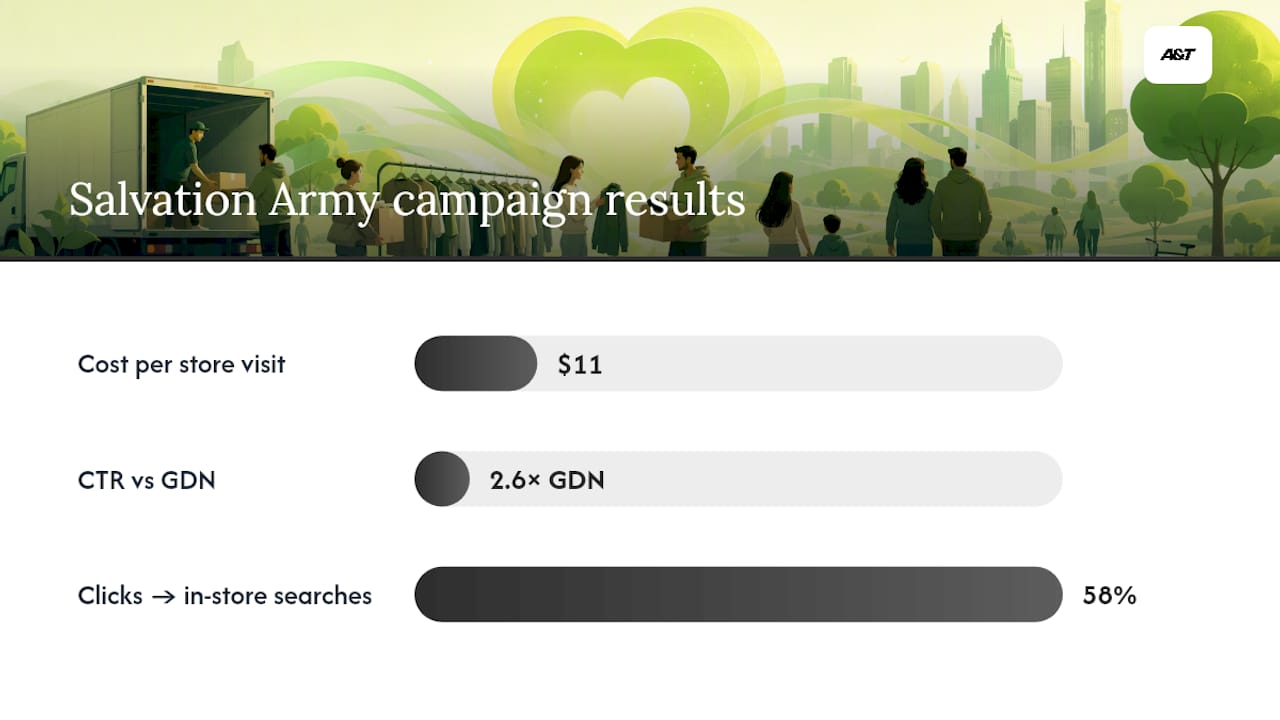
The Salvation Army's AI-assisted retail campaign demonstrated what localized programmatic creative can achieve: an $11 cost per store visit, click-through rates approximately 2.6x the Google Display Network benchmark, and 58% of clicks leading to in-store searches, all within a 30-day test. The key was hyperlocal creative variation, not a single national asset.
For ecommerce competitive ad strategies that extend these principles across channels, the same feed-first, specificity-led approach applies whether you're running Google Shopping, Meta DPA, or programmatic display.
8. Legal and compliance considerations for retail advertising in the U.S.
U.S. retail advertising operates under a layered compliance framework. The Federal Trade Commission (FTC) governs deceptive advertising claims, requiring that any comparative claim (e.g., "lowest price," "best quality") be substantiated with evidence the advertiser can produce on demand. Unsubstantiated superlatives are an enforcement risk, not just a credibility problem.
Pricing and promotional claims carry specific rules. The FTC's "former price" guidelines require that a "was/now" price comparison reflect a price at which the item was genuinely offered for a reasonable period. Retailers that inflate a "was" price to manufacture a larger discount face both FTC scrutiny and state consumer protection actions. California, New York, and Illinois have particularly active enforcement in this area.
Endorsements and creator partnerships fall under the FTC's Endorsement Guides, updated in 2023. Any creator who receives payment, free product, or any other material connection must disclose that relationship clearly and conspicuously in every post, not just in a buried caption. "Ad," "#sponsored," or "#partner" at the start of the caption (not buried in hashtags) meets the standard.
Retail media and data privacy. Platforms like Target Roundel and Walmart Connect use first-party shopper data for targeting. Advertisers using these platforms should confirm that their own data practices (customer lists uploaded for matching) comply with applicable state privacy laws, including the California Consumer Privacy Act (CCPA) and similar statutes in Virginia, Colorado, and Connecticut.
Sweepstakes and experiential promotions require official rules, a no-purchase-necessary alternative, and compliance with state-specific prize registration requirements in New York and Florida for promotions above certain value thresholds.
This article provides general information, not legal advice. Confirm current FTC guidelines and applicable state requirements with qualified legal counsel before launching any promotional campaign.
Key Takeaways
The most effective retail brand differentiation ad examples combine a specific customer insight with channel-native creative, measurable KPIs, and a structured 30-day test before scaling spend.
| Point | Details |
|---|---|
| Lead with a differentiating message | Brand-differentiating messages increase ad awareness and strengthen the path from consideration to purchase. |
| Match creative to channel format | On-site retail media needs product-level assets (images, ratings, promo flags); social needs native creator storytelling. |
| Experiential content fuels paid media | In-store activations generate video and photo assets that outperform studio-produced ads in paid social placements. |
| Test before scaling | Run a 30-day, two-cell A/B test with 1,000+ impressions per cell before committing regional or national budget. |
| Atdigiagency for execution | Atdigiagency handles strategy, creative development, and multi-channel media buying for retailers ready to run differentiated paid campaigns. |
What most retail marketers get wrong about differentiation
Most retail brands treat differentiation as a brand strategy problem when it's actually a creative execution problem. The insight exists. The positioning exists. What's missing is the discipline to translate that positioning into a specific, channel-native creative idea and then test it with enough rigor to know whether it's working.
The brands that consistently win, whether it's IKEA with a single-minded OOH message or a regional retailer running a creator activation on a $2,000 budget, share one habit: they commit to one differentiating idea per campaign and resist the urge to add more claims. Every additional message you add to an ad dilutes the one that would have worked.
The other pattern worth noting: the best-performing retail ad examples in this article all started with a customer belief, not a product feature. Craft's bouncy store didn't say "superior cushioning technology." It made shoppers feel the cushioning. Primark's Kim Parr activation didn't say "affordable quality." It made shoppers experience quality before revealing the price. That's the gap between a claim and a proof, and it's where differentiation actually lives.
Atdigiagency builds the paid campaigns behind retail differentiation
Running differentiated retail ads at a measurable ROI requires more than a good creative idea. It requires the right media structure, precise targeting, and a measurement setup that connects creative performance to actual sales outcomes. That's exactly what Atdigiagency delivers for retail and e-commerce brands.
Our team handles the full execution stack:
- Google Ads management (Shopping, Performance Max, Display)
- Meta Ads management (Facebook and Instagram, including creator content amplification)
- TikTok Ads management
- Retail media creative development (Amazon, Target Roundel, Walmart Connect)
- Conversion tracking setup and campaign measurement
If you're ready to run a differentiated paid campaign with a clear testing plan and measurable results, see how we build performance campaigns for retail brands.
Useful sources and further reading
- The missing big idea: Brand-differentiating messages and advertising effectiveness across the brand funnel | Springer
- The Salvation Army’s AI retail campaign — Think with Google
- The Power of Creative in Retail Media — TripleLift
- The store where you experience a shoe with your whole body | Creative Boom
- Primark challenges perceptions with immersive fictional fashion label experience | LBBOnline
- Retail advertising: Types, trends & examples (Lightspeed)
- Driving differentiation through private label brands (UNFI)
- Splash Blast taps T-Pain as first-ever 'Master of Splashermonies' (PR Newswire)