
TL;DR:
- SEO builds long-term trust and organic traffic, taking 3 to 12 months for results.
- Paid media provides immediate visibility and detailed measurement but requires ongoing budget.
- Combining SEO and paid media maximizes growth, with paid offering quick data and SEO offering lasting authority.
Most business owners assume they need to pick a side. Either invest in SEO and wait months for results, or run paid ads and watch the budget disappear the moment you pause. Both views miss the bigger picture. SEO and paid media are not rivals. They are different instruments in the same band. Understanding what each channel does, when it works best, and how they interact is what separates businesses that grow predictably from those that spin their wheels. This article breaks down both strategies clearly, compares them side by side, and shows you exactly how to use them together for real digital growth.
Table of Contents
- What is SEO and how does it work?
- What is paid media and how does it work?
- SEO vs paid media: Side-by-side comparison
- When and how to combine SEO and paid media for maximum impact
- What most experts miss about SEO vs paid media
- Get expert help combining SEO and paid media for real growth
- Frequently asked questions
Key Takeaways
| Point | Details |
|---|---|
| SEO builds trust long-term | SEO delivers compounding, sustainable growth by increasing organic visibility and authority. |
| Paid media wins on speed | Paid campaigns drive immediate traffic and results, giving you total budget control. |
| Synergy outperforms either alone | Combining SEO and paid media amplifies results and drives both short-term wins and long-term value. |
| Choose based on goals | Your channel choice should match your business goals, timeline, and resources for effective results. |
What is SEO and how does it work?
SEO stands for search engine optimization. In plain terms, it is the practice of making your website easier for search engines like Google to find, understand, and rank. When someone searches for a product or service you offer, SEO is what determines whether your site shows up on page one or page five.
The four main components of SEO are:
- Content: Creating relevant, useful pages that match what your audience is searching for
- On-page optimization: Structuring your titles, headings, and meta descriptions so search engines read your pages correctly
- Technical SEO: Ensuring your site loads fast, works on mobile, and is crawlable by search bots
- Backlinks: Earning links from other credible websites, which signal authority and trust to Google
These elements work together. A technically sound website with strong content and quality backlinks earns better rankings over time. The SEO mechanics involve optimizing website content, technical structure, on-page elements, and building backlinks to improve organic rankings over 3 to 12 months, focusing on authority and relevance signals.
That timeline is worth noting. SEO is not a quick fix. It is a compounding investment. The work you do today builds on itself over months and years. A well-optimized page can attract traffic for years without additional spend.
"SEO is the channel that rewards patience and consistency. Businesses that commit to it early gain a compounding advantage that becomes very hard for competitors to close."
Where SEO truly shines is in building trust. Organic rankings carry an implied endorsement. Users tend to trust organic results more than ads. That trust translates to higher click-through rates and often better conversion quality over time.
That said, SEO has real limitations. It takes time. You cannot turn it on and off like a faucet. Algorithm updates can shift rankings unexpectedly. And for brand-new websites, the early months can feel frustratingly slow.
Pro Tip: If you are just starting out, focus your SEO efforts on long-tail keywords with lower competition. They are easier to rank for and often attract buyers who are closer to making a decision.
For businesses curious about how the benefits of paid ads compare to organic growth, the answer is not either-or. Both have a role. But first, let's understand paid media on its own terms.
What is paid media and how does it work?
Paid media covers any digital advertising where you pay to place your message in front of an audience. This includes Google Ads, Meta (Facebook and Instagram) campaigns, display advertising, YouTube ads, and more. You set a budget, define your audience, and pay when users click, view, or take an action.
Here is how the core mechanics work:
- Auction system: Platforms like Google run real-time auctions every time a user searches. Your bid, combined with your ad quality score, determines where your ad appears.
- Budget control: You set daily or campaign-level budgets. You can start small, test what works, and scale what performs.
- Targeting precision: Paid media lets you target by location, age, interests, search intent, past website visits, and more. This level of control is something SEO simply cannot match.
- Immediate visibility: Once your campaign is live, your ads can appear within hours. No waiting months for results.
- Measurable outcomes: Every click, conversion, and dollar spent is trackable. You know exactly what your investment is producing.
The speed and control of paid media make it ideal for product launches, seasonal promotions, and competitive markets where you need visibility now. Understanding paid advertising terms like cost per click, return on ad spend, and quality score helps you manage campaigns more effectively.
Stat to know: Businesses that use paid media strategies for short-term speed and control while building SEO for long-term sustainability consistently outperform those relying on a single channel.
The biggest limitation of paid media is simple: when the budget stops, the traffic stops. There is no residual effect. You are essentially renting visibility rather than owning it. Costs can also rise as competition increases in your market, which squeezes margins if campaigns are not managed carefully.
Pro Tip: Use paid media data to inform your SEO strategy. The keywords that convert best in your Google Ads campaigns are often the same ones worth targeting in your organic content.
SEO vs paid media: Side-by-side comparison
Understanding both channels on their own, it's time to see how they stack up directly.
| Factor | SEO | Paid media |
|---|---|---|
| Cost | Lower long-term cost, higher upfront effort | Ongoing spend required |
| Speed | 3 to 12 months to see results | Results within days of launch |
| Sustainability | Compounding, long-lasting results | Stops when budget stops |
| Control | Limited, subject to algorithm changes | High, full budget and targeting control |
| Trust factor | High, organic results feel credible | Lower, users know it's an ad |
| Measurement | Harder to attribute directly | Precise, real-time tracking |
| Scalability | Scales slowly over time | Scales quickly with budget |
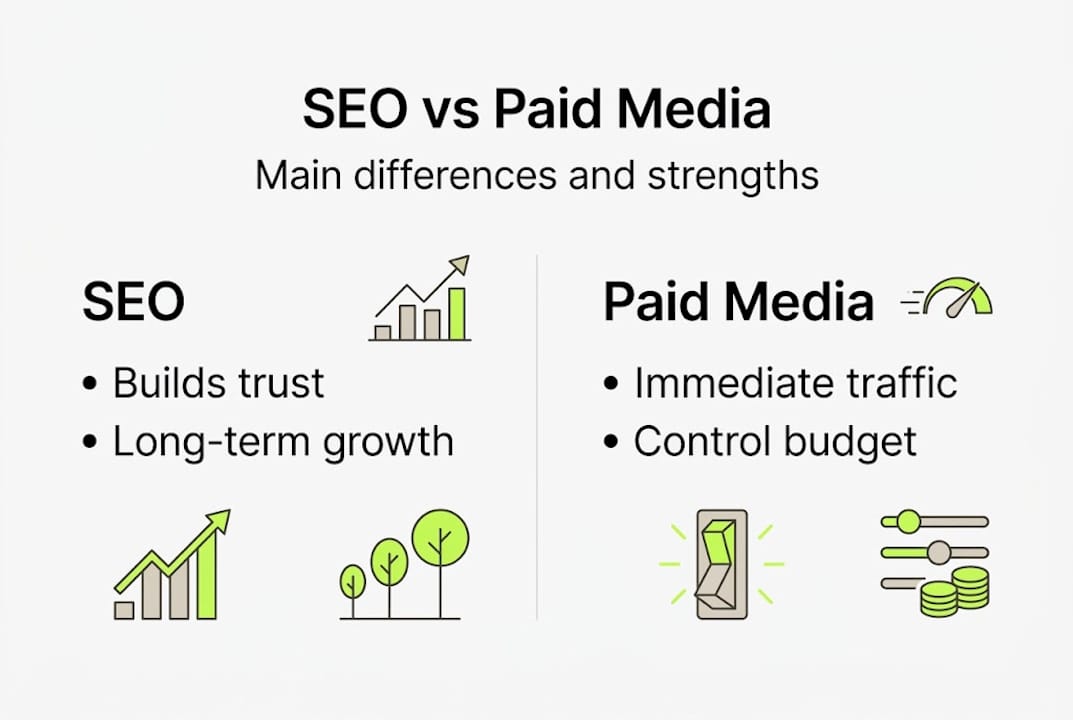
As the SEO vs PPC comparison shows, SEO takes longer to ramp up but builds compounding results, while paid media is fast but stops when spend stops. Neither is objectively better. They serve different purposes at different stages of growth.
Here is a quick guide to which channel fits common business goals:
- Launch a new product fast: Paid media wins. You need visibility now.
- Build long-term brand authority: SEO wins. Consistent content and rankings build trust over time.
- Compete in a crowded market: Both. Use paid ads for immediate positioning while SEO builds organic ground.
- Work with a tight budget: SEO offers better long-term ROI if you have time. Paid media requires ongoing spend.
- Test messaging or offers: Paid media wins. You get fast data on what resonates.
- Drive recurring traffic without recurring cost: SEO wins. Ranked pages keep delivering.
The ability to track ad ROI accurately is one of paid media's strongest advantages. SEO attribution is improving, but paid campaigns still offer cleaner data for decision-making.
"The smartest marketing strategies we've seen don't ask 'SEO or paid?' They ask 'how do both channels reinforce each other?' That question leads to better outcomes every time."
For most growing businesses, the paid ads benefits are most powerful when layered on top of a solid organic foundation, not used as a substitute for one.
When and how to combine SEO and paid media for maximum impact
The combining SEO and PPC approach maximizes both long-term and short-term results. The question is not whether to combine them. It is how and when.
| Business scenario | Recommended approach |
|---|---|
| New business, limited budget | Start with paid media for quick data, build SEO in parallel |
| Established brand, slow organic growth | Invest in SEO content while maintaining paid campaigns |
| Seasonal business | Run paid ads during peak seasons, use off-season for SEO |
| Product launch | Paid media for launch visibility, SEO for sustained discovery |
| Competitive market | Use paid ads for high-intent keywords, SEO for informational content |
Here are the best practices for running both channels together:
- Align your keyword strategy. The search terms you bid on in paid campaigns should inform your SEO content calendar.
- Use paid data to validate SEO investments. Before spending months writing content, test keyword demand with a small paid campaign.
- Sequence your investments. For most businesses, paid media first makes sense. It generates revenue and data. Then reinvest a portion into SEO for long-term compounding.
- Track the right metrics. Do not measure SEO and paid media with the same ruler. Organic growth is measured in rankings and traffic trends. Paid performance is measured in cost per acquisition and return on ad spend.
- Avoid cannibalization. If you rank organically for a keyword, you may not need to bid on it. Review overlap regularly.
Pro Tip: Look at your paid campaign case studies and identify which landing pages convert best. Then prioritize those pages for SEO optimization. You are already proving the demand with paid traffic.
The goal is to integrate SEO and paid ads so each channel feeds the other. Paid media gives you speed and data. SEO gives you authority and compounding returns. Together, they cover the full customer journey. Applying paid media best practices ensures your paid spend is purposeful and your SEO efforts are not working in isolation.

What most experts miss about SEO vs paid media
Here is the uncomfortable truth: most businesses do not lose because they chose the wrong channel. They lose because they spent too long debating which one to choose.
The "versus" framing is a trap. It forces a binary decision on a non-binary problem. We have worked with businesses that went all-in on SEO and had nothing to show for 18 months because they had no revenue coming in to fund content creation. We have also seen businesses burn through paid budgets with no SEO foundation, paying for the same traffic over and over with no lasting asset to show for it.
The shift that actually moves the needle is asking a different question. Not "which is better?" but "how do they work together for my specific stage of growth?" When you start blending SEO and paid media with a clear plan, growth stops feeling like a gamble and starts feeling like a system. That is the mindset we bring to every client we work with.
Get expert help combining SEO and paid media for real growth
If this article has clarified how SEO and paid media each play a role in your digital growth, the next step is putting that knowledge into action. We specialize in building and scaling performance marketing systems that deliver measurable results. From Google Ads management to Meta Ads management, we build campaigns that are strategic, data-driven, and designed to scale. Our clients do not get generic advice. They get a focused team that genuinely cares about their outcomes. If you are ready to grow with purpose, we are ready to help you get there.
Frequently asked questions
How long does SEO take compared to paid media?
SEO can take 3 to 12 months for significant results, while paid media can drive traffic almost instantly after a campaign launches. The right timeline depends on your market, competition, and how consistently you invest in each channel.
Is it better to invest in SEO or paid media first?
For most businesses, paid media first makes sense because it generates fast data and revenue. SEO and PPC synergy delivers the best long-term outcome, with paid media funding early growth while SEO builds compounding organic traffic.
Can SEO and paid media work together?
Absolutely. Integrating both channels improves overall marketing performance, broadens your reach, and gives you richer data to make smarter decisions across both strategies.
Do you have to spend a lot for paid media to see results?
Not necessarily. Small budgets can deliver meaningful results, especially with precise targeting and strong creative. However, more competitive markets require higher spend to gain meaningful visibility and volume.