
Marketing managers and business owners running paid ad campaigns often struggle with one critical challenge: maximizing return on investment. With digital ad spending projected to exceed $1 trillion globally, the pressure to optimize every dollar is intense. You need a systematic approach to refine targeting, creative, and budget allocation while leveraging modern AI tools. This guide delivers a practical, step by step framework to transform underperforming campaigns into ROI generating machines in 2026.
Table of Contents
- Understanding The Challenge: Why Optimize Your Paid Ad Campaigns?
- Preparation: Essential Prerequisites And Tools For Paid Ad Optimization
- Execution: Step By Step Process To Optimize Your Paid Ad Campaigns
- Verification And Scaling: Measuring Results And Scaling Successful Campaigns
- Optimize Your Paid Ads With Expert Performance Marketing Team
- Frequently Asked Questions
Key takeaways
| Point | Details |
|---|---|
| Systematic optimization drives ROI | Following a structured process improves campaign performance and reduces wasted ad spend |
| AI automation boosts efficiency | AI-managed campaigns deliver 3.7x better ROI compared to manual approaches |
| Data accuracy is foundational | Proper tracking setup and KPI definition enable informed optimization decisions |
| Testing reveals winners | A/B testing and iterative experimentation identify high performing audiences and creatives |
| Gradual scaling sustains growth | Controlled budget increases with continuous monitoring prevent performance degradation |
Understanding the challenge: Why optimize your paid ad campaigns?
Small to medium sized e-commerce and telehealth businesses face mounting pressure to extract maximum value from every advertising dollar. Global digital ad spending is projected to hit $1.04 trillion, creating fierce competition for audience attention. Without systematic optimization, you risk budget waste, poor targeting, and missed conversion opportunities.
Common pain points plague marketing managers daily. You might be spending heavily on broad audiences that never convert. Manual bid adjustments consume hours yet deliver inconsistent results. Creative fatigue sets in, and your click through rates plummet. These challenges compound when you lack clear visibility into which campaign elements drive actual revenue versus vanity metrics.
"The difference between profitable and unprofitable campaigns often comes down to systematic optimization rather than budget size."
AI automation has revolutionized paid advertising efficiency. Campaigns using AI automation deliver better ROI compared to manual management, handling real time bid adjustments and budget distribution that humans simply cannot match at scale. This technology shift means staying competitive requires adopting modern optimization frameworks.
Focusing relentlessly on ROI keeps your campaigns aligned with business goals. Every optimization decision should tie back to measurable revenue impact, not just improved engagement metrics. Understanding why optimize ad campaigns roi creates the foundation for strategic decision making.
Key challenges to address include:
- Budget waste on low converting audience segments
- Inefficient manual bid management consuming team resources
- Poor attribution making it impossible to identify winning elements
- Creative fatigue reducing campaign effectiveness over time
- Scaling difficulties when trying to grow successful campaigns
Preparation: Essential prerequisites and tools for paid ad optimization
Before diving into optimization tactics, you need solid data infrastructure and clear performance benchmarks. Accurate conversion tracking forms the backbone of every optimization decision you will make.
Set up conversion pixels and tracking codes across all customer touchpoints. Your e-commerce platform should fire events for add to cart, initiate checkout, and purchase completion. Telehealth businesses need tracking for appointment bookings, form submissions, and patient registrations. Without this foundation, you are optimizing blind.
Define your key performance indicators based on business objectives. Cost per acquisition (CPA) tells you how much each customer costs. Return on ad spend (ROAS) reveals revenue generated per dollar spent. Click through rate (CTR) indicates ad relevance and audience targeting accuracy. Conversion rate shows landing page effectiveness.
Modern optimization leverages AI powered tools and strategies. Campaign Budget Optimization (CBO) is a strong trend in 2026, allowing Meta's AI to dynamically distribute budget across ad sets for maximum efficiency and ROI. This automation handles micro adjustments that would be impossible manually.

Staying current with paid advertising trends 2026 ensures you adopt winning strategies early. The landscape evolves rapidly, and last year's tactics may underperform today.
| Tool/Platform | Role in Optimization | Key Benefit |
|---|---|---|
| Google Analytics 4 | Tracks user behavior and conversions | Provides attribution insights across touchpoints |
| Meta Pixel | Monitors Facebook/Instagram actions | Enables retargeting and lookalike audiences |
| Google Ads Scripts | Automates bid and budget changes | Saves time on routine optimizations |
| Campaign Budget Optimization | AI-driven budget allocation | Maximizes ROI through dynamic distribution |
| Heatmap Tools | Analyzes landing page engagement | Identifies conversion barriers |
Pro Tip: Before making any optimization changes, validate your tracking accuracy by comparing platform reported conversions against actual sales or leads in your CRM. Discrepancies indicate setup issues that will sabotage optimization efforts.
Ensure you have sufficient historical data before optimization. Most platforms need at least 50 conversions per ad set to make statistically valid recommendations. Understanding tracking ad performance metrics prevents premature decisions based on incomplete data.
Execution: Step by step process to optimize your paid ad campaigns
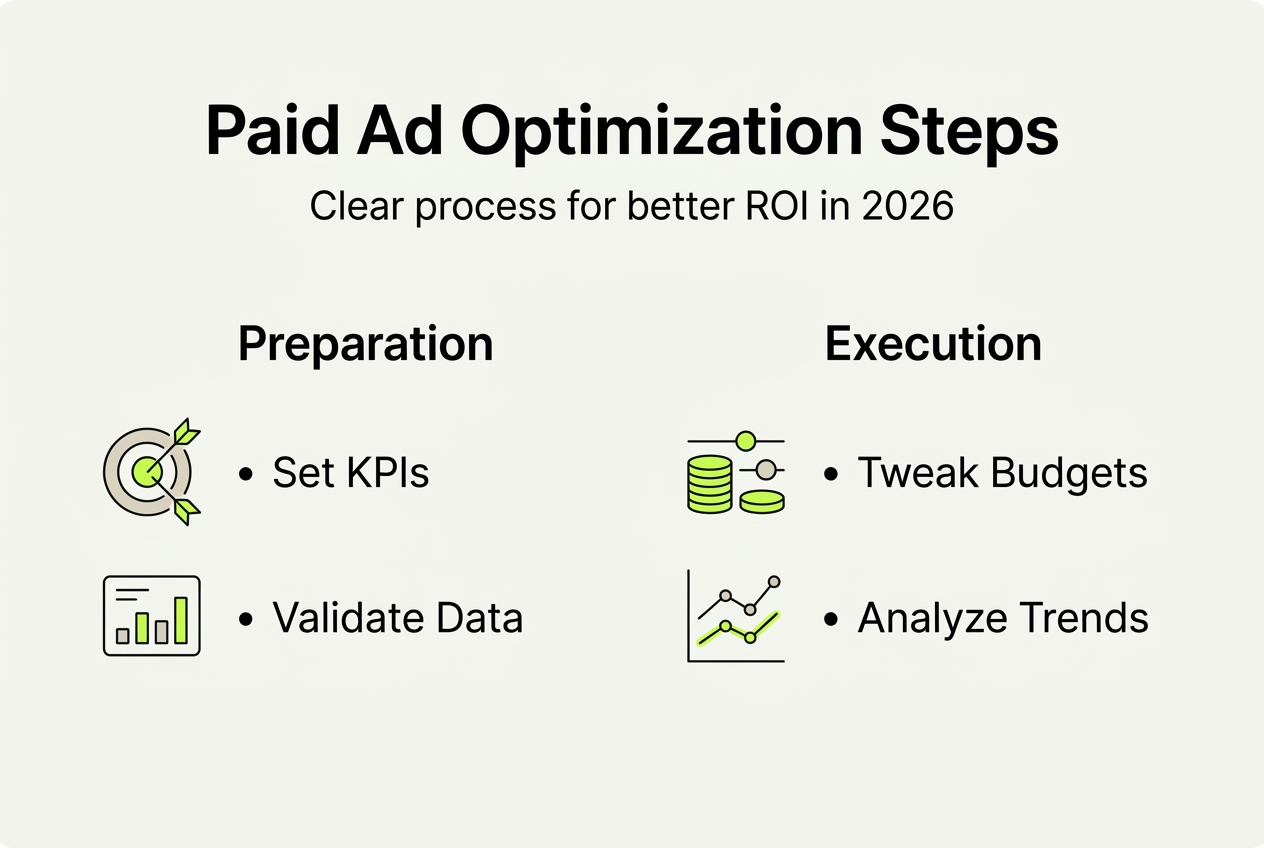
Systematic optimization follows a proven sequence that builds on data insights and testing discipline. This framework works across Google Ads, Meta platforms, and other paid channels.
-
Audit existing campaign performance to identify optimization opportunities. Export the last 90 days of data and segment by campaign, ad set, ad creative, audience, and placement. Flag anything with CPA above your target or ROAS below breakeven. These become your first optimization targets.
-
Analyze audience performance to find your best converters. Compare demographics, interests, and behaviors across winning versus losing ad sets. You might discover that women aged 35 to 44 convert at twice the rate of your broader targeting. Double down on what works.
-
Test audience segments systematically through controlled experiments. Create separate ad sets for different demographics, interests, or lookalike percentages. Run them simultaneously with equal budgets for valid comparison. This reveals which segments deserve more investment.
-
Refresh creative assets to combat ad fatigue. Develop 3 to 5 variations testing different hooks, visuals, and calls to action. Campaigns using AI automation deliver better ROI partly because AI can rotate creatives based on performance signals faster than manual management.
-
Implement A/B testing frameworks for landing pages and ad copy. Change one element at a time so you know what drives results. Test headlines, button colors, form lengths, and social proof placement. Small improvements compound into significant ROI gains.
-
Adjust bids and budgets based on performance data. Increase spending on high ROAS campaigns while reducing or pausing underperformers. AI tools excel here, making thousands of micro adjustments daily that humans would miss.
-
Optimize ad placements by analyzing where conversions actually happen. You might find Instagram Stories outperform Facebook Feed for your telehealth services. Shift budget to winning placements while testing new ones at smaller scale.
-
Leverage automation tools to scale your optimization efforts. Google's Smart Bidding and Meta's Advantage+ campaigns use machine learning to optimize in real time. Following step by step ad campaign setup ensures proper configuration.
| Optimization Approach | Time Investment | Typical ROI Improvement | Scalability |
|---|---|---|---|
| Manual Management | 15-20 hours/week | 10-25% increase | Limited by human capacity |
| AI-Automated Optimization | 3-5 hours/week | 30-90% increase | Highly scalable across campaigns |
Pro Tip: Maintain at least 1000 impressions per ad variant before making performance judgments. Lower volumes create statistical noise that leads to poor decisions. Patience in testing pays off with reliable insights.
Advanced optimization incorporates strategies from meta ads strategies and techniques used in AI trading strategy optimization where algorithmic decision making outperforms human intuition.
Verification and scaling: Measuring results and scaling successful campaigns
Validating optimization success requires monitoring specific metrics that tie directly to business outcomes. Track these KPIs weekly to confirm your changes deliver intended results.
Your primary verification metrics should include CPA trends, ROAS improvements, conversion rate changes, and overall revenue growth. Compare performance across equal time periods to account for seasonality. A 20% CPA reduction means nothing if conversion rates dropped 30%.
Common pitfalls derail even well planned optimizations. Scaling budgets too aggressively before sufficient data accumulation leads to performance crashes. Many marketers see strong results at $50 daily spend, then triple the budget overnight and watch efficiency plummet. Gradual increases allow algorithms to adapt.
Ignoring proper attribution setup creates blind spots in your optimization. Last click attribution might show Google Ads driving all conversions while ignoring Meta's role in initial awareness. Multi touch attribution reveals the true customer journey.
| Metric | Before Optimization | After Optimization | Improvement |
|---|---|---|---|
| Cost Per Acquisition | $85 | $52 | 38.8% decrease |
| Return on Ad Spend | 2.1x | 4.3x | 104.8% increase |
| Conversion Rate | 1.8% | 3.2% | 77.8% increase |
| Monthly Revenue | $42,000 | $89,000 | 111.9% increase |
Campaign Budget Optimization enables intelligent scaling. CBO is a strong trend because it automatically reallocates budget to top performing ad sets within your campaign. This dynamic distribution maintains efficiency as you scale spending.
Implement these scaling best practices:
- Increase budgets by 20% every 3 to 5 days rather than doubling overnight
- Monitor performance daily during scaling periods for early warning signs
- Maintain winning audience and creative combinations while testing new variants
- Use CBO to let AI handle micro level budget decisions
- Document what works so you can replicate success across campaigns
Pro Tip: When scaling successful campaigns, create duplicate ad sets at higher budgets rather than increasing existing ones. This preserves your proven baseline while testing scalability, giving you a safety net if performance degrades.
Understanding how to scale google ads and testing paid campaigns ROI provides frameworks for sustainable growth. Continuous testing remains critical even after finding winners because audience behavior and competitive dynamics constantly evolve.
Watch for these warning signs during scaling:
- CPA increasing by more than 15% week over week
- Frequency climbing above 3.5 impressions per user
- Click through rates declining despite fresh creative
- Conversion rates dropping on previously strong landing pages
Address issues immediately by pausing aggressive scaling, refreshing creative assets, or expanding audience targeting. The key is catching problems early before significant budget waste occurs.
Optimize your paid ads with expert performance marketing team
Executing this optimization framework consistently requires dedicated expertise and time that many marketing teams lack. Professional performance marketing agencies specialize in maximizing paid ad ROI through proven processes and AI powered tools.
Partnering with specialists gives you access to advanced optimization techniques, multi channel campaign management, and data analysis capabilities that would take years to build in house. Expert teams handle the complex testing, monitoring, and adjustment cycles while you focus on core business operations.
Comprehensive google ads management and meta ads management services deliver the systematic optimization approach outlined in this guide without requiring you to become a paid ads expert. Professional teams leverage AI automation, proven creative frameworks, and continuous testing to drive measurable revenue growth.
Discover how performance focused agencies transform paid advertising from a cost center into a profit engine at AT Digi Agency.
Frequently asked questions
What are the first steps to start optimizing paid ads?
Begin by implementing accurate conversion tracking across all customer touchpoints and validating that data matches your actual sales or leads. Define clear KPIs like CPA, ROAS, and conversion rate based on your business goals. Audit your last 90 days of campaign performance to identify underperforming elements that need immediate attention. These foundational steps ensure you optimize based on reliable data rather than guesswork.
How does AI improve paid ad optimization?
AI automation handles real time bid adjustments and budget distribution across thousands of variables that humans cannot process manually. Machine learning algorithms identify patterns in user behavior and adjust targeting to reach high intent audiences at optimal times. Studies show AI managed campaigns can deliver up to 3.7 times better ROI than manual methods by making micro optimizations continuously. This technology excels at scaling winning strategies while maintaining efficiency.
What common mistakes should I avoid during ad optimization?
Avoid scaling campaign budgets too aggressively before accumulating sufficient conversion data, as this disrupts algorithm learning and degrades performance. Never neglect proper tracking and attribution setup, which creates blind spots in your optimization decisions. Resist making frequent manual changes to automated campaigns, as constant interference prevents AI systems from learning effectively. Most platforms need 3 to 7 days of stable operation to optimize properly.
How long does it take to see optimization results?
Most optimization changes require 7 to 14 days to show statistically significant results, depending on your conversion volume and budget size. High volume campaigns with 50 plus conversions weekly may show trends within 5 to 7 days. Lower volume campaigns need 3 to 4 weeks for reliable data. Patience is critical because premature decisions based on incomplete data often reverse genuine improvements. Track performance weekly rather than daily to avoid overreacting to normal fluctuations.
Should I optimize campaigns myself or hire experts?
The decision depends on your team's expertise, available time, and campaign complexity. In house optimization works well if you have dedicated specialists and manage relatively simple campaigns. However, professional agencies bring proven frameworks, advanced tools, and experience across multiple industries that accelerate results. Consider hiring experts if you lack time for continuous testing and monitoring, manage budgets exceeding $10,000 monthly, or need multi channel coordination across Google, Meta, and other platforms.