
TL;DR:
- Mobile-first marketing centers on designing customer interactions primarily for mobile devices to improve conversion rates and retention. It emphasizes speed, personalization, and real-time data, with mobile KPIs like ROAS, CPI, and retention guiding strategy. Implementing this approach involves auditing experiences, redesigning for mobile, and fostering cross-team collaboration to outperform desktop-centric tactics.
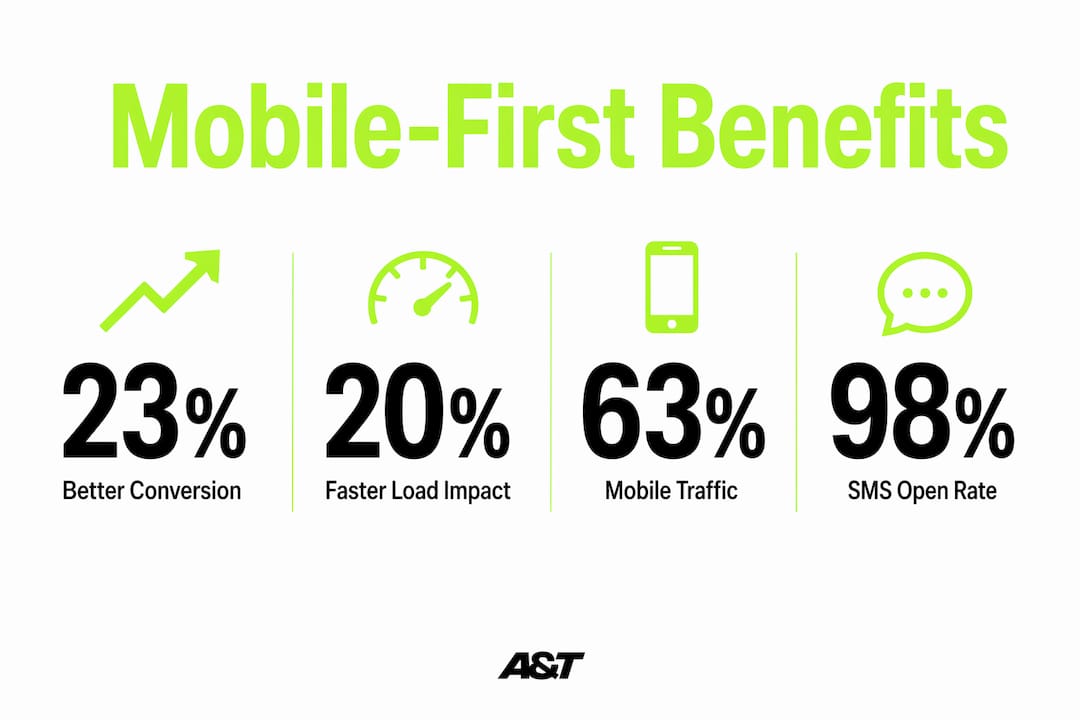
Mobile-first marketing is the strategy of designing and delivering every customer interaction with mobile devices as the primary context, not an afterthought. Over 63% of global web traffic now originates from mobile devices, which means your customers are already living on their phones. Google's mobile-first indexing makes mobile experience a direct ranking factor, so poor mobile execution hurts both your SEO and your revenue. Tools like Google Analytics 4, Hotjar, and Braze exist specifically to help marketing teams measure and optimize these mobile interactions. The role of mobile-first marketing in 2026 is not optional. It is the primary engine of customer engagement, conversion, and retention for any SME that wants to compete.
What are the key benefits of a mobile-first marketing strategy?
The benefits of mobile-first strategy are measurable, not theoretical. Mobile-first sites convert 23% better and produce 67% lower bounce rates compared to desktop-first designs. That gap represents real revenue left on the table by businesses still treating mobile as a secondary concern.
Speed is the most direct lever. A one-second delay in load time drops conversion rates by 20%. For an SME running paid traffic, that single second can erase the return on an entire campaign budget.
Channel reach is another concrete advantage. Over 70% of digital ad spend is projected to flow to mobile channels in 2026. Businesses that have already built mobile-optimized funnels capture that spend efficiently. Those that have not are paying for clicks that land on broken experiences.
SMS marketing illustrates the channel gap clearly:
- SMS open rate: 98%
- Email open rate: approximately 25%
- Push notifications: deliver real-time, location-aware messages at near-zero incremental cost
- In-app messaging: reaches users at peak engagement moments within your product
The importance of mobile marketing extends beyond reach. Mobile-first design forces teams to strip out friction, which produces faster, cleaner experiences that perform better across every device. That constraint is a feature, not a limitation.
Pro Tip: Before launching any paid campaign, run your landing page through Google PageSpeed Insights. A score below 70 on mobile is a conversion problem, not just a technical one.
How to implement mobile-first marketing in your SME
Execution is where most SMEs stall. The following sequence reflects how high-performing mobile marketing teams actually build their systems.
-
Audit your current mobile experience. Use Google PageSpeed Insights and Hotjar heatmaps to identify where mobile users drop off. Prioritize pages that receive paid traffic first.
-
Set performance budgets. Define hard limits for Largest Contentful Paint and Interaction to Next Paint before any development work begins. These metrics directly correlate with revenue-impacting user experience.
-
Redesign for mobile UX, not mobile adaptation. True mobile-first design starts with core user tasks on small screens. It accounts for thumb reach, variable network conditions, and multitasking. Shrinking a desktop layout is not mobile-first design.
-
Implement behavioral segmentation. Use Google Analytics 4 or Mixpanel to segment users by device type, session behavior, and conversion stage. Generic broadcast messaging underperforms against targeted, behavior-triggered sequences.
-
Deploy marketing automation. Platforms like Braze unify real-time customer profiles and execute personalized messaging across SMS, push, and in-app channels at scale. Automation is what separates mobile marketing from mobile broadcasting.
-
Add mobile payment options. Integrating Apple Pay and Google Pay increases mobile conversions by 30% by removing checkout friction. For any SME running e-commerce, this is one of the highest-ROI technical changes available.
-
Build an experimentation culture. High-performing mobile marketing teams run 30 to 50 A/B tests per month, compared to 5 to 10 in traditional marketing. That velocity is how you find what actually works on mobile, where user behavior differs sharply from desktop.
-
Align product and marketing teams. Mobile-first execution requires product, engineering, and marketing to share the same performance data and sprint priorities. Siloed teams produce siloed experiences.
The data-driven marketing approach that works for paid campaigns applies directly here. Real-time data guides every decision, from creative to copy to channel allocation.
Pro Tip: Start with one high-traffic mobile landing page, optimize it fully using the steps above, and measure the conversion lift before scaling the process across your entire site.
What metrics and KPIs matter most for mobile marketing success?
Vanity metrics do not pay salaries. Mobile-first marketing requires a specific set of KPIs that reflect actual business outcomes, not surface-level engagement.
The most revenue-relevant mobile KPIs are:
- Cost Per Install (CPI): measures acquisition efficiency for app-based products
- Return on Ad Spend (ROAS): the direct revenue output per dollar of mobile ad spend
- Day 1, Day 7, and Day 30 retention rates: reveal whether your mobile experience creates lasting value or just one-time visits
- Churn rate: the percentage of mobile users who disengage within a defined period
- Average Revenue Per User (ARPU): tracks monetization efficiency across your mobile audience
Mobile-first strategies require tracking these KPIs because standard web analytics tools were built for desktop behavior. Mobile user journeys are non-linear, cross-session, and often cross-device.
Multi-touch attribution models replace last-click attribution for mobile campaigns. A user might see a Meta ad on their phone, research on desktop, and convert via a mobile SMS link. Last-click attribution misattributes that conversion entirely. Mobile Measurement Partners like AppsFlyer and Adjust provide the cross-channel visibility needed to allocate budget accurately.
Pro Tip: Set up a weekly dashboard in Google Analytics 4 that isolates mobile traffic by channel, device type, and conversion event. Review it every Monday before making any budget decisions for the week.
Understanding why analytics drives better ROI is not optional at this stage. The teams that reallocate budget in real time based on mobile performance data consistently outperform those that review results monthly.
Mobile-first vs. desktop-centric vs. multi-channel: what actually differs?
The distinction matters because each approach produces fundamentally different results, not just different workflows.
| Approach | Primary focus | Mobile treatment | Typical outcome |
|---|---|---|---|
| Desktop-centric | Desktop UX and conversion | Afterthought or responsive shrink | High mobile bounce, low conversion |
| Multi-channel | Presence across all channels | One channel among many | Diluted mobile experience, average performance |
| Mobile-first | Mobile as primary context | Core design and strategy driver | Higher conversion, lower bounce, better retention |
Desktop-centric marketing treats mobile as a secondary adaptation. The result is bloated pages, misaligned CTAs, and checkout flows that frustrate users on small screens. Multi-channel marketing includes mobile but rarely optimizes for it. The mobile experience gets the same creative and copy as desktop, which ignores how differently people behave on their phones.
Mobile-first demands a different execution model entirely. Screen size, thumb reach, variable connectivity, and short attention windows all shape how content must be structured. A 1,200-word landing page that converts well on desktop will fail on mobile if it is not rebuilt with mobile reading behavior in mind.
The impact of a mobile-first approach is most visible in the constraint it imposes. When you design for the smallest screen first, you are forced to prioritize what actually matters to the user. That discipline produces leaner, faster experiences that outperform bloated desktop adaptations on every device. For SMEs with limited development resources, this constraint is an advantage. You build less, but what you build works better.
Ignoring mobile-first execution has a direct cost. A retail client running Google Ads to a desktop-optimized page with a three-second mobile load time is paying for traffic that converts at a fraction of its potential. The ad spend management decisions that drive ROI always include mobile performance as a core variable.
Key takeaways
Mobile-first marketing succeeds when speed, personalization, and real-time data work together as a system, not as isolated tactics.
| Point | Details |
|---|---|
| Mobile dominates web traffic | 63% of global web traffic is mobile, making mobile-first execution non-negotiable for SMEs. |
| Speed directly impacts revenue | A one-second load delay drops conversions by 20%; set performance budgets before building. |
| SMS outperforms email significantly | SMS achieves a 98% open rate versus email's 25%, making it a high-priority mobile channel. |
| Experimentation velocity separates winners | Mobile-first teams run 30 to 50 A/B tests monthly versus 5 to 10 in traditional marketing. |
| Track mobile-specific KPIs | Measure CPI, ROAS, and Day 1/7/30 retention instead of relying on last-click attribution. |
What I've learned about mobile-first marketing in practice
The biggest mistake I see SMEs make is treating mobile-first as a design project. They redesign their site, declare victory, and return to running the same campaigns they always ran. That is not mobile-first marketing. That is mobile-first aesthetics.
Real mobile-first marketing is a measurement and experimentation discipline. The design is just the foundation. What happens after launch, the A/B tests, the retention tracking, the budget reallocation based on real-time ROAS data, that is where the actual performance gains live.
I have also watched teams over-personalize their mobile messaging and trigger a privacy backlash from their own customers. Personalization on mobile requires transparency and restraint. Users will share data when they trust you and see clear value. Push them too hard and they opt out permanently. The balance is earned, not assumed.
One more thing worth saying directly: do not port your desktop campaigns to mobile. Rewrite the copy for shorter attention spans. Rebuild the landing pages for thumb navigation. Rethink the checkout flow for one-handed use. The mobile-friendly SEO considerations that affect rankings are the same ones that affect conversion. They are not separate problems.
Mobile-first is a mindset shift from brand guardianship to growth engineering. The teams that internalize that shift outperform those that treat it as a checklist.
— Ann
How Atdigiagency helps you execute mobile-first paid campaigns
Building a mobile-first marketing system takes more than good intentions. It takes the right paid ad infrastructure, real-time optimization, and creative that is built for mobile behavior from the start. Atdigiagency specializes in exactly that. We build and manage Google Ads campaigns optimized for mobile conversion, from performance budgets to landing page alignment. We also run Meta Ads campaigns designed specifically for mobile-first audiences on Facebook and Instagram. For SMEs that want measurable results without wasted spend, we manage the full system. No unnecessary meetings. Just campaigns that convert.
FAQ
What is mobile-first marketing?
Mobile-first marketing is the practice of designing and executing marketing strategies with mobile devices as the primary user context. It prioritizes mobile speed, UX, and personalization over desktop adaptation.
Why does mobile-first indexing matter for SMEs?
Google uses the mobile version of your site for ranking and indexing. A poor mobile experience directly reduces your search visibility, which means less organic traffic regardless of your content quality.
What is the most effective mobile marketing channel?
SMS marketing achieves a 98% open rate, making it the highest-engagement direct channel available. Push notifications and in-app messaging also outperform email for real-time, behavior-triggered communication.
How do I measure mobile marketing ROI?
Track mobile-specific KPIs including ROAS, CPI, and Day 1/7/30 retention rates using tools like AppsFlyer, Adjust, or Google Analytics 4. Multi-touch attribution models give a more accurate picture than last-click data.
How many A/B tests should a mobile-first team run?
High-performing mobile marketing teams run 30 to 50 A/B tests per month. That experimentation velocity is what separates teams that find winning mobile experiences from those that guess.