
Most TikTok ad rejections trace to one of three buckets: creative that trips automated moderation, a landing page that does not match the ad, or an account-level flag. Read the exact rejection reason in Ads Manager first. If the issue is a clear creative or page defect, fix it and resubmit. If you are confident the ad complies and the rejection looks wrong, appeal with evidence instead of guessing. Account suspensions need separate handling entirely.
TL;DR:
- Most rejections are caused by landing-page mismatches, such as inconsistent pricing, broken links, or missing privacy policies, making fixes quick and straightforward.
- Creative rejections often involve unsupported claims, restricted language, unlicensed audio, or low-quality videos, requiring careful review before resubmission.
- Account suspensions tend to result from repeated violations or linked accounts, not from a single rejected ad, and require separate escalation to resolve.
- Fixing issues based on the exact rejection reason and including supporting evidence in appeals significantly increases the chances of approval.
- Preflight checks on claims, licensing, and landing pages before submission prevent most rejections and save time during review.
Table of Contents
- Why Do TikTok Ads Get Rejected? The Common Triggers
- How Do You Fix a Rejected TikTok Ad Step by Step?
- How Do You Appeal a TikTok Ad Rejection?
- How Long Does TikTok Ad Review Actually Take?
- Agency-Grade Prevention: What Stops Repeat Rejections
- What Do TikTok's Ad Policies Actually Cover?
- Common Misconceptions About TikTok Ad Rejections
- Real Examples: Rejected Ads and What Fixed Them
- Does Rejection Hurt Your Account Standing?
- What Actually Moves the Needle on TikTok Approvals
- Get a Free Audit of Your Rejected TikTok Ad
- Sources
Why Do TikTok Ads Get Rejected? The Common Triggers
TikTok's own guidance points to a short list of repeat offenders: intellectual property infringement, inconsistent ad creative, and misleading or contradictory information between the ad and what it promotes, according to TikTok's own breakdown of common rejection reasons. Once you know the categories, spotting your own mistake gets a lot faster.
Creative triggers are the ones marketers hit most often, usually without realizing it:
- Absolute or unverifiable claims ("cures anxiety," "guaranteed 10x returns")
- Restricted-claim language in health, finance, or weight loss categories
- Unlicensed music or audio pulled from outside TikTok's commercial library
- On-screen text or captions that contradict the voiceover or the landing page
- Low-resolution video, distorted audio, or clips that fail TikTok's spec requirements
Practitioners report that health and finance claims, along with implied guaranteed outcomes, are among the most frequent automated flags, even when the wording feels harmless to the advertiser.
Landing-page triggers now rival creative issues as a leading cause of rejection. Agency audits from 2026 identify landing-page mismatch as the single biggest driver of TikTok ad rejections, ahead of any creative defect, according to DeepClick's TikTok ad approval analysis. Common versions include:
- The ad promotes a price, offer, or product that the landing page does not show
- Broken links, 404 errors, or redirect chains that dump users somewhere unrelated
- Missing privacy policy, refund terms, or a visible contact method
- Content gated behind an email wall before the promised offer appears
- A landing page in a different language or market than the ad targets
Account-level triggers sit apart from creative and page problems entirely: an account still pending approval, a suspension from a prior violation, multiple accounts flagged as connected, or Business Center and pixel setup errors that make TikTok question who is actually running the ad.
How Do You Fix a Rejected TikTok Ad Step by Step?
Fixing a rejected ad is a diagnosis problem before it's an editing problem. Rushing straight to edits without reading the rejection reason is how advertisers end up resubmitting the same broken ad twice.
- Read the exact rejection text and screenshot the policy code. TikTok labels rejections with a specific policy reference. Copy it verbatim, since you'll need it for either the fix or the appeal.
- Sort the issue into one of three buckets: creative, landing page, or account. The rejection text almost always tells you which one.
- Fix creative defects directly. Strip out absolute claims, swap in licensed audio, correct on-screen text that contradicts your voiceover, and confirm your file meets TikTok's resolution and duration specs. If your original creative angle relied on urgency or outcome language, rework it using the kind of high-converting ad creative examples that pass moderation without losing the hook.
- Fix landing-page defects before touching the creative. Match the price and offer shown in the ad, add a visible privacy policy and contact link, remove any deceptive redirect, and test the page on an actual phone, not just a desktop preview.
- Clean up account hygiene. Confirm business details and billing are accurate, verify pixel and Conversions API health, and avoid running multiple client accounts from the same device or payment fingerprint.
- Resubmit once, then wait. Edit everything you need to fix in a single pass, submit, and let the review finish. Repeated micro-edits restart the clock every time.
- Build a fresh creative if two appeals fail. At that point, the algorithm may be pattern-matching on the asset itself rather than a single line of text.
Pro Tip: Before resubmitting, run your ad copy through a quick internal read for absolute claims ("best," "guaranteed," "cures"). Testing variations against smarter ad copy practices before launch catches most of these before TikTok ever sees them.
How Do You Appeal a TikTok Ad Rejection?
Appealing only works when you can actually prove compliance. Guessing and appealing anyway wastes the one shot TikTok's tool gives you per ad.
You'll find the Appeal option directly inside Ads Manager next to the rejected ad or ad group. TikTok's One Click Appeal locks the ad or ad group once submitted, so there's no editing mid-appeal, and it accepts up to five supporting files in PNG, JPG, or PDF format alongside a written explanation capped at 2,000 characters, according to TikAdSuite's appeal guide.
Attach evidence that directly answers the rejection reason, not general context:
- Campaign and ad ID numbers
- A screenshot of the exact rejection message
- Mobile screenshots of your landing page showing the disputed claim or price
- Licenses, certifications, or regulatory approvals if the flag involved a restricted category
- Proof of music licensing if the flag involved audio
Appeal only when you have concrete evidence the ad complies. If you're not sure, fix and resubmit instead. Appeals win more often when the written explanation names the specific policy and points the reviewer exactly where to look, rather than arguing generally that the ad "should be fine." If TikTok denies the appeal, rebuild the creative from scratch, open a support ticket, or escalate to your account rep if you have one.
How Long Does TikTok Ad Review Actually Take?
Initial reviews typically complete within about 24 hours, though new accounts or restricted verticals often run 24 to 72 hours, per practical benchmarks from AdRate's TikTok review guide. Resubmissions and appeals commonly take longer than the first review, sometimes stretching another 24 to 48 hours, and DeepClick's audit data confirms that appeal queues in particular tend to lag behind initial submissions.
Escalate when:
- A critical launch has missed the 48 to 72 hour window with no response
- You've submitted two appeals with clear evidence and both were denied
- Your account itself has been suspended, not just an individual ad
When you escalate through a support ticket or a rep email, include everything in one message: ad IDs, timestamps of each submission, the rejection screenshot, your proof files, landing-page screenshots, and one clear, specific ask. Vague escalation requests get vague responses.
Agency-Grade Prevention: What Stops Repeat Rejections
Most repeat rejections come from skipping a preflight check, not from a single bad ad. Before anything gets submitted, run a short internal policy pass: confirm the creative is truly final (no last-second text swaps), check the landing page on mobile, and verify music licenses and any trademarked terms in the script.
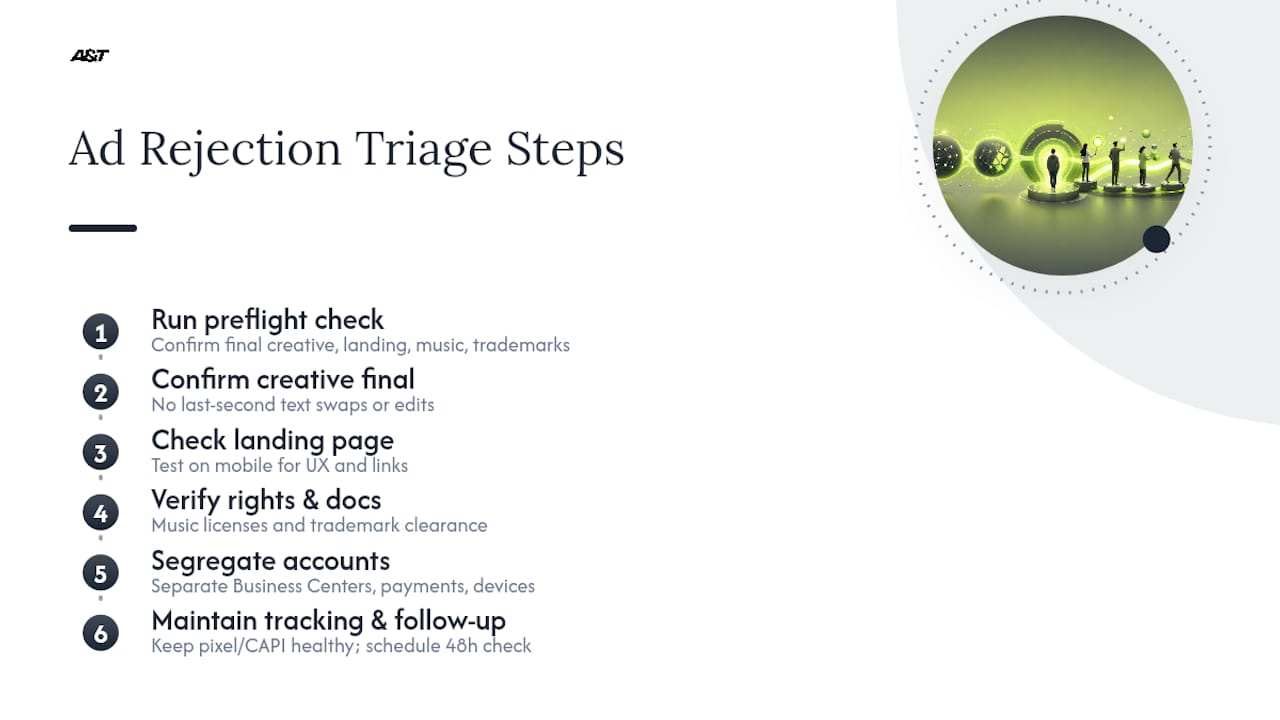
At scale, separate Business Centers, payment methods, and devices across different clients or campaigns. TikTok's systems flag shared fingerprints faster than most advertisers expect. Keep pixel and Conversions API connections healthy, and document your approvals for any restricted vertical (health, finance, supplements) so you have paperwork ready if a rejection or appeal comes up later.
Pro Tip: Schedule a quick check 48 hours after any approval. A single "finalize before submit" habit, meaning no post-submission edits, reduces resubmits and prevents the review clock from restarting on ads that were already fine.
What Do TikTok's Ad Policies Actually Cover?
TikTok's advertising policies are broader than most first-time advertisers assume, and they apply differently depending on your vertical, target market, and ad format. The policies cover prohibited content outright (illegal goods, weapons, counterfeit products), restricted content that requires special permissions or disclaimers (alcohol, gambling where legal, certain financial products), and quality standards around claims, sourcing, and disclosure.
The line that trips up most legitimate advertisers isn't the obvious prohibited category. It's the restricted-claim zone: health outcomes, financial returns, weight-loss results, and "guaranteed" language of any kind. TikTok's moderation treats these claims as high-risk by default, whether or not you can back them up, because verifying a claim's accuracy at ad-review scale isn't realistic for the platform.
Intellectual property is the other boundary worth taking seriously. Using a brand name, logo, or copyrighted footage without rights, even briefly or as a comparison, triggers the same infringement flag TikTok lists as one of its most common rejection reasons. Music is the most overlooked version of this: audio pulled from outside TikTok's licensed commercial library is a frequent, avoidable rejection.
Advertisers running health-adjacent campaigns face the tightest scrutiny. If your category touches telehealth, supplements, or medical claims, the compliance bar sits well above a general consumer product ad, and guidance built specifically around telehealth ad compliance is worth reviewing before you write a single line of ad copy.
Common Misconceptions About TikTok Ad Rejections
The biggest misconception is that rejection means permanent exile. It usually doesn't. Most rejections are a single ad or ad group getting flagged, not a verdict on your account. Fix the specific defect, resubmit, and the ad typically clears on the next pass.
Another common myth: rejection always means you did something wrong. TikTok's own help documentation confirms that ads can get rejected or pulled after they were already approved, triggered by user reports, a policy update, a change you made to your landing page, or an automated re-review catching something the first pass missed, according to TikTok's Help Center. An ad that ran fine for two weeks can get flagged retroactively without any new edit on your end.
Some advertisers also assume small print or a buried disclaimer will satisfy moderation. It usually won't. TikTok's review process increasingly combines visual scanning, audio analysis, and text recognition on on-screen captions with automated crawling of the landing page itself, so a disclaimer in eight-point font at the bottom of a page carries little weight against a bold claim in the video.
Finally, plenty of advertisers believe appealing is always the right move. It isn't. Appealing an ad that genuinely violates policy just burns your one-shot appeal and delays the fix you actually needed to make.
Real Examples: Rejected Ads and What Fixed Them
A supplement brand running a weight-loss campaign got rejected for "before and after" claims implying guaranteed results. The fix wasn't a new video. The team removed the specific numeric claim ("lost 15 pounds in 3 weeks") from both the voiceover and the caption, replaced it with a general lifestyle framing, and resubmitted. It cleared review within the standard window.
A telehealth advertiser's ad passed creative review but got flagged on the landing page a week after launch. The ad promised a flat consultation price; the page had since changed to a tiered pricing model during a site update. TikTok's automated re-review caught the mismatch. The fix took ten minutes: align the page's headline price with the ad, and the flag cleared without needing an appeal.
A retail brand selling novelty gummies got rejected for restricted-ingredient language, even though the product was fully legal. This one warranted an appeal rather than an edit, since the claim was accurate. The team attached the product's lab certification and a screenshot of the exact rejection reason. The appeal succeeded because the evidence matched the specific policy cited, not because the explanation was longer or more persuasive.
Each case followed the same pattern: read the exact reason, decide whether it's a genuine defect or a false flag, and act accordingly.
Does Rejection Hurt Your Account Standing?
A single rejected ad has almost no lasting effect on your account. TikTok treats it as routine moderation, not a strike against you. The risk shows up with volume and pattern, not with one flagged asset.
Repeated rejections across multiple ads, especially for the same policy violation, start building a pattern TikTok's systems track. Enough of that pattern can slow down how quickly future ads clear review, since accounts with a rejection history sometimes get routed through additional scrutiny. In more serious cases, especially involving intellectual property infringement or misleading claims, repeated violations can escalate toward account suspension.
Suspension is a different problem entirely from a rejected ad, and it needs different handling. A suspended account typically can't launch any new campaigns until the underlying issue is resolved through TikTok support, which often takes considerably longer than a standard ad appeal. Multi-account violations compound this risk. Running several accounts that TikTok's systems detect as connected (shared devices, payment methods, or IP patterns) can trigger a broader review of everything tied to that cluster, not just the flagged account.
The practical takeaway: treat each rejection as a data point. One or two isolated rejections are normal cost of doing business. A repeated pattern on the same violation type is a signal to fix your process, not just your next ad, before it becomes an account-level problem.
What Actually Moves the Needle on TikTok Approvals
The conventional advice treats every rejection like a wording problem: soften the claim, tweak the caption, resubmit. That works often enough to feel like the whole answer, but it misses where the real damage happens. Landing-page mismatch, not creative language, is now the largest single rejection driver, and it's the one most marketing teams check last instead of first.

The bigger blind spot is timing. Teams obsess over the initial review window and then get blindsided when a resubmit or appeal takes longer, not because anything went wrong, but because that's simply how the queue works. Building appeal and resubmit delays into your launch calendar from day one avoids the scramble that usually leads to a second, worse mistake: appealing an ad that genuinely violates policy just because the clock is running.
If there's one priority worth taking from all of this, it's building the habit before the submission, not the fix after. A five-minute preflight check on claims, music licensing, and mobile landing-page accuracy prevents more rejections than any appeal ever recovers.
— Ann
Get a Free Audit of Your Rejected TikTok Ad
Atdigiagency runs TikTok ad accounts daily, and diagnosing a rejection is often a five-minute job for a team that reads policy codes for a living. If you've got an ad stuck in rejection or repeatedly bouncing back from appeals, send over the ad ID, a screenshot of the rejection reason, and your landing page URL, and the team will tell you exactly what's triggering it and how to fix it before you burn another appeal.
This isn't a one-off favor. It's the same triage process behind Atdigiagency's TikTok ads management service, which handles appeals, landing-page fixes, and account hygiene for clients running launch-critical campaigns where every lost day of review costs money. For brands managing paid social across more than one platform, the same team also runs Meta Ads campaigns side by side with TikTok, so creative and compliance stay consistent everywhere you're spending.
Request a free audit and get a straight answer on what's blocking your ad.
Sources
- Why was my TikTok ad rejected? | TikTok For Business Blog
- How to Appeal TikTok Ad Rejections (and Win) in 2026 - TikAdSuite
- TikTok Ad Approval 2026: Rejected, Review, Appeal | DeepClick