
Many e-commerce marketers run paid ads without fully understanding what happens after someone clicks. They launch campaigns, watch impressions climb, and hope for sales. But without conversion tracking, you’re flying blind. Conversion tracking measures the specific actions users take on your site after clicking an ad, from page views to purchases. It’s the foundation that transforms guesswork into data-driven decisions. This guide explains what conversion tracking is, why it matters for your bottom line, and how you can implement it to maximize your advertising ROI in 2026.
Table of Contents
-
How Conversion Tracking Boosts Ad Performance And Algorithm Learning
-
Advanced Tracking Techniques: Enhanced Conversions And Data Privacy
-
How To Get Started With Conversion Tracking For Your E-Commerce Business
-
Partner With ATDigiAgency For Expert Conversion Tracking And Ad Management
Key takeaways
| Point | Details |
|---|---|
| Conversion tracking measures actions | It captures specific user behaviors like purchases, sign-ups, and cart additions tied to your business goals. |
| Powers ad platform optimization | Accurate tracking feeds algorithms that improve targeting, bidding, and creative decisions automatically. |
| Incomplete tracking kills performance | Missing conversion data can reduce campaign efficiency by 30-50% or more. |
| Enhanced Conversions boost accuracy | This technique sends hashed customer data securely to recover conversions lost to browser restrictions. |
| Accuracy before scale | Perfecting tracking setup delivers better returns than increasing ad spend on broken measurement. |
What is conversion tracking and why does it matter?
Conversion tracking captures the critical moments when visitors take actions you care about. Every time someone views a product page, adds an item to their cart, or completes a purchase, conversion tracking sends event data to your advertising platforms. This data includes product details, customer information, and the specific actions taken. Without it, you’re running campaigns with no idea which ads, keywords, or audiences actually drive revenue.
Think of conversion tracking as your advertising scoreboard. It links ad clicks to real business outcomes, proving which campaigns generate ROI and which waste budget. When you know that Ad Set A drives 47 purchases while Ad Set B generates zero, you can shift spending instantly. The data flows into Google Ads, Meta, and analytics platforms, creating a feedback loop that improves performance over time.
Key terms matter here. Events are the specific actions you track, like “purchase” or “add to cart.” Attribution connects those events back to the ads that influenced them. Pixels and tags are code snippets that capture and transmit this data. Understanding these basics helps you communicate with developers and platform support when issues arise.
For e-commerce businesses, performance marketing ROI depends entirely on knowing what works. Accurate conversion tracking is the foundation of profitable advertising. It transforms your campaigns from expensive experiments into predictable growth engines. You can test new products, audiences, and creative approaches with confidence because you’ll see exactly what drives results.
Common conversion events for e-commerce include:
-
Page view: Someone lands on a product or category page
-
Add to cart: A visitor adds an item to their shopping cart
-
Initiate checkout: User begins the checkout process
-
Purchase: Transaction completes successfully
-
Newsletter signup: Visitor subscribes to your email list
Pro Tip: Define which conversions matter most to your business before setting up tracking. A newsletter signup might be valuable for building your list, but a purchase directly impacts revenue. Prioritize tracking the events that align with your primary business goals, then expand to secondary actions.
How conversion tracking boosts ad performance and algorithm learning
Advertising platforms like Google Ads and Meta use machine learning to optimize your campaigns automatically. But these algorithms need fuel, and conversion data provides exactly that. Every conversion you track teaches the platform who’s likely to buy, what creative resonates, and when to show your ads. Without complete tracking, you’re asking a race car to run on fumes.
When you track conversions accurately, ad platforms build detailed profiles of your best customers. They analyze patterns like demographics, interests, browsing behavior, and purchase timing. This powers prospecting campaigns that find new customers who match your existing buyers. Your lookalike audiences become more precise. Your retargeting becomes more relevant. Everything improves because the algorithm understands your goals.

Smart bidding strategies depend entirely on conversion data. Google’s Target ROAS and Meta’s Value Optimization adjust bids in real time based on how likely each user is to convert. If tracking is broken, the platform can’t distinguish high-value prospects from window shoppers. You end up paying the same price for both, which destroys profitability. Complete tracking lets algorithms bid aggressively for likely buyers and conservatively for everyone else.
The performance impact is dramatic. Incomplete tracking reduces campaign efficiency by 30-50% or more. Imagine cutting your results in half simply because your measurement is broken. That’s the reality many marketers face without realizing it. They blame creative, targeting, or market conditions when the real problem is invisible to them.
Here’s how conversion tracking benefits your campaigns:
-
Accurate attribution: Know which ads, keywords, and placements drive sales
-
Smarter audiences: Build lookalikes and custom segments based on actual buyer behavior
-
Optimized bidding: Let algorithms adjust bids automatically for maximum ROI
-
Creative insights: Identify which images, headlines, and formats convert best
-
Budget allocation: Shift spending to campaigns that deliver measurable results
Marketing managers should prioritize tracking completeness before increasing budgets. A 10% improvement in tracking accuracy often delivers better returns than a 50% increase in ad spend.
Consider tracking ad performance metrics as an ongoing practice, not a one-time setup. Platforms update their tracking requirements regularly. Browser privacy features evolve. Your product catalog changes. Regular audits ensure your measurement stays accurate as your business grows. This vigilance separates profitable campaigns from money pits.
The connection between tracking and digital ad campaign ROI is direct. Better data means better decisions. Better decisions mean higher returns. It’s that simple. Many businesses focus on creative and targeting while ignoring the measurement foundation that makes optimization possible. Don’t make that mistake. Even basic improvements in conversion optimization can transform struggling campaigns into profit centers.
Advanced tracking techniques: enhanced conversions and data privacy
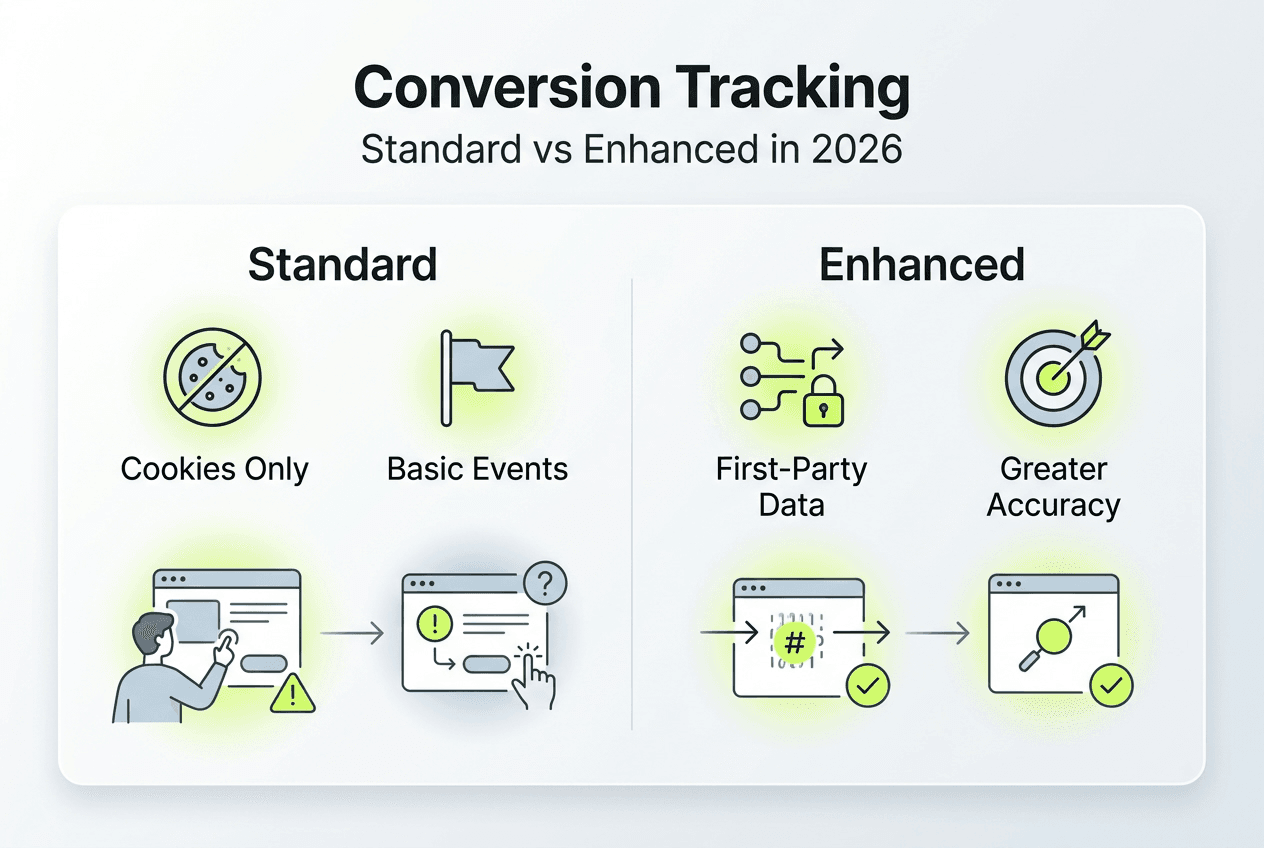
Browser restrictions, ad blockers, and privacy regulations have made traditional conversion tracking less reliable. Cookies get blocked. Users opt out. Data gaps appear in your reports. Enhanced Conversions solve this problem by sending hashed first-party customer data directly to Google in a privacy-safe way. This technique recovers conversions that would otherwise go untracked, improving your data quality without violating user privacy.
Here’s how it works. When someone completes a purchase, your website captures their email address, phone number, and other details they provided. Enhanced Conversions uses SHA-256 hashing to scramble this data into unreadable strings before sending it to Google. The platform matches these hashed values against signed-in Google users, attributing conversions more accurately even when cookies fail. The process is automatic once configured, and the customer data never travels in plain text.
The privacy angle matters in 2026. Regulations like GDPR and CCPA require businesses to handle customer data responsibly. Enhanced Conversions comply with these rules because hashing makes the data anonymous in transit. Google can match it to their own user records without exposing personal information to third parties. You get better tracking accuracy while respecting customer privacy, a win for everyone.
Implementing Enhanced Conversions early improves data quality before you scale spending. Many marketers wait until they notice attribution problems, but by then they’ve already lost weeks or months of optimization data. Setting it up from day one ensures your ad spend management decisions rest on solid measurement from the start.
Here’s a comparison of standard tracking versus Enhanced Conversions:
| Feature | Standard Tracking | Enhanced Conversions | | — | — | | Data source | Browser cookies only | Cookies plus hashed first-party data | | Privacy compliance | Vulnerable to restrictions | Built for privacy regulations | | Accuracy with ad blockers | Significantly reduced | Partially recovers lost conversions | | Setup complexity | Basic tag implementation | Requires customer data capture | | Attribution improvement | Baseline performance | 15-30% more conversions attributed |
Pro Tip: Implement Enhanced Conversions as soon as you have basic tracking working. The sooner you start collecting higher-quality data, the faster your campaigns optimize. Don’t wait for problems to appear.
One important limitation: Enhanced Conversions won’t make GA4 and Google Ads match perfectly due to different attribution models and conversion windows. Google Analytics uses last-click attribution by default, while Google Ads credits the last Google Ads click. The platforms also count conversions differently when multiple touchpoints exist. Enhanced Conversions improve accuracy within each platform but don’t eliminate these structural differences. Understanding this prevents frustration when your reports don’t align exactly.
Advanced tracking techniques like Enhanced Conversions represent the evolution of digital advertising measurement. As privacy protections increase, first-party data becomes more valuable. Businesses that collect customer information ethically and use it to improve tracking will outperform competitors stuck with cookie-only measurement. The technical investment pays dividends in campaign performance and customer insights.
How to get started with conversion tracking for your e-commerce business
Setting up conversion tracking correctly requires planning, not just technical implementation. Start by defining your business goals and mapping them to specific events. If your primary goal is revenue, prioritize purchase tracking. If you’re building an email list, focus on newsletter signups. Clear goals prevent tracking everything poorly instead of tracking what matters well.
Follow these steps to implement conversion tracking effectively:
-
Identify your most valuable conversion events based on business impact
-
Install the base tracking code (Google tag, Meta pixel) on every page of your site
-
Configure event tracking for key actions like purchases, cart additions, and signups
-
Test each conversion by completing the action yourself and verifying it appears in your ad platform
-
Set up Enhanced Conversions to improve data accuracy from day one
-
Create a tracking validation checklist and audit your setup monthly
-
Document your tracking configuration so team members understand what’s measured and why
Common conversion events for e-commerce businesses include:
-
Purchase (with transaction value and product details)
-
Add to cart (capturing product interest before checkout)
-
Initiate checkout (identifying cart abandonment points)
-
View product (measuring interest in specific items)
-
Search (understanding what customers want)
-
Newsletter signup (building your email list)
Testing is critical. Many marketers assume their tracking works because they see some data flowing in. But partial tracking is often worse than no tracking because it creates false confidence. Complete a test purchase on your site. Check if the conversion appears in Google Ads and Meta within 24 hours. Verify the transaction value matches. If anything looks wrong, troubleshoot before launching campaigns.
Use your analytics platform to validate data consistency. Google Analytics 4 should show similar conversion counts to your ad platforms, accounting for attribution differences. Major discrepancies signal tracking problems. Common issues include duplicate tracking codes, events firing on the wrong pages, or missing parameters in the conversion data. Catching these early saves money and frustration.
Pro Tip: Prioritize tracking accuracy before scaling spend. A campaign with perfect tracking at $1,000 per month will outperform a campaign with broken tracking at $10,000 per month. Fix measurement first, then grow budgets confidently.
Many e-commerce platforms like Shopify, WooCommerce, and BigCommerce offer built-in conversion tracking integrations. These simplify setup but still require verification. Don’t assume the integration works perfectly. Test it yourself. Check that all required parameters (transaction value, product IDs, customer data for Enhanced Conversions) transmit correctly.
Once basic tracking works, expand to secondary events that provide optimization insights. Tracking “add to cart” helps you identify products that interest customers but don’t convert. Tracking “initiate checkout” reveals where users abandon the purchase process. These intermediate events give ad platforms more data points for optimization, improving performance even if they’re not your primary business goal.
For detailed guidance on campaign setup and optimization, explore resources on ad spend management ROI, step by step ad campaign setup, and optimizing ad campaign ROI. These guides complement conversion tracking by showing how to use the data you collect to make smarter advertising decisions.
Partner with A&T Digital Agency for expert conversion tracking and ad management
Getting conversion tracking right requires technical expertise and ongoing optimization. Many e-commerce businesses struggle to implement tracking correctly while managing daily operations. That’s where A&T Digital Agency comes in.
Our team specializes in setting up and managing conversion tracking for Google Ads and Meta Ads campaigns. We handle the technical implementation, testing, and ongoing audits so your measurement stays accurate as platforms evolve. Our boutique approach means you work directly with experienced strategists who understand e-commerce, not junior account managers reading from scripts.
We’ve helped businesses across telehealth, retail, entertainment, and wellness sectors build profitable advertising systems. Our focus on measurable results means we prioritize tracking accuracy from day one. We implement Enhanced Conversions, configure proper attribution, and validate data quality before scaling your ad spend. This foundation lets our campaigns optimize faster and deliver higher ROI.
Ready to transform your paid advertising with accurate conversion tracking? Contact A&T Digital Agency today to discuss how we can improve your campaign performance and grow your business profitably.
Frequently asked questions
What is conversion tracking?
Conversion tracking is a measurement system that captures specific user actions on your website and sends that data to advertising platforms. It records events like purchases, signups, and cart additions, linking them back to the ads that drove those actions. This enables accurate ROI measurement and campaign optimization.
What’s the difference between conversion tracking and web analytics?
Web analytics platforms like Google Analytics measure overall website behavior and traffic sources. Conversion tracking specifically connects ad clicks to business outcomes within advertising platforms like Google Ads and Meta. While analytics shows what happened on your site, conversion tracking tells ad algorithms which campaigns drove those results so they can optimize automatically.
What are Enhanced Conversions?
Enhanced Conversions supplement standard tracking by sending hashed first-party customer data (email, phone, address) to Google securely. This improves attribution accuracy when cookies fail due to browser restrictions or ad blockers. The data is hashed using SHA-256 before transmission, protecting customer privacy while recovering conversions that would otherwise go untracked.
How do I know if my conversion tracking is set up correctly?
Complete a test transaction on your website and verify it appears in your ad platform within 24 hours. Check that the conversion value, product details, and customer data (if using Enhanced Conversions) transmit accurately. Compare conversion counts between your ad platforms and Google Analytics, accounting for attribution differences. Major discrepancies indicate tracking problems that need troubleshooting.
What are common conversion tracking problems and how do I fix them?
Common issues include duplicate tracking codes firing twice per conversion, events triggering on wrong pages, missing transaction values, and incomplete Enhanced Conversions setup. Fix these by auditing your tag implementation, using browser developer tools to verify events fire correctly, and testing actual conversions yourself. Most platforms offer tag debugging tools that show exactly what data they’re receiving.