
TL;DR:
- Dynamic ad copy automatically changes at serve time to match user queries, inventory, or signals, increasing relevance. Effective implementation depends on feed quality, template design, and rigorous QA to maximize benefits such as higher click-through and conversion rates at scale. Proper setup and continuous optimization are essential to avoid common pitfalls like irrelevant substitutions or policy violations.
Dynamic ad copy is ad text that changes automatically at serve time, swapping headlines, descriptions, prices, or product names based on the user's search query, product feed data, or contextual signals — so every viewer sees a message matched to their specific moment. If you manage campaigns at any meaningful scale, this is worth understanding now.
When to use it:
- You run e-commerce or lead-gen campaigns with large product catalogs or keyword sets too wide to write manually
- You need ads to stay current with changing prices, inventory, or promotions without daily copy edits
When to hold off:
- Your brand requires tightly controlled legal or regulated language in every ad
- Your product feed is incomplete or inconsistently formatted
Table of Contents
- What are the real benefits of dynamic ad copy?
- How does dynamic ad copy work?
- What types of dynamic ads should you know about?
- How do major platforms implement dynamic ad copy?
- How do you set up dynamic ad copy without common pitfalls?
- How do you measure and optimize dynamic ad copy performance?
- What privacy and compliance risks come with dynamic ad copy?
- When should you avoid dynamic ad copy?
- How Atdigiagency approaches dynamic ad copy for clients
- Key Takeaways
- What most teams get wrong with dynamic ad copy
- Atdigiagency builds and manages dynamic ad systems that convert
- Useful sources and further reading
What are the real benefits of dynamic ad copy?
The business case comes down to three things: relevance, efficiency, and scale. When ad text mirrors what a user actually searched or the product they just browsed, the message lands harder. That alignment tends to lift click-through rates and conversion rates because the copy feels less like an ad and more like an answer.
Operationally, the gains are just as real. Writing unique ads for hundreds of product variants or thousands of keyword combinations is not sustainable. Dynamic formats let one well-designed template do the work of hundreds of static ads, freeing your team to focus on strategy and creative direction rather than copy production.
Here are the core performance benefits to expect:
- Higher CTR potential: Query-matched headlines are more likely to earn a click because the ad reflects the searcher's own language.
- Improved conversion rate: Showing the exact product a user browsed, with current pricing, reduces friction between the ad and the purchase decision.
- Better ROAS at scale: Catalog-driven formats let you run personalized ads across your full inventory without proportional increases in creative labor.
- Reduced keyword maintenance: Dynamic Search Ads fill coverage gaps automatically, capturing long-tail queries you might never have thought to bid on.
- Faster response to inventory changes: Feed-connected ads update when your catalog updates, so you are not serving ads for out-of-stock items.
One honest caveat: these benefits are not automatic. Feed quality, template design, and platform differences strongly affect outcomes. A poorly structured feed will produce irrelevant substitutions. A template without sensible defaults will break under edge cases. The mechanism is only as good as the data behind it.
How does dynamic ad copy work?
At its core, dynamic ad copy works by separating the ad structure from the specific values that fill it. Instead of writing "Buy Red Running Shoes — Free Shipping," you write a template with placeholders, and the platform fills those placeholders at serve time using data it has access to.

The four main generation patterns are:
Template and placeholder substitution is the most common approach. You write a headline like "Shop {Product Name} — {Price} Today" and connect it to a product feed. When the ad serves, the platform pulls the matching product name and price from your feed and renders the final text.
Keyword insertion is a simpler version of the same idea. Google Ads and Microsoft Advertising both support dynamic text that inserts the triggering search term directly into the ad headline, making the copy feel highly relevant to the query without a full feed setup.
Feed-driven substitution is what powers catalog-based formats on Meta and Amazon. The product feed becomes the data source, and the platform matches feed attributes to the user's behavior or interests to decide which product to show.
AI-driven text customization, available through Google's AI Max in Search campaigns, goes further. It generates additional headlines and descriptions by extracting content from your landing pages and using generative AI to create grounded, relevant variations. This reduces manual work but requires stronger governance because the system synthesizes new phrasing rather than just substituting known values.
The serve-time pipeline looks like this: a user's query or behavior triggers the ad system, which looks up the relevant data (feed, keyword, landing page, user signals like geo or device), fills the template, runs policy and character-limit checks, and renders the final ad. The whole process happens in milliseconds.
Pro Tip: Build a QA checklist that previews every template against your shortest and longest possible placeholder values before launch. A product name that works at 12 characters may break your headline at 35. Catching this before launch prevents policy flags and broken grammar at scale.
What types of dynamic ads should you know about?
Dynamic ad copy appears across every major channel, but the mechanism and data inputs differ significantly by type. Understanding the taxonomy helps you pick the right tool for each campaign objective.
-
Keyword insertion / ad customizers (search): Google Ads ad customizers use curly-brace placeholders to insert products, categories, prices, or countdown timers into text ads. Targeting can be set at the campaign, ad group, or keyword level. Best for: promotional campaigns, time-sensitive offers, and large keyword sets where manual copy would be impractical.
-
Dynamic Search Ads (DSA): Google uses your website's landing-page content to match searches and generate headlines automatically. You write the description; the headline is created by the platform. Best for: filling long-tail keyword gaps, new product launches, and sites with large, frequently updated content.
-
Dynamic Product Ads (DPA) / catalog-based social ads: Meta's catalog-driven format shows users the specific products they viewed or products similar to what they browsed, pulling image, name, price, and availability from your feed. Best for: e-commerce retargeting and prospecting with broad audiences.
-
Dynamic display banners: Platforms like Google Display Network and AdRoll swap imagery and copy within a banner template based on the user's browsing history or feed data. Best for: retargeting campaigns where visual product recall matters.
-
Dynamic video variants: Platforms can swap intro sequences, product clips, or end cards based on audience segments or feed data. Best for: large-scale video retargeting or personalized product storytelling.
To make this concrete: a user searching "waterproof hiking boots size 10" might see a DSA headline generated from your product page ("Waterproof Hiking Boots — Free Returns"), while a user who browsed that same boot on your site yesterday sees a Meta DPA with the exact boot image, current price, and a "Back to check it out?" prompt. Same campaign logic, completely different copy, driven by different data inputs.
How do major platforms implement dynamic ad copy?
Each platform has its own approach, and the operational implications differ enough that treating them as interchangeable is a mistake.

| Channel | How headlines/descriptions are generated | Primary data inputs | Best for | Setup complexity | Key risks |
|---|---|---|---|---|---|
| Google Ads (customizers) | Template + placeholder substitution | Advertiser feed, keyword, schedule | Promos, price/inventory ads, countdowns | Medium: feed upload, placeholder syntax | Broken grammar, character overflow, policy flags |
| Google Ads (DSA) | AI extraction from landing pages | Website content, search query | Long-tail coverage, new products | Low: URL rules, description writing | Irrelevant headline matches, crawl gaps |
| Google AI Max (text customization) | Generative AI + landing-page extraction | Landing page, existing assets | RSA performance lift, reduced manual work | Low to medium: asset review, governance | Off-brand phrasing, unexpected synthesis |
| Meta Catalog Ads (DPA/DABA) | Feed-driven template rendering | Product catalog, user behavior/interests | E-commerce retargeting, prospecting | Medium: catalog setup, pixel/CAPI tagging | Feed errors, price mismatches, stale inventory |
| Amazon Ads | Catalog/template-driven dynamic creative | Product listing data, shopper signals | Retail, product discovery | Medium: ASIN feed, creative templates | Listing quality issues, category mismatches |
| AdRoll | Dynamic creative swapping across display/social | Product feed, retargeting pixel data | Cross-channel retargeting | Medium: feed integration, pixel setup | Creative fatigue, feed sync delays |
A few operational notes worth calling out:
- Google's ad customizer data sources let you target substitutions at the campaign, ad group, or keyword level and track statistics per item, which makes performance comparison cleaner.
- Meta's catalog formats shift creative effort from writing copy to maintaining feed quality. Poor product metadata produces poor ads, regardless of template design.
- AdRoll's strength is cross-channel reach, but feed sync delays can cause it to serve ads for products that are already out of stock.
For teams managing Meta catalog campaigns, this breakdown of DPA and DABA formats covers feed and template management in practical detail.
How do you set up dynamic ad copy without common pitfalls?
A clean setup prevents most of the problems teams encounter after launch. Work through these steps in order.
-
Define objectives and use cases first. Decide whether you are running retargeting, prospecting, or inventory-driven sales before touching any feed or template. The use case determines which format you need and which data inputs matter.
-
Audit and clean your product feed. Check every attribute: title, description, price, availability, image URL, and product category. Missing or inconsistent attributes are the single most common cause of irrelevant substitutions. For catalog-driven formats, the feed is the creative.
-
Map attributes to template placeholders. Match each feed attribute to the correct placeholder in your template. Confirm that every placeholder has a default fallback value for cases where the attribute is missing or too long.
-
Design character-limit-aware templates. Write templates that work at both the shortest and longest realistic placeholder values. Google Ads requires at least three headlines without countdowns when using countdown customizers, so defaults are not optional.
-
Set targeting, geo, and scheduling parameters. Confirm audience segments, geographic restrictions, and scheduling rules align with your campaign objectives and any compliance requirements.
-
Run a full QA preview before launch. Use the platform's ad preview tool to render the ad with multiple placeholder values. Check for broken grammar, character overflow, policy-sensitive language, and landing-page alignment.
-
Stage the rollout. Start with a limited audience or budget. Monitor impression share, CTR, and any policy flags in the first 48–72 hours before scaling.
-
Verify landing-page alignment. Every substituted value (product name, price, feature) must appear on the destination landing page. A mismatch between ad copy and landing page is one of the most common causes of quality score penalties and poor conversion rates.
Pro Tip: Design templates so that any single placeholder can be removed without breaking the sentence. Use IF-conditions for optional attributes like promotional pricing, so the ad reads cleanly whether or not the value is present. This one habit prevents the majority of grammar and policy issues at scale.
How do you measure and optimize dynamic ad copy performance?
Measurement for dynamic formats requires a slightly different lens than static campaigns. You are not just evaluating the ad as a whole; you are diagnosing which substitutions and templates are driving results.
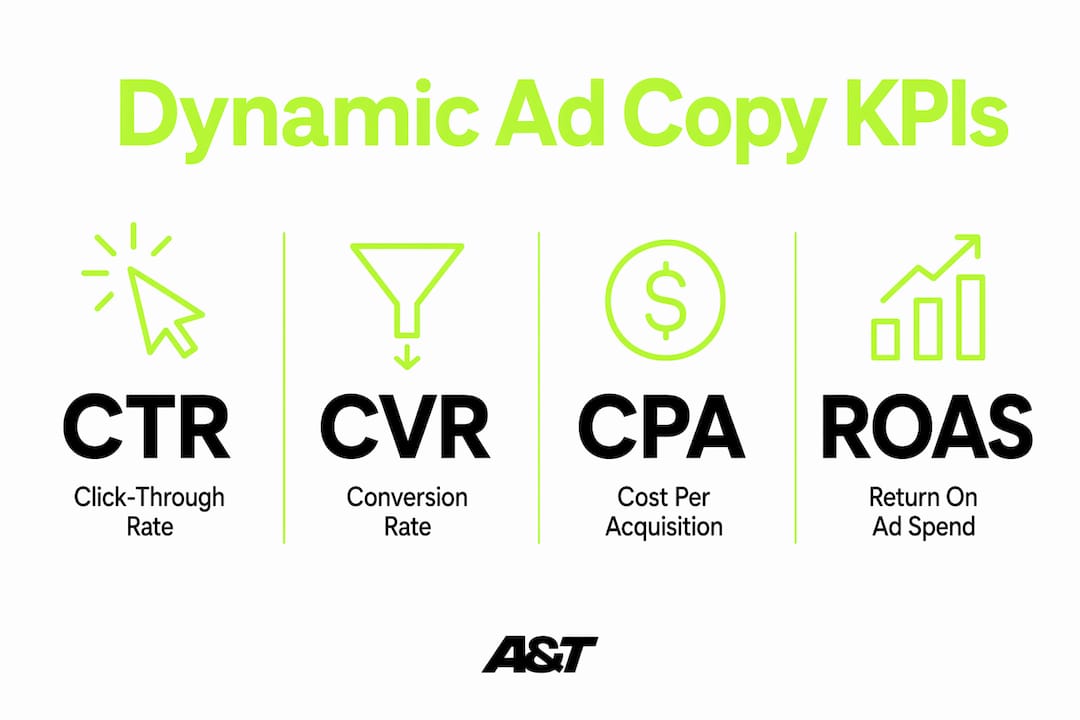
Primary KPIs to track: CTR by template and placeholder value, conversion rate by product or keyword segment, CPA and ROAS at the campaign and ad group level, and impression share to identify coverage gaps that DSA or customizers could fill.
Testing guidance: Run holdout experiments where a segment sees static copy while another sees dynamic variants. This gives you a clean read on incremental lift rather than a correlation. For AI-driven formats like Google's text customization, measure at the asset group level and compare responsive search ad performance before and after enabling the feature. Treat keyword insertion, ad customizers, and AI-driven headline generation as separate levers in your experiments — they have different data inputs and different failure modes.
Feed health diagnostics: Pull feed error reports weekly. Attribute-level issues (missing prices, truncated titles, incorrect availability flags) show up as impression drops, low CTR on specific products, or policy disapprovals. Fix feed issues before adjusting bids or budgets.
Optimization levers: Refine templates based on which placeholder combinations generate the highest CTR. Prune placeholder values that consistently underperform. Improve feed data quality for products with high impressions but low conversion rates. For ad copy testing to produce clean results, isolate one variable at a time.
Pro Tip: Segment your performance reports by the substituted value, not just the ad group. A template may perform well on average while a handful of placeholder values drag down results. Surfacing those outliers is where the real optimization work happens.
What privacy and compliance risks come with dynamic ad copy?
Dynamic personalization and privacy compliance are in direct tension, and that tension is only increasing. Here is what to manage actively:
- Consented data only: Any user signal used to personalize copy, including browsing behavior, purchase history, or location, must be collected under a valid consent framework. In the U.S., this means compliance with state-level privacy laws like the California Consumer Privacy Act (CCPA) and any applicable FTC guidelines. The Network Advertising Initiative provides opt-out standards that apply to behavioral targeting.
- No PII in ad copy: Never allow personally identifiable information to appear in dynamically generated headlines or descriptions. This includes names, email addresses, or any data point that could identify an individual.
- Geo and regulatory constraints: Certain product categories (financial services, healthcare, housing) face additional restrictions on how personalization signals can be used in ad targeting and copy. Verify platform policies for your specific category before enabling dynamic formats.
- Product and price mismatches: A feed that shows a price lower than what is on the landing page creates both a compliance risk and a poor user experience. Automate feed syncs and set alerts for price discrepancies.
- Policy violations from auto-generated headlines: AI-driven text customization can occasionally produce headlines that trigger platform policy flags, particularly for sensitive categories. Review generated assets regularly and use negative keyword lists and content exclusions to limit problematic substitutions.
- Default fallback text: Every template must have a default that renders a clean, policy-compliant ad when a placeholder value is missing or fails validation. Without this, the platform may disapprove the ad or serve a broken version.
When should you avoid dynamic ad copy?
Dynamic formats are not the right answer for every campaign. Knowing when to use static, handcrafted copy is just as important as knowing how to build dynamic systems.
Brand-sensitive or legally regulated copy is the clearest case for staying static. If your legal team needs to approve every word in an ad, a system that generates or substitutes text at serve time creates an approval gap you cannot close. Pharmaceutical, financial, and legal advertisers often fall into this category.
Narrow audiences with small sample sizes are another situation where dynamic formats underperform. The personalization logic needs enough data to make meaningful substitutions. A campaign targeting 500 users in a specific zip code will not generate the signal volume needed to optimize template performance, and the variation may actually hurt consistency.
Complex or irregular inventory can make feed-driven formats riskier than their benefit justifies. If your product catalog has inconsistent attributes, frequent availability changes, or highly variable pricing structures, maintaining feed quality becomes a full-time job. In those cases, a smaller set of well-crafted static ads often outperforms a dynamic system built on unreliable data.
Finally, if your campaign's creative differentiation depends on a specific narrative, emotional arc, or brand voice that cannot be templated, dynamic copy will flatten it. Some of the highest-converting ads we see are handcrafted for a specific audience moment. For guidance on high-converting creative approaches that complement dynamic formats, the principles of strong static copy still apply.
How Atdigiagency approaches dynamic ad copy for clients
When we work with a client on dynamic ad copy, the first thing we do is audit the feed and the campaign structure before writing a single template. In one retail campaign, a client came to us running catalog ads on Meta with a feed that had missing product titles for roughly a third of their SKUs. The ads were serving, but the substitutions were pulling fallback values that had no relevance to the user's browsing history. Fixing the feed before touching the templates produced a measurable improvement in ad relevance scores within two weeks.
The agency-client division of labor matters here. Here is how we typically split responsibilities:
- Client supplies: Product feed or catalog (with complete attributes), brand guidelines and approved messaging, product taxonomy and category structure, and any legally required copy constraints.
- Atdigiagency handles: Feed quality audit and attribute mapping, template design and placeholder logic, platform setup (Google Ads customizers, Meta catalog, AdRoll), QA preview and policy checks, staged rollout, and ongoing performance monitoring and optimization.
For teams considering managed implementation, the ad creative optimization workflow we use covers the full lifecycle from feed prep through ongoing testing.
Key Takeaways
Dynamic ad copy works best when feed quality, template design, and QA governance are treated as equally important as the campaign strategy itself.
| Point | Details |
|---|---|
| Definition and mechanism | Dynamic ad copy swaps text at serve time using feeds, keyword signals, or AI, so each viewer sees a relevant message. |
| Top benefit | Relevance at scale: one template covers hundreds of products or queries without proportional creative labor. |
| When to use it | Use dynamic formats when your catalog or keyword set is too large to manage manually and your feed data is clean. |
| First three setup steps | Audit your feed, map attributes to placeholders with defaults, and QA every template at minimum and maximum placeholder lengths. |
| Atdigiagency's role | Atdigiagency manages feed audits, template design, platform setup, and ongoing optimization for clients running dynamic ad campaigns. |
What most teams get wrong with dynamic ad copy
The rush to automate is the most consistent mistake we see. Teams enable Dynamic Search Ads or Meta catalog ads, point the system at their website or feed, and assume the platform will handle the rest. It will not. The platform will serve something, but "something" and "relevant" are not the same thing.
The highest-ROI fix is almost always upstream of the ad itself: clean the feed, write templates with real defaults, and build a QA flow before you scale. AI-driven text customization is genuinely useful, and making that AI-generated text sound natural and on-brand is a skill worth developing. But no amount of platform sophistication compensates for a feed where half the product titles are truncated or a template that produces broken grammar when a product name runs long.
Measured rollout beats wholesale automation every time. Start with your best-performing product segment, prove the dynamic format works there, then expand. The teams that do this consistently outperform the ones that flip the switch and optimize reactively.
Atdigiagency builds and manages dynamic ad systems that convert
If you are managing a product catalog or running paid search at a scale where manual copy is a bottleneck, Atdigiagency can audit your feed, design your templates, and run the full implementation across Google Ads and Meta. We handle the setup that most teams skip: attribute mapping, default fallback logic, QA previews, and staged rollouts that catch problems before they cost you budget.
Our Google Ads management service covers ad customizers, Dynamic Search Ads, and AI Max text customization, along with the ongoing optimization work that keeps dynamic campaigns performing as your catalog and market evolve. If you want to know whether your current feed and campaign structure are ready for dynamic formats, reach out for a feed audit. We will tell you exactly what needs to change before you scale.
Useful sources and further reading
These primary platform docs and reference sources are worth bookmarking if you are building or auditing dynamic ad campaigns:
- Google Ads: About ad customizers — The definitive reference for placeholder syntax, targeting levels, and feed structure for ad customizers. Start here before building any customizer template.
- Google Ads: Dynamic Search Ads — Explains how Google matches landing-page content to queries and generates headlines automatically. Useful for understanding coverage gaps and DSA campaign structure.
- Google Ads: Text customization for responsive search ads — Covers AI Max text customization, how generative AI is grounded in landing-page content, and governance considerations for AI-generated assets.
- Google Ads: Countdown customizers — Details on COUNTDOWN and GLOBAL_COUNTDOWN functions, default headline requirements, and character-limit rules for time-sensitive ads.
- Google Ads Developers: Ad customizers — Technical reference for how customizer data sources are structured, targeted, and tracked for performance comparison.
- Microsoft Advertising: Dynamic text — Microsoft's definition and implementation guide for dynamic text insertion, useful for cross-platform campaigns.
- Dynamic Yield: Dynamic Ads glossary — A vendor-neutral definition of dynamic creatives and catalog-based formats; good for framing the concept across channels.
- Network Advertising Initiative — The industry body governing behavioral advertising standards and opt-out requirements in the U.S.; essential reading for compliance on any personalized ad format.