
TL;DR:
- Engagement marketing builds personalized, two-way interactions across multiple channels to foster loyalty and advocacy. It requires continuous system orchestration, behavioral segmentation, and cross-team collaboration to deliver relevant, contextual experiences throughout the customer journey. Success depends on measuring relationship outcomes like retention and lifetime value, not just traditional activity metrics.
Engagement marketing is defined as a strategic approach that builds meaningful, personalized, and ongoing two-way interactions between a brand and its customers across multiple channels to generate loyalty and active participation. Unlike traditional advertising, which broadcasts a message and waits, engagement marketing invites customers to participate through quizzes, polls, loyalty programs, interactive newsletters, and community forums. Platforms like HubSpot, Zendesk, and Emarsys have built entire product lines around this discipline because the evidence is clear: brands that engage customers consistently outperform those that simply advertise at them. The result is stronger retention, higher lifetime value, and customers who advocate for your brand without being asked.
What is engagement marketing and how does it differ from traditional advertising?
Engagement marketing, also called customer engagement marketing, is the practice of replacing one-way advertising with timely, relevant, personalized messages that invite a response. Traditional advertising pushes a message to a passive audience. Engagement marketing pulls customers into a conversation.
The difference is structural. In a traditional campaign, a brand runs a TV spot or display ad, measures impressions, and moves on. In engagement marketing, every touchpoint is designed to trigger a reaction: a reply, a click, a share, a purchase, or a review. The customer becomes an active participant rather than a passive recipient.
Here is what that looks like in practice:
- Personalized welcome sequences triggered by sign-up behavior, not a calendar date
- Interactive polls and quizzes embedded in email or social media to gather preference data
- Loyalty programs that reward repeat behavior with exclusive offers, not generic discounts
- Chatbots and CRM automation that anticipate customer needs based on past behavior and deliver proactive outreach
The technology layer matters here. Tools like Salesforce CRM, HubSpot's marketing automation, and Zendesk's customer engagement platform make it possible to personalize at scale. Without automation, personalization collapses into manual work that no team can sustain.
Pro Tip: Segment your audience by behavior, not just demographics. A customer who browsed your pricing page three times in a week deserves a different message than someone who opened one email six months ago. Behavioral segmentation is where personalized ad strategies start paying off.
How does engagement marketing span the entire customer journey?
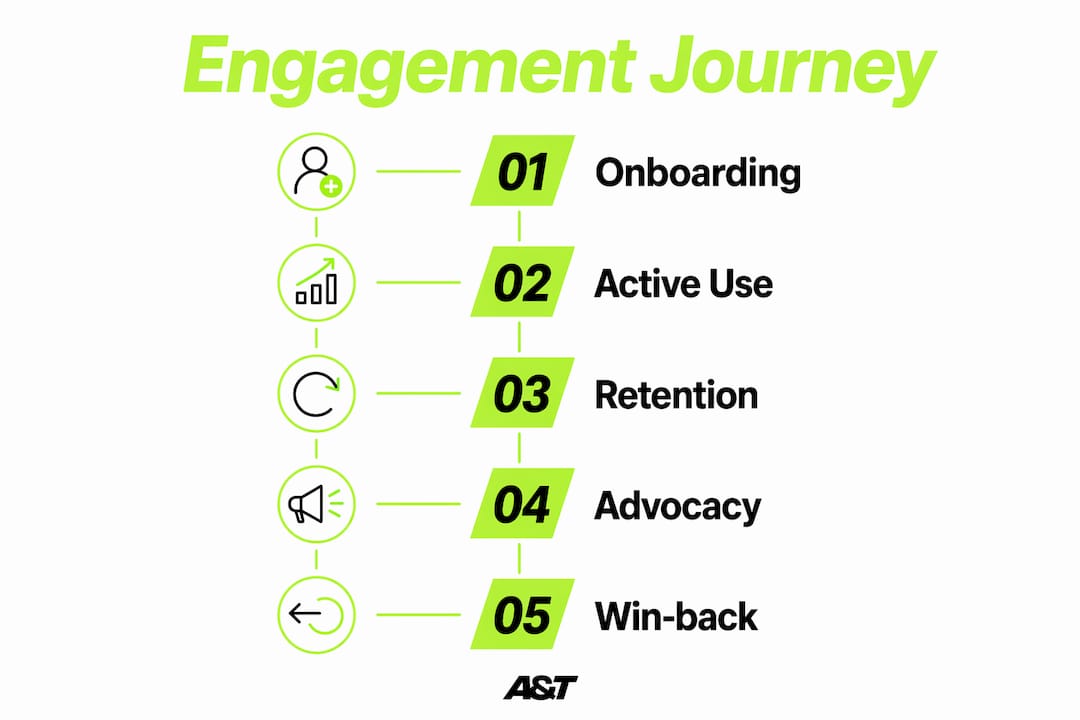
Engagement marketing is not a campaign. It is a system. Engagement is continuous from first contact through post-purchase and into long-term advocacy, and every stage requires a different approach.
The lifecycle breaks down into four distinct phases, each with its own engagement goal:
| Journey Stage | Engagement Goal | Example Tactic |
|---|---|---|
| Onboarding | Build familiarity and trust | Personalized welcome email series, product tutorials |
| Active use / Purchase | Deepen value and reduce friction | Behavior-triggered offers, in-app tips, loyalty points |
| Retention | Prevent churn, reinforce loyalty | Re-engagement campaigns, exclusive member content |
| Advocacy | Turn customers into promoters | Referral programs, user-generated content campaigns |
The challenge most marketers face is not building one of these stages. It is connecting all four without creating a disjointed experience. A customer who just opened a support ticket should not receive a promotional upsell email the same afternoon. Event-driven automation solves this by pausing or rerouting messages based on real-time context signals.
Orchestration is the word that separates good engagement programs from great ones. When your email platform, CRM, social scheduling tool, and support system share data, you can deliver a message that feels like it came from a brand that actually knows the customer. When those systems are siloed, you send conflicting signals and erode trust fast.
The teams responsible for this experience extend well beyond marketing. Customer engagement spans marketing, sales, operations, and support. A sales rep who follows up on a webinar lead, a support agent who resolves a complaint with empathy, and a marketing email that arrives at the right moment all contribute to the same engagement outcome.
What are proven engagement marketing strategies and examples to implement now?
The most effective engagement marketing strategies share three traits: they are personal, they are timely, and they respect the channel they live in. Here is a practical framework you can apply now.

1. Segment before you send. Divide your audience by purchase history, browsing behavior, and engagement frequency. A customer who buys monthly needs a different message than someone who has not purchased in 90 days. Emarsys and similar platforms use layered behavioral KPIs to build these segments automatically.
2. Build interactive content into every channel. Polls on Instagram Stories, quizzes in email campaigns, and live Q&A sessions in webinars all convert passive readers into active participants. Shopify merchants, for example, use product recommendation quizzes to increase average order value while simultaneously collecting preference data.
3. Coordinate across channels without repeating yourself. A customer who clicks a Facebook ad and then receives the same offer via email and SMS within 24 hours feels chased, not valued. Multi-channel coordination means each channel plays a distinct role in the same story.
4. Use community and social proof as engagement levers. Brand forums, user-generated content campaigns, and customer review programs create peer-to-peer engagement that no ad budget can replicate. Brands like Glossier and Peloton built their early growth almost entirely on community-driven engagement before scaling paid media.
5. Measure what actually matters. Clicks and open rates are activity metrics. Retention rate, repeat purchase rate, and customer lifetime value are relationship metrics. The shift from channel metrics to relationship outcomes is the single most important measurement change a marketing team can make.
Pro Tip: Run a 90-day win-back sequence for lapsed customers before writing them off. A three-email series with a personalized subject line referencing their last purchase, a mid-sequence value reminder, and a final exclusive offer consistently outperforms a single "we miss you" blast. Track campaign results by retention, not just opens.
What common challenges do marketers face with engagement marketing?
Engagement marketing fails in predictable ways. Knowing the failure modes in advance is more useful than any list of best practices.
-
Over-messaging. Sending too frequently, across too many channels simultaneously, trains customers to ignore you or unsubscribe. Aggressive messaging is one of the fastest ways to reverse the goodwill that engagement marketing is designed to build. Frequency caps and suppression logic in your automation platform are non-negotiable.
-
Static personalization. Personalization that was accurate six months ago may be irrelevant today. A customer who bought baby products last year may no longer need them. Dynamic optimization of audience segments and message content is required on a rolling basis, not a quarterly review cycle.
-
Treating engagement as content volume. More blog posts, more emails, and more social posts do not equal more engagement. Channel-specific interaction rules matter. LinkedIn audiences respond to thought leadership. SMS audiences respond to urgency and brevity. Instagram audiences respond to visual storytelling. Applying the same content format across every channel is a reliable way to underperform on all of them.
-
Siloed teams. When marketing, sales, and support operate independently, customers receive contradictory messages. A customer engagement platform like Zendesk or HubSpot Service Hub centralizes customer data so every team sees the same context before reaching out.
-
Ignoring the post-purchase window. Most engagement investment goes into acquisition. The 30 days after a first purchase are statistically the highest-leverage window for building long-term loyalty. Brands that increase customer retention even by a small margin see compounding revenue effects over time.
The fix for most of these challenges is not more tools. It is clearer ownership. Assign someone to manage the engagement calendar across channels, audit message frequency monthly, and review retention metrics quarterly.
Key takeaways
Engagement marketing succeeds when it treats every customer interaction as a relationship investment, not a campaign output, measured by retention and lifetime value rather than clicks.
| Point | Details |
|---|---|
| Definition and core purpose | Engagement marketing builds two-way, personalized interactions across channels to generate loyalty and active participation. |
| Lifecycle system, not a campaign | Effective engagement covers onboarding, active use, retention, and advocacy stages with distinct tactics at each. |
| Orchestration is the differentiator | Event-driven automation and cross-team data sharing prevent conflicting messages and create a unified customer experience. |
| Measure relationship outcomes | Track retention rate, repeat purchase rate, and lifetime value instead of open rates and impressions. |
| Avoid the volume trap | More messages do not equal more engagement. Channel-specific relevance and frequency discipline drive results. |
Why most engagement programs plateau before they should
I have reviewed a lot of engagement programs across different verticals, and the pattern is consistent. Teams build a solid onboarding sequence, set up a few behavioral triggers, and then declare the system done. Six months later, they wonder why retention numbers have not moved.
The problem is that engagement marketing is treated as a build-and-launch project when it is actually a continuous calibration exercise. Customer preferences shift. Purchase cycles change. A message that converted well in Q1 may feel tone-deaf by Q3 because the customer's context has changed entirely.
The other thing most teams underestimate is the cross-functional requirement. Marketing cannot own engagement alone. I have seen campaigns that performed brilliantly at the email level completely undermined by a poor support experience the same week. The customer does not separate those interactions. They experience them as one brand. That means your engagement strategy is only as strong as your weakest team touchpoint.
What actually works is treating cross-channel marketing as an operational discipline, not a creative one. Set suppression rules. Audit your message calendar monthly. Pull retention data into your weekly marketing review. And use a marketing automation checklist to make sure your tech stack is actually connected before you scale spend.
The brands that win at engagement are not the ones with the most creative campaigns. They are the ones with the most disciplined systems.
— Ann
Turn your engagement strategy into paid ad results
Understanding customer engagement is one thing. Operationalizing it through paid media is where most businesses leave money on the table. At Atdigiagency, we build and manage Google Ads campaigns and Meta ad systems designed around the same principles that make engagement marketing work: personalization, timing, and multi-channel coordination. We use behavioral data to target the right audience at the right stage of their journey, not just the broadest possible reach. If you are ready to connect your engagement strategy to campaigns that generate measurable revenue, we are the team to do it with. No unnecessary meetings. Just results.
FAQ
What is engagement marketing in simple terms?
Engagement marketing is the practice of building ongoing, two-way interactions between a brand and its customers through personalized, timely, and relevant experiences across multiple channels. It replaces one-way advertising with conversations that invite active customer participation.
How does engagement marketing differ from content marketing?
Content marketing focuses on creating and distributing valuable material to attract an audience. Engagement marketing uses that content and other tactics to trigger a specific response or interaction, turning passive readers into active participants through loyalty programs, polls, and personalized outreach.
What are the main benefits of engagement marketing?
The primary benefits are stronger customer retention, higher lifetime value, and organic brand advocacy. Brands that measure relationship outcomes like retention and repeat purchase rate consistently outperform those focused only on acquisition metrics.
Which tools support engagement marketing most effectively?
HubSpot, Zendesk, Emarsys, and MoEngage are among the most widely used platforms for managing customer engagement at scale. Each combines CRM data, automation, and analytics to deliver personalized, context-aware messaging across email, social, and mobile channels.
How do you measure engagement marketing success?
Success is measured by retention rate, repeat purchase frequency, customer lifetime value, and net promoter score rather than clicks or open rates alone. These metrics reflect the quality of the relationship, not just the performance of a single campaign.