
TL;DR:
- User experience in advertising influences consumer engagement, with poor design leading to high ad rejection and revenue loss. Prioritizing speed, simplicity, and user control enhances ad effectiveness and builds trust. Incorporating human judgment in AI-driven creative processes ensures campaigns maintain emotional resonance and brand integrity.
User experience in advertising is defined as the quality of interaction a person has with an ad, including how it loads, how it looks, how it behaves, and whether it respects their time. When that experience is poor, the consequences are measurable and severe. 70% of consumers find digital ads annoying, 18% use ad blockers on streaming platforms, and 37% have canceled subscriptions because of ads. These numbers do not describe a preference. They describe a crisis in ad design that directly costs businesses revenue. Focusing on user experience in ads is not a creative nicety. It is the difference between a campaign that builds brand equity and one that actively destroys it.
Why user experience in ads determines campaign success
The phrase "user experience in advertising," or ad UX, refers to the full set of design and behavioral choices that shape how a person perceives and responds to an ad. This includes visual design, load time, placement, frequency, and the degree of control the user has over the interaction. Most marketers treat these as secondary concerns. The data says they should be primary ones.
Ad blockers signal that users reject bad advertising design, not advertising itself. Akash Sharma, Chief Strategy Officer at Admerly, frames this precisely: when users install an ad blocker, they are not saying they hate brands. They are saying the experience of encountering ads has become intolerable. That distinction matters enormously for how you allocate your creative and media budget.
Intrusive ads do not just fail to convert. They actively increase churn. The 37% of users who canceled subscriptions due to ads represent real revenue lost to a fixable design problem. Every dollar spent on media placement is undermined when the ad itself creates friction, interrupts context, or ignores the user's environment.
User control is the most underused lever in ad UX. Visible skip, mute, and close buttons significantly improve user perception and acceptance of ads. Giving users agency does not reduce ad effectiveness. It increases it, because the users who choose to engage are genuinely interested.
"Treating UX as fundamental rather than a constraint transforms ad effectiveness. The brands winning attention in 2026 are the ones designing for the person, not the placement." — Akash Sharma, Admerly
Key behaviors that signal poor ad UX include:
- Ads that auto-play with sound on mobile
- Pop-ups that block content without a clear close option
- Retargeting that shows the same creative more than three times in a session
- Ads that slow page load time by more than one second
- Creative that ignores the visual context of the surrounding content
Intrusive ads vs. UX-focused ad design: what actually works
The advertising industry has operated on a push model for decades. Push advertising interrupts the user, takes control of their screen or audio, and demands attention on the advertiser's terms. The pull model works differently. It earns attention by placing relevant content where users are already looking, in formats they find acceptable.
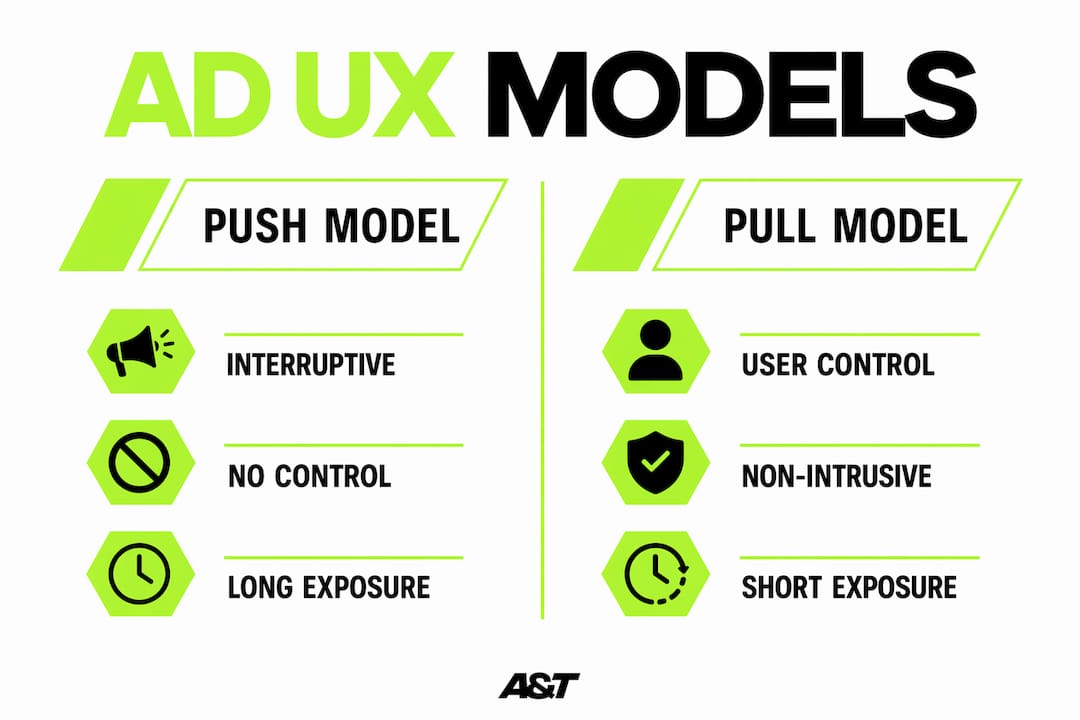
The push model's core flaw is the time cost it imposes on users. A 30-second unskippable pre-roll forces a person to pay with their attention whether they want to or not. Transitioning from push to pull reduces ad fatigue and enhances engagement, because users who encounter ads on their own terms are more receptive and more likely to remember the brand positively.
One of the most counterintuitive findings in recent ad performance research concerns creative quality. Lo-fi, less polished ads that mimic native content outperform traditional polished ads by bypassing user ad defenses. High-production ads trigger a subconscious skip reflex. Lower production value ads that resemble organic content bypass avoidance mechanisms entirely. This is not an argument for lazy creative. It is an argument for contextually appropriate creative.
Pro Tip: Before investing in high-production video ads, test a lo-fi version shot on a phone in the same format as organic content on that platform. The performance gap often surprises even experienced media buyers.
| Feature | Push (intrusive) model | Pull (UX-focused) model |
|---|---|---|
| User control | None or minimal | Skip, mute, close options present |
| Attention quality | Forced, low recall | Voluntary, high recall |
| Ad fatigue risk | High, especially with frequency | Low when frequency is managed |
| Brand perception | Often negative after repeated exposure | Neutral to positive |
| Creative approach | Polished, broadcast-style | Native, contextual, platform-matched |
The digital advertising checklist Atdigiagency uses with clients always starts with a UX audit of existing creative before touching media spend. The reason is simple: optimizing spend on ads that create friction is a waste of budget.
How speed, simplicity, and design reduce friction in ads
Every second of friction in digital design has measurable business costs. This applies directly to advertising. An ad that takes three seconds to load on mobile is not just annoying. It is a conversion killer.

47% of users expect a page to load in two seconds or less, and a one-second delay can reduce conversions by 20%. For paid campaigns where every click costs money, that delay is not a technical problem. It is a financial one. Mobile optimization is not optional in 2026. It is the baseline.
Cognitive load is the second major friction source in ad design. Hick's Law states that the more choices a person faces, the longer it takes them to decide. Ads that present multiple offers, several CTAs, or dense copy force the brain to work harder. That extra work translates directly into lower click-through rates and higher bounce rates on landing pages.
The practical implications for ad design are specific:
- Use one clear call to action per ad unit
- Limit body copy to fewer than 20 words in display formats
- Use white space deliberately to direct attention to the CTA
- Match the visual weight of the ad to the surrounding page content
- Compress image and video assets to meet platform load time standards
| UX metric | Benchmark | Impact on ad performance |
|---|---|---|
| Page load time | Under 2 seconds | 20% higher conversion rate |
| Number of CTAs | One per ad | Reduces decision paralysis |
| Mobile optimization | Full responsive design | Reduces bounce on click-through |
| Ad frequency cap | 3 impressions per session | Reduces negative brand association |
| Copy length (display) | Under 20 words | Higher readability and attention |
Data-driven UX improvements reduce friction, decrease wasted spend, and increase long-term revenue. The brands that treat these metrics as creative constraints are the ones outperforming competitors who treat them as optional.
For teams running Google Display campaigns, Atdigiagency's guide on Google Display ad strategies covers how to apply these UX principles at the campaign level, including asset sizing, frequency controls, and landing page alignment.
How AI and human-centered design shape ad UX going forward
AI is now a standard tool in ad production. It accelerates creative iteration, generates copy variants, and enables rapid prototyping across formats. But AI cannot replace human UX judgment. Research from the Wharton School confirms that UX is critical to protect brand meaning and build trust, precisely because AI-generated content scales volume without guaranteeing quality of experience.
The risk is real. When AI generates dozens of ad variants without a UX framework governing them, the result is often content that is technically functional but emotionally flat. Users notice. They may not articulate why an ad feels off, but they respond to it with lower engagement and higher skip rates.
The role of AI in content strategy is expanding, but the human layer remains non-negotiable for ad work that needs to earn trust. AI-accelerated UX requires new skills focused on transparency, explainability, and hybrid collaboration between automated tools and human designers.
Practical ways to integrate AI with UX principles in ad production:
- Use AI to generate five to ten copy variants, then apply UX criteria (clarity, cognitive load, CTA strength) to select the best two for testing
- Run AI-generated creative through a UX review checklist before publishing, covering load time, visual hierarchy, and mobile rendering
- Use AI for audience segmentation to improve contextual relevance, which is itself a UX factor
- Maintain human oversight on brand voice and emotional tone, areas where AI consistently underperforms
Pro Tip: Treat AI as your production assistant, not your creative director. The fastest path to high-performing ad UX is AI speed combined with human judgment on what actually resonates with a real person.
AI tools empower faster content creation, but human UX expertise is what converts that content into trust. The teams that understand this distinction will build campaigns that scale without sacrificing the user relationship.
Key takeaways
Ad UX is the single most underleveraged performance variable in paid advertising, and fixing it costs less than increasing media spend.
| Point | Details |
|---|---|
| UX drives conversion directly | A one-second load delay reduces conversions by 20%, making speed a financial priority. |
| User control increases acceptance | Visible skip, mute, and close options improve ad perception and reduce churn risk. |
| Lo-fi beats polished in context | Native-style ads bypass skip reflexes and outperform high-production creative on most platforms. |
| Simplicity reduces friction | One CTA, under 20 words of copy, and white space consistently outperform cluttered ad designs. |
| AI needs human UX oversight | AI scales output but requires human judgment to protect brand trust and emotional resonance. |
The case for treating ad UX as a strategic asset
I have reviewed hundreds of paid ad campaigns across Google Ads and Meta, and the pattern is consistent: the campaigns with the worst ROI are almost never suffering from a targeting problem. They are suffering from a UX problem. The ad is intrusive, the landing page is slow, the CTA is buried, or the creative ignores the platform context entirely.
What frustrates me most is how rarely marketers audit the experience their ads create. They obsess over CPM, CTR, and ROAS, but they do not ask the question that precedes all of those metrics: does this ad respect the person seeing it? When the answer is no, every downstream metric suffers.
The brands I have seen grow consistently through paid advertising share one trait. They treat UX as a strategic asset, not a design afterthought. They test ad formats against UX criteria before scaling spend. They cap frequency before users reach frustration thresholds. They match creative to platform context rather than repurposing broadcast assets for digital placements.
Ad fatigue is not inevitable. It is the predictable result of ignoring UX. The good news is that the fix is measurable, testable, and within reach for any team willing to prioritize the user's experience over the advertiser's convenience.
— Ann
Ready to build ads that people actually want to see?
At Atdigiagency, we build paid ad systems where UX is built into the campaign from day one, not bolted on after performance drops. Our team manages Google Ads campaigns and Meta ad programs with a process that covers creative UX review, frequency management, landing page alignment, and continuous performance testing. We work with businesses that are serious about converting spend into revenue, not just impressions into clicks. If your current campaigns are generating traffic but not conversions, the problem is almost always a UX issue we can identify and fix. Let's look at your campaigns together and find where the friction is costing you money.
FAQ
Why does user experience in ads matter for ROI?
Poor ad UX directly reduces conversions. A one-second load delay alone can cut conversions by 20%, meaning every dollar of media spend returns less revenue when the ad experience creates friction.
What makes an ad intrusive vs. user-friendly?
Intrusive ads auto-play with sound, block content, or repeat too frequently without user control. User-friendly ads offer skip or mute options, match platform context, and load within two seconds.
Do lo-fi ads really outperform polished creative?
Yes, in many contexts. Native-style, lower-production ads bypass the subconscious skip reflex that high-production ads trigger, resulting in higher engagement on social and streaming platforms.
How does AI affect ad user experience?
AI accelerates creative production but cannot replace human UX judgment. Without human oversight, AI-generated ads often scale volume at the cost of emotional relevance and brand trust.
How can I improve ad UX without rebuilding every campaign?
Start with three changes: cap ad frequency at three impressions per session, add a visible close or skip option to video ads, and reduce landing page load time to under two seconds. These fixes address the most common UX failures without requiring a full creative overhaul.