
TL;DR:
- Businesses that personalize advertising at every touchpoint generate 40% more revenue than their competitors. Personalization aligns with consumer expectations, improves engagement, reduces costs, and enhances brand trust for SMBs. Effective strategies involve collecting first-party data, segmenting audiences, testing creative variations, and leveraging accessible AI tools to optimize ROI.
Generic ads are a tax you pay for not knowing your audience. Businesses that generate 40% more revenue than their competitors share one common habit: they personalize their advertising at every touchpoint. If your campaigns are still broadcasting the same message to everyone, you're not just leaving money on the table, you're actively handing it to competitors who've figured out how to speak directly to each customer. This article breaks down what personalization really means, why the data makes an overwhelming case for it, and exactly how you can build it into your paid ad systems starting now.
Table of Contents
- The real reason personalization matters in digital ads
- How personalization drives higher engagement and revenue
- Personalization vs. generic ads: When is generic still useful?
- Unlocking ROI: Technologies powering efficient ad personalization
- Our take: What most SMBs miss about ad personalization
- Ready to personalize your ad strategy with expert help?
- Frequently asked questions
Key Takeaways
| Point | Details |
|---|---|
| Personalization pays off | Ad campaigns tailored to your audience consistently earn more revenue and deeper engagement. |
| Customers expect relevance | Most consumers now demand personalized experiences—and notice when brands fall short. |
| AI enables cost savings | Modern technology makes advanced personalization scalable and affordable for SMBs. |
| Balance is strategic | Use generic ads for wide reach and personalization for higher conversion and loyalty. |
| Start simple, grow smart | Even basic campaign personalization beats generic messaging—expand as you learn what works. |
The real reason personalization matters in digital ads
Personalization isn't a buzzword. It's a direct response to how consumer expectations have shifted. People now interact with hundreds of ads daily, and their patience for irrelevant messaging is essentially zero.
The numbers make this clear: 71% of consumers expect personalized interactions, and 76% report feeling frustrated when brands fail to deliver. That frustration doesn't just mean a lost click. It means a damaged brand impression, reduced trust, and a customer who is now more receptive to your competitor.
For small and medium-sized businesses, this creates both a challenge and a real opening. Larger brands often move slowly. They have legacy systems, approval chains, and fragmented data. You can move faster, get closer to your customer, and build campaigns that actually feel relevant.
Here's what's at stake when personalization is absent from your campaigns:
- Lower click-through rates because the message doesn't match the viewer's need
- Higher cost-per-acquisition as you pay for impressions that never convert
- Reduced customer lifetime value because first experiences feel impersonal
- Wasted budget on audiences that would never buy regardless
Understanding your audience well enough to personalize starts before you write a single ad. You need clear customer personas: who they are, what they want at each stage of their journey, and what objections they carry into every buying decision.
Pro Tip: Before you build any personalized campaign, map out at least three distinct audience personas with different pain points, motivations, and purchase triggers. Your messaging strategy should address each one separately, not try to speak to all three at once.
Learning how to optimize personalized ad campaign ROI from the start saves you significant budget and time during campaign execution.
How personalization drives higher engagement and revenue
Once you understand why personalization matters, the next step is quantifying what it actually does to your results. This is where the data gets compelling.

Personalized ads generate 49% higher engagement, a 36% increase in conversion rate, and 44% better brand recall compared to generic alternatives. These aren't marginal improvements. These are numbers that can transform a struggling campaign into a consistent revenue engine.
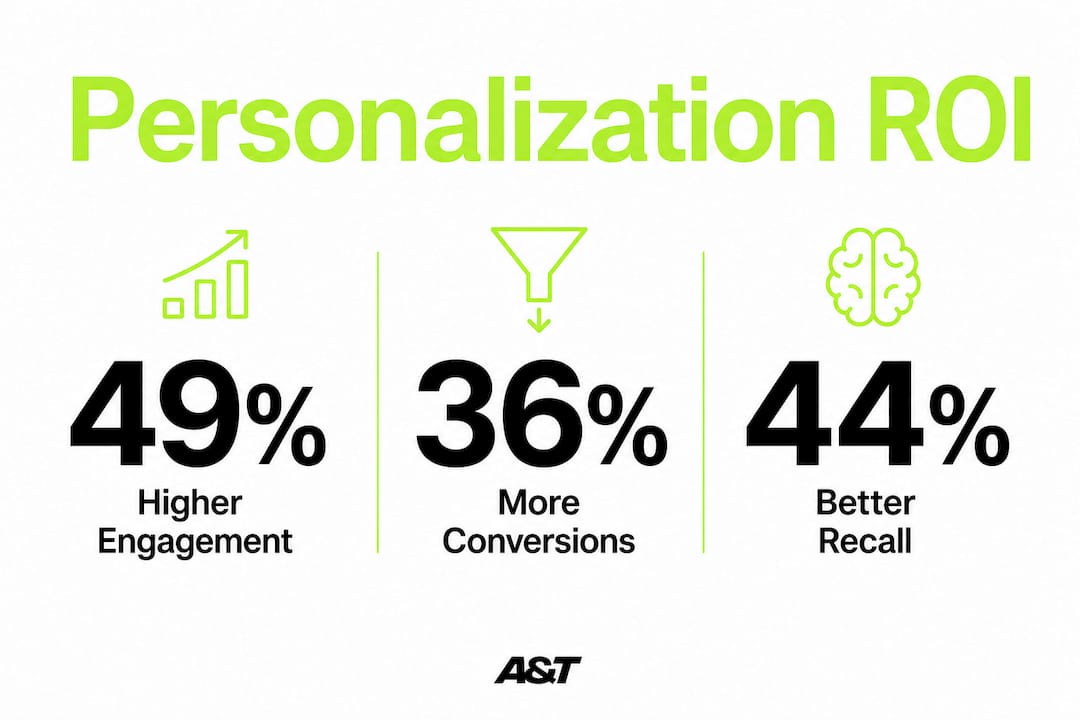
| Metric | Generic ads | Personalized ads | Improvement |
|---|---|---|---|
| Engagement rate | Baseline | +49% | Significant lift |
| Conversion rate | Baseline | +36% | Strong revenue impact |
| Brand recall | Baseline | +44% | Long-term value |
| Revenue potential | Baseline | +40% revenue | Competitive advantage |
These gains compound across your entire funnel. Higher engagement at the top means more qualified traffic in the middle. Better conversion rates in the middle mean lower cost-per-sale at the bottom. And stronger brand recall means your next campaign starts with a warmer audience.
Here's a step-by-step framework for building a personalized ad flow:
-
Collect and organize first-party data. Start with what you already have. Customer purchase history, email engagement, website behavior, and CRM records all tell a story about what your audience actually cares about. This is your foundation.
-
Segment your audience into meaningful groups. Don't just split by age and location. Segment by intent, behavior, and stage in the buying journey. A customer who visited your pricing page three times needs a very different message than someone who just discovered your brand.
-
Develop dynamic creative for each segment. This means different headlines, images, offers, and calls to action for different audience groups. The goal is for each person to feel like the ad was made for them specifically, because it was.
-
Set up automated triggers based on behavior. If someone adds a product to their cart and leaves, that action should automatically trigger a retargeting ad with a specific message addressing their hesitation. Behavior-based triggers close the gap between interest and conversion.
-
Test variables systematically. Don't change everything at once. Test one creative element at a time so you know exactly what's driving performance shifts. Headline versus image versus offer. Learn fast, then scale what works.
-
Analyze and optimize continuously. Personalization is not a set-it-and-forget-it strategy. Review performance weekly. Kill underperforming variations. Double down on what's working.
Exploring real SMB creative ad examples shows you exactly how businesses like yours are executing this in practice. And studying top converting creative examples across verticals gives you a clear benchmark for what strong personalized creative actually looks like.
Pro Tip: Run A/B tests on at least two distinct creative variations per audience segment before drawing conclusions. Test headline framing first since it's usually the highest-leverage variable for engagement.
Personalization vs. generic ads: When is generic still useful?
Personalization wins on most metrics. But smart advertising isn't about choosing one approach and ignoring the other entirely. It's about knowing when each approach serves your goals.
| Factor | Personalized ads | Generic ads |
|---|---|---|
| Best for | Retargeting, conversion, loyalty | Brand awareness, new product launches |
| Data requirement | Moderate to high | Low |
| Cost efficiency | High (less waste) | Lower initially |
| Message relevance | High | Broad |
| Speed to launch | Slower (more setup) | Fast |
| Funnel stage | Mid to lower funnel | Top of funnel |
Generic ads still have a legitimate role in your media mix. Here are situations where a broad approach makes sense:
- Launching a new product or service where you have no behavioral data yet and need to cast a wide net to gather initial signals
- Building top-of-funnel brand awareness in a new market or geographic area where you're introducing your brand for the first time
- Promoting a universal offer like a sitewide sale or free shipping that applies equally to every potential customer
- Testing new creative concepts before investing in segmented versions, using broad audiences to get faster feedback
The real problem isn't choosing between the two. It's execution. Even brands with strong personalization ambitions often fall short because of a structural data problem.
Most businesses haven't integrated their customer data across platforms. Less than 50% of companies have adequate data infrastructure to support AI-driven personalization. Data silos, meaning customer data trapped in disconnected tools like your CRM, email platform, website analytics, and ad accounts, prevent the unified view you need to personalize effectively. Generic ads become the fallback not by choice, but by necessity.
This is why proper data infrastructure isn't just a tech problem. It's a revenue problem. Investing in connecting your data sources pays dividends in every campaign you run afterward.
Understanding optimizing ad campaigns across funnel stages helps you decide where personalization delivers the biggest return for your specific business. And pairing that with strong retargeting strategies creates a system where generic top-funnel ads feed into highly personalized mid and lower-funnel experiences.
Unlocking ROI: Technologies powering efficient ad personalization
One of the biggest misconceptions SMBs carry is that advanced personalization requires enterprise-level budgets. That was true five years ago. It's not true now.
AI-powered personalization tools have become genuinely accessible. And the efficiency gains they deliver make the investment straightforward to justify. AI personalization can cut advertising costs by 20 to 30% for SMBs through reduced wasted spend and improved targeting precision. You're not just spending less. You're spending better.
| Technology or method | Primary benefit | Cost impact |
|---|---|---|
| AI audience targeting | Finds high-intent users automatically | Reduces wasted impressions |
| Dynamic creative optimization | Serves best-fit ad variant per user | Increases conversion rate |
| Predictive analytics | Anticipates purchase behavior | Improves budget allocation |
| Automated bid strategies | Adjusts bids in real time | Lowers cost-per-conversion |
| CRM data integration | Personalizes based on purchase history | Boosts lifetime value campaigns |
Here's how to start integrating these technologies into your campaigns without a massive upfront investment:
-
Start with platform-native AI tools. Both Google Ads and Meta Ads have built-in machine learning features that do a significant amount of personalization work automatically. Responsive search ads, Performance Max campaigns, and Meta's Advantage+ targeting are all AI-driven and available at any budget level.
-
Connect your CRM to your ad platforms. Use customer match features to upload your existing customer lists. This allows you to create highly personalized campaigns for past buyers, active leads, and lapsed customers using data you already own.
-
Implement a pixel or tracking tag on your website. This is the foundation of behavioral personalization. Without it, you can't retarget site visitors, track conversions accurately, or build lookalike audiences from your best customers.
-
Set up basic audience segmentation in Google Analytics or Meta Events Manager. Identify your highest-value audience segments based on actual behavior, then use those segments to build targeted campaigns with tailored messaging.
-
Use dynamic ads for catalog-based businesses. If you sell multiple products, dynamic ads automatically show each person the specific products they've already shown interest in. This alone can dramatically improve retargeting performance with minimal manual effort.
-
Build a simple analytics dashboard. Track the metrics that matter most: cost-per-click, conversion rate, cost-per-acquisition, and return on ad spend. Review it weekly and look for trends by audience segment.
Deep knowledge of analytics and optimization is what separates businesses that scale their personalization programs from those that stall. And keeping up with ad tech creative campaigns shows you what emerging formats like video and augmented reality are doing for engagement in personalized ad environments.
Pro Tip: Set up a weekly analytics review focused specifically on audience segment performance. Identify which segments are outperforming and shift budget toward them incrementally each week. Small reallocation decisions, made consistently, compound into significant ROI gains over a quarter.
Our take: What most SMBs miss about ad personalization
Here's the honest truth from our experience working with SMBs across telehealth, retail, entertainment, and wellness: most businesses focus almost entirely on audience data and almost not at all on messaging.
They'll spend weeks building the perfect audience segment, narrowing by age, interest, location, and behavior. Then they write one headline that's still basically generic and wonder why performance is flat. Personalization isn't just who you're talking to. It's what you say, when you say it, and how the offer is framed for that specific person at that specific moment.
The most effective personalized campaigns we've seen match creative and offer to micro-moments, meaning the exact context in which someone is encountering your ad. Someone searching for a solution late at night is in a very different mindset than someone scrolling a social feed during lunch. The same offer framed differently for each context performs dramatically differently.
The other trap we see constantly is over-automation. AI tools are powerful. But when you let automation run completely unchecked, messaging becomes flattened and lifeless. Every ad starts to sound like every other ad. The algorithm optimizes for clicks, not for brand voice or emotional resonance. You end up with personalized targeting but generic creative. That combination is worse than you'd expect.
Stay involved in your campaigns. Review creative regularly. Test new angles. Ask yourself whether each ad actually sounds like it was written for a real person with a real problem.
The simplest advice we give to SMBs just starting out: run one genuinely personalized campaign before you run ten generic ones. Pick your best audience segment, write messaging that speaks directly to their specific pain point, make an offer that removes their specific objection, and measure the results against your baseline.
One focused, personalized campaign will teach you more about your audience than a dozen broad campaigns ever will. It will also perform better. Use campaign analytics best practices to make sure you're measuring the right things from the start so you can iterate with confidence.
Ready to personalize your ad strategy with expert help?
Personalization at scale takes the right strategy, the right creative, and the right data setup working together. When those three elements are aligned, the ROI improvement isn't marginal. It's transformational.
At A&T Digital Agency, we build and manage personalized paid ad systems for SMBs across Google and Meta, from audience architecture and dynamic creative to continuous optimization and clear reporting. Our Google Ads management and Meta Ads management services are built specifically to deliver personalized, high-ROI campaigns without wasted spend or unnecessary complexity. If you're ready to move from generic to genuinely effective, explore our full new ad services and let's build something that actually converts.
Frequently asked questions
What does ad personalization mean for small businesses?
Ad personalization means tailoring your digital ads to match specific customer interests, behaviors, or demographics so each audience segment receives messaging that feels directly relevant to them, resulting in higher engagement and better conversion rates.
Do personalized ads really increase sales for SMBs?
Yes. Personalization can boost revenue by up to 40% and improve conversion rates by over 36%, making it one of the highest-return strategies available to SMBs running paid ads.
How can SMBs afford advanced personalization?
AI-powered tools now cut advertising costs by 20 to 30% through reduced waste and smarter targeting, and most major ad platforms include built-in AI features that deliver personalization at no additional cost.
Is there a downside to fully personalized ad strategies?
Yes. Most SMBs lack the integrated data infrastructure needed for true personalization, and over-reliance on automation without active creative oversight often produces messaging that feels generic despite being technically targeted.