
TL;DR:
- Audience segmentation involves dividing ad audiences into meaningful groups to enhance campaign effectiveness and ROI. It prioritizes behavioral and community-based data over demographic filters, resulting in more precise targeting and higher conversions. Continuous data-driven refinement is essential for maximizing segmentation benefits and sustained growth.
Audience segmentation is the strategic practice of dividing your ad audiences into distinct groups based on meaningful characteristics to maximize campaign effectiveness. Known formally as market segmentation in advertising, it is the difference between spending your budget on everyone and spending it on the right people. Businesses that apply it correctly see revenue growth up to 760% compared to generic broadcast marketing. Platforms like Meta Ads and Google Ads have built their entire targeting infrastructure around this principle, and in 2026, the gap between segmented and unsegmented campaigns has never been wider.
Why segment ad audiences: the core business case
The most direct answer to why you should segment ad audiences is this: unsegmented campaigns waste money, and the data proves it. 63% of digital ad impressions currently reach the wrong demographic entirely. That means more than half your budget, on average, is funding impressions that will never convert. Segmentation fixes that at the source.
The financial case goes further. 77% of marketing ROI is generated by segmented, targeted, and triggered messaging, compared to just 23% from broadcast messaging. That ratio alone should settle the debate for any performance-focused marketer. Segmentation does not just improve results at the margins. It fundamentally shifts where your returns come from.
Beyond ROI, segmentation drives the personalized experiences that modern buyers now expect as a baseline. 81% of customers expect personalized experiences from the brands they engage with. Failing to deliver that is not a neutral outcome. It actively erodes trust and reduces the likelihood of conversion. The benefits of audience segmentation extend from cost efficiency to customer loyalty, and both matter for sustainable growth.
Here is a practical summary of what segmentation delivers:
- Higher conversion rates because your message matches the specific need of each group
- Lower cost per acquisition by eliminating wasted impressions on unqualified audiences
- Stronger engagement metrics including click-through rate and time on site
- Better product development signals because segment-level feedback reveals what different customer groups actually want
- Improved customer retention when post-purchase messaging stays relevant to each segment's behavior
"Segmentation is not about creating unnecessary complexity. It is about recognizing the complexity that already exists in your customers' differing needs and value potential." — Brandwatch
How does audience segmentation differ from demographic targeting?
Demographic targeting, the practice of filtering by age, gender, income, or location, is the oldest form of ad targeting and also the most overrated. Two people can share identical demographics and have completely opposite purchase motivations. A 35-year-old woman in Chicago might buy running shoes because she trains for marathons, or because she needs comfortable footwear for a retail job. The same ad will not work for both.
This is where behavioral and community-based segmentation outperform demographics. Community membership predicts purchase behavior more accurately than demographic similarity because it reflects genuine cultural affiliation and shared values. Someone who identifies with a CrossFit community, follows specific nutrition accounts, and engages with performance gear content is a far more precise target than "adults aged 25 to 44."
| Segmentation type | What it measures | Predictive accuracy |
|---|---|---|
| Demographic | Age, gender, income, location | Low to moderate |
| Behavioral | Purchase history, browsing, engagement | High |
| Community-based | Shared values, media consumption, group identity | Very high |
| Psychographic | Lifestyle, attitudes, motivations | High |
The strategic recommendation is to layer these data types rather than choose one. Start with behavioral signals from your CRM or pixel data, then overlay community or psychographic attributes to sharpen the profile. Demographics can serve as a guardrail, not the primary filter.
Pro Tip: If you are running Meta Ads, avoid building segments based purely on interest stacking. Interest categories are self-reported and often inaccurate. Behavioral data from your pixel or CRM uploads will consistently outperform manual interest targeting.
What are the main types of audience segmentation for ad campaigns?
Understanding the segmentation types available to you is the foundation of any solid targeting strategy. Each type serves a different purpose, and the right choice depends on your business model, data availability, and campaign objective.
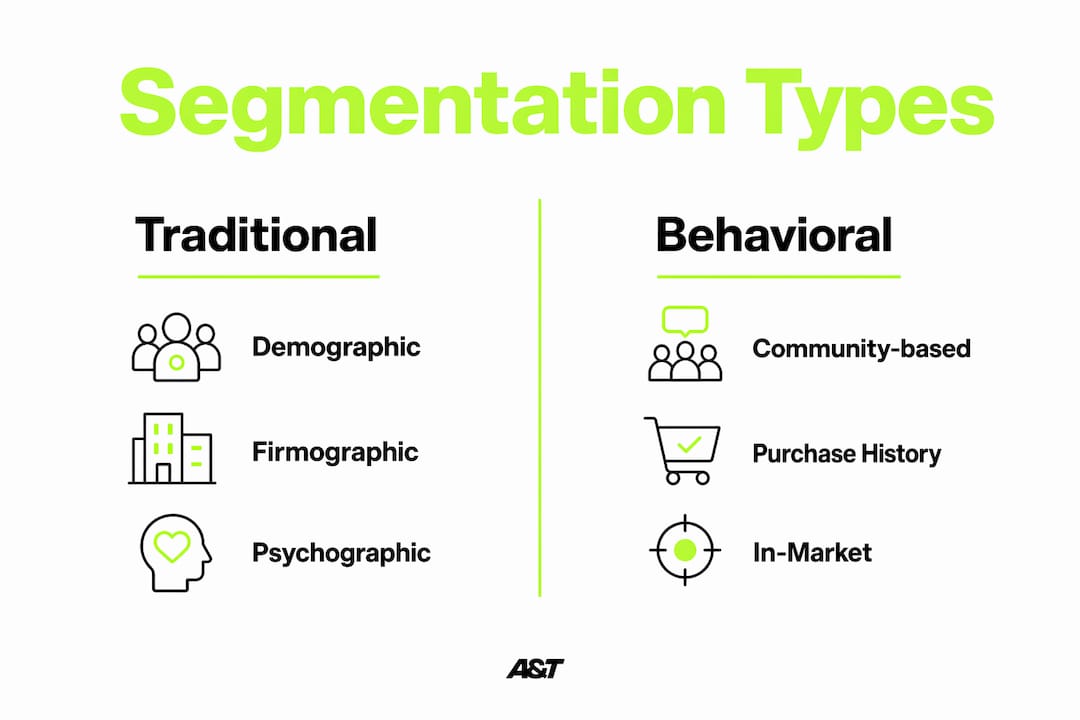
Demographic segmentation uses age, gender, household income, education, and location. It is the easiest to implement and the most widely available across platforms like Google Ads and Meta. Use it as a baseline filter, not a primary targeting mechanism.
Behavioral segmentation groups people by what they do: pages visited, products viewed, purchases made, emails opened, or content consumed. This is the most directly tied to purchase intent. A visitor who viewed your pricing page three times in one week is a fundamentally different prospect than someone who read a single blog post.

Psychographic segmentation targets based on values, attitudes, interests, and lifestyle. It is harder to measure directly but powerful for brand-level messaging. Brands in health and wellness, financial services, or premium retail rely heavily on psychographic data to connect emotionally with buyers.
Firmographic segmentation applies specifically to B2B campaigns. It filters by company size, industry, revenue, and job function. On LinkedIn Ads or Google's Customer Match, firmographic targeting lets you reach the CFO of a 200-person SaaS company instead of a general business audience.
Community-based segmentation is the most sophisticated and increasingly the most effective. It maps shared cultural identities, media consumption habits, and group affiliations. Pulsar Platform and similar social intelligence tools surface these communities by analyzing what people read, share, and engage with at scale.
When choosing which types to apply, evaluate two factors: data quality and segment size. A psychographic segment built on guesswork is less useful than a behavioral segment built on 10,000 verified purchase events. Prioritize segments where you have clean, first-party data and where the audience is large enough to generate statistically meaningful results.
How to implement audience segmentation for paid ads in 2026
Segmentation is not a one-time setup. Effective segmentation requires continuous refinement based on real-time data, not a static profile built at campaign launch. Here is how to approach it as an ongoing process:
-
Audit your existing data. Pull your CRM records, pixel events, and email engagement data. Identify which customer groups are already visible in the data before you build anything new.
-
Define your segments by behavior first. Group customers by purchase frequency, average order value, or funnel stage. A first-time visitor, a repeat buyer, and a lapsed customer each need a different message and a different offer.
-
Upload first-party data to your ad platforms. On Meta Ads, use Custom Audiences built from CRM lists or pixel events. On Google Ads, use Customer Match. These signals are more reliable than platform-native interest categories, especially post-iOS14.
-
Build suppression lists. Exclude recent purchasers from acquisition campaigns. Exclude cold audiences from retention offers. Suppression is segmentation in reverse, and it prevents wasted spend on audiences that are already converted or irrelevant.
-
Test and refresh segments on a set schedule. Audience behavior shifts. A segment that performed well in Q1 may be stale by Q3. Set a monthly review cadence to update lists, remove churned customers, and add newly qualified prospects.
-
Evaluate platform AI tools carefully. Meta's Advantage+ audience targeting now outperforms manual segmentation for smaller accounts with limited data. If your pixel has fewer than 500 conversion events, letting the algorithm find your audience may outperform rigid manual segments.
Pro Tip: For Google Ads, use in-market audiences layered over your keyword targeting rather than as a standalone. This narrows your keyword traffic to users who are actively researching a purchase, which typically cuts cost per lead without reducing volume significantly.
What common mistakes should marketers avoid when segmenting ad audiences?
The most common mistake is over-segmentation. Marketers split audiences into dozens of micro-groups, each with its own creative and budget, and end up with segments too small to generate reliable data. A segment needs sufficient volume to exit the learning phase on Meta or Google. Splitting too early creates noise, not insight.
A second mistake is treating segmentation as a one-time project. Audiences evolve. Customers move through the funnel, change their behavior, and respond to market shifts. A segment profile built six months ago without updates is likely misdirecting spend today.
Third, many campaigns fail because segments are defined but never measured separately. If you run segmented campaigns but report on aggregate performance, you cannot identify which segment is driving results and which is draining budget. Segment-level reporting is not optional. It is the mechanism that makes segmentation worth doing.
Pro Tip: Start with one or two high-impact segments and expand after testing. Your highest-value existing customers and your most recent website visitors are almost always the two best starting points. Validate performance there before building out additional layers.
Key takeaways
Audience segmentation is the single most effective lever for improving paid ad performance, and every dollar spent without it is a dollar working below its potential.
| Point | Details |
|---|---|
| Segmentation drives ROI | 77% of marketing ROI comes from segmented messaging versus broadcast campaigns. |
| Demographics alone underperform | 63% of ad impressions miss the target demographic when relying on demographics only. |
| Behavioral data outperforms interest stacking | CRM and pixel signals deliver more accurate targeting than platform interest categories post-iOS14. |
| Segmentation requires ongoing updates | Static segments decay. Monthly refreshes based on real-time data maintain targeting accuracy. |
| Start focused, then expand | Begin with two high-impact segments, validate results, then scale to additional audience layers. |
Why I think most marketers are still underusing segmentation
After working across dozens of paid ad campaigns spanning telehealth, retail, and entertainment, the pattern I see most often is this: marketers understand segmentation in theory but apply it too shallowly in practice. They split by age and gender, call it segmented, and wonder why performance plateaus.
The real shift happens when you move from demographic filters to behavioral cohorts. The moment you start targeting people based on what they have done rather than who they appear to be, the data starts telling you something useful. A customer who bought twice in 90 days and opened your last three emails is not just a demographic. That person is a retention opportunity with a specific message attached to it.
The tools available in 2026 make this more accessible than ever. Meta's Custom Audiences, Google's Customer Match, and platforms like Pulsar Platform for community intelligence have removed most of the technical barriers. The gap now is strategic, not technical. Marketers who treat segmentation as a continuous, data-driven process rather than a campaign setup step will consistently outperform those who do not. The complexity is worth it. In fact, it is not complexity at all. It is just paying attention to who your customers actually are.
— Ann
Put segmentation to work with a performance marketing team
Understanding why you should segment ad audiences is step one. Executing it across Google Ads and Meta campaigns with clean data, proper suppression lists, and continuous optimization is where most in-house teams hit a ceiling. At Atdigiagency, we build and manage paid ad systems that apply advanced audience segmentation from day one, not as an afterthought. Our campaigns are built around your actual customer data, not platform defaults. If you want segmentation that translates directly into lower cost per acquisition and higher revenue, we are the team that makes that happen without unnecessary overhead. Personalized ad strategies start with knowing exactly who you are talking to.
FAQ
Why is audience segmentation important in advertising?
Audience segmentation is important because it directs your ad spend toward the people most likely to convert, reducing wasted impressions and improving ROI. Research shows that segmented campaigns generate 77% of marketing ROI compared to just 23% from unsegmented broadcast messaging.
How often should you update your ad audience segments?
Segments should be reviewed and refreshed at least monthly. Audience behavior shifts with seasons, market conditions, and funnel movement, so static segments lose accuracy quickly without regular updates based on real-time campaign data.
What is the best type of segmentation for paid ads?
Behavioral segmentation using CRM data and pixel signals is the most effective approach for paid ads, particularly post-iOS14. It targets people based on verified actions rather than assumed interests, which produces more accurate audience matches and higher conversion rates.
Can small businesses benefit from audience segmentation?
Small businesses benefit significantly from segmentation because it prevents budget waste on unqualified audiences. Starting with two segments, such as recent website visitors and existing customers, delivers measurable improvement without requiring large data sets or complex infrastructure.
What is the difference between segmentation and personalization?
Segmentation divides your audience into groups based on shared characteristics. Personalization uses those groups to deliver tailored messages and offers. Segmentation is the foundation. Personalization is what you build on top of it.