
TL;DR:
- Testing ad placements with controlled experiments provides reliable data that guides efficient budget allocation and improves campaign performance.
- Failure to wait for sufficient optimization events or to address tracking issues can lead to misleading results and poor strategic decisions.
Most marketing professionals assume their ad platform knows best. Run automatic placements, let the algorithm decide, and watch the results roll in. That assumption costs real money. Understanding why test ad placements matter is not a theoretical exercise. It's the difference between a campaign that scales and one that burns through budget while reporting misleading wins. Ad placement testing, the structured practice of isolating where your ads appear to measure true performance impact, gives you the data to make confident, defensible budget decisions instead of educated guesses.
Table of Contents
- Key takeaways
- Why test ad placements at all
- The real importance of ad placement testing
- How to test ad effectiveness with proper methodology
- Common pitfalls that invalidate your tests
- Applying test results to your placement strategy
- My take on what most marketers get wrong
- Ready to get your placement strategy right
- FAQ
Key takeaways
| Point | Details |
|---|---|
| Testing protects your budget | Data-driven placement decisions prevent spend on channels that generate clicks but not conversions. |
| Attribution accuracy is non-negotiable | Broken tracking makes placement test results unreliable and can cause you to cut placements that actually work. |
| Learning phase patience pays off | Each ad variant needs roughly 50 optimization events before data becomes stable enough to act on. |
| Automatic placements are a starting point | Meta's Advantage+ can reduce CPC and lift conversions, but manual refinement after testing performs best. |
| Business metrics beat vanity metrics | Placement tests tied to revenue or incrementality reveal true ROI; engagement metrics alone can mislead. |
Why test ad placements at all
Before we get into methodology, let's be clear on what "ad placements" actually means in practice. Placements are the specific locations where your ads appear across a platform's inventory. On Meta, that includes Facebook Feed, Instagram Stories, Instagram Reels, Facebook Marketplace, and Meta Audience Network, among others. On Google, placements span Search, Display, YouTube, Gmail, and Discover. Each one delivers your message to users in a different context, with different intent levels and different browsing behaviors.
That context changes everything. A user scrolling Instagram Stories is in a passive, entertainment mindset. A user clicking a Google Search ad just typed a specific query. The same creative shown in both environments will perform completely differently, and the same placement can perform differently across audiences, industries, and offer types.
Several factors shape placement performance:
- User intent at the moment of exposure. Search placements attract high-intent users. Social feed placements interrupt lower-intent browsing.
- Creative format compatibility. A square image looks fine in a feed but feels clunky in a Stories slot designed for vertical video.
- Audience behavior patterns. Younger demographics over-index on Reels. Older demographics may convert better through Facebook Feed.
- Competitive density. Some placements carry higher CPMs because more advertisers compete for them. Others are cheap for a reason.
Meta's Advantage+ placements (formerly automatic placements) use machine learning to distribute your budget across inventory based on predicted performance. The algorithm is not incompetent. But it optimizes for what you tell it to optimize for, and without testing, you cannot verify whether its decisions align with your actual business goals.
Pro Tip: Before running your first placement test, audit your conversion events. If your pixel is only firing partial data, the algorithm is already making decisions based on incomplete information.

The real importance of ad placement testing
Here's what skipping placement tests actually costs you. Budget allocated to a placement that drives low-quality conversions is not neutral spending. It actively crowds out budget that could go to placements generating real revenue. The importance of ad placement testing becomes obvious the moment you run your first clean split test and see a 3x cost-per-acquisition gap between two placements you assumed were equivalent.
The core reasons testing matters come down to four business realities:
- Risk reduction through evidence. Testing replaces assumptions with measured user behavior. You stop gambling on gut instinct and start making decisions backed by data.
- Budget efficiency at scale. When you know which placements convert at your target CPA, you can concentrate spend there. Every dollar works harder.
- Attribution sanity checks. Signal loss from in-app browsing or pixel failures degrades conversion reporting. A structured test across placements helps you spot anomalies that indicate tracking problems, not genuine performance differences.
- Algorithm accountability. Platforms report metrics from their own tracking, which naturally favors their inventory. In-platform tests can overstate success when disconnected from actual business outcomes like sales or qualified leads.
"Testing is only useful if measurement and attribution are accurate. Broken data makes placement testing ineffective, no matter how well-designed the test structure is." — Meta Advertisers Common Testing Problem
Tie your placement tests to meaningful metrics. Cost per acquisition, revenue per conversion, and return on ad spend tell a real story. Click-through rate and reach tell you something is happening, but not whether it matters.
How to test ad effectiveness with proper methodology
A clean A/B test in advertising isolates one variable. In placement testing, that variable is where the ad appears. Everything else stays constant: the creative, the audience targeting, the budget, the bid strategy, and the offer. If you change two variables at once, you cannot know which one drove the difference.
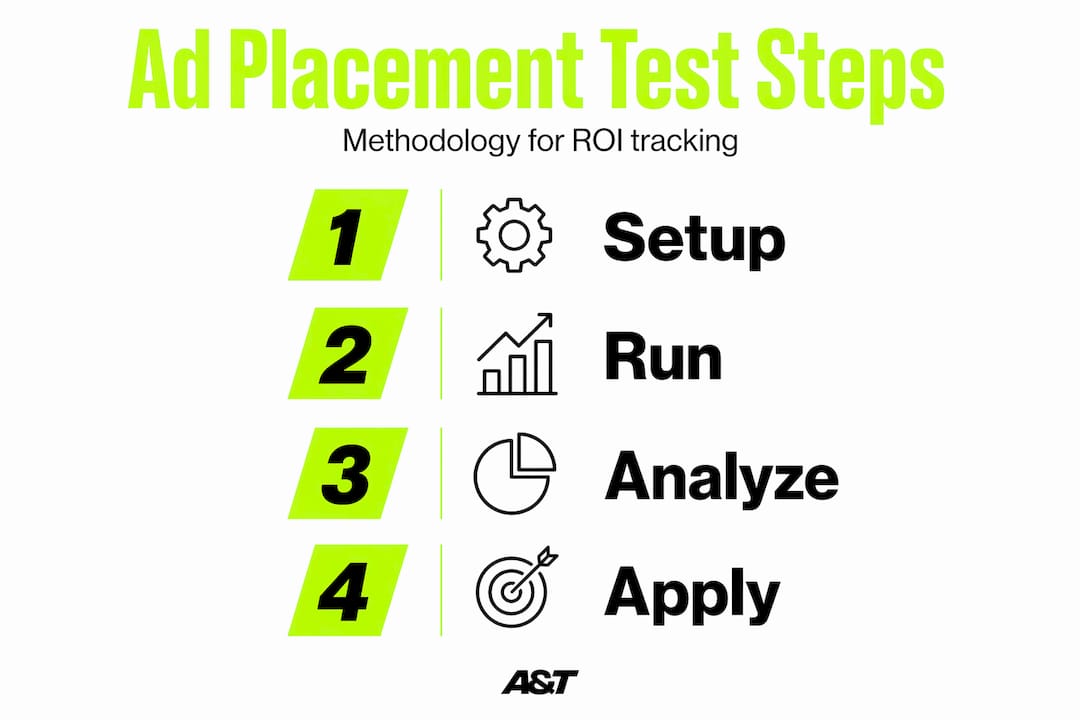
Here's a practical sequence for running placement tests that generate reliable results:
- Define your test goal. Are you optimizing for cost per lead, purchase conversion rate, or cost per click? Name it before you build anything.
- Build separate ad sets per placement. In Meta Ads Manager, create one ad set targeting Facebook Feed only and another targeting Instagram Stories only. Use identical creatives and audience settings.
- Set budgets that allow statistical significance. Each variant needs at least 50 optimization events to exit the learning phase. If your conversion rate is 2%, you need roughly 2,500 clicks per placement to hit that threshold.
- Run the test for at least 7 to 14 days. Weekly cycles of user behavior exist. Reading results after two days introduces day-of-week bias.
- Avoid launching too many variants at once. Concurrent variants fragment your budget and extend the learning phase for every ad set simultaneously. Test two or three placements at a time, then expand.
- Analyze using placement-level breakdown reports. Meta Ads Manager's Breakdown tool lets you slice performance data by placement within a campaign. Use this alongside your isolated test data for cross-validation.
| Test Phase | Action | What to Watch |
|---|---|---|
| Setup | Isolate placement as the only variable | Budget, audience, creative identical across ad sets |
| Learning Phase | Let each variant accumulate 50+ events | Avoid making changes until learning phase exits |
| Analysis | Review CPA, ROAS, conversion rate by placement | Cross-check with business-level revenue data |
| Decision | Scale winning placement, pause underperformers | Revisit after 30 days to account for seasonality |
Pro Tip: Use Meta's built-in A/B test feature for statistically clean splits. It controls for audience overlap automatically, which manual duplicate ad sets do not.
Common pitfalls that invalidate your tests
Even well-designed placement tests fail when the underlying data is compromised. These are the pitfalls we see most often and the ones that quietly corrupt results before you realize anything is wrong.
- Pixel and event tracking failures. A broken or misfiring pixel will underreport conversions from certain placements. If Instagram Stories shows zero conversions over a week, check whether your pixel fires in that in-app browser environment before concluding the placement does not work.
- Algorithm bias toward cheap inventory. Meta's Audience Network placements often show strong CTR and low CPM. But high CTR does not always signal quality. Accidental clicks and bot traffic inflate engagement metrics without contributing real business value.
- Budget fragmentation from over-testing. Running five placement tests simultaneously splits your budget five ways. Each ad set starves for data. You end up with five inconclusive results instead of two confident ones.
- Over-reliance on engagement metrics. A placement that drives 8% CTR but 0.4% conversion rate is not performing. It's attracting curious clicks, not buyers. Cross-reference everything downstream.
- Ignoring server-side tracking options. For campaigns where conversion accuracy is critical, Meta's Conversions API provides a server-side signal that does not depend on browser-based pixel firing. This is especially relevant for placements that open in-app browsers.
"Placement-level CTR is a diagnostic metric. It tells you something is wrong or interesting. It does not tell you whether that placement is profitable." — Meta Advantage+ Placements Guide
Fix your tracking before you test. Otherwise, you're optimizing against noise.
Applying test results to your placement strategy
Once your test data is clean and statistically meaningful, the work shifts from analysis to application. This is where you optimize ad placements systematically rather than reactively.
A practical sequence that works:
- Start with Meta Advantage+ placements to gather broad performance data across all inventory.
- Pull the placement breakdown report after sufficient data accumulates (minimum two weeks, ideally one full month).
- Identify placements with CPA above your threshold or conversion rates significantly below average. Exclude them manually.
- Rebuild focused campaigns using only the top two or three performing placements, then run a secondary test to confirm the lift.
Meta's own data shows that Advantage+ placements can increase conversions by 20% compared to fully manual campaigns. That's a real advantage. But the hybrid approach, letting the algorithm run first and then refining with your test data, consistently outperforms both extremes.
| Strategy | Best For | Key Risk |
|---|---|---|
| Full automatic (Advantage+) | New campaigns, audience discovery | No visibility into placement-level waste |
| Fully manual placements | Proven campaigns with clean data | Misses algorithm optimization advantages |
| Hybrid (auto then refine) | Scaling campaigns with testing discipline | Requires patience during learning phase |
Align your placement decisions with campaign objectives. Awareness campaigns can tolerate broader placement reach. Conversion campaigns demand tighter control and higher attribution confidence. Testing ad copy alongside placements adds another layer of precision to your optimization cycle.
The goal is not to run a test once and declare a winner forever. Audience behavior shifts. Platform inventory changes. Creative fatigue sets in. Build iterative testing into your campaign calendar as a standard practice, not a one-time project.
My take on what most marketers get wrong
I've watched smart marketers build elaborate placement test structures and still walk away with bad decisions. The problem is almost never the test design. It's the patience and the attribution hygiene.
In my experience, the most common mistake is reading test results before the learning phase exits. You see Audience Network underperforming at day four and pause it. But the algorithm never had enough data to optimize for your actual conversion events. You've made a permanent decision based on temporary noise.
The second issue I keep seeing is treating test results as universal. A placement that underperforms for a B2B lead generation campaign might be the best performer for a consumer product with impulse purchase behavior. Context does not transfer automatically.
What I've learned is that the discipline of testing pays off compounding returns. The first clean test gives you a data point. The fifth gives you a pattern. The tenth gives you a placement strategy you can defend in any budget conversation with confidence. But that only happens if your attribution is accurate and you have the patience to let data accumulate before acting.
The false economy of rushing tests is real. Saving two weeks of data collection to make a faster decision often means making the wrong one and spending three months correcting it.
— Ann
Ready to get your placement strategy right
If placement testing feels like a moving target, you are not alone. At Atdigiagency, we manage Google Ads campaigns and Meta Ads campaigns where placement strategy is built into every campaign from day one. We do not guess which placements work. We test, measure, and allocate based on real conversion data tied to your business outcomes. Our team handles the methodology, the attribution setup, and the iterative optimization cycle, so you get results without the trial-and-error cost. If scaling your paid ad performance with a team that genuinely cares about your numbers sounds like what you need, let's talk.
FAQ
What does ad placement testing mean?
Ad placement testing is the practice of running controlled experiments to compare how different ad positions or inventory types (such as Facebook Feed versus Instagram Stories) perform against your campaign goals, using one variable at a time for reliable results.
How long should a placement test run?
A placement test should run for at least 7 to 14 days and accumulate a minimum of 50 optimization events per ad variant before you draw conclusions. Reading results too early introduces statistical noise and day-of-week bias.
Why is CTR not enough to evaluate placement performance?
High click-through rate from a placement can reflect bot traffic or accidental clicks, especially in Audience Network inventory. CTR should be cross-checked against downstream metrics like conversion rate and cost per acquisition before making placement decisions.
Should I use automatic or manual placements?
Start with automatic placements to gather broad performance data, then use breakdown reports to identify underperformers and exclude them manually. This hybrid approach combines algorithm efficiency with your own data-driven judgment and tends to outperform either extreme on its own.
What causes placement test results to be misleading?
Broken pixel tracking, in-app browser signal loss, budget fragmentation from running too many variants simultaneously, and over-reliance on engagement metrics are the most common causes. Fix your attribution setup before you run any placement test to make sure the data you collect is actually reliable.