
TL;DR:
- Creative quality accounts for 49-70% of ad performance variance for small businesses.
- Building diverse assets and testing multiple variations improve AI optimization and campaign results.
- Regularly measuring metrics like hook rate, hold rate, CTR, and CVR helps identify and fix chain breaks.
Most small business owners running paid ads share the same frustration: the budget gets spent, but the results never quite match expectations. The fix rarely lives in the bid strategy or the targeting settings. It lives in the creative itself. Creative drives 49-70% of ad performance variance, yet most SMBs treat it as an afterthought. This guide walks you through every stage of building effective ad creatives, from setting clear objectives to testing what works, so your next campaign actually moves the needle.
Table of Contents
- Define objectives and gather requirements
- Build creatives: A step-by-step process
- Test and optimize: Measure what matters
- Troubleshooting and common mistakes
- What most SMBs get wrong about ad creative—And how to fix it
- Next steps: Upgrade your creative with our performance marketing experts
- Frequently asked questions
Key Takeaways
| Point | Details |
|---|---|
| Creative drives performance | Ad creative accounts for nearly half or more of campaign success, making it the most important lever for SMBs. |
| Variety boosts results | Using multiple headlines, images, and videos enables AI optimization and leads to higher conversions. |
| Test and measure | Tracking metrics like hook rate, hold rate, CTR, and CVR helps spot weaknesses and refine creative for better ROI. |
| Avoid common mistakes | Watch for asset shortages and chain breaks to prevent wasted ad spend and underperformance. |
Define objectives and gather requirements
Before you open a design tool or write a single headline, you need to know exactly what you want the ad to accomplish. This sounds obvious, but it's where most campaigns go sideways. Vague goals produce vague creative. Specific goals produce specific results.
Start by naming your primary objective. Are you driving traffic to a landing page? Generating leads through a form? Building brand awareness in a new market? Each goal demands a different creative approach. A brand awareness ad prioritizes visual impact and memorability. A conversion ad prioritizes a clear offer and a direct call to action. Mixing these up wastes money.
Once your objective is clear, gather every asset you'll need before production starts. This includes headlines, body copy, images, logos, video clips, and any offer details. Rushing this step forces last-minute compromises that hurt quality.
Here's a quick comparison of basic versus optimized asset requirements:
| Asset type | Basic setup | Optimized setup |
|---|---|---|
| Headlines | 1-2 options | 3-5 varied options |
| Images | 1 static image | 3+ images, mixed formats |
| Videos | None | At least 1 short-form video |
| Body copy | 1 version | 2-3 versions, different angles |
| CTAs | 1 generic CTA | 2+ specific, action-driven CTAs |
Why does quantity matter here? Because multiple headlines and images give AI-driven platforms like Google and Meta the raw material they need to find the best-performing combinations. You're not just creating ads. You're feeding a system that learns.
Look at strong ad creative examples from other SMBs to understand what variety actually looks like in practice. Notice how top performers rarely rely on a single image or one headline variant.
Key assets to gather before you start building:
- At least 3 distinct headline options targeting different pain points or benefits
- 2 or more images covering different visual styles (lifestyle, product-focused, testimonial-based)
- 1 short video if your budget allows, even a 15-second clip
- Clear offer details: discount, free trial, guarantee, or unique value proposition
- Brand guidelines: colors, fonts, logo files
Pro Tip: Write your headlines before you design anything. Copy drives creative direction, not the other way around. If your headline is strong, the design job becomes much easier.
Build creatives: A step-by-step process
With your requirements in hand, it's time to build. The process below works for SMBs with limited resources and for teams with more bandwidth. Adjust the tools, not the steps.
Step 1: Ideation. List 5-10 angles for your ad. An angle is the specific reason a customer should care right now. Think urgency, social proof, problem-solution, or comparison. Pick the top 3 that align with your objective.
Step 2: Draft your copy. Write headlines and body copy for each angle. Keep headlines under 30 characters for Google Ads and under 40 for Meta. Body copy should be direct. State the problem, offer the solution, and tell the reader what to do next.
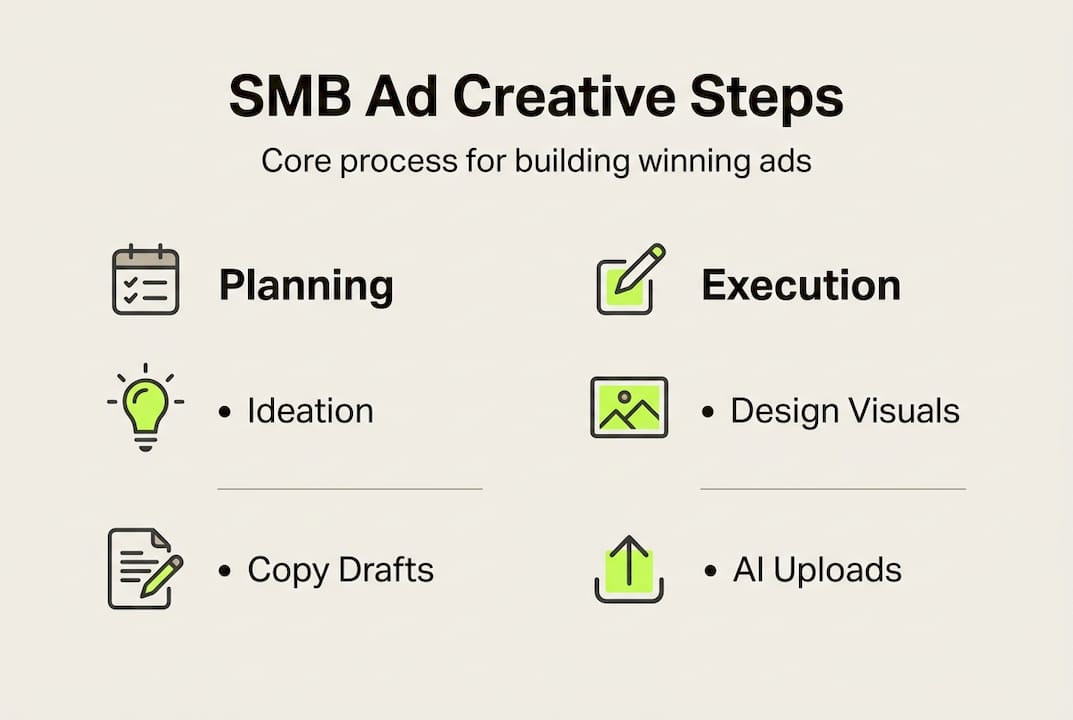
Step 3: Design your visuals. Use tools like Canva, Adobe Express, or Meta's built-in creative tools for quick, professional results. Match your visual to your headline's angle. If your headline promises speed, your image should feel fast and clean, not cluttered.
Step 4: Build with AI in mind. Upload multiple asset variations so the platform can test combinations automatically. This is not optional if you want results. Creative drives 49-70% of performance variance, and AI optimization only works when it has enough variety to test.

Step 5: Review and finalize. Check every asset against your objective. Does the image match the headline? Does the CTA match the landing page? Misalignment at this stage kills conversions before a single dollar is spent.
Here's how the two approaches compare:
| Approach | Asset variety | AI optimization | Expected performance |
|---|---|---|---|
| Without AI optimization | 1-2 assets | None | Flat or declining over time |
| With AI optimization | 3+ assets per type | Full | Continuous improvement |
For video specifically, explore video and AR engagement strategies to see how even simple short-form content can dramatically lift engagement rates for SMBs.
Pro Tip: Free tools like Canva's Magic Write or Meta's Advantage+ Creative can generate copy and image variations in minutes. Use them to multiply your asset count without multiplying your workload.
Test and optimize: Measure what matters
Building strong creatives is only half the job. Testing and optimizing based on real data is where campaigns go from average to excellent.
Start by understanding the metrics that actually tell you something useful:
| Metric | Ideal range | What it tells you |
|---|---|---|
| Hook rate | 25-35%+ | Are people stopping to watch or read? |
| Hold rate | 10-20%+ | Are people staying engaged after the hook? |
| CTR (click-through rate) | Varies by platform | Are people clicking through to your offer? |
| CVR (conversion rate) | Varies by industry | Are clicks turning into leads or sales? |
These four metrics form a chain. Hook rate, hold rate, CTR, and CVR each represent a stage in the customer journey. When one breaks down, you know exactly where to fix the creative.
Here's how to run a structured test:
- Launch 2-3 creative variations simultaneously with equal budget allocation.
- Let each variation run for at least 7-10 days before drawing conclusions. Shorter windows produce unreliable data.
- Compare hook rates first. If one creative stops people more effectively, it wins the first stage.
- Then check hold rate. A high hook with a low hold means the opening grabbed attention but the body didn't deliver on the promise.
- Review CTR and CVR together. High CTR with low CVR is a red flag.
- Pause the weakest performer. Refresh it with a new angle or visual, and re-enter the test.
Understanding creative's role in ad performance helps you interpret these numbers in context, not just in isolation. Pair this with solid analytics in advertising practices to build a testing rhythm that compounds over time.
Important: A high CTR does not mean your creative is working. If clicks aren't converting, your ad is attracting the wrong audience or overpromising on the offer. Chase CVR, not just clicks.
Pro Tip: Watch your hold rate closely. It's the most honest signal in the chain. A low hold rate tells you the creative is making a promise the content doesn't keep, and that pattern kills campaign longevity fast.
For a structured approach to the full process, the SMB ad strategy process breaks down how to build testing cycles that actually produce learning.
Troubleshooting and common mistakes
Even well-built creatives run into problems. Knowing what to look for saves you from burning budget on fixable issues.
The most common mistakes we see SMBs make:
- Too few assets. Running one headline and one image gives the algorithm nothing to work with. Performance plateaus fast.
- Overpromising in the hook. A dramatic opening that the rest of the ad can't support creates a chain break between hook rate and hold rate.
- Ignoring the data. Running the same creative for weeks without checking metrics is one of the fastest ways to waste ad spend.
- Misreading high CTR. Clicks feel like success. They aren't, unless they convert.
- No refresh cycle. Creative fatigue is real. Even great ads wear out. Most SMBs wait too long to introduce new variations.
Chain breaks are the most important concept to understand here. A chain break happens when one metric looks strong but the next one collapses. High hook with low hold means your opening is misleading. High CTR with low CVR means your ad and landing page are misaligned. Each break points to a specific fix.
How to resolve the most common chain breaks:
- Hook high, hold low: Rewrite the body of your ad to deliver on the opening promise. Don't change the hook. Fix what comes after it.
- CTR high, CVR low: Audit your landing page. The disconnect is usually there, not in the ad itself.
- Everything low: Start over with a new angle. The core message isn't resonating.
Note: Asset variety isn't just a launch-day decision. Refreshing your creative library every 4-6 weeks keeps the algorithm learning and prevents audience fatigue from eroding your results over time.
For a deeper look at diagnosing campaign issues, the ad strategy troubleshooting framework gives you a repeatable process to follow.
What most SMBs get wrong about ad creative—And how to fix it
Here's the uncomfortable truth: most SMBs spend more time debating their monthly ad budget than they do improving their creative. That's backwards.
Budget adjustments move the dial by 5-10%. A genuinely better creative can double your results without changing a single dollar of spend. We've seen it happen repeatedly across verticals, from telehealth to retail to entertainment. The campaigns that scale aren't the ones with the biggest budgets. They're the ones with the most intentional creative refresh cycles.
The shift we recommend is simple but hard to execute without discipline. Treat creative like a product, not a task. Build it, test it, measure it, and improve it on a fixed cycle. Every 4-6 weeks, ask whether your top-performing ad is still your best possible ad. Usually, it isn't.
Stopping to optimize ad campaign ROI isn't just about bidding smarter. It's about feeding better inputs into the system. Creative is the input that matters most. Prioritize it accordingly.
Next steps: Upgrade your creative with our performance marketing experts
If you've worked through this guide and realize your creative process needs a serious upgrade, you're not alone. Most SMBs reach a point where the strategy is clear but the execution is stretched thin. That's exactly where we come in.
At A&T Digital Agency, we build and manage paid ad systems designed to deliver measurable results. From Google Ads management to Meta Ads management, our team handles creative development, testing, and optimization so you can focus on running your business. No unnecessary meetings. No guesswork. Just campaigns built to convert.
Frequently asked questions
Which creative assets make the biggest difference for ad performance?
Varied, high-quality headlines and images consistently drive the strongest results because multiple asset types give AI platforms the combinations they need to optimize effectively. Diversity in your asset library is not optional; it's the engine behind performance.
What are the key metrics I should track for my ad creatives?
Track hook rate, hold rate, CTR, and CVR as a connected chain, where each metric reveals a specific stage of creative effectiveness. A break in the chain tells you exactly where to focus your fix.
How can small businesses compete with larger brands on creative?
SMBs can outperform larger competitors by refreshing assets regularly, using free AI tools to multiply variations, and letting platform algorithms do the heavy lifting, since creative drives 49-70% of performance regardless of budget size.
What should I do if my ad has a high click-through but low conversions?
Audit your landing page first, then review whether your creative is overpromising, since high hook with low hold or high CTR with low CVR almost always signals a misalignment between what the ad promises and what the destination delivers.