
TL;DR:
- Creative assets contribute up to 56% of digital campaign sales lift, outperforming targeting.
- SMB marketers often undervalue creative, investing less despite its significant impact on ROI.
- Combining human creativity with AI tools enhances ad performance and emotional resonance.
Most marketing managers at small to medium-sized businesses spend the majority of their time optimizing targeting, adjusting audiences, and fine-tuning bidding strategies. Creative assets rarely get the same attention. That is a costly mistake. Creative assets drive up to 56% of sales lift in digital campaigns, far outpacing targeting (11%) or reach (14%). This guide breaks down why creative is the most undervalued lever in paid advertising, what the data actually says, and how your team can start using creative assets to drive real, measurable campaign results.
Table of Contents
- Why creative assets matter more than you think
- How creative assets shape campaign outcomes
- Creative vs. targeting: What actually moves the needle?
- Elevating your campaign's creative: Best practices and action steps
- A fresh perspective: Why creative assets are your campaign's strongest investment
- Drive ROI with expert creative and campaign support
- Frequently asked questions
Key Takeaways
| Point | Details |
|---|---|
| Creative drives results | Creative assets contribute more to campaign ROI than targeting or reach, based on industry data. |
| Marketer perception gap | Most marketers underestimate the impact of creative, missing out on bigger gains. |
| Practical steps matter | SMBs can boost campaigns by applying a proven creative framework and regular asset updates. |
| Balance AI with humans | AI tools boost efficiency but human insight delivers emotion and lasting brand value. |
Why creative assets matter more than you think
There is a significant gap between what marketers believe drives results and what the data confirms. Most SMB marketing teams assume targeting is the primary ROI driver. It feels logical. Better audience segmentation means your message reaches the right people, right? But the numbers tell a different story.
Marketers estimate creative accounts for only 21% of ROI, while the actual figure sits at 47%. That is more than double the perceived impact. Meanwhile, targeting is overestimated at 25% when it actually contributes far less. Understanding the role of creative in ads is the first step toward reallocating your energy where it genuinely counts.
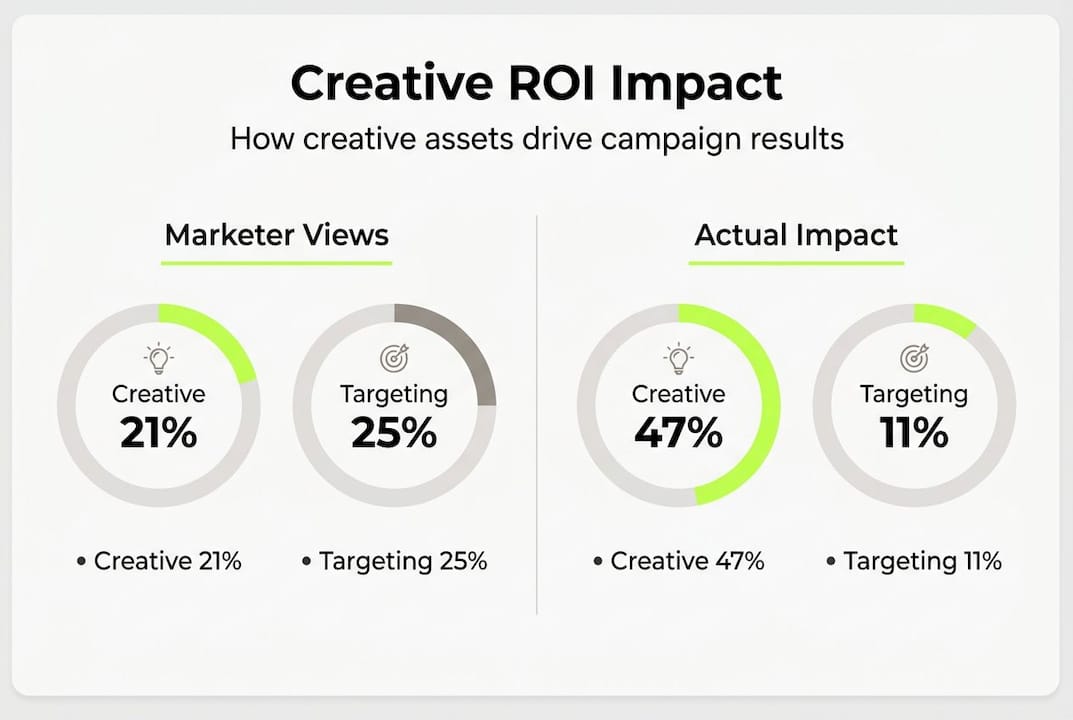
| Campaign factor | Marketer perception | Actual ROI contribution |
|---|---|---|
| Creative assets | 21% | 47% |
| Targeting | 25% | 11% |
| Reach | 22% | 14% |
| Brand | 15% | 15% |
The table above makes the case clearly. Creative is the single largest contributor to campaign ROI, yet it receives the least strategic investment from most SMB teams.
Why does this happen? A few reasons stand out. First, targeting is tangible. You can see audience settings, tweak demographics, and feel productive. Creative work feels subjective and harder to measure in isolation. Second, platforms like Google and Meta make targeting adjustments easy, so teams default to what is accessible. Third, many SMBs simply lack the creative production resources to iterate quickly.
Common pitfalls where SMBs fall short with creative assets include:
- Reusing the same visuals across campaigns without refreshing them
- Writing ad copy that focuses on features instead of audience pain points
- Ignoring format requirements for different placements (feed vs. stories vs. search)
- Skipping A/B testing on headlines and visuals altogether
- Failing to align creative with the specific stage of the buyer journey
Proper ad attribution for campaigns also plays a role here. Without clear attribution, it is hard to see how much creative quality is influencing your results versus other variables. Once you have visibility, the creative gap becomes undeniable. Explore creative examples for SMBs to see what high-performing assets actually look like in practice.
How creative assets shape campaign outcomes
Creative assets do not just influence clicks. They shape how audiences feel about your brand, whether they remember you, and ultimately whether they buy. The mechanisms are both psychological and practical.
Here is how strong creative directly improves campaign KPIs:
- Attention: Scroll-stopping visuals and bold headlines reduce cost-per-click by capturing attention before competitors do
- Emotional response: Ads that connect with audience emotions drive stronger engagement and sharing behavior
- Recall: Consistent visual identity and messaging improve brand recall, which compounds over time
- Conversion: Clear, benefit-driven copy paired with strong visuals moves people from interest to action faster
- Loyalty: Creative that reflects genuine audience values builds long-term brand affinity, not just one-off transactions
"Creative assets drive up to 56% of sales lift in digital campaigns, far exceeding other factors like targeting or reach."
Consider a real-world example. An SMB selling health supplements ran the same targeting setup with two different creative approaches. Version A used generic product photography and feature-focused copy. Version B used lifestyle imagery and copy addressing the audience's specific frustration with low energy. Version B generated 3x more conversions at the same ad spend. The audience was identical. The creative made the difference.
Pro Tip: Before launching any campaign, write down the single biggest pain point your audience faces. Every element of your creative, from the headline to the image to the call to action, should speak directly to that pain point. Misaligned creative is the fastest way to waste budget.
This is why personalizing ad campaigns consistently produces stronger returns. When creative speaks to a specific person's situation, it resonates. Generic creative, no matter how well-targeted, falls flat. Video and AR creatives take this further, generating up to 35% more engagement by creating immersive, memorable experiences that static ads simply cannot replicate.

Creative resonance also builds long-term loyalty. A customer who remembers your ad because it made them feel understood is far more likely to return, refer others, and engage with future campaigns. That compounding effect is where creative's true value lives.
Creative vs. targeting: What actually moves the needle?
Let us put this debate to rest with data. The rise of broad match targeting, smart campaigns, and AI-powered audience expansion on Google and Meta has fundamentally shifted the landscape. Platforms now handle much of the targeting work automatically. That shift places even more weight on creative quality as the primary differentiator.
Marketers allocate attention to targeting at 25% versus creative at 21%, but reality flips that completely. Creative delivers 47% of ROI. Targeting delivers 11%.
| Campaign lever | Marketer priority | Actual ROI impact |
|---|---|---|
| Creative assets | Low (21%) | High (47%) |
| Targeting | High (25%) | Low (11%) |
| Reach/media spend | Medium (22%) | Low (14%) |
Here is a quick audit to check if your creative is actually moving the needle:
- Pull your top five ads by spend and compare click-through rates. Low CTR usually signals a creative problem, not a targeting problem.
- Check your frequency metrics. If audiences are seeing the same creative repeatedly without converting, the creative needs refreshing.
- Review your landing page alignment. Does the creative promise match what the landing page delivers?
- Run a simple A/B test on your headline only. A single word change can shift conversion rates significantly.
- Compare performance across placements. If one placement underperforms, the creative format may not suit that context.
Pro Tip: Use broad targeting intentionally on Meta and let the algorithm find your buyers. Your job is to give it creative that converts. When the creative is strong, broad targeting often outperforms hyper-segmented audiences because the platform has more room to optimize.
Targeting still matters for budget efficiency and avoiding wasted impressions. But it is a floor, not a ceiling. Creative strategy in 2026 is where campaigns win or lose. Solid performance tracking helps you see which creative variables are driving results so you can double down on what works. Pair that with a structured creative ad strategy for SMBs and you have a system that compounds over time.
Elevating your campaign's creative: Best practices and action steps
Knowing creative matters is one thing. Building assets that actually perform is another. Here is a practical framework your team can follow.
Step-by-step creative development framework:
- Define the audience pain point first. Every great creative starts with a clear understanding of what your audience is struggling with. Skip this and everything else suffers.
- Write the message before designing the visual. Copy drives the concept. Design amplifies it. Reversing this order produces pretty ads that say nothing.
- Match format to placement. A square image for a feed ad, a vertical video for stories, a bold headline for search. Format mismatches kill performance.
- Test one variable at a time. Change the headline, the image, or the call to action, but not all three simultaneously. Clean tests produce actionable data.
- Refresh creative every four to six weeks. Ad fatigue is real. Even high-performing creative loses effectiveness over time.
Best practices to keep in mind:
- Lead with the benefit, not the feature
- Use real people and authentic imagery over stock photos when possible
- Keep copy concise. Most people scan, not read.
- Ensure brand consistency across all touchpoints
- Design for mobile first, always
Pro Tip: AI excels at CTR and volume optimization, but humans are better at creating emotional resonance and brand impact, especially for high-value purchases. Use AI tools to generate variations and test at scale, then apply human judgment to identify which concepts carry the emotional weight your brand needs. The combination beats either approach alone. Learn more about AI in marketing ROI and how smart tracking amplifies creative decisions.
For a deeper walkthrough, the step-by-step creative guide covers the full process from brief to launch, including how to structure creative reviews and build an asset library that scales.
A fresh perspective: Why creative assets are your campaign's strongest investment
Here is an honest take we share with every client: most campaigns do not fail because of bad targeting. They fail because the creative does not earn attention or trust.
Platforms have commoditized targeting. Google and Meta's algorithms are genuinely good at finding buyers. What they cannot do is make your ad worth stopping for. That is entirely on the creative.
SMBs actually have an edge here that large brands often lose. Authentic, audience-centric creative built by a team that genuinely understands the customer can outperform polished, high-budget production. Relatability converts. Big budgets do not guarantee big results when the message misses.
We have seen this repeatedly across campaigns in telehealth, retail, and wellness. The clients who invest in creative iteration, who test, learn, and refine their assets, consistently outperform those who chase targeting improvements. Browse winning creative examples to see what that looks like across real SMB campaigns.
Creative is not an expense. It is the engine. Everything else is infrastructure.
Drive ROI with expert creative and campaign support
If this guide has made one thing clear, it is that creative assets deserve the same strategic investment as any other campaign element. Probably more. At A&T Digital Agency, we build paid ad systems where creative and data work together from day one. Our team handles everything from concept to execution, testing, and optimization so your budget works harder.
Whether you are running Google Ads management campaigns or scaling with Meta Ads management, we bring the creative strategy and performance rigor that turns ad spend into measurable growth. No unnecessary meetings. Just campaigns that convert.
Frequently asked questions
What are creative assets in marketing campaigns?
Creative assets are the visual, audio, and text elements, like images, videos, headlines, and ad copy, that communicate your campaign message and brand identity to your target audience.
How much do creative assets impact campaign performance?
Creative assets drive up to 56% of sales lift in digital campaigns, making them the single largest performance driver, ahead of targeting and reach.
Is targeting or creative more important for ROI?
Creative outperforms targeting for ROI at 47% versus 11%, meaning marketers who over-invest in targeting at the expense of creative quality are leaving significant returns on the table.
How can SMBs improve their creative assets quickly?
Start with one focused change, refresh your hero visual, rewrite your headline around a specific audience pain point, or test a new call to action, and measure the impact before moving to the next improvement.
Does AI or human creativity work better in advertising?
AI excels at CTR and volume, but human creativity drives emotional connection and brand loyalty, especially in high-value campaigns where trust and resonance determine the buying decision.
Recommended
- Unlock campaign success with creative strategy in 2026
- Unlock campaign success with creative strategy in 2026
- Top campaign optimization tips for maximum ROI in 2026
- Creative Ad Campaigns: 35% More Engagement with Videos & AR
- Adobe Attribution 2026: Boost ROI Accuracy by 20% | Trackingplan
- Events in marketing automation: Unlock ROI in 2026