
Most Google Ads management fees fall into four models: percentage of spend, flat retainer, hybrid, and rare performance-based deals. Small and mid-sized businesses typically pay between $1,500 and $5,000 a month for professional management, on top of whatever they spend on the ads themselves. That last part trips people up constantly. The management fee and the ad budget are two separate checks.
TL;DR:
- Management fees for small to mid-sized accounts typically range from $1,500 to $5,000 per month, depending on spend level and pricing model.
- Higher ad spends usually shift fees toward hybrid or percentage-based models, with large accounts above $50,000 monthly often paying 8% to 15%.
- Additional costs like tracking setup, creative production, and tools can significantly increase overall investment beyond the management fee.
- The true cost includes management fees, human labor, and supporting tools, with total expenses ideally staying below 10% of the ad spend for small accounts.
- Selecting a provider should prioritize clear ownership of accounts, transparent reporting, and compatibility between your budget and the agency’s pricing approach.
Table of Contents
- How Does Google Ads Management Pricing Actually Work?
- What Fee Should You Expect at Your Ad Spend Level?
- What's Actually Included in a Google Ads Management Fee?
- How Do You Calculate Your True Google Ads Cost?
- How Do You Choose the Right Pricing Model and Vet a Provider?
- How Atdigiagency Approaches Pricing and Value
- Does Google Ads Management Pricing Vary by Region?
- Why Does Pricing Scale With Campaign Complexity?
- How Does Pricing Differ by Industry?
- Does Contract Length Change Your Google Ads Fee?
- The Real Cost Problem Isn't the Fee, It's What It Hides
- Ready to Get a Straightforward Pricing Conversation?
- Sources
How Does Google Ads Management Pricing Actually Work?
Every agency or freelancer you talk to will quote you using one of four structures, and understanding the incentive baked into each one tells you more than the number itself.
This is the most common model once budgets grow, and it's easy to see why agencies like it: as your spend goes up, so does their paycheck. The catch is obvious. On a $20,000 monthly budget, that corresponds to several thousand dollars in fees.
Flat retainers charge a fixed monthly amount regardless of spend, usually somewhere between $1,500 and $8,000 or more depending on scope. A flat fee removes the "bigger budget, bigger fee" incentive problem entirely, which is why it tends to show up on smaller and mid-sized accounts where predictability matters more than scale. On that same $20,000 budget, a $3,000 flat retainer provides predictable costs regardless of budget changes.
Hybrid models blend a smaller base fee with a reduced percentage cut, often used at mid-to-high spend levels where pure percentage pricing would feel excessive. It's a compromise that keeps some predictability while still rewarding the agency for managing bigger accounts.
Performance-based pricing ties fees to results, like cost per lead or a share of attributed revenue. It sounds appealing on paper but remains rare in practice, mostly because attribution disputes and cash-flow risk make it hard for either side to agree on clean terms.
Where you'll encounter each:
- Freelancers and solo consultants lean toward flat retainers, often at the lower end of the range.
- Boutique agencies mix flat and hybrid pricing depending on account complexity.
- Larger agencies default to percentage-of-spend once budgets clear roughly $50,000 a month.
The common pricing structures agencies use haven't shifted much in years, even as the tools managing campaigns have changed dramatically.
What Fee Should You Expect at Your Ad Spend Level?
Your monthly ad spend is the single biggest predictor of what you'll pay in management fees, and the relationship isn't linear. Smaller accounts often pay a higher percentage of spend because the fixed labor cost of running a campaign doesn't shrink just because the budget is modest.
| Ad Spend Tier | Monthly Ad Spend | Typical Management Fee | Common Pricing Model |
|---|---|---|---|
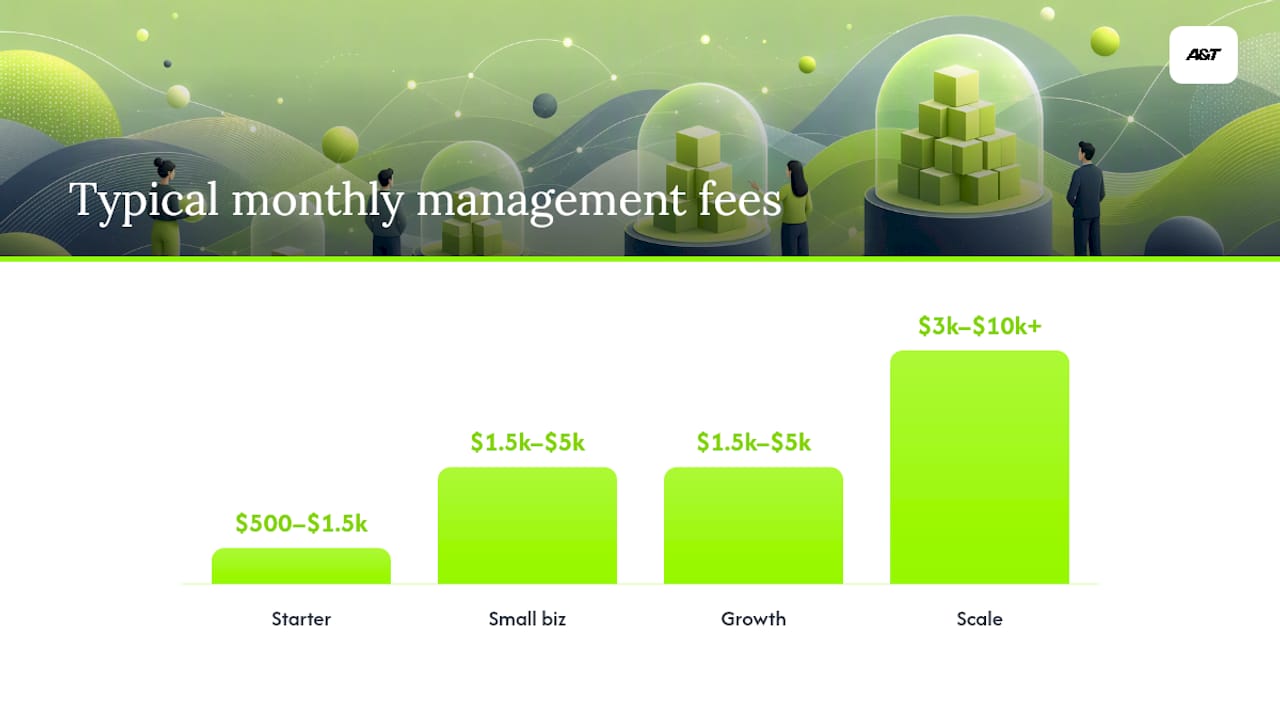
| Starter | Under $3,000 | $500 to $1,500 | Flat retainer or freelancer |
| Small business | $3,000 to $10,000 | $1,500 to $5,000 | Flat retainer |
| Growth | $10,000 to $30,000 | $1,500 to $5,000 | Flat or hybrid |
| Scale | $30,000 to $50,000 | $3,000 to $10,000+ | Hybrid or percentage |
| Enterprise | $50,000+ | Negotiated, often 8% to 15% | Percentage or custom |
At the starter tier, be skeptical of anything advertised under $500 a month. Sub-$500 offers frequently skip real tracking setup or creative testing, which means you're paying for account access, not actual strategy. A freelancer or a part-time consultant genuinely outperforms a mid-tier agency on cost-per-value below roughly $10,000 to $30,000 in monthly spend, since agency overhead doesn't pay for itself until budgets scale further. The economics of a full agency team typically start making sense north of $50,000 a month, where dedicated strategists and creative resources actually get put to work.
Most SMB engagements land in that $1,500 to $5,000 band, which lines up with what most businesses pay for management across the growth and early-scale tiers.
What's Actually Included in a Google Ads Management Fee?
A management fee should cover ongoing optimization: bid adjustments, keyword refinement, ad copy testing, negative keyword pruning, and regular reporting. Most reputable providers also include Performance Max campaign oversight, audience refinement, and monthly or biweekly strategy calls. That's the baseline. Anything beyond it tends to get billed separately, and this is where proposals get murky.
One-time setup charges show up most often around tracking infrastructure. Server-side Google Tag Manager implementations commonly run $5,000 to $25,000, Enhanced Conversions setup adds another $1,500 to $8,000, and building out a GA4-to-BigQuery pipeline can cost $3,000 to $15,000 depending on complexity. These are real, substantial one-time investments, not padding, since proper tracking is what makes the rest of the campaign optimization meaningful.
Ongoing extras tend to include creative production, landing page builds, and tool subscriptions for competitive research or reporting dashboards. Creative production at real scale can add $3,000 to $25,000 a month on its own, particularly for accounts running heavy video or dynamic creative testing.
Some agencies bundle all of this into one number upfront. Others present a lean management fee and let you discover the pass-throughs later. Ask for an itemized breakdown before signing anything, not after.
How Do You Calculate Your True Google Ads Cost?
Your real monthly investment has three components: the management fee, the human hours behind the account, and the tooling that supports it. Skip any one of them and you're not seeing the full picture.
The management fee plus human hours plus tooling framework breaks down roughly like this. Software-only tools run $0 to $249 a month. Human hours, when billed separately from a flat fee, run $200 to $2,250 a month depending on account complexity. Tooling for competitive research, reporting, or automation typically adds $50 to $500 or more.
Here's how that plays out at three spend levels:
That high percentage is normal at this tier because labor costs don't scale down.
The working benchmark: keep total costs under roughly 10% of spend for small accounts and under 5% once you clear $30,000 a month. If your total is creeping past that, you're either overpaying or under-optimized. Both are worth a hard conversation with your provider.
How Do You Choose the Right Pricing Model and Vet a Provider?
Picking the right model comes down to spend level and risk tolerance, but vetting the actual provider matters more than the pricing structure itself. A fair flat fee from a sloppy agency still wastes money.
- Match the model to your spend. Under $10,000 a month, a skilled freelancer or hybrid arrangement often beats a full agency on value. Between $10,000 and $50,000, a hybrid model or flat retainer with guaranteed hours balances predictability with proper resourcing. Above $50,000, percentage-of-spend from an established agency usually makes financial sense.
- Demand account ownership. You, not the agency, should own the Google Ads account, the Google Tag Manager container, and the analytics property. If they insist on managing everything through their own MCC with no transfer option, that's a red flag, not a convenience.
- Require a 30-day exit clause. Long-term lock-in with no easy out signals the agency expects you to leave once you see the results.
- Ask specific vetting questions. How many accounts does each strategist manage? What's their approach to Performance Max campaigns? Can they show real creative work, not just a slide deck?
- Watch for vague reporting. If a proposal can't tell you exactly what's included in the fee versus what gets billed as an extra, assume the extras will surprise you later.
Pro Tip: Before you sign anything, ask to see a sample monthly report from an existing client account. If it's a wall of impressions and clicks with no cost-per-acquisition trend line, that agency is optimizing for busywork, not results.
Reviewing independent listings, like a Better Business Bureau profile, can also surface complaint patterns before you sign a contract.
How Atdigiagency Approaches Pricing and Value
Atdigiagency structures retainers around what an account actually needs, not a one-size percentage. That typically means a base strategy and optimization layer, creative support for ad testing, and full tracking setup handled properly from day one rather than bolted on after launch. Clients keep ownership of their accounts and tracking infrastructure throughout.
Case work across telehealth, entertainment venues, health and wellness, and retail brands shows the same pattern: results come from disciplined testing and clean tracking, not from chasing the lowest possible fee. Onboarding starts with a strategy audit before any budget moves, and reporting runs on a consistent cadence, so clients observe performance trends rather than disconnected metrics. Details on scope and current retainer options live on the Google Ads management service page.
Does Google Ads Management Pricing Vary by Region?
Broadly, yes, though the differences trace back to labor costs and market maturity rather than the platform itself, since Google Ads runs on the same auction system everywhere. Agencies based in higher-cost metro markets in the United States tend to quote toward the upper half of the $1,500 to $5,000 SMB range, while agencies in lower-cost regions or those operating remotely can often price toward the lower half for comparable work.
Internationally, markets with more mature paid-search competition, like the US, UK, and Australia, tend to see agencies charge closer to the percentage-of-spend model, since larger average budgets make that structure more common. Markets where digital ad spend is newer or smaller on average lean more heavily on flat retainers, simply because fewer accounts hit the spend levels where percentage pricing becomes standard.
None of this means you should chase the cheapest region on a map. A remote or offshore-priced provider can absolutely deliver strong results, but the platform basics and the tracking discipline behind a campaign matter far more than where the account manager happens to sit. Price by region as a starting expectation, then evaluate the actual work.
Why Does Pricing Scale With Campaign Complexity?
Fees rise with the number of campaigns and their complexity for a simple reason: each campaign type demands different setup, monitoring, and testing rhythms. A single Search campaign targeting one product line takes a fraction of the hours that a full account running Search, Shopping, Performance Max, and Display simultaneously requires.
Multi-campaign accounts also multiply the reporting burden. An agency managing five campaigns across three match types and two conversion goals needs to track performance separately for each segment, not just roll everything into one blended number. That's real labor, and it shows up in the fee whether it's billed as a flat rate or a percentage.
Geographic and audience segmentation add another layer. A business running separate campaigns for five regions, or testing multiple audience segments against different offers, is effectively running several smaller accounts under one roof. Expect fees to track closer to the higher end of your spend tier's range if your account structure looks like this, even if total ad spend stays modest.
This is also where hybrid pricing tends to earn its keep. A flat base fee covers baseline account management, while a smaller percentage layer absorbs the added complexity of running more campaigns without requiring a full renegotiation every time you launch a new product line.
How Does Pricing Differ by Industry?
Industry shapes pricing more than most business owners expect, mainly because it changes how much creative and tracking work goes into the account before a single dollar gets spent efficiently.
Telehealth and healthcare accounts often carry higher setup costs because tracking has to account for stricter compliance around conversion data and patient information, pushing setup fees toward the higher end of the Enhanced Conversions and GA4 ranges. Entertainment and ticketing businesses, by contrast, tend to run high-volume, fast-turnaround campaigns tied to specific event dates, which favors agencies comfortable with rapid creative iteration rather than slow-and-steady optimization.
Retail and e-commerce accounts, including consumer products, usually lean on Shopping campaigns and Performance Max, which shifts more of the fee toward creative production and feed management rather than manual bid strategy. A retail account selling a niche product might pay less in pure management fees but more in ongoing creative and feed-optimization costs than a B2B service business running straightforward lead-generation Search campaigns.
Health and wellness brands often sit in between: moderate creative needs, moderate tracking complexity, and campaigns that benefit from consistent testing cycles rather than one-off pushes. None of these patterns change the core pricing models available to a business, but they do shift where the money goes within whatever fee structure you choose.
Does Contract Length Change Your Google Ads Fee?
Longer commitments often come with modest fee discounts, but the bigger impact is on scope and priority, not just price. An agency signing a 12-month contract can justify investing more setup time upfront, since they know they have runway to recoup that investment through better long-term performance.
That premium covers the agency's own risk. Without a longer commitment, they're less likely to front-load strategic work that only pays off months later.
That said, discounts for long-term contracts should never come at the cost of an exit clause. A 12-month contract with a 30-day out clause built in gives you the pricing benefit of commitment without the risk of being stuck if the relationship isn't working. Be wary of any provider offering a steep discount in exchange for a long-term contract with no early-termination option. That's a pricing structure built around their retention, not your results.
The Real Cost Problem Isn't the Fee, It's What It Hides
Most of the conventional advice on Google Ads pricing focuses on finding the "right" percentage or flat fee, as if the number itself were the whole story. It isn't. Tracking quality does more to determine your actual return than a two or three percentage-point difference in management fees ever will.
The instinct to shop for the lowest fee also misses how AI-assisted tools are changing the baseline. Automated platforms can lower headline management costs, but they still need human oversight and real creative input to perform at an enterprise level. Cheap and automated isn't the same as cheap and effective.
If there's one thing to prioritize first, it's this: ask any provider how they handle tracking and creative testing before you ask about their fee structure. The pricing model matters. The discipline behind the number matters more.
— Ann
Ready to Get a Straightforward Pricing Conversation?
Atdigiagency prices retainers around the actual work an account needs, not a vague industry average, so you know exactly what your fee covers before you sign anything. That means no surprise pass-throughs for tracking setup, no vague "optimization" line items, and no long-term lock-in without an exit clause built in. If you're comparing quotes and want a proposal that spells out strategy, creative support, and tracking setup in plain terms, request a rundown of current retainer options on the Google Ads management service page. Businesses running paid campaigns across both channels can also review combined budgeting on the Meta ads management page. Book a discovery call and get a fee structure built around your actual spend, not a one-size number pulled from a rate card.
Sources
- Google Ads Management Pricing In 2026: What Every Agency, AI Tool, And Autonomous Service Actually Charges
- How Much Does Google Ads Management Cost in 2026? — Ritner Digital