
Advertising is allowed under HIPAA. What is not allowed is disclosing protected health information for marketing purposes without valid authorization, and that single distinction is where most healthcare marketers get tripped up. Run compliant campaigns by auditing your data flows, cutting pixels that fire on health-specific pages, routing conversion data through server-side pipelines, and signing business associate agreements with any vendor that touches identifiable data. Everything below breaks down how to actually build that system.
TL;DR:
- Tracking visitors who interact with health-specific pages or share IP addresses linked to health portals risk creating protected health information without proper authorization.
- Vendors handling identifiable patient data require signed business associate agreements, and platforms like Google and Meta typically will not sign BAAs for advertising purposes, necessitating data de-identification.
- Moving conversion tracking server-side ensures only sanitized, minimal data like click IDs and hashed signals are sent to ad platforms, reducing HIPAA exposure.
- Conducting thorough audits of all data flows and restrictively vetting third-party scripts are essential steps to prevent unintentional PHI leaks before campaign launches.
- Breach of PHI into ad platforms triggers legal obligations for immediate action, documentation, and possible regulatory notification, emphasizing the importance of quick response and system safeguards.
Table of Contents
- What Counts as HIPAA Compliant Advertising Marketing (And What Doesn't)
- When Tracking Pixels Turn Website Visitors Into PHI
- Business Associate Agreements: Who Needs One and What It Must Cover
- Building Privacy Compliant Ads: Server-Side Tracking and Safe Payloads
- Auditing Your Data Flows Before You Launch Another Campaign
- What Happens If PHI Leaks Into an Ad Platform
- A&T Digital's Perspective: How We Implement HIPAA-Aware Ad Programs
- The Gap Between Compliance Theory and What Actually Gets Fixed
- How Atdigiagency Builds Compliant Campaigns Without Slowing You Down
- Where to Verify These Rules Directly
- Sources
What Counts as HIPAA Compliant Advertising Marketing (And What Doesn't)
The Privacy Rule defines marketing as a communication that encourages someone to purchase or use a product or service. Under this definition, most promotional healthcare advertising requires the patient's written authorization before you can use or disclose their protected health information to create or target it. That single requirement is the backbone of every HIPAA marketing rule you'll encounter, and HHS spells out the standard directly.
A few scenarios push a campaign squarely into "marketing" territory:
- Selling or renting a patient list to a third party, even a well-meaning research partner.
- Sending condition-based outreach, like targeting an ad to everyone who searched for or clicked on a diabetes-related page on your site.
- Any arrangement where a covered entity receives payment from a third party in exchange for making a communication about that third party's product.
Not every patient-facing message triggers authorization, though. HHS carves out several exceptions that healthcare marketers rely on constantly:
- Communications that describe the health-related services the covered entity itself provides, including newsletters about new locations or providers.
- Care coordination and case management communications, even when they mention alternative treatments or providers.
- Face-to-face communications between a provider and a patient, such as a doctor recommending a specific specialist during a visit.
- Promotional gifts of nominal value, like a branded item handed out at a health fair.
The practical upshot: a general awareness campaign for your clinic ("We're open, we take new patients, here's our specialty list") sits comfortably in exception territory. A campaign that says "You searched for anxiety treatment, here's our program" does not, because it implies knowledge of someone's health status and uses that knowledge to encourage a purchase decision. That's the line advertising for medical practices constantly has to walk.
When Tracking Pixels Turn Website Visitors Into PHI
Here's the part most marketing teams miss entirely: your Meta Pixel or Google Ads tag doesn't need to capture a diagnosis to create a HIPAA problem. If it links an identifiable person to their interaction with your healthcare website, that data can become protected health information the moment it's collected, regardless of intent.
HHS's 2022 online tracking bulletin names the specific signals that qualify:
- IP addresses tied to a visit on a patient portal or symptom-checker page.
- Device identifiers collected through mobile SDKs or browser fingerprinting.
- Appointment dates or scheduling details captured in URL parameters.
- Geolocation data pulled from a visitor's browser or device.
- Any other individually identifiable health information connected to that interaction.
This applies even to anonymous site visitors who have never become patients. Someone browsing your urgent care locator page or reading about a specific condition on your blog is generating individually identifiable health information the moment a third-party tracker captures their IP address alongside that page context, according to HHS's own guidance.
Here's the number that should worry you: none of this is fixed by a cookie banner. HHS explicitly states that accepting a privacy policy or clicking "agree" on a consent pop-up does not satisfy HIPAA's authorization requirement, since that authorization has to be a specific, written document tied to the actual disclosure. A generic GDPR-style banner and HIPAA compliant tracking are two completely different legal standards, and treating them as interchangeable is one of the most common (and expensive) mistakes in healthcare advertising compliance.
Pages that create real exposure include appointment schedulers, symptom checkers, patient portals, condition-specific landing pages, and any URL where a query parameter reveals what a visitor was searching for or booking.
Business Associate Agreements: Who Needs One and What It Must Cover
Any vendor that receives, transmits, or processes protected health information on your behalf is a business associate under HIPAA, whether or not their marketing materials use that language. That includes plenty of analytics and measurement vendors that healthcare marketers assume are just "tech tools."
- Identify who actually qualifies. If a CRM, tag manager, heat-mapping tool, or ad platform integration touches identifiable data connected to a health interaction, that vendor is a business associate and needs a signed BAA before any data flows to them.
- Build the BAA around the actual data flow, not a template. A proper agreement for a tracking or analytics vendor should specify exactly what data categories are permitted, require the vendor to implement safeguards matching the Security Rule, and obligate them to report any breach without delay.
- Confirm the vendor will actually sign. Major ad platforms generally will not sign BAAs for their advertising products, which is a critical fact for anyone shopping the best HIPAA compliant CRM or tag management setup: the architecture has to guarantee those platforms never receive PHI in the first place, since a signature isn't coming.
- Have a fallback ready when a vendor refuses. Route data through a BAA-capable intermediary (a compliant CDP sits between your systems and the ad platform), strip identifiers down to Safe Harbor standards before forwarding anything, or simply block that data flow entirely until a compliant path exists.
If a vendor doesn't sign and you can't de-identify the data adequately, disclosing PHI to them anyway is treated as an impermissible disclosure that can trigger breach-notification obligations on its own.
Building Privacy Compliant Ads: Server-Side Tracking and Safe Payloads
The single highest-leverage fix for most healthcare advertisers is moving conversion logic off the browser entirely. Client-side pixels fire whatever the browser sees, including URL parameters, form field values, and page context, and they send it straight to the ad platform with no filter in between. Server-side tagging inserts your own controlled environment between the website and the ad platform, so you decide exactly which fields leave your system.
That's how HIPAA safe conversion tracking actually works in practice. Instead of letting Meta's Pixel or Google's tag capture everything on a confirmation page, the event gets sent first to your own server, gets sanitized there, and only a stripped-down version reaches the ad platform.
The three major offline conversion channels all support this pattern, but only if you configure them correctly:
- Google Ads offline conversion import should receive a GCLID and a conversion value, never a form field, diagnosis code, or appointment reason.
- Meta Conversions API should be fed hashed, minimal identity signals paired with a conversion event, not raw health-context data from a lead form.
- Microsoft offline conversions follow the same principle: match on a click ID, not on anything that reveals what the person was seeking care for.
Hashing an email address before sending it is a good practice, but don't mistake it for legal de-identification. HIPAA's Safe Harbor method requires removing or addressing all 18 specific identifiers, and hashing one or two fields client-side doesn't clear that bar on its own, a distinction that trips up teams who assume "encrypted" and "de-identified" mean the same thing.
Pro Tip: Store click IDs like GCLID and fbclid completely separate from any record that contains PHI. Match conversions server-side using only the click ID, and never let a health context field ride alongside it in the same database row.
A quick do/don't checklist for your implementation team:
- Do name events generically ("form_submit," "appointment_scheduled") rather than "diabetes_consult_booked."
- Don't pass diagnosis-related keywords, symptoms, or treatment types in URL parameters.
- Do strip email, phone, and name fields from any payload unless they're hashed and paired with a compliant BAA.
- Don't place pixels directly on scheduling confirmation pages, portal logins, or symptom-checker results without a sanitization layer in front of them.
Auditing Your Data Flows Before You Launch Another Campaign
Most healthcare marketing teams inherited their tracking setup rather than designed it, which means the audit usually turns up more leaks than anyone expected.
- Map every data flow first. Walk through every form, authentication page, URL structure, and third-party script on your site, and document exactly what data each one captures and where it sends it.
- Prioritize fixes by exposure. Appointment schedulers and symptom checkers carry the highest risk since they connect identity directly to a health interaction; fix those before touching a general blog page.
- Remove or restrict trackers using an allow-list. Rather than trying to audit every script after the fact, flip the model: only approved, vetted tags are permitted to fire on any page that touches patient data, and everything else is blocked by default.
- Shift to aggregated measurement where individual tracking isn't necessary. Marketing mix modeling, geo-holdout tests, and platform incrementality studies measure campaign-level impact without ever touching user-level PHI, and they're often a better read on true incremental lift anyway.
This operational cleanup, according to legal commentary following the 2022 bulletin, tends to be the fastest and highest-impact work most healthcare sites can do, well ahead of any platform-specific configuration project. Reviewing remarketing practices for healthcare patients is a good place to start, since retargeting lists are frequently where the riskiest data ends up concentrated.
What Happens If PHI Leaks Into an Ad Platform
OCR has made clear that tracking-related disclosures fall within its enforcement scope, and legal analysts have flagged rising litigation risk for organizations that used trackers without adequate BAAs or de-identification steps in place. This isn't a theoretical enforcement category anymore.
Breach notification obligations kick in when a disclosure of unsecured PHI likely compromises the security or privacy of that information. That triggers a documented risk assessment, not an automatic notification in every case, but the assessment itself has to happen and has to be recorded.
If you discover PHI has leaked into an ad platform, move through this immediately:
- Stop the leak first: disable the pixel, tag, or script responsible before doing anything else.
- Document exactly what data was exposed, for how long, and to which vendor or platform.
- Loop in legal counsel before making any public or regulatory statement.
- Notify OCR and affected individuals if the risk assessment concludes notification is required.
Speed matters here. The longer a leaky tag stays live, the larger the affected population and the harder the remediation story becomes.
A&T Digital's Perspective: How We Implement HIPAA-Aware Ad Programs
When we build ad programs for healthcare and telehealth clients, the pattern is consistent: server-side tagging first, a signed BAA with any intermediary vendor second, and a documented data-flow audit before a single dollar of media spend goes live. That order matters, because skipping the audit means you're optimizing a system you don't fully understand yet.
We typically take over the technical implementation when a client's existing stack has no server-side layer at all. When a client already has engineering resources, we advise on architecture and vendor selection instead and let their team execute.
The Gap Between Compliance Theory and What Actually Gets Fixed
Most HIPAA marketing rules content treats compliance as a legal checklist, something the legal or compliance department signs off on once and files away. That framing misses where the actual risk lives. The riskiest exposure sits in engineering decisions made by whoever configured your tag manager two years ago, not in a policy document.
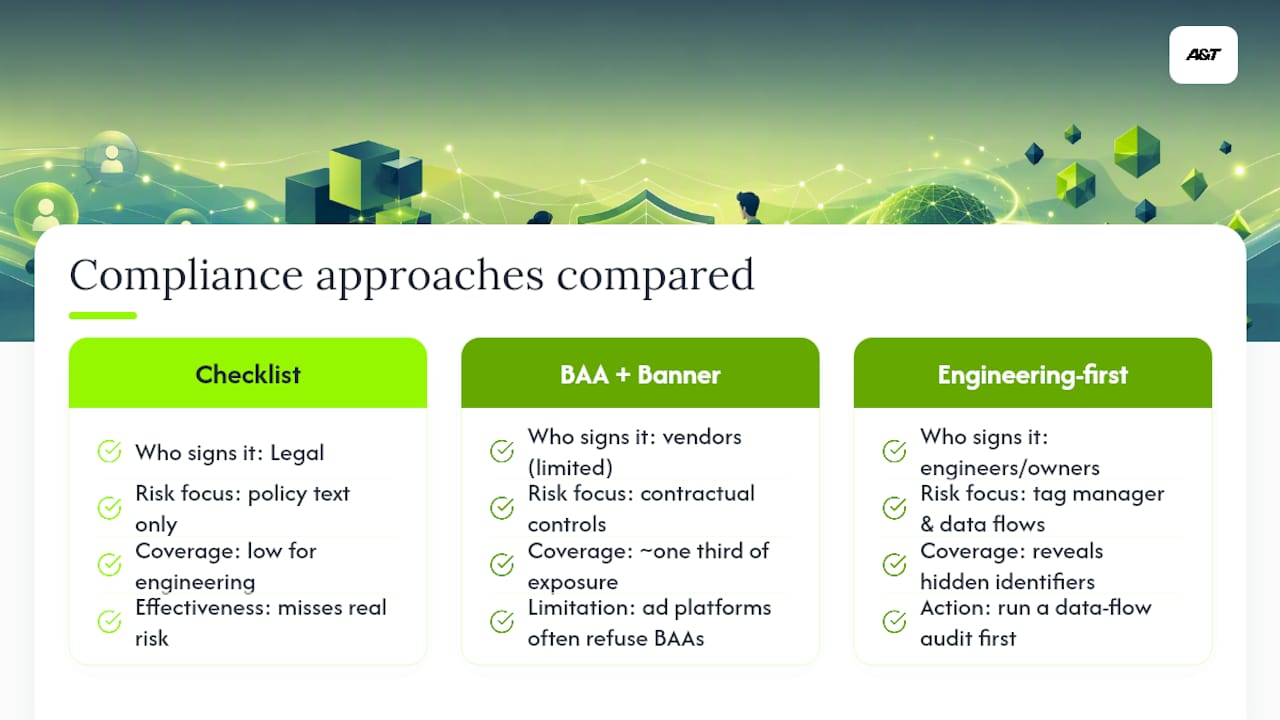
The conventional advice, get a BAA and add a cookie banner, addresses maybe a third of the real exposure. It ignores the fact that most ad platforms won't sign BAAs for advertising products in the first place, which means the entire compliance burden shifts to your own architecture. A cookie banner has never been a HIPAA authorization and never will be.
If you're prioritizing one thing this quarter, make it the data-flow audit. You cannot fix what you haven't mapped, and most teams are surprised by how much identifiable data their "harmless" analytics stack has been quietly forwarding. Compliance work that starts with engineering, not policy, is the work that actually holds up under scrutiny.
— Ann
How Atdigiagency Builds Compliant Campaigns Without Slowing You Down
Atdigiagency is the direct alternative to hiring a compliance consultant and a media buyer separately, because we handle the data-flow audit, the server-side conversion pipeline, and the campaign launch as one connected engagement instead of three disconnected vendors. That matters for healthcare and telehealth clients specifically: we've built Google Ads campaigns and Meta Ads programs where the tracking architecture was designed around HIPAA constraints from day one, not patched afterward.
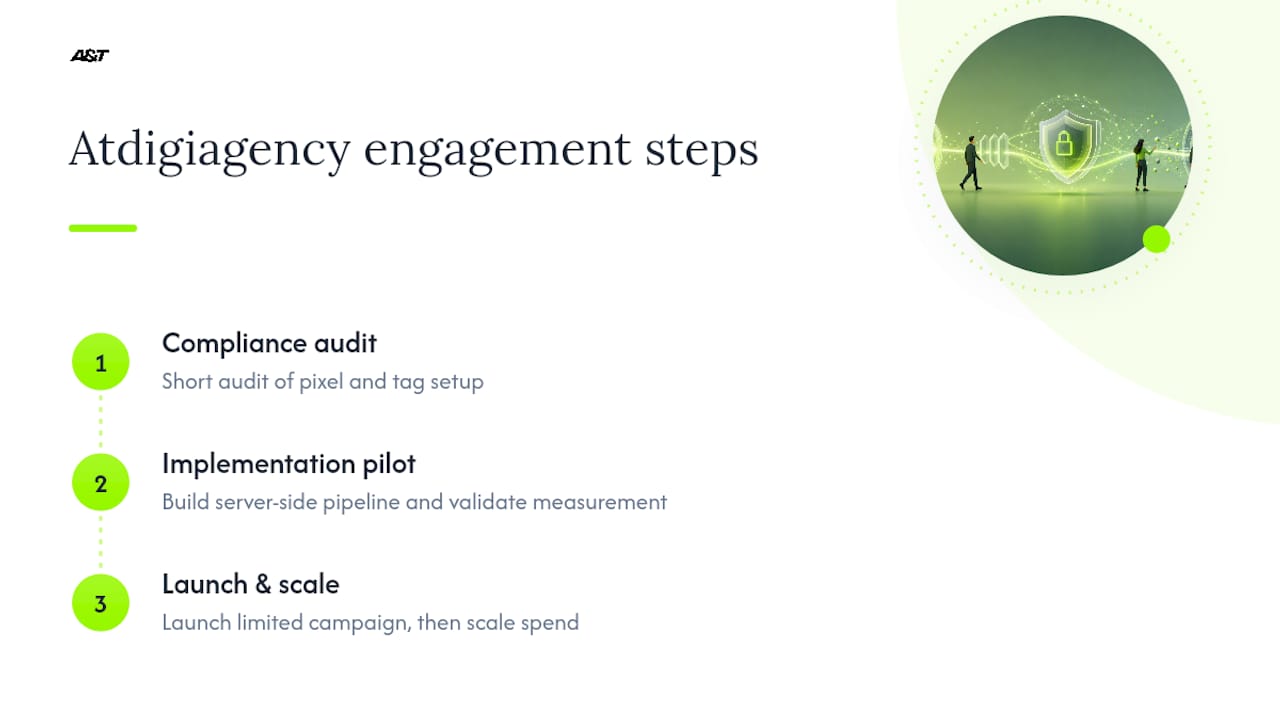
The typical starting engagement looks like a short compliance audit of your current pixel and tag setup, followed by an implementation pilot where we build the server-side pipeline and launch a limited campaign to validate the measurement before scaling spend. If your team wants a full picture of what we handle, our services overview covers the range. Reach out to get your current tracking setup reviewed before your next campaign goes live.
Where to Verify These Rules Directly
The two documents worth bookmarking are HHS's marketing FAQ and its online tracking technology bulletin, both of which set the legal baseline everything in this article builds on. For implementation detail, a technical guide to conversion tracking setup across Google, Meta, and Microsoft and a broader analytics ROI perspective from marketing partners round out the practical side.
This article is general information, not a substitute for advice from a qualified lawyer. Consult a qualified legal professional about your own circumstances before acting on anything here.
Sources
- Hhs
- HHS Publishes Guidance on Using Online Tracking Technologies Under HIPAA | Davis Wright Tremaine
- HIPAA-Compliant Healthcare Advertising: How to Run Compliant Campaigns