
TL;DR:
- Most SMBs waste budgets due to lack of proper conversion tracking and attribution.
- Implementing measurable marketing connects ad spend directly to revenue and growth.
- Using tools like conversion lift tests and multi-touch attribution improves campaign ROI significantly.
Most small business owners assume that spending on digital ads means results will follow. They don't. Most SMBs invest in digital ads without knowing whether those ads drive actual revenue. That gap between spend and outcome is where budgets go to waste. Measurable marketing closes that gap. It replaces guesswork with data, and vanity metrics with real business outcomes. In this article, we'll walk you through what measurable marketing actually means, how to set it up on Google Ads and Meta, and how to use those insights to grow revenue with confidence.
Table of Contents
- The foundation of measurable marketing
- Setting up actionable measurement for Google and Meta campaigns
- Interpreting metrics and optimizing for revenue growth
- Case studies: Real-world examples of measurable marketing in action
- Why most SMBs miss out on measurable marketing's real impact
- Unlock measurable marketing growth with expert partners
- Frequently asked questions
Key Takeaways
| Point | Details |
|---|---|
| Measurable marketing defined | It means linking every marketing dollar to clear, actionable results using platform analytics and conversion tracking. |
| Setup for Google & Meta | Structured measurement and conversion lift tests are now accessible and essential for SMB success. |
| Fuel revenue growth | By triangulating data sources, you can confidently shift budgets toward what's working. |
| Case studies prove impact | Real SMBs demonstrate how measurable marketing led to tangible ROI gains. |
| Expert support helps | Partnering with specialist agencies accelerates measurable marketing adoption and outcomes. |
The foundation of measurable marketing
Measurable marketing is not just about tracking clicks. It's about connecting every dollar you spend to a business result you actually care about, whether that's a sale, a lead, or a booked appointment. Traditional marketing often stops at reach or impressions. Measurable marketing goes further.
Measuring marketing effectiveness requires connecting platform metrics with business outcomes, not just reporting on what the dashboard shows. That distinction matters more than most people realize.
Here's how traditional and measurable marketing compare:
| Factor | Traditional marketing | Measurable marketing |
|---|---|---|
| Success metric | Impressions, reach | Revenue, ROAS, CPA |
| Attribution | Last click or none | Multi-touch attribution |
| Optimization | Gut feeling | Data-driven decisions |
| Reporting | Platform dashboards | Cross-channel triangulation |
| Budget control | Fixed spend | Dynamic, performance-based |
Most SMBs are running campaigns without the data connections that make optimization possible. They see clicks in Google Ads, likes on Meta, and assume things are working. But without conversion tracking, attribution modeling, and cross-platform data, you're flying blind.
The core principles of measurable marketing come down to three things:
- KPIs that connect to revenue: Not just traffic, but Conversion Value, ROAS, and CPA
- Attribution modeling: Understanding which touchpoints actually drove the sale
- Conversion tracking: Verified, accurate data flowing from your ads into your analytics
Tracking ad performance metrics properly is the starting point. From there, optimizing campaign analytics becomes a repeatable process rather than a one-time exercise. The right performance marketing tools make this scalable even for lean teams.
"Start with platform metrics, then layer in multi-touch attribution and Conversion Lift testing to get a complete picture of what's actually driving growth."
This is the mindset shift that separates businesses that scale from those that stall.
Setting up actionable measurement for Google and Meta campaigns
Understanding the principles is only half the battle. Let's break down the practical steps you need to take to make your Google and Meta campaigns truly measurable.
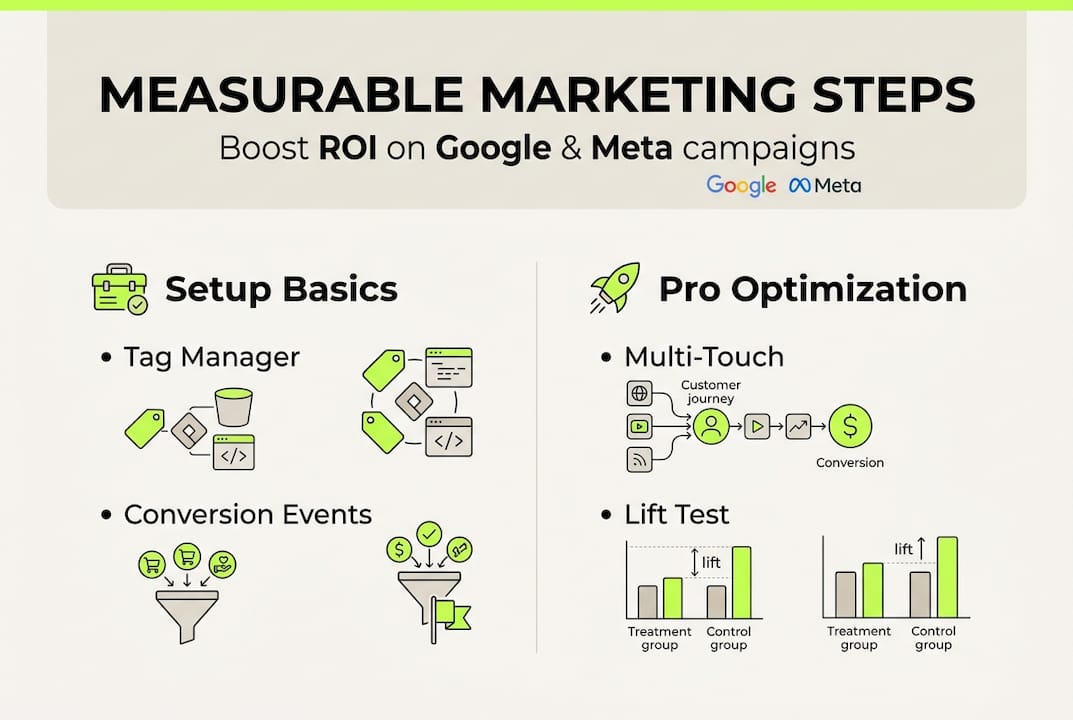
Step 1: Install and verify conversion tracking Set up Google Tag Manager and connect it to both Google Ads and GA4. On Meta, install the Meta Pixel and configure standard events like Purchase, Lead, and Add to Cart.
Step 2: Define your conversion events Not every click matters equally. Identify the actions that represent real business value and track only those as primary conversions.
Step 3: Connect GA4 to your ad platforms Link GA4 to Google Ads and import conversion events. This gives you cross-channel visibility and a single source of truth.
Step 4: Enable Multi-Touch Attribution (MTA) MTA assigns credit across multiple touchpoints in the buyer journey. Instead of crediting only the last click, it shows you which channels and ads contributed to the conversion.
Step 5: Run Conversion Lift tests Google Ads and Meta now offer conversion lift and advanced attribution tools built for SMBs. Conversion Lift tests compare exposed audiences to control groups, revealing the true incremental impact of your ads.

Pro Tip: Don't rely on click-through rates alone to judge campaign performance. Run a Conversion Lift test after at least two weeks of active spend to see how many conversions your ads actually caused, not just correlated with.
76% of SMBs report better ROI after implementing structured measurement frameworks. That number reflects a simple truth: you can't improve what you don't measure accurately.
Avoid these common pitfalls:
- Tracking form views instead of form submissions
- Double-counting conversions across platforms
- Ignoring view-through conversions on Meta
- Skipping attribution window alignment between platforms
For boosting marketing ROI, the setup phase is where most of the leverage lives. Getting advertising analytics tips from experienced practitioners can save you months of trial and error.
Interpreting metrics and optimizing for revenue growth
Now that your measurement is set up, let's dive into the numbers and learn how to turn data into actionable insights for revenue growth.
Four metrics deserve your full attention:
| Metric | What it measures | What to do with it |
|---|---|---|
| CTR (Click-Through Rate) | Ad relevance and creative appeal | Low CTR signals weak creative or poor targeting |
| CPA (Cost Per Acquisition) | Efficiency of spend per conversion | High CPA means reallocate budget or refine audience |
| Conversion Value | Revenue generated from ad clicks | The closest metric to actual business impact |
| ROAS (Return on Ad Spend) | Revenue per dollar spent | Your primary scaling signal |
Here's what smart optimization actually looks like in practice:
- Pause underperforming ad sets where CPA exceeds your target by more than 30%
- Scale winning creatives that show strong ROAS across both Google and Meta
- Shift budget toward high-intent keywords in Google Ads when Conversion Value climbs
- Test new audience segments on Meta only after establishing a baseline ROAS
- Review attribution windows to ensure you're not cutting campaigns that convert slowly
Triangulate platform data, GA4 MTA, and conversion lift tests to pinpoint which budget shifts drive real revenue. This approach removes the guesswork that kills otherwise promising campaigns.
Pro Tip: Never adjust daily budgets based on a single day of data. Wait for multi-touch validation across at least seven days before making significant spend changes. Reacting too fast is one of the most expensive mistakes SMBs make.
Revenue growth is the north star. Not impressions. Not clicks. Not even conversions in isolation. When you anchor every decision to Conversion Value and ROAS, your optimization choices become clearer and more defensible.
Explore multi-channel growth case studies and US business marketing ROI benchmarks to contextualize your own numbers against what's working in the market right now.
Case studies: Real-world examples of measurable marketing in action
Theory is important, but nothing beats seeing how these concepts play out in the real world. Here are actual case studies that demonstrate measurable marketing in action.
Telehealth provider: A telehealth brand running Google Ads had strong click volume but couldn't explain why patient bookings weren't growing. After implementing proper conversion tracking and MTA, they discovered that 60% of their ad spend was going to keywords that drove clicks but zero bookings. Reallocating that budget to high-intent terms doubled their monthly appointments without increasing total spend.
Health and wellness retailer: A supplement brand selling on Meta was reporting strong ROAS inside the Meta dashboard. But when they ran a Conversion Lift test, they found that nearly 40% of those attributed conversions would have happened without the ads. They restructured their audience targeting and reduced wasted impressions by 35%.
Entertainment venue: A local venue running both Google and Meta campaigns had no cross-channel visibility. After linking GA4 to both platforms and enabling MTA, they saw that Meta was driving awareness while Google was closing the sale. They adjusted their messaging strategy by platform and saw a 22% increase in ticket revenue within 90 days.
Common threads across every success story:
- Conversion tracking was verified and accurate before optimization began
- Conversion Lift tests revealed the true incremental value of each channel
- Attribution clarity led to smarter budget allocation, not just more spend
- Revenue metrics replaced surface-level engagement metrics as the primary KPI
SMBs using conversion lift saw up to 30% greater ROI compared to standard metrics alone. That's not a marginal gain. That's the difference between a campaign that breaks even and one that funds your next growth phase.
"The businesses that win aren't always spending more. They're measuring better, and making smarter decisions with every dollar."
Review digital ad campaign examples and learn how to launch Google Ads for growth with measurement built in from day one.
Why most SMBs miss out on measurable marketing's real impact
After seeing real campaign stories, here's our unfiltered perspective on why many SMBs fail to maximize measurable marketing, and what to do differently.
Most SMBs treat measurement as an afterthought. They launch campaigns, check the platform dashboard weekly, and call it done. That's not measurement. That's monitoring. And monitoring alone doesn't move revenue.
The uncomfortable truth is that surface metrics feel reassuring. High impressions, decent CTR, a few conversions. It looks like progress. But without triangulation across GA4, MTA, and Conversion Lift, you're seeing a partial picture and making full-budget decisions based on it.
We've seen businesses leave significant revenue on the table because they were optimizing for the wrong signals. Clicks aren't customers. Impressions aren't income. The businesses that compound growth year over year are the ones that demand accountability from every dollar spent.
Don't settle for the basics. Explore proven performance tactics and build a measurement framework that connects your ad spend directly to business outcomes. That's where the real gains live.
Unlock measurable marketing growth with expert partners
Ready to make your campaigns truly measurable? Here's how expert support can help.
At A&T Digital Agency, we build paid ad systems that are accountable from day one. Every campaign we run on Google Ads management or Meta ads management includes conversion tracking, attribution setup, and ongoing optimization tied to revenue metrics. We don't report on impressions and call it a win. We track what moves your business forward.
If you're an SMB ready to stop guessing and start growing, explore what AT Digi Agency services can do for your campaigns. No unnecessary meetings. Just measurable results.
Frequently asked questions
What makes marketing measurable for SMBs?
Measurable marketing ties campaign data directly to business outcomes using analytics, attribution, and conversion tracking, so every spend decision is backed by evidence rather than assumption.
Why use Conversion Lift tests for Google and Meta?
Conversion Lift tests measure the incremental impact of your ads on actual revenue, not just clicks or impressions, giving you a far more accurate picture of what's working.
How do I triangulate data for better ROI decisions?
Combine platform metrics, GA4 multi-touch attribution, and conversion lift results to identify which specific budget shifts are driving real revenue growth across your campaigns.
What are the most important metrics to track?
Focus on Conversion Value, ROAS, CPA, and multi-touch attribution data, since these connect directly to revenue rather than surface-level engagement signals.
Can measurable marketing work for small budgets?
Yes. SMB-accessible tools like Conversion Lift and GA4 MTA make rigorous measurement possible even with limited spend, and the ROI gains often justify the setup investment quickly.