
TL;DR:
- Campaign automation encompasses budgeting, asset creation, multi-channel execution, sales coordination, and ROI reporting in an integrated system. It transforms manual tasks into repeatable workflows, connects marketing and sales data, and leverages AI for continuous optimization, improving efficiency and measurable revenue. Properly implemented, it enables personalized, cross-channel customer experiences and increases campaign performance without adding staff overhead.
Most business owners think campaign automation means scheduling a few emails or queuing up social posts. It's a reasonable assumption, but it misses the bigger picture by a wide margin. The real role of campaign automation spans budget planning, asset creation, cross-channel execution, sales handoffs, and ROI reporting, all working together in a single, connected system. For small and medium-sized businesses trying to grow without adding headcount, understanding this full scope is the difference between running campaigns that feel busy and running campaigns that drive measurable revenue.
Table of Contents
- Understanding campaign automation: More than just automation
- How campaign automation streamlines operations for fast, efficient execution
- The power of AI in campaign automation: Continuous testing and optimization
- Cross-channel orchestration: Creating consistent, contextual customer experiences
- Scaling personalized campaigns: Real-world examples and practical tips for SMBs
- Why many SMBs miss the full value of campaign automation—and how to unlock it
- Boost your campaigns with expert multi-channel paid ads management
- Frequently asked questions
Key Takeaways
| Point | Details |
|---|---|
| Multichannel integration | Campaign automation connects online and offline channels to deliver consistent customer experiences across platforms. |
| Operational efficiency | Automating campaign operations removes manual bottlenecks, allowing faster campaign launches and increased throughput. |
| AI-driven optimization | Artificial intelligence enables continuous testing and budget adjustment for improved campaign performance and cost savings. |
| Sales and marketing alignment | Integrated automation shares pipeline and customer data, improving lead quality and ROI measurement for SMBs. |
| Scalable personalization | Automation helps SMBs send thousands of personalized triggered campaigns without additional manual effort. |
Understanding campaign automation: More than just automation
Campaign automation is not a single tool or a one-step fix. It is a system that manages the full lifecycle of your marketing activity. That includes planning budgets, building creative assets, launching campaigns across channels, coordinating follow-up from your sales team, and reporting results back to leadership. Done right, it replaces the manual juggling act that burns time and creates errors.
One of the biggest campaign automation benefits most SMBs overlook is what happens between marketing and sales. When both teams share the same data, lead handoffs stop falling through the cracks. Marketing automation connects marketing, sales, and management under one system to give teams shared pipeline visibility and demonstrate return on marketing investment. That alignment is worth more than any single tactic.
Here is what a complete campaign automation system typically manages:
- Budget allocation and approval workflows
- Creative asset production and version control
- Campaign launch and scheduling across channels
- Lead scoring, routing, and sales notifications
- Performance reporting and attribution tracking
For SMBs, the importance of campaign automation also shows up in financial clarity. When you can measure which campaigns produced which revenue, justifying your ad spend becomes straightforward. Analyzing campaign data at this level of detail is only practical when your systems are connected, not when you are stitching together spreadsheets from five different platforms.
The numbered process of implementing campaign automation effectively tends to follow this path:
- Audit your current manual campaign tasks and identify repetition
- Connect your CRM, ad platforms, and analytics into a shared data layer
- Define your campaign workflow from lead entry to closed deal
- Introduce automation at the highest-friction points first
- Measure the output and refine the logic over time
How campaign automation streamlines operations for fast, efficient execution
Manual campaign operations have more layers than most teams realize. Before a single ad goes live, someone needs to get creative approved, resize assets for each placement, update tracking links, notify the sales team, and set up a reporting dashboard. Each step takes time. Each step is a chance for something to go wrong.

The role of automation in campaigns here is to collapse those layers into a repeatable, audited workflow. 40% of organizations have automated campaign operations, avoiding repetitive steps like approvals and reporting, and that directly translates to faster campaign launches and fewer missed deadlines. For an SMB without a dedicated operations team, that speed advantage is significant.
Common manual bottlenecks that automation removes:
- Creative approval loops that require back-and-forth email chains
- Asset resizing and reformatting for each ad platform's specifications
- Campaign duplication when launching similar campaigns for multiple audiences
- Manual reporting pulls from individual platforms each week
- Sales alert delays when a high-scoring lead fails to trigger timely follow-up
Applying data-driven marketing strategies becomes far easier when your team is not buried in operational busywork. Automation gives them space to think, not just execute.
Pro Tip: Map your campaign process as a visual workflow before you automate anything. Write down every task, who owns it, and what triggers the next step. This single exercise usually reveals three or four steps that could be eliminated entirely before automation even enters the picture.
The power of AI in campaign automation: Continuous testing and optimization
Basic automation handles "if this, then that" logic. AI in campaign automation goes further. It detects patterns in performance data that no human reviewer would catch at scale, then acts on them without waiting for your next weekly review.
Here is how that continuous optimization loop typically works:
- Data collection: The system gathers real-time performance signals, click rates, conversion rates, cost per acquisition, and audience engagement.
- Pattern detection: AI identifies which creative versions, audience segments, and time windows are producing the strongest results.
- Automatic adjustment: Budgets shift toward higher-performing elements. Underperforming ads pause. Bids update based on predicted conversion probability.
- Feedback loop: New performance data feeds back into the model, refining future decisions.
The practical result for SMBs is that your campaigns improve while they run, not just between flights. AI marketing automation enables continuous testing, detects performance patterns, and automatically adjusts budgets and messaging for higher efficiency. That is the kind of optimization that used to require a full-time analyst.
"In marketing like in chess, those who calculate their moves ahead win. AI automation is what lets a small team play at that level."
The advantages of automated marketing here are not theoretical. When your budget is limited, every dollar needs to work harder. AI-powered AI-driven optimization removes the guesswork from budget allocation and replaces it with decisions grounded in real performance data.
Cross-channel orchestration: Creating consistent, contextual customer experiences
Running separate campaigns on email, paid social, and your website without connecting them is like having three salespeople calling the same prospect with different pitches. The prospect gets confused. Your brand looks disorganized. And your data tells you nothing useful because you cannot see the full customer journey.
Campaign automation solves this through orchestration. Campaign automation synchronizes online and offline channels through a single interface to ensure customers receive consistent and contextual experiences. That means the email someone receives aligns with the ad they just saw, which aligns with what they find when they land on your website.
Here is how disconnected channel automation compares to true cross-channel orchestration:
| Factor | Disconnected automation | Orchestrated cross-channel automation |
|---|---|---|
| Message consistency | Each channel runs independently | Unified message across all touchpoints |
| Customer experience | Repetitive or conflicting messages | Contextual, sequenced journey |
| Data visibility | Siloed by platform | Single view of customer activity |
| Budget efficiency | Spend duplicated across channels | Coordinated spend based on journey stage |
| Reporting accuracy | Fragmented attribution | End-to-end conversion tracking |
Channels that can be coordinated through a single automation platform:
- Email and SMS sequences
- Paid search and display advertising
- Social media ads and organic posts
- Direct mail and in-store triggers
- Call center follow-up and live chat
Measuring multichannel campaigns accurately depends on having this unified view. Without orchestration, you are measuring pieces of a journey instead of the journey itself.
Scaling personalized campaigns: Real-world examples and practical tips for SMBs
Personalization at scale sounds like something only enterprise brands can afford. It is not. With the right automation setup, a small team can run hundreds of triggered, personalized campaigns simultaneously without adding staff.
Essentra, a mid-size manufacturer, is a clear example. They scaled over 400 automated journeys and 1,500 transactional emails triggered automatically, enabling high-volume personalized messaging without manual sends. The infrastructure that made this possible is accessible to businesses of any size today.
Triggered campaigns that SMBs can implement immediately:
- Welcome series: New subscribers receive a sequenced introduction to your brand, products, and offers over the first two weeks.
- Abandoned cart recovery: Customers who leave without purchasing receive a timed reminder, often with a relevant incentive.
- Post-purchase follow-up: Buyers are automatically enrolled in a review request, upsell, or loyalty sequence based on what they bought.
- Re-engagement campaigns: Dormant contacts receive a targeted win-back sequence before being removed from active lists.
- Lead nurture tracks: Prospects are routed into content sequences based on their industry, behavior, or stage in the buying process.
How does campaign automation work in practice for personalization? It connects your CRM data and website behavior to trigger the right message at the right moment. A contact who views your pricing page three times but does not convert can automatically receive a case study relevant to their industry the next morning.
Pro Tip: Start with one automation, the welcome series, and measure its performance for 30 days before building the next one. Teams that try to launch five automations at once end up with five underperforming ones because none of them get the attention needed to refine the logic.
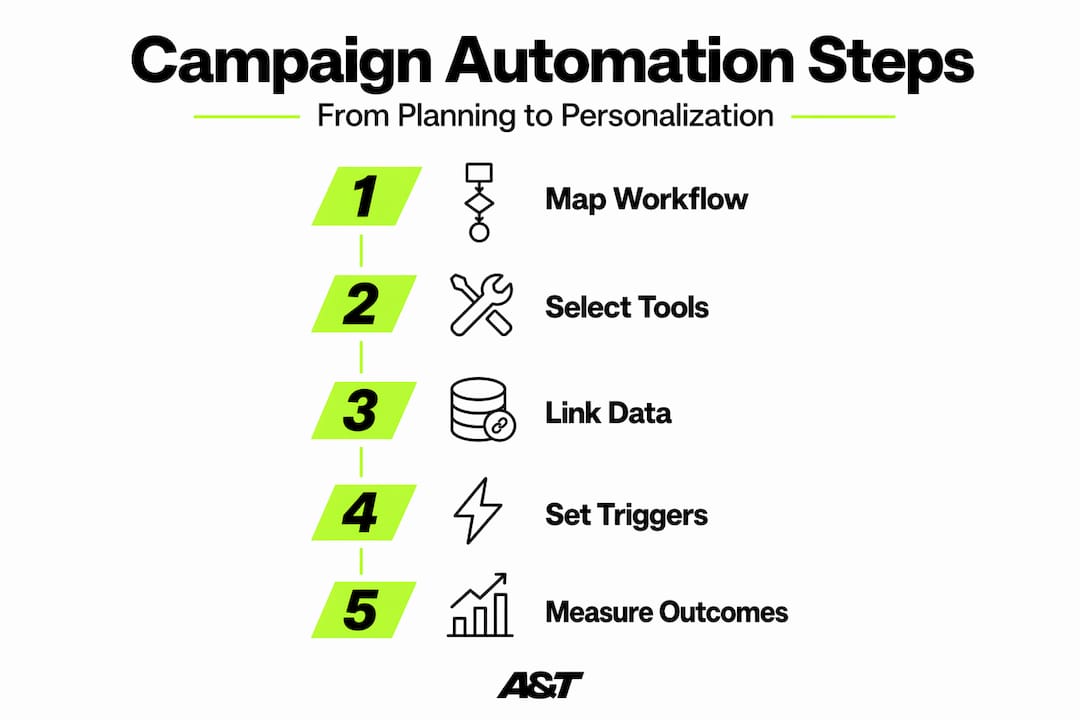
You can analyze campaign outcomes from each automation to identify which triggers and messages convert, then use those findings to leverage analytics for campaign optimization across your entire program.
Why many SMBs miss the full value of campaign automation—and how to unlock it
We work with SMBs regularly, and we see the same pattern. A business invests in a campaign automation tool, sets up a few email sequences, and then wonders why the results are not moving the needle. The tool is not the problem. The setup is.
The mistake is treating automation as a message-sending machine rather than a decision-making system. Teams automating just message sends without connecting data, decisioning, and orchestration typically will not see closed-loop performance improvements. You need three things working together: linked data, decision logic, and workflow governance.
Linked data means your ad platform, CRM, website analytics, and email tool all share the same customer record. Without this, your automation is making decisions in the dark.
Decision logic means you have defined what should happen based on customer behavior. Not just "send email after signup," but "if this lead scores above 70 and has visited the pricing page, notify sales within one hour." That level of specificity is what separates campaigns that convert from campaigns that just run.
Workflow governance means someone on your team owns the automation rules, reviews them quarterly, and has authority to update them when the business changes. Automation that runs unchecked for 18 months often ends up sending the wrong message to the wrong audience because the original logic no longer matches your current product or positioning.
This is where data-driven marketing strategies and measuring marketing ROI become essential practices, not nice-to-haves. Automation gives you speed. Governance gives you control. Both together give you results.
Pro Tip: Create a simple automation map that lists every active workflow, its trigger, its goal, and the last date it was reviewed. If you cannot answer those four questions for every automation you are running, you have a governance gap.
Boost your campaigns with expert multi-channel paid ads management
Understanding the role of campaign automation is one thing. Building a system that actually delivers results across Google and Meta is another challenge entirely. At A&T Digital Agency, we help SMBs turn campaign strategy into revenue through performance-focused Google Ads management services and Meta Ads management services that are built for measurable outcomes. We manage the full cycle, from targeting and creative to testing and optimization, so your budget works harder without adding to your internal workload. If you are ready to pair the right automation setup with expert paid campaign execution, explore our digital marketing solutions and see what a focused, results-driven team can do for your growth.
Frequently asked questions
What is the primary role of campaign automation for small businesses?
Campaign automation helps small businesses deliver coordinated multichannel campaigns, improve lead quality, and measure ROI clearly by connecting marketing and sales data in one shared system rather than managing each channel separately.
How does AI improve campaign automation effectiveness?
AI goes beyond rule-based automation by continuously testing and adjusting budgets, messaging, and targeting in real time based on live performance data, which reduces wasted spend and improves results without requiring manual intervention.
Can campaign automation handle both online and offline marketing channels?
Yes. Advanced platforms synchronize online and offline channels through a single interface, so a customer's email, paid ad, direct mail, and in-store experience all reflect the same message and journey stage.
What common manual tasks can campaign automation eliminate?
Automation removes repetitive tasks including approval workflows, asset resizing, campaign duplication, and manual reporting pulls, with 40% of organizations already automating these operations to ship campaigns faster and with fewer errors.