
Spark Ads let you scale proven organic TikTok posts, brand or creator, as native paid placements that preserve social proof and usually improve CTR and CPA. The move works best when you already have a post showing strong completion rates and real comment activity. If your organic library is thin or you need a fast, controlled test of a new hook, standard in-feed ads still do that job better.
TL;DR:
- Spark Ads perform best when boosting posts with strong organic engagement and high completion rates, not for new or unproven content.
- Authorization codes must be renewed regularly, with short-term codes costing roughly 15 percent more than longer-term ones, to maintain campaign continuity.
- Spark Ads usually deliver 30 to 40 percent lower CPMs than standard in-feed ads, making them more cost-efficient for awareness and retargeting campaigns.
- Performance metrics such as completion rate, CPA, and paid profile visits are more meaningful for Spark Ads than raw view counts or CTR alone.
- Managing Spark Ads effectively requires close coordination between creator relationships and paid media operations to avoid expired codes, mismatched contracts, or margin erosion.
Table of Contents
- What Are TikTok Spark Ads and Why Do They Work?
- How Do Spark Ads Work: Authorization, Codes, and Setup?
- Spark Ads vs In-Feed Ads: Which One Fits Your Goal?
- Step-by-Step: Setting Up a Spark Ads Campaign in Ads Manager
- What Do Creator Authorization Rights Actually Cost?
- Best Practices for Choosing Posts and Working With Creators
- Which KPIs Actually Matter for Spark Ads?
- How Does an Agency Actually Run Spark Ads Day to Day?
- Ready to Put Spark Ads to Work for Your Brand?
- Sources
What Are TikTok Spark Ads and Why Do They Work?
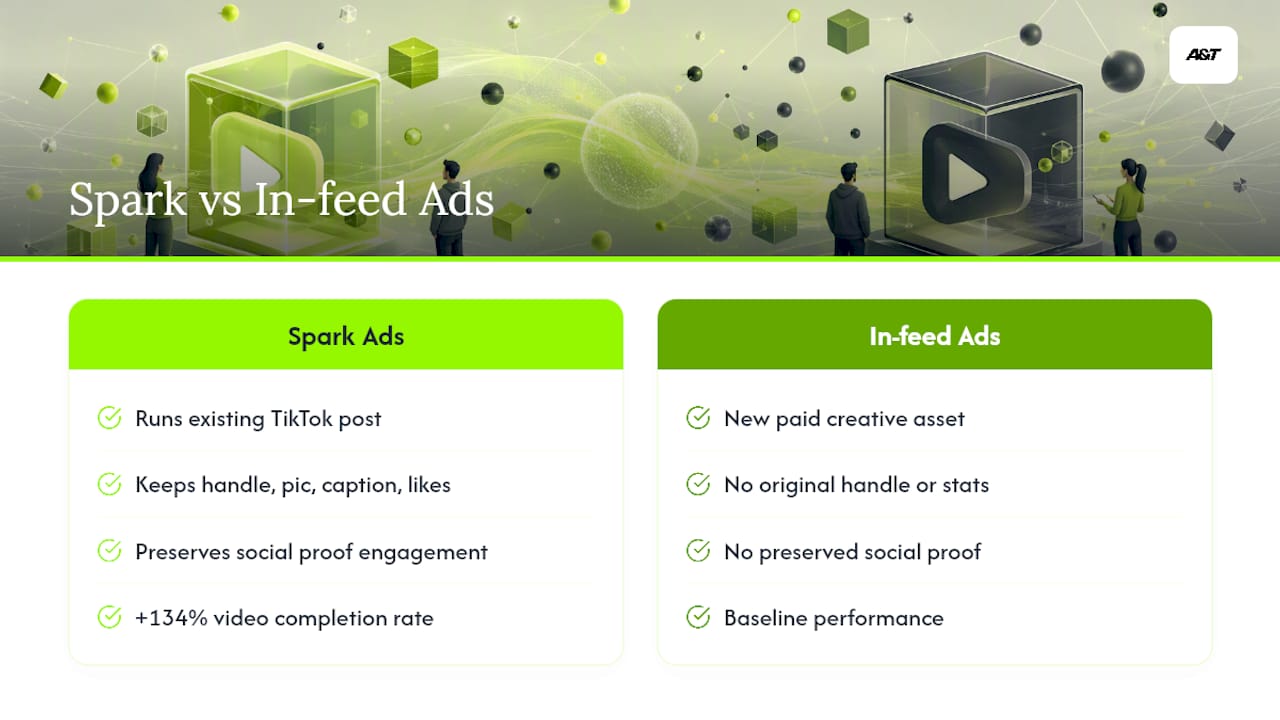
A Spark Ad takes an existing TikTok post, brand-owned or creator-owned, and runs it as a paid placement while keeping the handle, profile picture, caption, and every like, comment, and share count intact. Nothing about the post looks like an ad because it isn't a new asset. It's the same video viewers already trusted, now with paid distribution behind it.
That preserved social proof is the whole mechanism. Viewers scroll past content that already has thousands of comments and shares, and TikTok's algorithm treats that engagement signal as a reason to keep serving it. Published benchmarks show Spark Ads outperforming standard in-feed placements on both CTR and completion rate in many analyses.
Statistic Callout: In TikTok's own A/B testing across selected brand auctions, Spark Ads produced a 134% lift in video completion rate and a 157% lift in 6-second view-through rate compared with standard in-feed ads.
How Do Spark Ads Work: Authorization, Codes, and Setup?
Every Spark Ad campaign starts with authorization, not creative. TikTok requires an explicit code before any post can run as a paid placement, and the process differs depending on who owns the content.
- Brand-owned posts. Open the post in TikTok's Ads Manager or Creator Center and generate a Video Code directly. No third-party approval needed since you own the asset.
- Creator-owned posts. The creator generates an Authorization Code (sometimes called an Ad Code) inside their own account and hands it to you. You never gain access to their account.
- Set the authorization duration. TikTok offers windows ranging from a single day up to 365 days. Shorter windows suit one-off promotions; year-long codes suit always-on creator partnerships.
- Track expiration. Once a code lapses, the ad stops delivering even if the campaign budget is unspent, so calendar the renewal date the moment you receive the code.
TikTok also caps how many Spark posts an Ads Manager account can run at once, and it applies its normal content moderation rules to the original post, meaning a post that violates community guidelines won't survive the boost even if it performed well organically.
Spark Ads vs In-Feed Ads: Which One Fits Your Goal?
The two formats share the same auction and placement inventory, but they solve different problems. In-feed ads give you full creative control and clean click reporting on a purpose-built asset. Spark Ads borrow existing engagement, at the cost of you not being able to change a single frame without generating a new code.
- Creative control: In-feed ads let you test five hooks in a week; Spark Ads require an already-proven post.
- Cost efficiency: Spark Ads commonly run 30 to 40 percent lower CPMs than equivalent in-feed placements, because the algorithm rewards the inherited engagement.
- Reporting nuance: Spark Ads count profile visits, follows, and shares generated from the boosted post as part of performance, which makes raw CTR comparisons against in-feed ads misleading unless you normalize for that.
- Best use case for Spark: awareness campaigns, retargeting warm audiences, and any moment where social proof does the persuading.
- Best use case for in-feed: rapid creative testing, direct-response offers with a hard CTA, or campaigns with no qualifying organic post yet.
A smart funnel sequence often runs in-feed ads upper-funnel to find the winning hook, then converts that same hook into a Spark Ad once it earns organic traction.
Step-by-Step: Setting Up a Spark Ads Campaign in Ads Manager
Launching a Spark Ad correctly takes about ten extra minutes over a standard ad. Skip a step and the ad either gets rejected or under-delivers.
- Confirm the source post has strong organic signals (completion rate and comment activity, not just views).
- Obtain the Video Code (brand post) or Authorization Code (creator post) before building the campaign.
- In Ads Manager, choose your campaign objective. Reach, traffic, and conversions all support Spark Ads.
- At the ad group level, set placements, targeting, and budget as you normally would.
- At the ad level, select "Use TikTok post" and paste the code exactly as issued.
- Preview the ad to confirm the profile, caption, and engagement counts display correctly before publishing.
Watch these settings closely once the campaign is live:
- Daily budget minimums, which TikTok enforces per ad group and can throttle delivery if set too low.
- Bidding strategy. Cost-cap bidding tends to protect CPA better than lowest-cost on Spark placements.
- Pacing. Standard pacing avoids the early-spend spikes that skew day-one CPA reads.
Before you hit publish, run a quick prelaunch check: verify the authorization code hasn't expired, confirm the original post isn't flagged or restricted (a common cause of TikTok ad rejection), and make sure your conversion events are firing correctly in TikTok's pixel or events API.
What Do Creator Authorization Rights Actually Cost?
Spark Ads authorization isn't free when the post belongs to a creator. Market practice treats it as an add-on percentage layered on top of the creator's base rate, and that premium scales with how long you want the rights.
- Short authorization (7 to 14 days): commonly adds roughly 15 percent to the base creator fee.
- Extended authorization (60 to 90 days): carries a noticeably higher premium, often double the short-window rate.
- Year-long or exclusive rights: command the largest premiums, sometimes rivaling the original content fee itself.
Budget the authorization cost separately from your media spend, and only pay the premium when the post is already proving itself organically. A creator's viral hit is worth negotiating hard for; a mediocre post with a modest view count usually isn't worth a long-term code. Lock the terms in writing: name the specific video ID, the exact duration, whether the rights are exclusive to your brand, and when payment is due relative to code delivery.
Best Practices for Choosing Posts and Working With Creators
Raw view count is the wrong filter. A post with 500,000 views and a flat comment section will underperform a post with 60,000 views and an active, replying comment thread once you put money behind it. Completion rate and comment-to-view ratio predict paid delivery efficiency far better than views alone.
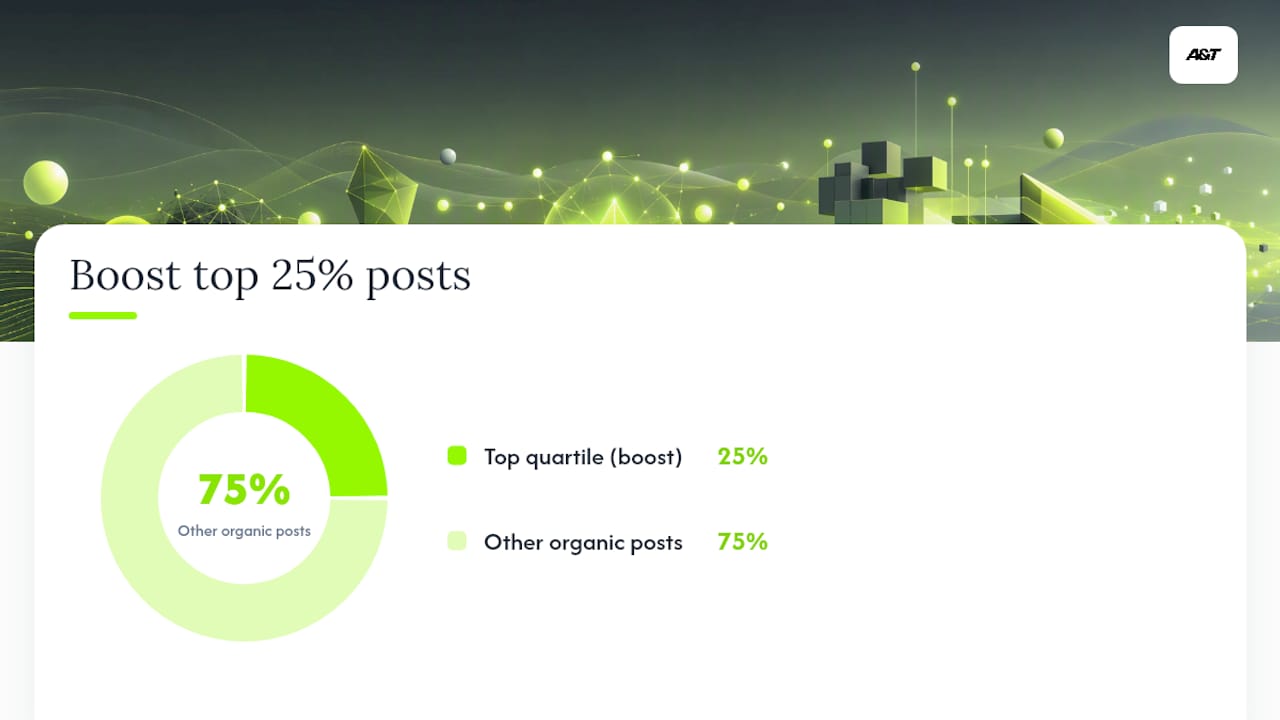
Pro Tip: Pull your last 90 days of organic posts, sort by completion rate, and boost only the top quartile. Everything below that line rarely earns back its media spend.
Build authorization language into creator contracts before the post goes live, not after it goes viral. Negotiating rights once a video is trending gives the creator every bit of leverage and usually costs you more.
- Set frequency caps so the same audience doesn't see the boosted post more than three or four times a week.
- Rotate in a fresh Spark asset every two to three weeks to prevent creative fatigue from dragging down CTR.
- Tie paid spend to creator-level profitability, not just campaign-level ROAS, so a high-CPA creator doesn't hide behind a strong overall blend.
- Watch for the most common trap: scaling a Spark Ad past what the underlying product margin can support. A post can perform beautifully on engagement metrics while quietly losing money per order.
Which KPIs Actually Matter for Spark Ads?
Track CTR, completion rate, CPA, ROAS, and paid profile visits together, not in isolation. Spark Ads generate engagement types, like profile visits and follows, that standard in-feed ads simply don't capture the same way, so a side-by-side CTR comparison between the two formats needs context before you draw conclusions.
Statistic Callout: Independent benchmarking shows Spark Ads frequently lower CPA and raise completion rates compared with in-feed placements running the same targeting.
- Review performance weekly for the first month, then move to a biweekly cadence once an asset stabilizes.
- Run a holdout test comparing the Spark version against a fresh in-feed version of similar content when budget allows.
- Track paid follower growth as a secondary KPI. It's a signal Spark Ads capture that in-feed ads rarely do.
For a deeper framework on setting KPI targets before launch, our guide on tracking ad performance metrics and ROI covers the reporting cadence in more detail.
How Does an Agency Actually Run Spark Ads Day to Day?
Running Spark Ads well means managing two workflows at once: creator relationships and paid media. Atdigiagency handles the full lifecycle, strategy, authorization coordination, launch, measurement, and ongoing optimization, so nothing falls into the gap between the influencer team and the media buying team.
That integration matters because treating creator ops and paid allocation as one system reduces the friction that kills ROI: expired codes, mismatched contracts, and campaigns scaled without checking whether the underlying product margin can support the spend. An agency model built around performance marketing keeps authorization timing, attribution, and profit tracking under one roof instead of three disconnected owners.
— Ann
Ready to Put Spark Ads to Work for Your Brand?
An agency can run TikTok Ads as part of a full performance marketing system, not a standalone experiment bolted onto a content calendar. For a reader who just learned how much authorization mechanics, creator contracts, and margin tracking actually matter, that's the real advantage: one team handling the code negotiation, the campaign build, and the profit math together, instead of a brand juggling a creator manager, a media buyer, and a spreadsheet that never quite reconciles.
If your organic posts are already showing strong completion rates and you want them turned into paid placements that protect margin instead of eroding it, that's exactly the work our performance marketing team handles daily across Google, Meta, and TikTok. Reach out for a campaign review and see which of your existing posts are ready to scale.
Sources
- TikTok Spark Ads Guide: Boosting Creator Content as Paid Ads and Pricing Impact
- TikTok Spark Ads vs Normal (In-Feed) Ads: Differences, Cost & Use Cases
- 8 TikTok Spark Ads Best Practices for 2026 | HiveHQ
- TikTok Spark Ads vs In-Feed Ads Performance 2026 - TTS Vibes