
TL;DR:
- Ad placement optimization involves actively selecting and refining where your ads appear to maximize conversions based on performance data. It requires balancing automation with manual oversight to identify high-value surfaces and eliminate wasteful placements, improving overall ROI. A hybrid approach offers the best results by leveraging automation for data collection and human analysis for nuanced decision-making.
Most business owners think ad placement is simply a matter of picking a few websites and letting campaigns run. It is not. Ad placement optimization is the deliberate, data-driven process of identifying exactly where your ads deliver real business results and continuously refining those placements to reduce waste and increase conversions. If you are running Google Ads or Meta campaigns without actively managing placements, you are almost certainly spending money on surfaces that will never convert for your audience. This article breaks down what ad placement optimization means, how it works on major platforms, and how you can apply it without guessing.
Table of Contents
- What is ad placement optimization and why it matters
- How ad placements work on major platforms
- Testing and optimizing ad placements for best results
- Advanced insights: metrics, AI automation, and creative considerations
- Why a hybrid approach to ad placement optimization wins in 2026
- Boost your ad performance with expert placement optimization
- Frequently asked questions
Key Takeaways
| Point | Details |
|---|---|
| Ad placement optimization defined | It’s the data-driven process of selecting and refining where your ads appear to maximize conversions and ROI. |
| Use platform tools intelligently | Platforms like Google Ads and Microsoft provide granular placement options and detailed reporting to aid optimization. |
| Test placements systematically | Run controlled A/B tests isolating placement variables and collect enough conversions to find winners. |
| Balance AI and manual control | Start with broad AI-driven placements and refine manually based on data insights for best results. |
| Creative flexibility matters | Flexible ad creatives allow AI algorithms to optimize placement more effectively across various surfaces. |
What is ad placement optimization and why it matters
Ad placement optimization is the process of choosing and continually refining where your ads show to maximize business outcomes using performance data. That means going beyond broad targeting and deciding specifically whether your ad belongs on a cooking blog, a YouTube channel, a mobile app, or a news website, based on what the data tells you.
A placement is simply the location where your ad appears. It could be:
- A specific website or webpage on the Google Display Network
- A YouTube channel or individual video
- A mobile app or app category
- A specific section within a social media feed
When you ignore placements, your budget gets distributed across hundreds of surfaces automatically. Some of those surfaces will never produce a conversion. Others will consistently bring in leads or purchases at a low cost. The difference between those two groups is precisely what optimizing ad campaign ROI is about.
Understanding ad placement also means recognizing where placements fit in your broader targeting stack. Placements work alongside keywords, topics, audience segments, and demographic filters. They are the most granular layer of control you have over where your message actually lands. Think of it like digital campaign planning: if your strategy is a blueprint, placements are the specific rooms you choose to build.
The benefits of ad placement go well beyond tidiness. When you identify which placements drive conversions and eliminate the ones that drain budget, your cost per acquisition drops, your click-through rate improves, and your overall campaign performance becomes more predictable. For small and medium businesses with tighter budgets, that predictability is not a luxury. It is survival.
How ad placements work on major platforms
Google Ads gives you the most granular placement control available in digital advertising. Google Ads placements are the most specific targeting you can do, choosing exact websites, apps, or YouTube channels where ads appear. That specificity is powerful, but it requires active management to work in your favor.
On Google Display and Video campaigns, you can:
- Add managed placements to target specific sites or channels you want to appear on
- Exclude placements to block sites or apps that waste budget or attract low-quality traffic
- Review automatic placements to see where Google has been running your ads without your input
- Pause underperforming placements without deleting them, preserving the data for future reference
Microsoft Advertising has made significant strides here too. Performance Max placement reports now show conversions, clicks, and spend by website URL, enabling confident placement decisions over longer evaluation periods. That kind of transparency matters because it lets you make decisions based on full conversion cycles, not just surface-level metrics.
The critical mistake most advertisers make is reacting too quickly. A placement that looks expensive after five days might become your best performer after four weeks once attribution catches up. This is why we consistently recommend evaluating placements across at least one full conversion cycle before making any changes.
Improving ad performance starts with knowing how these platforms surface your ads by default. Most campaigns launch in a broad automated state. That is fine for gathering initial data. But leaving them there permanently is where budget goes to waste. Pair your Google Display Ads strategies with active placement review on a regular cadence, and you will uncover winning surfaces that automation alone would never isolate for you.

Understanding the mechanics of ad rotation strategies also plays a role here. How frequently your ads rotate across placements affects which surfaces accumulate enough data for reliable analysis.
Testing and optimizing ad placements for best results
Good placement decisions are built on controlled testing. Here is a step-by-step approach we use and recommend:
- Isolate the placement variable. Running controlled A/B tests changing only placement variables helps identify which placements drive better conversions. Do not change your creative, bid strategy, or audience at the same time. One variable at a time gives you clean data.
- Set a meaningful budget threshold. If your daily budget is too low, you will not reach statistical significance before your test period ends. Allocate enough to generate real signals.
- Wait for sufficient conversion volume. Aim for at least 50 to 100 conversions per variation before deciding on a winning placement. Fewer than that and you are reading noise, not data.
- Track secondary KPIs alongside conversions. Conversion rate is your primary signal, but CTR, CPM, CPA, and ROAS each reveal something different about placement quality.
- Review results and make incremental changes. Exclude the bottom performers, increase bids on winners, and run the cycle again.
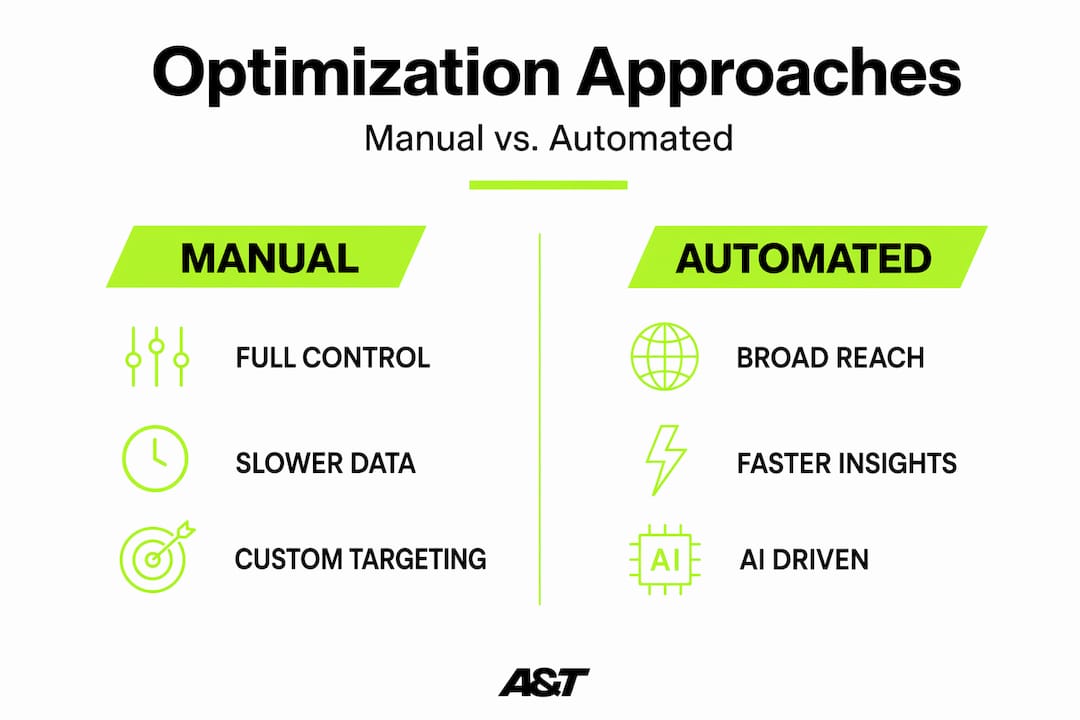
Here is how manual and automated placement optimization compare:
| Factor | Manual optimization | Automated optimization |
|---|---|---|
| Control | Full control over included/excluded sites | Platform decides based on algorithm |
| Speed | Slower, requires regular review | Fast, real-time adjustments |
| Data requirements | Relies on advertiser's own analysis | Needs sufficient campaign data to function |
| Best for | Niche audiences, specific verticals | Broad campaigns with high conversion volume |
| Risk | Missing effective placements outside your list | Wasted spend on irrelevant surfaces |
| Effort | Higher, ongoing management | Lower, but less transparent |
The most effective approach uses both, which we cover in the perspective section below.
For A/B testing in ads, the same discipline applies. Your test needs structure and patience to produce conclusions you can actually act on. Rushing this process is one of the most common and expensive mistakes in paid advertising. If you need a starting framework, our ad optimization checklist walks through the key steps, and our guide to testing ad creatives covers the creative side of the same equation.
Pro Tip: Never evaluate a placement based on a single week of data during a seasonal spike or promotional period. That snapshot will mislead you. Pull data over a normalized period of at least 21 days before drawing any conclusions.
Advanced insights: metrics, AI automation, and creative considerations
Ad placement analytics go deeper than clicks and impressions. Once you move past basic reporting, a few nuances separate strong optimizers from average ones.
First, the role of AI. Automated placement algorithms work by dynamically mapping your audience across available surfaces in real time. They are good at scale. But AI-driven ad placements require creative flexibility; rigid constraints can limit the AI surfaces available for your ads. If you pin specific elements or restrict ad formats too tightly, you are reducing the number of surfaces the AI can test on your behalf. That narrows your reach and can actually hurt performance.
Second, viewability. Many advertisers over-index on viewability scores. Viewability metrics vary; triangulate with conversions and segment by device and format to avoid misleading optimization decisions. A placement with 80% viewability that produces no conversions is not a good placement. One with 55% viewability that delivers a strong ROAS might be your best performer.
Key metrics to track and pitfalls to watch:
- Conversion rate by placement is your primary signal. Everything else is context.
- CPA by placement tells you what you are actually paying for each result on each surface.
- ROAS by placement reveals which sites or apps are producing revenue, not just clicks.
- Bounce rate from placement traffic (when you can see it via GA4) indicates audience quality.
- Avoid optimizing based on CTR alone. High CTR with low conversions often means irrelevant traffic.
- Avoid pausing placements after fewer than two weeks without a significant budget.
- Avoid treating all devices equally within a placement. Mobile app placements often perform very differently from desktop web placements on the same domain.
This connects directly to improving ad ROI strategies: the more granularly you analyze placement data, the more precisely you can redirect budget toward what is working.
The AI productivity gains available to agencies and in-house teams right now are real, but only when AI has the flexibility it needs to operate effectively. Constrain it too much and you lose the benefit entirely.
Pro Tip: When using responsive display ads or Performance Max, provide as many creative variations as possible. More creative assets give the AI more combinations to test across more placements, which directly improves its ability to find effective ad placements for your specific audience.
Why a hybrid approach to ad placement optimization wins in 2026
Here is the honest truth: full automation without oversight is not a strategy. It is hope.
We have seen it repeatedly. A business launches a Performance Max campaign, lets it run for three months, and reports decent average results. Then we pull placement-level data and find that 40% of spend went to mobile game apps and entertainment sites with zero conversions. The automation was doing its job at scale. But no one was steering it.
Pure automation finds patterns across massive datasets. It is fast and broad. What it does not do well is surface niche placements that a human with industry context would recognize immediately. AI-driven placement delivers scale and speed, but manual targeting helps uncover nuanced winning placements missed by automation. A telehealth brand we worked with had a handful of health-adjacent blog networks that consistently drove qualified leads at half the network average CPA. Automation had partially found them but was not concentrating budget there. Manual review and adjustment changed the economics of the entire campaign.
The best-performing campaigns we manage combine a broad automated launch phase for data collection with systematic manual refinement once placement-level performance data becomes statistically meaningful.
The hybrid approach works because each method covers the other's weakness. Automation gathers data fast across a wide surface area. Manual analysis then identifies the highest-value pockets within that data and reallocates budget accordingly. Creative flexibility supports the automation layer, while placement exclusions and manual bids sharpen the manual layer.
For small and medium businesses, this approach also protects budget from day one. You are not flying blind with pure automation, and you are not limiting your reach with pure manual targeting from launch. You start broad, you gather data, and you refine with intention.
Revisiting optimizing ad campaigns ROI through this lens makes every decision more defensible. You are not guessing. You are operating on a feedback loop that gets more accurate every week.
Boost your ad performance with expert placement optimization
Knowing the theory is one thing. Executing it consistently while running a business is another. At A&T Digital Agency, we build and manage paid ad systems that apply exactly this hybrid approach, systematic testing, placement-level analytics, and ongoing refinement to make every dollar work harder. Our Google Ads management services and Meta Ads management services are built around data-driven execution, not set-it-and-forget-it campaigns. If you are spending on paid ads and not actively managing placement performance, you are leaving real money on the table. We can help you find it, focus on it, and build a system around it. No unnecessary meetings. Just campaigns that convert.
Frequently asked questions
What exactly does ad placement optimization involve?
It involves selecting and refining where your ads appear, such as specific websites, apps, or video channels, using performance data to improve outcomes like conversions and sales.
How long should I run placement tests to get reliable results?
Placement performance should be evaluated over several weeks or full conversion cycles rather than reacting to brief snapshots, which often produce unreliable conclusions.
Can AI handle all my ad placement optimization automatically?
AI can efficiently find high-performing placements at scale, but manual targeting uncovers nuanced winning placements that automation alone tends to miss, making human review essential.
How do creative constraints affect AI ad placements?
Rigid creative constraints like pinning specific elements make it difficult for AI to meet user needs across varied surfaces, directly limiting the range of placements it can test and optimize.