
TL;DR:
- Effective campaign alignment involves real-time coordination of strategy, messaging, and metrics across teams and channels. It relies on shared goals, unified data, and ongoing communication to prevent inconsistencies that waste budget and damage trust. Maintaining this alignment through regular reviews and clear handoffs consistently improves conversion rates, shortens sales cycles, and maximizes return on investment.
Most marketing managers assume campaign alignment means everyone approved the same brief. That assumption is costing them conversions. What is campaign alignment, really? It is the active coordination of strategy, messaging, audience targeting, and metrics across every team and channel involved in a campaign. Not a document. Not a kickoff meeting. A living system where sales, marketing, and paid media all operate from the same playbook, in real time. Get it right, and your campaigns compound. Get it wrong, and you spend budget sending conflicting messages to the same prospect from three different directions.
Table of Contents
- Key takeaways
- What campaign alignment actually means
- Why campaigns fall apart without it
- How to achieve campaign alignment that holds
- The real benefits of aligned campaigns
- Keeping alignment alive after launch
- My honest take on where alignment breaks
- Ready to run campaigns that actually align
- FAQ
Key takeaways
| Point | Details |
|---|---|
| Alignment is behavior, not paperwork | True campaign alignment shows up in daily decisions, not just signed-off briefs. |
| Shared goals reduce conversion friction | When sales and marketing target the same audience with the same message, conversion rates rise. |
| Misalignment costs real budget | Inconsistent messaging across channels creates fractured customer journeys and wasted ad spend. |
| A shared brief is the starting point | One document covering audience, message hierarchy, and conversion goals coordinates every channel team. |
| Sustained alignment requires process | Regular cross-team reviews and unified dashboards keep alignment from deteriorating after launch. |
What campaign alignment actually means
The campaign alignment definition that most teams work from is too narrow. They treat it as a strategy document that gets shared once before launch. Real alignment is a shared system of communication where goals, data, and feedback flow continuously between marketing, sales, and every channel executing the campaign.
Here is what that looks like in practice. A Google Ads team targets a specific audience segment. The Meta campaign reinforces the same core message. The email sequence picks up where the ad left off. And when a prospect clicks through and becomes a lead, the sales team already knows what that person responded to, what content they downloaded, and what objection they are likely to raise. That is alignment. Each piece informs the next.
The core components of campaign alignment include:
- Shared audience definition. Every team agrees on who they are talking to, including segment, intent stage, and pain points.
- Unified message hierarchy. The primary value proposition stays consistent across ads, landing pages, email, and sales calls. Channel-level creative may vary, but the core promise does not.
- Connected goals and KPIs. Marketing measures leads. Sales measures pipeline. Alignment means both metrics trace back to the same revenue objective.
- Real-time data sharing. Marketing passes engagement signals to sales. Sales returns field objections and conversion data back to marketing.
- Coordinated timing. Paid campaigns, outreach sequences, and sales follow-up run on the same schedule, not in parallel silos.
Strategic campaign planning is what makes this possible before a dollar gets spent. But alignment does not end at planning. Organizations with shared understanding rather than just documented strategies maintain coherence through change and complexity. That distinction matters more than most teams realize.
Why campaigns fall apart without it
Poor campaign alignment in SMBs follows predictable patterns. Recognizing them early saves budget and stress.
-
Separate channel briefs produce divergent strategies. When the Google Ads team, the social team, and the email team each receive different briefs, or no brief at all, they make independent creative and targeting decisions. Multiple briefs produce divergent strategies, and inconsistent messaging across ads, landing pages, and emails costs conversion regardless of how well each individual channel performs.
-
Mismatched goals create internal conflict. Marketing optimizes for click-through rates. Sales wants SQLs. Neither team shares data with the other. When results disappoint, blame follows. The actual problem was never performance. It was a broken handoff.
-
Fragmented platforms delay decisions. Campaign data spread over many networks leads to fragmented management and strategy drift. By the time you consolidate reporting from five platforms, the optimization window has passed.
-
Inconsistent KPIs cause confusion downstream. Shared definitions and unified data reduce friction by clarifying what counts as a qualified lead. Without them, every team is measuring something different and calling it success.
-
Mismatched messaging breaks the customer journey. A prospect sees a Google Ad promising a free consultation, clicks through to a landing page pitching a product demo, and gets an email about a discount. Each touchpoint feels like a different brand. Trust evaporates.
Pro Tip: Before your next campaign launches, print out every customer-facing touchpoint in order. Read through them as a first-time prospect would. If the message shifts significantly from one step to the next, that is your alignment gap.
The cumulative effect of these failures is not just lower conversion rates. It is wasted spend, a damaged brand impression, and a sales team chasing leads that marketing warmed up with completely different messaging.
How to achieve campaign alignment that holds
Most alignment advice stops at "create a shared brief." That is the right starting point, but it is not enough. Here is how to build alignment that actually holds through execution.
Build one brief that explains the why
A campaign brief that explains strategic goals rather than just creative tasks aligns different channel teams on audience nuances, messaging priorities, and expected conversions. Include the audience segment and their specific pain point, the primary message and supporting proof points, the conversion goal at each funnel stage, and what success looks like for both marketing and sales.
Connect your data across platforms
Use technology to unify reporting. Tools that pull Google Ads, Meta, and CRM data into one view let you see the full picture without manual reconciliation. Data-driven marketing ROI depends on this shared intelligence layer. Without it, each team optimizes in a vacuum.

Coordinate sales outreach with live campaigns
Engagement signals shared quickly with sales reps improve prospecting success. When a prospect downloads a case study or attends a webinar, that signal should reach sales within hours, not at the next weekly meeting. Outreach that mirrors the active campaign reduces friction and increases reply rates.
Run alignment that holds in practice
The biggest trap is alignment on paper. Teams agree in kickoff. Then the campaign launches, someone goes off script, and nobody catches it until the post-mortem. Prevent this with:
| Alignment practice | What it prevents |
|---|---|
| Weekly cross-team message review | Channel drift and inconsistent customer-facing copy |
| Shared live dashboard | Delayed data and siloed performance reporting |
| Sales feedback loop to marketing | Messaging that sounds good in ads but fails in conversations |
| Campaign calendar tied to sales cadence | Sales calling on prospects before marketing has warmed them up |
Pro Tip: Set a standing 20-minute weekly sync between your paid media manager and your sales lead. Not to review results. To exchange live signals: what is working in ads, what objections are coming up in calls. That feedback loop is worth more than most reporting tools.
Sales alignment resources consistently show that coordination between marketing and sales outreach has a measurable effect on deal close rates. The mechanics are not complicated. The discipline to maintain them is where most SMBs fall short.
The real benefits of aligned campaigns
When campaign alignment clicks into place, the results are concrete, not theoretical.
Conversion rates rise. Consistent messaging across every touchpoint removes the cognitive friction prospects feel when something feels off. Consistent core proposition across channels matters more than creative uniformity. You do not need identical ads everywhere. You need the same promise delivered everywhere.
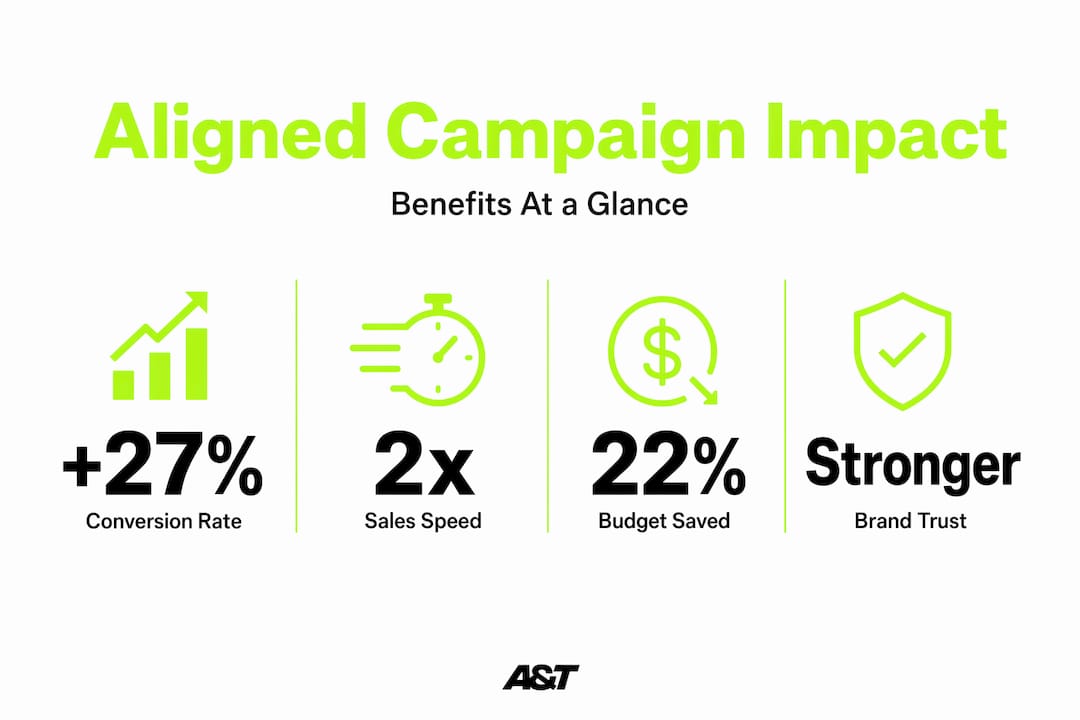
Sales cycles shorten. When sales knows exactly what a prospect engaged with, follow-up is relevant from the first touch. Coordinating campaign and sales outreach timing significantly improves prospect engagement. A call that references the exact ad a prospect clicked is not creepy. It is relevant.
Budget goes further. Duplicated effort across channels burns money fast. When teams share a brief and a dashboard, they stop rebuilding the same audience segments, recreating the same copy, and running conflicting promotions. The same spend produces more output.
Forecasting improves. Automated CRM tools that provide real-time engagement context give sales clearer pipeline visibility. When marketing and sales data connect, forecast accuracy climbs because both teams are looking at the same numbers.
Brand trust compounds. Prospects who receive a consistent message across every channel form a clearer picture of what you offer and why it matters. That clarity accelerates decisions.
Keeping alignment alive after launch
Most alignment breaks down not at kickoff, but six weeks into a campaign when teams stop talking. Here is how to maintain it.
Assign one person to own the shared campaign brief. That person's job is not creative approval. It is catching message drift before it reaches the customer. Every new piece of content gets checked against the brief before it ships.
Run monthly campaign brief reviews with all channel leads. Thirty minutes. Cover what the data says, where the message has drifted, and what needs adjusting. This meeting pays for itself every time it catches an inconsistency before it costs conversions.
Integrate your campaign calendar with your sales outreach schedule. Your campaign optimization tools should make this easy with shared views and automated alerts. When a new campaign phase launches, sales should know the same day, not find out when a prospect mentions it on a call.
Finally, build in accountability. Joint meetings covering account engagement and content performance improve coordination beyond surface-level updates. Shared accountability means both teams own the outcome. Neither team can blame the other when they both contributed to the result.
My honest take on where alignment breaks
I have worked with enough SMB marketing teams to say this clearly: alignment failures are almost never about bad intentions. Every team wants the campaign to work. The failures happen at operational handoff points. The moment the brief leaves the strategist's hands and lands with a channel manager who is three deadlines deep. The moment a sales rep follows up with a prospect using a pitch deck that has not been updated since last quarter.
What I have learned is that the most important word in campaign alignment is handoff. Who hands what to whom, and when? When you map those handoffs explicitly, you find the gaps. You find the place where the Google Ads message stops and the email sequence starts with no connective tissue. You find the place where a qualified lead sits in the CRM for four days before a sales rep picks it up, because nobody set a notification.
The teams I have seen get this right are not the ones with the most tools. They are the ones with the fewest ambiguities. One brief. One shared dashboard. One person responsible for catching drift. They prioritize integration over adding another platform, and they protect those handoffs like they protect their ad budget. Because in practice, a broken handoff costs just as much as a wasted click.
— Ann
Ready to run campaigns that actually align
If you recognize any of these alignment gaps in your current setup, you are not alone. Most SMBs are running paid campaigns across Google and Meta without a unified brief or a real feedback loop between their ad performance and their sales team. The spend is there. The coordination is not.
At Atdigiagency, we build paid ad systems where strategy, creative, and data connect from day one. Our team manages Google Ads campaigns and Meta advertising with full cross-channel coherence, so your message stays consistent from the first impression to the closed deal. We also guide clients through the campaign launch process with alignment built in from the brief stage. No duplicated efforts. No conflicting messages. Just campaigns that work together.
FAQ
What is campaign alignment in simple terms?
Campaign alignment means every team, channel, and message in a campaign works toward the same goal with the same core proposition. It connects strategy to execution so nothing contradicts itself between your ad, your landing page, and your sales follow-up.
Why does campaign alignment matter for SMBs?
For SMBs with limited budgets, misalignment is expensive. Inconsistent messaging reduces conversion rates and wastes ad spend. Alignment means every dollar works harder because every touchpoint reinforces the same message.
How do you achieve campaign alignment across channels?
Start with one shared brief covering audience, message hierarchy, and conversion goals. Then connect your reporting into a unified dashboard and establish a regular feedback loop between your paid media team and your sales team.
What are the main benefits of aligned campaigns?
Aligned campaigns produce higher conversion rates, shorter sales cycles, better budget efficiency, and stronger brand trust. When every channel delivers a consistent message, prospects move through the funnel with less friction.
How often should teams review campaign alignment?
A brief review at launch and a monthly check-in with all channel leads is the minimum. Weekly exchanges between paid media managers and sales reps help catch message drift before it affects conversions.