
TL;DR:
- Campaign budgeting is a strategic resource allocation process aimed at maximizing marketing returns at every funnel stage. It involves estimating, distributing, and continuously monitoring spending to achieve specific goals, rather than serving as a spending cap. Proper management, based on data and regular adjustments, ensures efficient campaigns and sustainable growth.
Most business owners treat a campaign budget like a spending cap. Set a number, launch the ads, and hope for the best. But that misses the point entirely. What is campaign budgeting, really? It's a deliberate system for allocating resources across your marketing activities to maximize returns at every stage of the funnel. Get this right, and your ads compound. Get it wrong, and even a generous budget bleeds out quietly. This guide breaks down the concept, the frameworks, and the real-world decisions that separate efficient campaigns from expensive experiments.
Table of Contents
- Key Takeaways
- What is campaign budgeting and why it matters
- How to determine your campaign budget
- Budget allocation frameworks that actually work
- How to monitor and adjust campaign budgets
- Common mistakes and expert-level fixes
- My honest take on campaign budgeting
- Let Atdigiagency handle the numbers
- FAQ
Key Takeaways
| Point | Details |
|---|---|
| Budget as a strategic tool | Campaign budgeting is not a spending limit. It's a resource allocation system tied to measurable goals. |
| Start with revenue benchmarks | Most businesses allocate 5–12% of annual revenue to marketing, with 40–50% directed to digital channels. |
| Match budget to campaign goals | Acquisition, retention, and awareness campaigns have different cost structures and require separate budget logic. |
| Monitor and reallocate regularly | Daily pacing checks, weekly audits, and monthly reviews prevent waste and catch underperformers early. |
| Avoid common misallocation traps | Pausing campaigns too early and skipping opportunity reserves are among the costliest budgeting errors SMBs make. |
What is campaign budgeting and why it matters
At its core, the campaign budget definition is straightforward. A campaign budget is the total amount of money you plan to spend on a specific marketing initiative, over a defined period, to achieve a defined outcome. That outcome might be leads, purchases, app installs, or brand recall. The budget covers everything from media buying to creative production.
Here is where people get confused. Your overall marketing budget is the big-picture number. It includes salaries, tools, agency fees, events, and content creation. A campaign budget is a subset of that. It governs one specific push toward one specific goal. A company might have a $200,000 annual marketing budget but carve out $30,000 for a Q3 Google Ads acquisition campaign. Those are two different things and treating them as interchangeable creates planning blind spots.
For small to medium-sized businesses, the campaign budget definition carries real operational weight because it signals priorities to your team and to the ad platforms themselves. When you underfund a campaign, Google and Meta's algorithms don't have enough data or spend flexibility to find the right audience efficiently. Budget is not just money. It's instruction.
Campaign budgeting covers several distinct functions:
- Planning: Estimating costs before a campaign launches based on channel CPCs, target volume, and campaign duration
- Allocation: Deciding how much goes to each channel, ad type, or audience segment
- Monitoring: Tracking spend versus results in real time to catch inefficiencies early
- Optimization: Reallocating money from low-performing areas to high-performing ones mid-flight
Understanding these layers is the foundation for everything that follows.
How to determine your campaign budget
Setting a campaign budget without benchmarks is guesswork. Start with what the data says. Businesses typically allocate between 5% and 12% of annual revenue to marketing, with startups trending toward 8–12% and mature companies sitting closer to 5–8%. Of that total, digital channels absorb 40–50%, with paid social and search ads taking the largest share.
For a $2 million annual revenue business, that means a total marketing spend of roughly $100,000 to $240,000. A focused paid ads campaign might represent 25–35% of that. These numbers give you a realistic starting range before you factor in your specific goals.
Here is how to work from goals down to a number:
- Define the campaign objective. Acquisition campaigns are typically more expensive than retention campaigns because you are paying to reach cold audiences. Brand awareness campaigns often use CPM pricing, while conversion campaigns run on CPC or CPA models. Each has a different cost structure.
- Estimate your cost per result. If your industry average cost per acquisition (CPA) is $50 and you want 200 new customers this quarter, your media budget floor is $10,000. Add 20–30% for testing, creative, and platform fees.
- Factor in your historical data. If you have run campaigns before, use that conversion history. A campaign with 60 prior conversions gives the algorithm a foundation to optimize from. Without history, budget conservatively and build up.
- Benchmark against industry standards. A typical marketing budget ranges from 5–10% of revenue, adjusted upward for aggressive growth targets or highly competitive markets like insurance, legal, or health.
- Separate campaign costs from fixed overhead. Your media spend is variable. Platform tools, agency management fees, and creative production are semi-fixed. Build each category into the budget separately so you know your true cost per campaign.
Pro Tip: If you are running Google Ads or Meta ads, set your daily budget at a minimum of 10 times your target CPA. This gives the algorithm enough room to test and learn. A $50 target CPA needs at least a $500 daily budget to generate statistically meaningful data.
Budget allocation frameworks that actually work
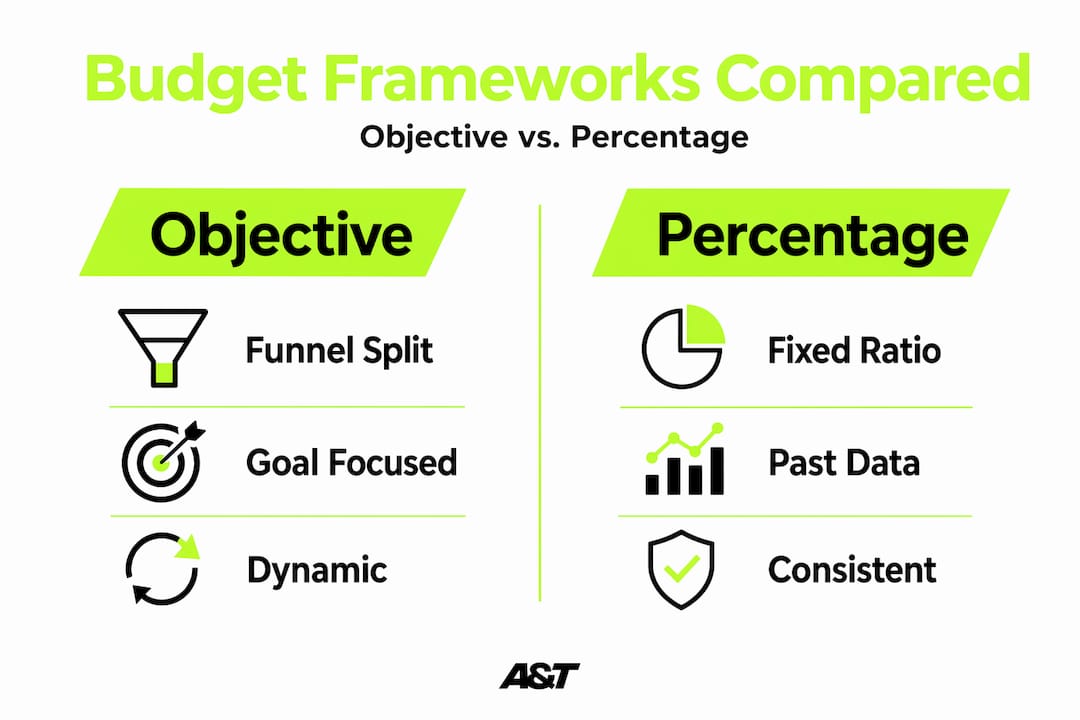
Knowing how much to spend is step one. Knowing how to divide it is where most SMBs lose money. There are two dominant frameworks for budget allocation.

Objective-driven allocation splits your budget based on funnel stage. Awareness campaigns (top of funnel) get a portion of the budget to fill the pipeline. Conversion campaigns (bottom of funnel) get the largest share because that is where revenue happens. Retargeting campaigns get a smaller reserve for people who already showed intent but did not convert. A common starting split for a direct-response focused SMB is 20% awareness, 60% conversion, and 20% retargeting.
Percentage-based allocation uses fixed ratios tied to channel performance history. If Google Search consistently delivers your lowest CPA, it earns a larger share. If display ads generate impressions but minimal conversions, they get a smaller budget with a specific awareness objective attached.
Here is a simple comparison of the two approaches:
| Framework | Best for | Risk | Strength |
|---|---|---|---|
| Objective-driven | Goal-focused campaigns with clear KPIs | Can oversimplify channel overlap | Keeps spend tied to measurable outcomes |
| Percentage-based | Businesses with 6+ months of channel data | Rigid if market conditions shift | Rewards proven channels consistently |
| Hybrid (both) | Scaling SMBs with mixed campaign goals | Requires more tracking discipline | Most adaptable to real-world performance |
Beyond these two frameworks, separating your budget into three cost categories sharpens financial discipline. Media buying is your largest and most variable cost. Consulting and agency fees are discretionary but often tied to performance. Compliance costs, like legal review for regulated industries, are fixed baselines that do not change based on campaign volume.
One more thing worth knowing about pacing: equal monthly budget distribution often leads to inefficiency. Ad platforms can overspend on high-opportunity days and underspend on slower ones. Reserve 10–20% of your campaign budget as an opportunity fund to scale into moments when demand spikes, like product launches, seasonal peaks, or competitor outages. That reserve is not leftover money. It is a deliberate weapon.
For a deeper look at dividing spend across paid channels, the digital ad spend management breakdown at Atdigiagency covers practical channel-by-channel splits that work in real campaigns.
How to monitor and adjust campaign budgets
Setting a budget is a one-time decision. Managing it is an ongoing process. Effective campaign budgeting is iterative, requiring multi-level monitoring to balance pacing, catch waste, and build the conversion volume that stabilizes bidding algorithms.
Here is what a practical review cadence looks like:
- Daily: Check pacing. Are you on track to spend your full daily budget? Are any campaigns overspending? Look for sudden CPA spikes or drops in click-through rates.
- Weekly: Review performance by channel and audience segment. Which campaigns are hitting your CPA or ROAS targets? Which are not? Look for trends, not one-day anomalies.
- Monthly: Reallocate. Move budget from bottom-quartile channels to top performers. If a channel's CAC exceeds 50% of first-year LTV, that channel needs either a restructured approach or a budget cut.
When deciding to cut, pause, or scale a campaign, use KPIs as your decision criteria, not gut feeling. Customer acquisition cost (CAC), cost per action (CPA), return on ad spend (ROAS), and lifetime value (LTV) all tell you different things. ROAS tells you revenue efficiency. CPA tells you cost efficiency. LTV tells you whether the customer you acquired is worth the cost. Use all four together.
Pro Tip: Before you cut a zero-conversion campaign, check whether it overlaps with a high-converting campaign in the same account. Pausing campaigns abruptly can harm account-wide performance because those campaigns provide machine learning signals that the converting campaigns depend on.
Learning how to analyze campaign data for optimization decisions is what separates businesses that grow their ad ROI from those that spin their wheels.
Common mistakes and expert-level fixes
Most campaign budgeting failures do not come from spending too little. They come from distributing what you have poorly. The biggest PPC budget problem is allocation, not total spending. Overfunding low-intent traffic while underfunding high-intent campaigns is the most common and most silent drain on your results.
A few specific mistakes show up repeatedly in SMB accounts:
Cutting campaigns the moment they hit zero conversions is one of the most expensive reflexes in paid advertising. Zero-conversion campaigns often provide necessary data signals for the machine learning models that drive your better-performing campaigns. Platforms need 30 or more conversions in a 30-day window to stabilize automated bidding strategies. Pulling the plug early resets that learning.
Ignoring seasonality is another costly oversight. A flat monthly budget assumes demand is constant. It rarely is. Build your budget calendar around known peaks in your industry.
"Budget allocation that focuses on intent and conversion data outperforms volume-based distribution every time. The businesses that scale sustainably are the ones that let performance data drive where the money goes, not assumptions about which channel should work." (Source)
For a structured look at applying these principles across Google and Meta campaigns, the top campaign optimization tips guide at Atdigiagency goes further into the specific mechanics.
My honest take on campaign budgeting
Most of the businesses I have worked with do not have a budget problem. They have a framing problem. They see the campaign budget as a constraint, something that limits what they can do. I see it as a direction mechanism. Every dollar you allocate tells the algorithm, the creative team, and the market what you actually care about.
What I have learned managing campaigns across telehealth, retail, and entertainment is that the businesses that treat budgeting as a living system, something they review, adjust, and defend with data, consistently outperform those that set it and forget it. The difference is not always the total amount. It is the discipline of the process.
I also want to be honest about automation. Google's Smart Bidding and Meta's Advantage+ are genuinely good at spending your budget efficiently within a campaign. But they are not good at deciding which campaigns deserve budget in the first place. That strategic layer still requires human judgment. Do not outsource the allocation decision to the algorithm. Use automation to execute once you have made the call.
The strategic campaign planning work that precedes launch is where most of the budgeting leverage lives. Get that right, and the rest becomes much easier to manage.
— Ann
Let Atdigiagency handle the numbers
If you have made it this far, you understand that budgeting for marketing campaigns is not a spreadsheet exercise. It is an ongoing performance discipline that requires the right frameworks, the right tracking, and someone watching the numbers daily.
At Atdigiagency, we build and manage paid ad systems for SMBs who want their budget working harder, not just spending faster. Our team handles everything from initial budget planning and channel allocation to real-time optimization and scaling decisions. Whether you are running Google Ads campaigns or scaling your Meta ad performance, we bring the data discipline and strategic oversight that turns ad spend into predictable revenue. No guesswork. No wasted months figuring it out alone.
FAQ
What is campaign budgeting in simple terms?
Campaign budgeting is the process of planning, allocating, and managing the money spent on a specific marketing campaign to achieve a defined goal. It covers media buying, creative costs, and ongoing optimization decisions.
How much should a small business budget for a campaign?
Most small businesses allocate between 5% and 12% of annual revenue to marketing, with paid digital campaigns taking 40–50% of that figure. Your starting campaign budget should be enough to generate at least 30 conversions in 30 days to allow algorithm stabilization.
What is the difference between a marketing budget and a campaign budget?
A marketing budget is the total annual spending plan across all marketing activities. A campaign budget is a specific allocation within that plan for one initiative, one goal, and one time period.
Why do campaigns fail even with an adequate budget?
Most PPC failures stem from poor budget distribution, not the total amount spent. Overfunding low-intent traffic and underfunding high-converting campaigns is the most common cause of poor ROI despite sufficient spend.
How often should I review and adjust my campaign budget?
Review pacing daily, performance weekly, and do strategic reallocation monthly. If a channel's customer acquisition cost exceeds 50% of first-year customer lifetime value, reallocate that budget to better-performing channels immediately.