
Focusing on ROI ensures every dollar you invest is judged by the profit it creates. For business professionals and marketers, ROI is the primary decision filter that separates profitable, scalable investments from expensive guesses. Three signals make this urgent right now:
- Global ad spending is forecast to exceed $1 trillion in 2026, according to NetSuite analysts. At that scale, demonstrating payoff is no longer optional.
- CRM-connected reporting is now the measurement standard at top-performing agencies. Matching campaigns to closed revenue converts reporting from a cost-defense exercise into a growth conversation.
- Atdigiagency builds every paid campaign around measurable outcomes, connecting Google Ads and Meta spend directly to revenue data so clients always know what their investment returned.
$1 trillion+ — projected global ad spend in 2026. Without ROI discipline, that budget is a liability, not an asset.
Table of Contents
- Why focus on ROI: the definition and the math
- The core business benefits of measuring ROI
- What actually drives ROI up or down
- How to apply ROI thinking across business scenarios
- Practical tips to improve ROI, plus a 4-step checklist
- Common measurement pitfalls and how to fix them
- When ROI isn't the only metric you need
- Key Takeaways
- The ROI habit most teams skip
- How Atdigiagency helps you build a measurement-first paid media program
- Useful sources
Why focus on ROI: the definition and the math
Return on investment (ROI) measures the profit generated relative to the cost of generating it. The standard formula is:
ROI = (Net Profit ÷ Total Investment Cost) × 100
Where net profit equals revenue minus all costs, and total investment cost includes every dollar spent to produce that revenue.
ROI is not the same as ROAS (return on ad spend). ROAS divides revenue by media spend alone. A campaign can show a 5x ROAS while still losing money once you factor in agency fees, creative production, platform costs, and overhead. Practitioners recommend using ROAS for daily optimization but ROI for board-level decisions, and POAS (profit on ad spend) for margin-sensitive e-commerce contexts.
Worked example with inclusive costs:
| Cost Category | Amount |
|---|---|
| Platform and tool overhead | $500 |
| ROI | 100% |
If you had measured only media spend, the apparent ROI would have been 210%. The real number is 100%. That gap is where bad budget decisions get made.
One more variable matters: the revenue base you choose. First-purchase ROI can significantly understate long-term value compared with a customer lifetime value (CLV) view. For campaign optimization, use first-purchase ROI. For strategic investment decisions, use CLV-based ROI. Agree on the basis before you report.
The core business benefits of measuring ROI
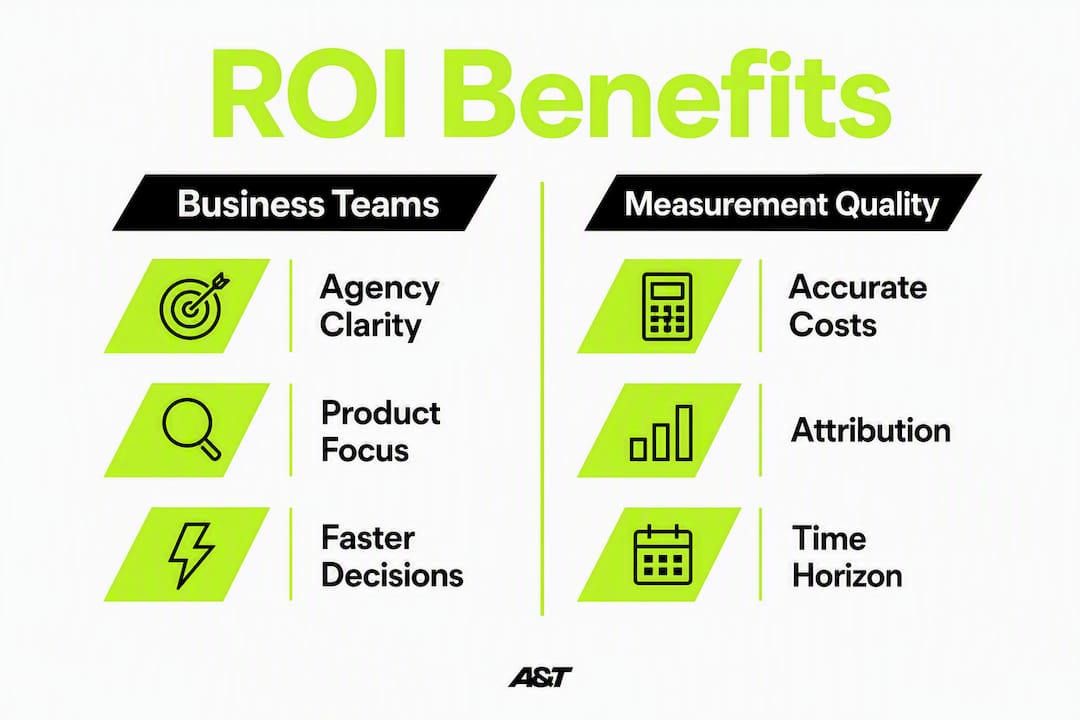
ROI focus delivers four outcomes that matter to leadership:
- Spend prioritization. ROI surfaces which programs return the most profit per dollar. It also exposes waste fast. When you can rank channels by net return, budget reallocation becomes a data decision, not a political one.
- Finance alignment. Vanity metrics create a credibility gap with CFOs and boards. ROI speaks the language finance already uses to allocate capital. Marketers who present profit-driven results get more budget, not more skepticism.
- Scalability signals. ROI identifies repeatable, investable growth channels. When a paid channel consistently returns above your target threshold, you have the evidence to expand the budget confidently. When it doesn't, you know before the quarter ends.
- Performance visibility and retention. Agencies that demonstrate revenue impact retain clients longer and expand budgets more often than those relying on disconnected channel metrics. The same principle applies internally: marketing teams that tie their work to revenue earn more organizational trust.
Agency viewpoint: A paid media team running CRM-connected reporting can show a client exactly which Google Ads campaign generated closed deals, not just clicks. That conversation shifts from "what did we spend?" to "where should we invest next?"
Product viewpoint: A product team using projected ROI to prioritize the development backlog makes faster, more defensible decisions about which features ship first.
What actually drives ROI up or down
Understanding the formula is step one. Controlling the variables is where the real work happens.
Incremental revenue vs. attributed revenue. Attribution models often credit revenue that would have happened anyway. True contribution margin, measured through incrementality tests, shows what the campaign actually caused.

Accurate cost capture. Most ROI calculations undercount costs. Agency fees, creative production, platform subscriptions, and internal team time all belong in the denominator. Missing any of them inflates the result.
Time horizon and CLV. A campaign that acquires customers at a $120 cost-per-acquisition (CAC) looks unprofitable if the average order value is $90. Add a 12-month CLV of $400 and the same campaign is a strong investment. The time horizon you choose changes the decision.
Attribution fidelity. Server-side tracking that persists click IDs into CRM records makes attribution defensible and auditable. Client-side pixels miss offline conversions and lose data to cookie blocking. The measurement method determines whether your ROI number is real or approximate.
Portfolio vs. project view. Not every initiative should be judged on its own ROI. Early-stage tests and brand investments belong in a portfolio view with longer time horizons. Applying short-term project ROI to a 24-month brand-building initiative will kill the right decision every time.
How to apply ROI thinking across business scenarios
ROI isn't a single-use tool. It applies differently depending on the decision in front of you.
Marketing campaign decisions. Compare channels by CAC vs. CLV ratio, not by volume. A channel that delivers fewer leads at a lower CAC and higher CLV beats a high-volume channel with poor retention. Integrated analytics and accounting systems make these comparisons accurate and repeatable. For retargeting specifically, conversion lift from warm audiences often produces the highest ROI of any paid channel.
Product development. Use projected ROI to rank the development backlog. An MVP that costs $50,000 to build and is expected to generate $200,000 in incremental revenue over 18 months has a clear ROI case. Features without a revenue or retention hypothesis don't.

Capital expenditures. ROI supports CAPEX vs. OPEX trade-offs by making the payback period explicit. A $500,000 equipment purchase that reduces production costs by $150,000 per year pays back in roughly 3.3 years. That number belongs in the approval memo.
Innovation and portfolio management. Exploration investments (new markets, new products) need a portfolio ROI lens, not a project-level one. Expect lower near-term returns and measure success by optionality created, not immediate profit. Exploitation investments (scaling what works) should be held to tight ROI targets.
Practical tips to improve ROI, plus a 4-step checklist
Tactics that move the number:
- Reduce CAC by improving ad targeting precision and landing page conversion rates.
- Lift average order value (AOV) through bundling, upsells, and post-purchase sequences.
- Improve retention to grow CLV. A 5% increase in retention can produce outsized profit gains because the acquisition cost is already sunk.
- Optimize the media mix using digital ad spend management principles to shift budget toward the highest-margin channels.
- Use paid media best practices to reduce wasted impressions and improve quality scores, which lowers cost-per-click without cutting reach.
4-step checklist for immediate action:
- Audit your cost inputs. Pull every cost associated with a campaign: media, creative, fees, and overhead. Recalculate ROI with the full denominator.
- Connect click IDs to your CRM. Set up server-side tracking so every ad click that converts to a closed deal is traceable.
- Run an incrementality test. Hold out a small audience segment and compare conversion rates. This tells you what the campaign actually caused vs. what would have happened anyway.
- Reallocate budget based on margin, not revenue. Shift spend toward the channels with the highest net profit per dollar, not the highest gross revenue.
Pro Tip: Test for margin, not just revenue. A campaign generating $100,000 in revenue at a 10% margin returns less profit than one generating $60,000 at a 35% margin. Most media teams optimize for the top line and miss this entirely.
Common measurement pitfalls and how to fix them
ROAS vs. ROI: use the right metric for the right decision
| Metric | What it measures | Best use | Common misuse |
|---|---|---|---|
| ROAS | Revenue per ad dollar | Daily bid and budget optimization | Reporting profitability to leadership |
| ROI | Net profit on total investment | Board-level and strategic decisions | Real-time campaign optimization |
| POAS | Profit per ad dollar | Margin-sensitive e-commerce | Ignored in favor of ROAS |
Layered reporting is the practitioner standard: ROAS for day-to-day media decisions, POAS for margin-aware e-commerce, and ROI for cross-functional leadership conversations. Trying to use one metric for all three purposes causes misalignment between marketing and finance.
Vanity metrics. Raw traffic, follower counts, and impressions mislead when they sit at the top of a dashboard. Demote them to diagnostic status. Place CAC, CLV, and conversion-to-revenue rates at the top. Engagement metrics provide context, not conclusions.
Attribution errors. Client-side pixels drop data when users block cookies or convert offline. Fix: implement server-side tracking and store click IDs in your CRM so every conversion path is auditable. For mature programs, add media-mix modeling and incrementality testing to measure actual lift rather than attributed conversions.
Agency case insight. When agencies connect campaign data to CRM closed-deal revenue, client conversations change. Instead of defending spend, the agency is discussing where to invest next. That shift is what drives client retention and budget expansion. Analyzing campaign data with CRM linkage is the single fastest way to change that dynamic.
When ROI isn't the only metric you need
ROI is the right primary metric for most investment decisions. It isn't always the complete picture.
Where ROI misleads:
- Early-stage product-market fit. Before you have a repeatable customer acquisition model, optimizing for ROI can kill experiments that need time to prove out. Measure learning velocity and retention cohorts instead.
- Brand-building investments. Awareness campaigns produce returns over 12–36 months. Applying a 90-day ROI lens to a brand campaign will make it look like a failure even when it's working.
- Strategic optionality. Some investments create future choices rather than immediate returns. Entering a new market, building a data asset, or acquiring a capability has option value that ROI doesn't capture.
Complementary metrics to use alongside ROI:
- Cohort retention rates (leading indicator of CLV)
- Net Promoter Score (NPS) as a brand health proxy
- Share of voice or branded search volume for awareness investments
- Pipeline velocity for B2B marketing programs
- SEO performance metrics as a leading indicator for organic revenue contribution
How to present this to leadership: show ROI as the primary metric, add one leading indicator (retention rate or pipeline velocity), and one strategic signal (NPS or share of voice). Three numbers tell a more honest story than one.
Key Takeaways
ROI is the primary decision filter for profitable, scalable investments, but it works only when costs are fully captured, attribution is defensible, and the right metric is matched to the right decision.
| Point | Details |
|---|---|
| Use the full cost denominator | Include media, creative, agency fees, and overhead — partial costs inflate ROI and mislead decisions. |
| Match the metric to the decision | Use ROAS for daily optimization, POAS for margin-sensitive e-commerce, and ROI for board-level strategy. |
| Connect CRM to ad data | Server-side tracking with click ID persistence makes attribution auditable and ROI numbers defensible. |
| Widen the view for brand and innovation | Apply portfolio ROI and complementary signals (NPS, cohort retention) when short-term profit isn't the right measure. |
| Atdigiagency as a practical partner | Atdigiagency builds CRM-connected, measurement-first paid campaigns across Google Ads, Meta, and TikTok for SMBs focused on real revenue growth. |
The ROI habit most teams skip
Most teams treat ROI as a reporting ritual. They calculate it at the end of a campaign, present it in a slide, and move on. That's the wrong sequence.
The teams that get the most out of ROI measurement build it into the beginning of every decision. Before a campaign launches, they agree on the cost basis, the revenue attribution method, and the time horizon. Before a budget is approved, they run a projected ROI against a realistic CLV assumption. Before a test is called a success, they check whether the lift was incremental or just attributed.
What we've seen at Atdigiagency is that live dashboards change the conversation faster than any monthly report. When a client can see campaign spend, CRM-linked revenue, and net ROI in real time, the question stops being "did this work?" and becomes "how much more should we put into this?" That shift, from cost-defense to investment-planning, is what makes ROI a genuine management tool rather than a compliance exercise.
The cultural piece matters too. Teams that ask "what did we spend?" are stuck in a cost mindset. Teams that ask "what did we earn, and where should we invest next?" are operating with a growth mindset. The data infrastructure (server-side tracking, CRM linkage, incrementality testing) enables that shift, but the habit has to come first.
How Atdigiagency helps you build a measurement-first paid media program
Most SMBs running paid ads are flying on ROAS alone, which means they're optimizing for revenue while their margins quietly erode. Atdigiagency is built for a different outcome: campaigns where every dollar is tracked from click to closed deal, and budget decisions are made on net profit, not gross revenue.
We set up server-side tracking, connect your ad accounts to your CRM, and build live dashboards that show ROI in real time, not in a monthly PDF. Our paid media work spans Google Ads management, Meta, and TikTok, with campaign strategy and creative development included. You get a small, focused team that moves fast and reports clearly.
If you want to know what your current campaigns are actually returning, and where the next dollar should go, reach out to Atdigiagency for a measurement audit.
Useful sources
- Marketing ROI: What It Is and How to Calculate It — NetSuite
- How vanity metrics stole marketing's credibility — AdExchanger
- Vanity Metrics 101: How To Identify (and Avoid) Vanity Metrics — Shopify
- Marketing ROI — Salesforce
- Why analytics in marketing drives better ROI — BabyLove Growth
- How to measure campaign results for better ROI — Atdigiagency