
TL;DR:
- Optimizing bidding strategies aligns ad spend with business goals and improves return on investment.
- Automation with machine learning outperforms manual bidding by processing signals faster and more accurately.
Bidding strategy optimization is the practice of adjusting how much you pay per click, impression, or conversion to get the most return from every dollar you spend on paid ads. Without it, you are either overpaying for traffic that does not convert or underbidding and losing placements to competitors. The role of bidding strategies goes far beyond setting a number and walking away. Platforms like Google Ads and Meta reward advertisers who align their bids with real business goals, whether that is acquiring new customers, hitting a target cost per acquisition, or maximizing revenue. Getting this right is one of the highest-leverage moves in performance marketing.
Why optimize bidding strategies in paid advertising?
A bidding strategy is your financial playbook for paid advertising decisions. It determines how every dollar you spend connects to a measurable outcome, not just a click or an impression. When your bids are misaligned with your goals, you generate exposure without growth.
The benefits of bidding optimization are concrete. You reduce wasted spend on low-intent traffic, improve your ad placement in competitive auctions, and increase the volume of conversions at a cost your business can sustain. A well-set bid strategy also gives platforms like Google Ads the data signals they need to find better audiences for you over time.
Manual bidding gives you full control but requires constant attention. Automated bidding, including Google Ads Smart Bidding, uses machine learning to adjust bids in real time based on signals no human can process fast enough. The importance of ad bidding becomes clear the moment you compare a campaign running on gut instinct against one running on data-driven bid rules.
What are the main types of bidding strategies and how do they differ?
Manual CPC bidding puts you in direct control of every keyword bid. You set a maximum cost per click, and the platform will not exceed it. This works well for small accounts with limited data or advertisers who want tight budget control during testing phases.
Automated bidding removes that manual work and replaces it with algorithmic decisions. Google Ads automated strategies include Maximize Clicks, Target Impression Share, and the four Smart Bidding strategies: Target CPA, Target ROAS, Maximize Conversions, and Maximize Conversion Value. Each one serves a different business objective.
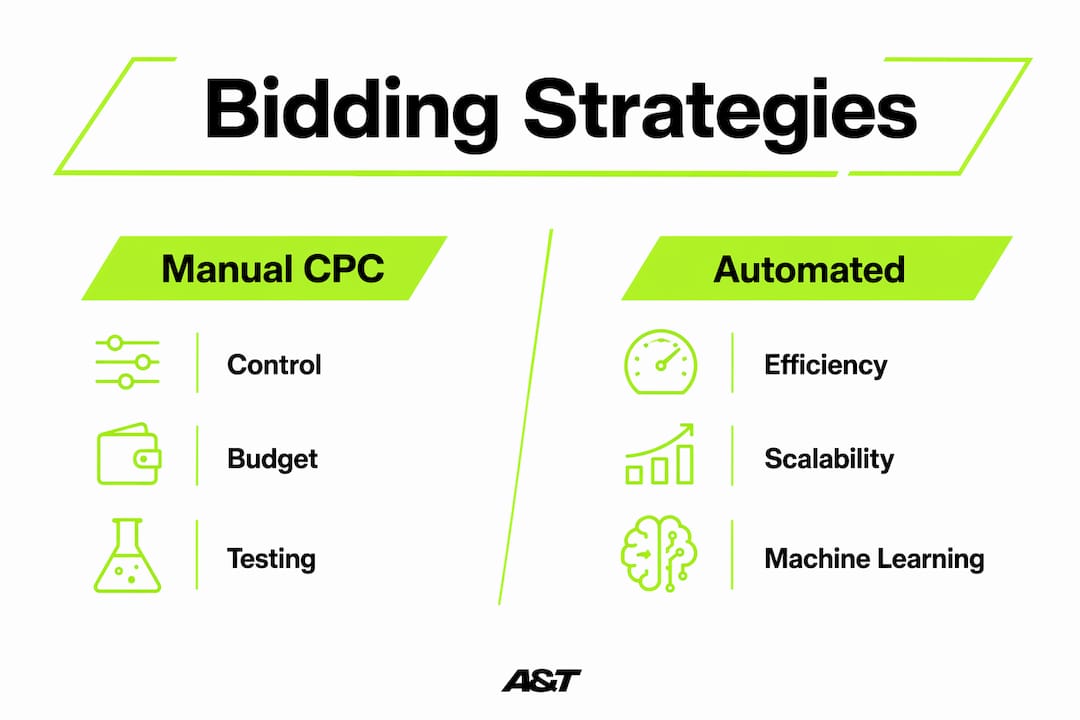
Here is how the main bidding types compare:
| Strategy | Best use case | Key feature |
|---|---|---|
| Manual CPC | Testing, tight budget control | Full bid control per keyword |
| Maximize Clicks | Traffic volume goals | Automated, no conversion data needed |
| Target CPA | Lead generation | Sets bids to hit a cost per acquisition |
| Target ROAS | Revenue-focused campaigns | Bids to hit a return on ad spend target |
| Maximize Conversions | Spend full budget efficiently | Maximizes conversion volume |
| Maximize Conversion Value | Revenue maximization | Prioritizes highest-value conversions |
Automated bidding consistently outperforms manual bidding in mature, high-volume accounts. The reason is simple: machines process more signals per auction than any human team can. For accounts with strong conversion history, switching from manual CPC to a Smart Bidding strategy is one of the fastest ways to improve results without increasing budget.
The tradeoff with manual bidding is time. Reviewing bids keyword by keyword across hundreds of terms is labor-intensive and prone to lag. By the time you adjust a bid, the market may have already shifted.

How does Smart Bidding use machine learning to improve results?
Smart Bidding is Google Ads' auction-time bidding system. It analyzes tens of millions of signals in milliseconds for every single auction. No manual process comes close to that speed or scale.
The signals Smart Bidding uses include:
- Device type (mobile vs. desktop conversion patterns differ significantly)
- Location (city-level and even neighborhood-level intent signals)
- Time of day and day of week (purchase behavior shifts by hour)
- Search query context (the exact phrasing, not just the keyword match)
- Audience lists (remarketing, similar audiences, customer match)
- Browser and operating system (conversion rates vary by environment)
Each of these signals is weighted differently for every auction. That is what makes auction-time bidding so powerful. A manual bid adjustment for "mobile" applies a flat modifier across all mobile traffic. Smart Bidding sets a unique bid for each mobile user based on their full context.
Smart Bidding also eliminates daily spend guesswork by tailoring bids to the specific conversion goal in every auction. You set the target, and the algorithm works toward it continuously.
Pro Tip: Give Smart Bidding at least two to three conversion delay windows before evaluating performance. Pulling the plug too early is the most common mistake advertisers make when switching from manual to automated bidding.
The practical implication is this: if your account has enough conversion data, Smart Bidding will outperform manual bidding. The threshold Google recommends varies by strategy, but Target CPA and Target ROAS perform best with at least 30–50 conversions per month in the campaign.
Why does ongoing analysis matter for ad performance?
Setting a bid strategy is not a one-time decision. Campaign data changes as competition shifts, seasonality kicks in, and your audience behavior evolves. Regular analysis and adjustments, including adding negative keywords, directly reduce wasted budget and improve efficiency.
A structured approach to bid optimization analysis looks like this:
- Review search term reports weekly. Identify queries triggering your ads that have no conversion intent. Add them as negative keywords immediately.
- Check bid strategy performance after the learning period. The optimal timing to adjust bid strategies is after two to three conversion delay windows. Changing settings mid-learning resets the algorithm.
- Segment performance by device, location, and time. If mobile traffic converts at half the rate of desktop, that data should inform your bid adjustments or exclusions.
- Monitor Quality Score trends. A dropping Quality Score signals a mismatch between your bid, ad copy, and landing page. Fixing that mismatch often improves results faster than raising bids.
- Audit budget pacing. If campaigns hit budget caps before the end of the day, you are leaving conversions on the table regardless of how well your bids are set.
Negative keywords are one of the most underused tools in bid management. Every irrelevant click you block is budget redirected toward traffic that actually converts.
Pro Tip: Build a shared negative keyword list at the account level and apply it to all campaigns. This prevents the same wasted spend from recurring across every new campaign you launch.
Long-tail keywords represent 70% of all search traffic and typically carry lower CPCs with higher conversion rates. Including them in your bid strategy analysis often reveals high-ROI opportunities that broad terms miss entirely.
How to align your bidding strategy with your business goals
The right bid strategy depends entirely on what you are trying to accomplish. Choosing Target ROAS when your goal is lead generation, or Maximize Clicks when your goal is revenue, produces poor results no matter how well the algorithm runs.
Match your strategy to your objective:
- Brand awareness goal: Use Target Impression Share to control how often your ads appear at the top of search results.
- Lead generation goal: Use Target CPA to control the cost of each form submission or phone call.
- Revenue goal: Use Target ROAS or Maximize Conversion Value to prioritize high-value transactions.
- Budget-limited accounts: Use Maximize Conversions with a budget cap to get the most conversions within your spend limit.
- New campaigns with no conversion data: Start with Maximize Clicks or manual CPC to build data, then transition to Smart Bidding once you have enough conversion history.
Budget constraints shape bid strategy choices in ways that are often overlooked. A Target ROAS strategy set too aggressively will cause Google Ads to restrict impressions because the algorithm cannot find auctions where it can hit your target. Setting a realistic target based on historical data, then tightening it gradually, produces better volume and better returns.
Bidding aligns your ad budget with specific goals like acquiring new customers or maximizing profits. When that alignment is off, you spend more and get less. When it is right, every dollar has a defined job.
Scalability is another factor. Manual bidding does not scale well beyond a few dozen keywords. As your account grows, PPC automation becomes the only practical way to maintain bid accuracy across hundreds of ad groups and campaigns simultaneously.
Key Takeaways
Optimizing bidding strategies is the single most direct way to improve ROI without increasing your advertising budget.
| Point | Details |
|---|---|
| Bidding is a financial plan | Every bid decision should connect ad spend to a measurable business outcome. |
| Smart Bidding outperforms manual at scale | Machine learning processes millions of auction signals that no human team can match. |
| Ongoing analysis is non-negotiable | Review search terms, negative keywords, and performance data on a weekly basis. |
| Match strategy to goal | Use Target CPA for leads, Target ROAS for revenue, and Maximize Clicks for new campaigns. |
| Timing matters for changes | Wait two to three conversion delay windows before adjusting a bid strategy mid-flight. |
What I have learned from years of managing bid strategies
The biggest mistake I see digital marketers make is treating bid strategy selection as a setup task rather than an ongoing discipline. They pick Target CPA, set a number, and check back in a month. By then, the campaign has either overspent chasing an unrealistic target or throttled itself into irrelevance.
Manual bidding taught me something automated systems cannot fully replace: the discipline of reading campaign data with genuine curiosity. When you set every bid by hand, you notice patterns. You see which hours convert, which devices waste money, and which keywords look good in volume but terrible in cost per conversion. That instinct transfers directly into smarter Smart Bidding setups.
The evolution of Smart Bidding has been real and significant. The system today is meaningfully better than it was three years ago. But it still needs human oversight. Algorithms do not know that your business is running a promotion next week, or that a competitor just dropped out of the market. Those context signals have to come from you.
My honest advice: use automation for the heavy lifting and reserve your attention for strategy. Set realistic targets, give the algorithm time to learn, and review campaign ROI on a schedule rather than reacting to daily fluctuations. The advertisers who win are the ones who treat bidding as a system, not a setting.
— Ann
How expert ad management accelerates your bidding results
Managing bid strategies across Google Ads and Meta campaigns requires both technical knowledge and consistent time investment. Most business owners and lean marketing teams do not have both. That gap is where performance marketing specialists add real value.
Atdigiagency builds and manages paid ad systems with bidding strategy optimization at the core. The team handles everything from initial strategy selection and Smart Bidding setup to weekly analysis, negative keyword management, and budget pacing. Clients get campaigns that are built to hit specific cost and revenue targets, not just generate traffic. If you want expert hands on your Google Ads management, Atdigiagency runs campaigns that are tested, purposeful, and built around your numbers.
FAQ
What is Smart Bidding in Google Ads?
Smart Bidding is Google Ads' automated bid system that uses machine learning to set bids at auction time. It analyzes signals like device, location, and user context to maximize conversions or conversion value toward a specific target.
How do I choose between manual and automated bidding?
Use manual CPC when your account is new or lacks conversion data. Switch to automated Smart Bidding strategies like Target CPA or Target ROAS once you have consistent conversion history, typically 30–50 conversions per month.
How long should I wait before changing a bid strategy?
Wait two to three conversion delay windows after launching or changing a bid strategy. Adjusting settings during the learning period resets the algorithm and produces unreliable performance data.
What role do negative keywords play in bid optimization?
Negative keywords block irrelevant searches from triggering your ads, which reduces wasted spend and directs budget toward traffic with genuine conversion intent. They are one of the most cost-effective bid management tools available.
Why do long-tail keywords matter for bidding strategy?
Long-tail keywords represent 70% of all search traffic and typically have lower CPCs with higher conversion rates. Including them in your bid strategy captures high-intent traffic at a lower cost than broad, competitive terms.