

TL;DR:
- Responsive search ads improve campaign relevance and reach by automatically testing diverse asset combinations based on user signals. They reduce manual testing effort, enhance ad relevance, and deliver performance improvements that grow over time with data. Effective use requires strategic asset creation, patience, and ongoing optimization to maximize their potential for SMBs.
Most marketers assume that tighter control over ad copy means better results. Write the headline yourself. Pick the description. Lock it in. It feels logical. But that instinct can actually limit your campaign's reach and relevance, especially when you're working with a smaller budget and can't afford to waste impressions. Responsive search ads can improve performance and capture incremental traffic through more relevant ad combinations, giving your campaigns more flexibility than any single static ad ever could. This article breaks down exactly how responsive search ads (RSAs) work, what benefits they deliver for small to medium-sized businesses (SMBs), where they fall short, and how to use them with intention.
Table of Contents
- What are responsive search ads and how do they work?
- Key benefits of responsive search ads for SMBs
- Potential challenges and what to watch out for
- Best practices and advanced tips for leveraging RSAs
- Our take: The right way to think about responsive search ads
- Boost your results with RSA & Google Ads expertise
- Frequently asked questions
Key Takeaways
| Point | Details |
|---|---|
| Automation increases relevance | RSAs let Google test and combine headlines/descriptions automatically for more personalized search results. |
| Greater reach and auction volume | More ad variations mean competing in more auctions, helping SMBs capture opportunities static ads miss. |
| Less manual work | RSAs dramatically reduce the need for repetitive A/B tests and manual updates by automating creative assembly. |
| Testing and patience needed | Effective RSA campaigns still require strong creative inputs and enough data to optimize effectively. |
What are responsive search ads and how do they work?
Responsive search ads are Google's primary ad format for search campaigns. Unlike traditional expanded text ads (ETAs), which had fixed headlines and descriptions you wrote and published as-is, RSAs work differently from the ground up.
With an RSA, you provide a pool of assets: up to 15 headlines and 4 descriptions. Google then automatically tests and adapts multiple headline and description combinations in real time, serving the version most likely to resonate with each individual searcher based on their query, device, location, and behavior signals.
Think of it like having 15 different sales pitches available and letting Google decide which three headlines and two descriptions to combine for each auction. The system learns over time which combinations drive clicks and conversions, and it prioritizes those going forward.
Here's a quick comparison of RSAs versus expanded text ads:
| Feature | Expanded text ads | Responsive search ads |
|---|---|---|
| Headlines | 3 fixed | Up to 15 (pooled) |
| Descriptions | 2 fixed | Up to 4 (pooled) |
| Ad combinations | 1 | Up to 43,680 |
| Testing method | Manual A/B | Automated machine learning |
| Optimization | Requires manual updates | Continuous, automatic |
| Status in Google Ads | Deprecated (read-only) | Active, primary format |
The practical impact of this is significant. Instead of running 3 or 4 separate ad variations to test copy, you feed Google diverse assets and the system handles the permutations for you. For SMBs that don't have hours to spend on manual split testing, this is a genuine efficiency gain.
The key benefits RSAs deliver at this stage include:
- Broader auction participation: More combinations means eligibility to appear for a wider range of search queries.
- Real-time relevance: Google matches the ad combination to what each user is actually searching for, not just a pre-approved script.
- Continuous learning: Asset performance data builds over time, improving future decisions automatically.
Understanding why this matters is also why we put Google Ads ROI optimization at the center of our campaign strategy work. Better ad relevance is one of the fastest levers to pull for improved Quality Score, lower CPCs, and stronger overall results.
Key benefits of responsive search ads for SMBs
Now that you know how RSAs work, let's get specific about the returns you can realistically expect. The benefits aren't just theoretical. They show up in real campaign metrics, particularly for resource-limited teams.
1. More reach without more budget
RSAs can match more queries than fixed ads because they adapt to the full spectrum of a user's search intent. A static ad written for "email marketing software" may not show up for someone searching "best tools to send newsletters." An RSA with diverse headlines covering both angles will. That incremental reach adds up, especially in competitive verticals.

2. Automation replaces tedious manual testing
Before RSAs, proving which headline worked required setting up separate ad variations, waiting for statistical significance, and then manually updating copy. RSAs reduce the operational burden of that entire process. You write the assets once, and Google handles the testing logic. Your team gets time back.
3. Better ad relevance across the funnel
Ad relevance is one of three components that determine your Quality Score. Higher Quality Scores directly lower your cost per click, which means more reach per dollar spent. RSAs improve relevance by dynamically matching copy to context, something no static ad can do at scale.
4. Performance gains compound with data
The longer your RSA runs, the smarter it becomes. Early on, you'll see broad exploration. Over time, Google narrows toward the combinations that actually convert. This is a performance system that gets better the more it runs. Pair that with a solid ad optimization checklist and you're giving the algorithm the best inputs to work with.
Here's how RSAs stack up against manual ad management from an operational standpoint:
| Factor | Manual ad management | RSAs with good assets |
|---|---|---|
| Time to test variations | Days to weeks | Immediate |
| Number of variations tested | 3 to 5 per ad group | Hundreds automatically |
| Optimization frequency | Manual, campaign-dependent | Continuous |
| Learning curve | High | Moderate |
| Requirement for success | Strong copy instincts | Strong asset diversity |
"Automation in paid ads isn't about removing judgment from the equation. It's about directing your judgment toward the inputs, so the system can scale the outputs."
Pro Tip: When writing headlines for your RSAs, avoid writing variations that all say roughly the same thing. Google needs genuine diversity to find real signal. Write headlines from different angles: one benefit-focused, one feature-focused, one urgency-driven, one that speaks directly to the customer's pain point. Variety is what unlocks performance.
Using automation to boost PPC ROI only works when the creative inputs are strong. That's where your strategic energy should go.
Numbered summary: The top 4 benefits of RSAs for SMBs
- Expanded reach across more relevant search queries
- Automatic A/B testing without manual overhead
- Higher ad relevance and potential Quality Score improvements
- Compounding performance gains as data accumulates
Potential challenges and what to watch out for
While the benefits are clear, it's equally important to understand the potential drawbacks and how to navigate them. RSAs are not a magic button. We've seen campaigns where adding RSAs caused short-term disruption. You should know that going in.
Performance doesn't always improve immediately
One case study reported moderate decreases in clicks, impressions, and CTR for campaigns that included RSAs. This doesn't mean RSAs are broken. It means the transition period is real, and jumping to conclusions after two weeks of data is a mistake marketers make all the time.
Early data is not reliable data
RSAs require enough traffic and conversions to evaluate asset performance meaningfully. If your campaign generates fewer than 100 clicks per week, the system won't have enough information to distinguish which asset combinations actually work. You'll see "Learning" statuses on assets that never resolve because there just isn't enough volume to reach statistical clarity.
Here are the most common RSA pitfalls to avoid:
- Launching and ignoring: RSAs need periodic asset reviews. Stale, low-rated assets drag performance down.
- Using redundant headlines: If all 15 headlines say the same thing differently, you're wasting asset slots and limiting what the algorithm can learn.
- Over-pinning assets: Pinning every headline forces Google into fixed combinations, defeating the purpose of RSA flexibility.
- Expecting instant lifts: Campaigns in highly competitive niches often see a learning curve of 4 to 6 weeks before performance stabilizes.
- Ignoring asset ratings: Google labels each asset as "Low," "Good," or "Best." Replace anything stuck at "Low" after sufficient data.
Statistic callout: According to independent research, some campaigns experienced a noticeable drop in CTR when RSAs were first introduced, reinforcing that a measurement window of at least 30 days is necessary before drawing any conclusions.
Pro Tip: Before drawing conclusions about RSA performance, make sure you're looking at a minimum of 4 weeks of data, ideally across at least 500 impressions per ad group. Volume matters as much as the numbers themselves.
Scaling Google Ads for higher ROI requires patience in the data collection phase. Cutting campaigns short because week-two numbers look soft is one of the most expensive mistakes SMBs make.
Best practices and advanced tips for leveraging RSAs
To ensure you actually get the promised benefits, here's how to set up your RSAs for maximum effect.
1. Write for diversity, not volume
More headlines don't automatically mean better performance. Write each headline to serve a genuinely different purpose. Cover the core offer, the unique value proposition, a social proof element, an urgency or scarcity angle, and a direct call to action. That diversity gives the algorithm real variables to test.
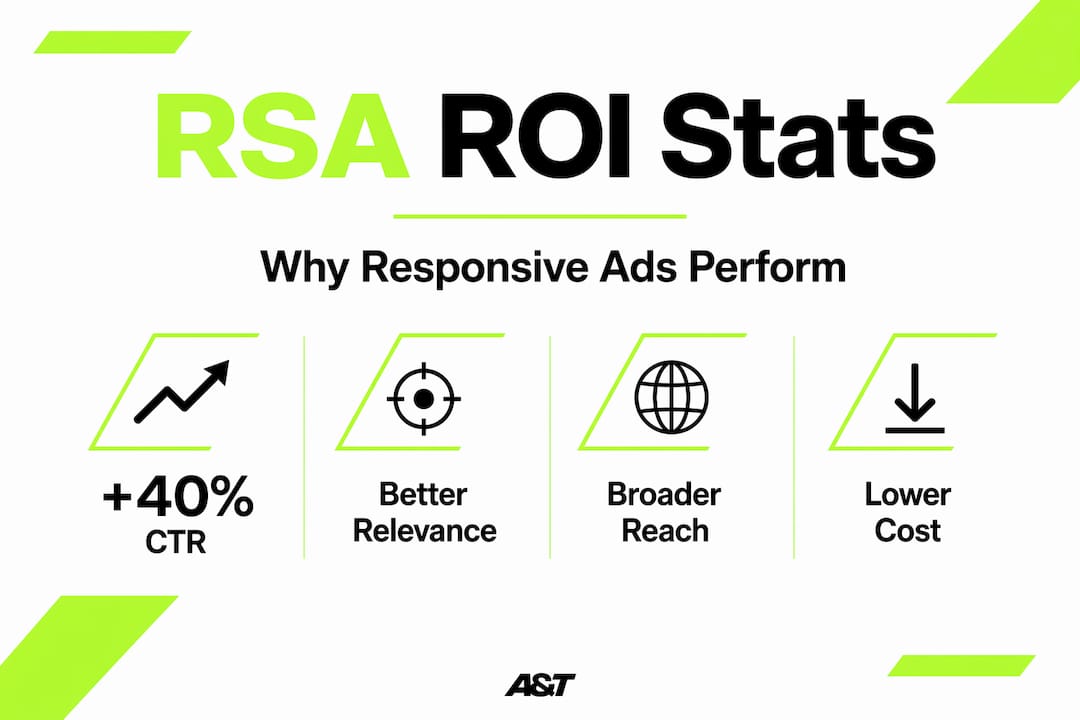
2. Give the system time to learn
RSAs work best when fed with quality assets and given enough time and data to learn. For most accounts, that means committing to a minimum 30-day evaluation window before making significant asset changes. Swapping headlines every few days resets the learning cycle and delays meaningful results.
3. Use pinning sparingly
You can pin a headline to a specific position (Position 1, 2, or 3) to ensure it always appears. This is useful when you have strict brand compliance requirements or legal disclosures. But Google's AI-driven asset assembly is moving toward more flexible combinations, and over-pinning limits what the system can optimize. Pin only what you must. Leave everything else flexible.
4. Monitor asset ratings and rotate out low performers
Every headline and description gets rated over time. Log in weekly, check your asset performance column, and replace any asset stuck at "Low" after sufficient impressions. This keeps your creative pool fresh and gives the algorithm better material to work with.
5. Align RSA assets with landing page content
Ad relevance isn't just a Quality Score metric. It's a conversion driver. When your headlines directly mirror the language on your landing page, users feel a sense of continuity. That consistency builds trust and reduces bounce rates. Write your RSA assets with your landing page in mind.
6. Run at least 2 to 3 RSAs per ad group
Running more than one RSA per ad group gives you variation at the campaign level and more data to draw conclusions from. It also protects against single-ad fatigue in longer-running campaigns.
Pro Tip: Use the "Ad Strength" indicator in Google Ads as a guide, not a goal. An RSA rated "Excellent" on Ad Strength doesn't automatically outperform one rated "Good." Asset quality and audience alignment matter more than the Google-assigned strength score.
For a deeper look at how these principles apply to broader campaign structure, our advanced Google Ads tips for 2026 and Google Display Ads strategies resources cover the full picture.
Our take: The right way to think about responsive search ads
We've seen how RSAs perform across a wide range of industries: telehealth, retail, entertainment, health and wellness. The pattern is consistent. The SMBs that get the most out of RSAs are not the ones who hand everything over to automation and wait. They're the ones who treat RSA setup as a strategic input process and give the algorithm genuinely strong material to work with.
Many SMBs expect RSAs to transform performance overnight. That expectation sets them up for frustration. The real value lies in using RSAs to complement a thoughtful ad strategy, not replace it. Automation handles the testing permutations. Your job is to ensure the raw material, the headlines and descriptions, are smart, specific, and diverse enough to give the system something meaningful to work with.
There's also a patience problem in lower-volume accounts. If your campaign generates 200 impressions a week, RSAs will take longer to deliver reliable signal. That's not a flaw in the format. It's a data reality. Trying to optimize a low-traffic campaign like a high-traffic one will always lead to premature conclusions and wasted spend.
The honest truth: RSAs are a tool, and like any tool, their value depends entirely on who's using them and how. Understanding the full range of digital ad types and where RSAs fit within a broader paid strategy is what separates accounts that grow from accounts that just spend. Iteration and asset quality are more decisive than any algorithm update.
Boost your results with RSA & Google Ads expertise
Running RSAs well takes more than uploading headlines and hoping for the best. It takes a structured approach to asset creation, data interpretation, and ongoing optimization. That's exactly what we do at A&T Digital Agency. We build paid ad systems around your business goals, not templates. Whether you're launching your first Google Ads campaign or trying to improve results from an existing one, our team handles the full cycle: strategy, setup, optimization, and reporting. No unnecessary meetings. Just campaigns that convert. If you're ready to get more from your Google Ads budget, explore our expert Google Ads management services and see what data-driven execution actually looks like in practice.
Frequently asked questions
How do responsive search ads differ from expanded text ads?
RSAs let Google dynamically assemble combinations from a pool of up to 15 headlines and 4 descriptions, while expanded text ads used fixed, manually written copy that never changed between auctions.
Do responsive search ads always improve performance?
Not always. Some case studies reported moderate decreases in clicks and CTR when RSAs were introduced, which is why ongoing monitoring and a sufficient evaluation window are essential before drawing conclusions.
What's the minimum data needed for RSAs to be effective?
Experts suggest that an asset needs roughly 100 clicks to evaluate CTR and approximately 100 conversions to draw reliable conclusions about conversion rate or cost per acquisition.
Can I control which RSA headlines or descriptions appear?
You can pin specific assets to fixed positions, but flexible AI-driven assembly generally produces better performance. Reserve pinning for strict brand compliance requirements and leave the rest open.