
Expect to pay roughly $500 to $2,500 a month for basic SMB management, or 10% to 20% of ad spend once your budget grows past that. Management fees always sit on top of ad spend, never inside it. Flat retainers fit smaller, simpler accounts best. Percentage or tiered percentage models tend to fit accounts spending $10,000 or more a month, where the work scales with the budget.
TL;DR:
- Flat retainers are most cost-effective for accounts spending under $10,000 monthly, typically costing $500 to $1,500 per month.
- Percentage-based fees of 10% to 20% are suitable for accounts exceeding $10,000 monthly, often reaching $1,500 to $10,000 or more in management costs.
- Management costs increase with ad spend, channel complexity, number of campaigns, creative needs, and tracking setup, which all significantly influence quotes.
- Always verify whether management fees are flat or tiered, and ask for the total monthly cost, including spend, to accurately compare quotes.
Table of Contents
- PPC Management Pricing Models: Flat Retainer, Percent of Spend, Hourly, and Hybrid
- What PPC Management Actually Costs by Monthly Ad Spend
- What's Included in a PPC Management Fee (and What Costs Extra)
- What Actually Drives Your PPC Management Cost
- Agency vs. Freelancer vs. In-House: What Each One Actually Costs
- How to Evaluate a PPC Proposal Before You Sign
- How Atdigiagency Prices Engagements in Practice
- The Real Problem With Most PPC Pricing Advice
- Get a PPC Management Quote Built Around Your Actual Account
- Where These Numbers Come From
- Sources
PPC Management Pricing Models: Flat Retainer, Percent of Spend, Hourly, and Hybrid
The model an agency proposes tells you almost as much as the number attached to it. Each one aligns incentives differently, and that alignment matters more than the sticker price.
Flat retainer charges a fixed monthly fee regardless of spend, typically $1,500 to $10,000 depending on account complexity. You know your cost every month. The tradeoff: an agency has no built-in incentive to help you spend more, which is fine if you're budget-capped but frustrating if you're trying to scale fast.
Percent of ad spend charges 10% to 20% of monthly budget, and it's the most common model once spend climbs past five figures. It scales naturally with your account, but a flat percentage can quietly reward wasted spend if the agency has no reason to cap inefficiency.
Hourly billing runs $75 to $250 or more per hour, with Clutch pegging typical agency rates near $100 to $149 an hour. It suits narrow, defined projects like an audit or a campaign rebuild, not ongoing management.
Performance-based pricing ties fees to results, which sounds ideal until you're arguing over attribution. Hybrid models (small retainer plus a lighter percentage) often solve that by blending stability with scale-based upside.
- Flat retainer: best for accounts under $10,000/month in spend
- Percent of spend: best for accounts scaling past $10,000/month
- Hourly: best for audits, one-off projects, or short-term consulting
- Hybrid: best when you want cost predictability plus incentive alignment
Pro Tip: Ask whether the percentage is flat across all spend or tiered by bracket. A tiered structure that lowers the rate as spend increases keeps the agency from collecting a bigger fee just because your budget grew, not because performance improved.
What PPC Management Actually Costs by Monthly Ad Spend
The right pricing model shifts as your ad budget grows, and so does the realistic fee you should expect to pay. Here's how that breaks down in practice.
| Monthly ad spend | Typical management fee structure | Approx. management fee |
|---|---|---|
| Under $2,500 | Flat minimum retainer | $500–$1,500/month |
| $2,500–$10,000 | Flat retainer or flat percentage | $500–$2,500/month |
| $10,000–$49,999 | Percent of spend (10–15%) or tiered | $1,500–$10,000/month |
| — | Tiered percentage with negotiated caps | Custom, often capped |
Take a $15,000/month spender paying a flat 12%: that's $1,800 in management fees, for a total monthly outlay of $16,800. A smaller account spending $4,000/month on a $1,200 flat retainer lands at $5,200 total. Same category of spend, very different math depending on the model.
UseCalcPro's cost benchmarks note that below roughly $1,500 in total monthly budget, professional management often stops being cost-effective. At that level, the fee can eat a disproportionate share of what you'd otherwise put toward clicks.
- Rule of thumb: budget around 20% of your total marketing spend toward paid ads and management combined
- Always ask for the total monthly cost (spend plus fee), not just the management fee in isolation
- Compare quotes on total cost per lead or per sale, not the management fee alone
What's Included in a PPC Management Fee (and What Costs Extra)
A legitimate management fee should cover the full lifecycle of running your campaigns, not just bid tweaks, as explained in detail by Pay Per Click Campaign Management - seo analytic. If a quote looks unusually cheap, check what's missing before you sign.
Standard inclusions typically cover:
- Account setup, campaign structure, and keyword research
- Bid management and budget pacing across campaigns
- Ad copy writing and ongoing A/B testing
- Weekly or biweekly optimization (negative keywords, audience refinement, placement exclusions)
- Monthly performance reporting
- Basic landing-page recommendations tied to conversion rate
Common add-ons that often cost extra:
- Creative production (video, static ad design, photography)
- Server-side or advanced conversion tracking setup
- Full landing-page builds
- Third-party software or reporting tool fees
Setup and onboarding fees typically run $500 to $5,000 depending on account history, tracking complexity, and how many platforms you're launching across. That fee is justified when it covers real conversion tracking work and audience research, not when it's just a markup for opening an account.
Pro Tip: Get the setup fee itemized. A vague "onboarding fee" with no breakdown is a common spot where agencies pad margin without adding real setup work.
What Actually Drives Your PPC Management Cost
Two businesses spending the same $10,000 a month can get wildly different quotes, and the gap usually traces back to a handful of variables that have nothing to do with the base spend number.
- Ad spend and channel count: managing Google, Meta, and TikTok simultaneously costs more than managing one platform
- Number of campaigns, SKUs, and audience segments: a 500-SKU e-commerce catalog demands more structure than a single-service lead gen account
- Creative production needs: ongoing video and static ad testing adds real labor hours beyond copy and bids
- Measurement complexity: offline conversion imports and server-side tracking require setup and maintenance that flat "optimization" doesn't cover
- Team seniority and reporting cadence: a senior strategist on weekly calls costs more than a junior analyst on a monthly report, and that's often the real difference between two proposals at the same price point
Cutting complexity, not just spend, is usually the fastest way to lower your quote.
Agency vs. Freelancer vs. In-House: What Each One Actually Costs
Your delivery model matters as much as your pricing model. Each option trades cost against coverage and risk differently.
Agencies typically run $1,500 to $10,000/month flat or 10% to 20% of spend, and many projects land in the $10,000 to $49,999 range for larger engagements. You get a team, backup coverage, and established processes, but less day-to-day face time than a dedicated hire.
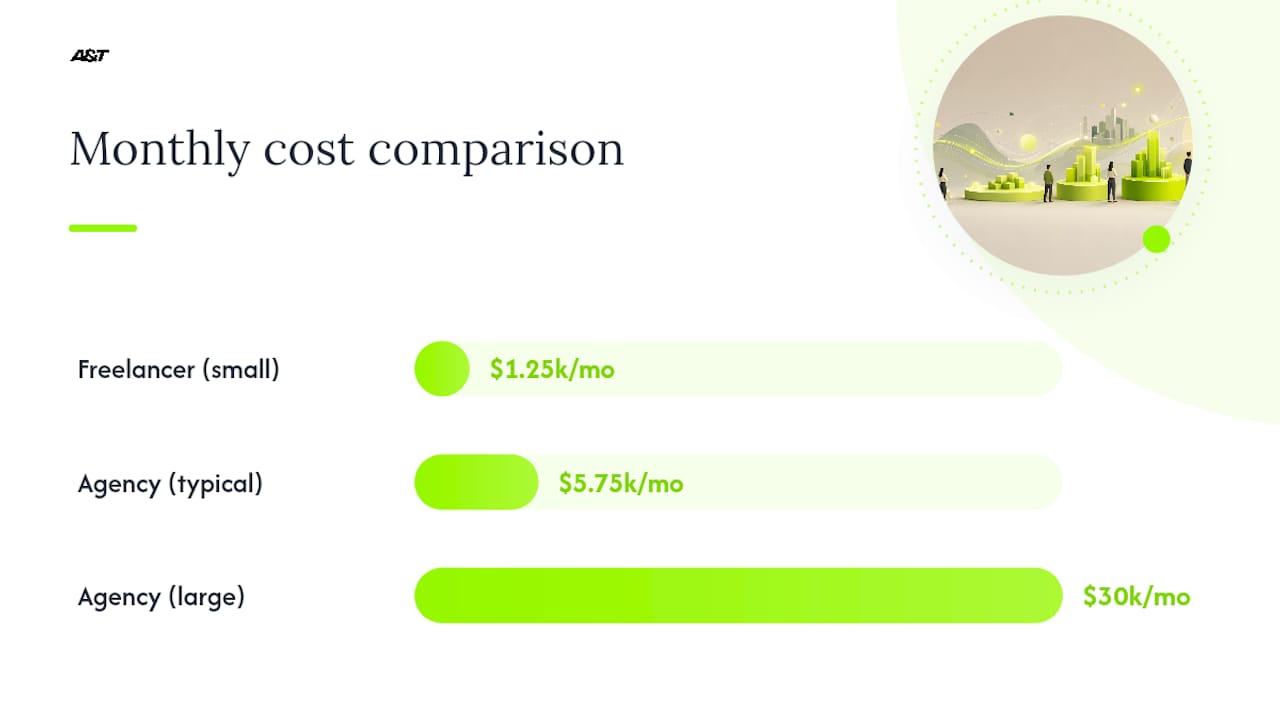
Freelancers bill $75 to $200+ an hour or a lower flat rate, often $500 to $2,000/month for smaller accounts. Costs run lower, but you're relying on one person with no built-in backup if they're unavailable or move on.
In-house hires cost a full salary, benefits, and ramp time, usually the most expensive option below $30,000/month in spend. It only pencils out once your account is complex enough to justify dedicated headcount full time.
- Agency: best value for most SMBs and mid-market accounts needing coverage without a full-time hire
- Freelancer: best for tight budgets willing to accept single-person risk
- In-house: best once spend and complexity justify a dedicated salary
How to Evaluate a PPC Proposal Before You Sign
Run every quote through the same checklist. It exposes the gaps a slick pitch deck won't mention.
- Ask exactly who staffs the account and how many hours per week they'll spend on it
- Confirm the reporting cadence and what metrics the report actually includes
- Get a written definition of "managed spend" (does it include all platforms, or just Google?)
- Ask whether tooling costs (call tracking, reporting software) are pass-through or included
- Request the contract minimum, notice period, and whether percentage fees have a negotiated cap
- Push for a trial month or quarter before locking into a long-term agreement
Pro Tip: Request a marginal, tiered percentage rather than a flat one on all spend. It's the single biggest negotiation lever for accounts scaling past $20,000/month, since it stops your management fee from growing faster than your results.
Red flags worth walking away from: opaque or infrequent reporting, unusually low fees paired with long lock-in contracts, and hourly billing with no defined deliverables attached.
How Atdigiagency Prices Engagements in Practice
Pricing a PPC engagement isn't a formula you plug numbers into. It's a judgment call based on how much complexity a business is actually bringing to the table.
We've structured flat retainers for a telehealth client with a single funnel and a tight, well-defined offer, where predictability mattered more than scale. We've also priced a mid-market retail account on a tiered percentage, because their spend was climbing fast across multiple product lines and a flat fee would have undercharged for the added campaign management.
The question we ask before quoting anyone isn't "how much do you want to spend." It's "how complex is what you're asking us to manage." Spend tells you the ceiling. Complexity tells you the real cost.
Our Google Ads management work follows this same logic: match the model to the account, not the account to a pricing template.
The Real Problem With Most PPC Pricing Advice
Most pricing guides hand you a range and stop there, and that's the part that fails business owners the most. A $1,500 flat fee and a 12% cut of a $30,000 budget can produce wildly different actual dollars, yet both get filed under "SMB pricing" in generic comparisons.
The bigger blind spot is complexity, not spend. Two accounts spending identical budgets can justify very different quotes once you factor in SKU count, channel count, and tracking setup, and readers who anchor only on the ad spend number get blindsided when quotes vary widely for what looks like the same job.
Prioritize the model over the number first. A flat retainer that fits a simple account beats a low percentage on a complex one every time, because the incentive structure decides whether your agency grows with you or just collects a bigger check as your budget happens to rise. Ask about tiered percentages before you ask about total cost. The math sorts itself out once the structure is right.
— Ann
Get a PPC Management Quote Built Around Your Actual Account
Atdigiagency works best for SMBs, e-commerce brands, telehealth providers, and entertainment venues that want a small team running paid media without the overhead of a full in-house department. A typical retainer includes account setup, ongoing campaign optimization, creative development, conversion tracking, and monthly reporting, structured around a flat or tiered fee that fits your actual spend level, not a one-size template.
There are no long onboarding calls and no bloated account teams. Just a team that builds the campaign structure, tests the creative, and reports on what's actually working. If you want a quote scoped to your spend and complexity, start with our Google Ads management services or check our Meta Ads management page if Facebook and Instagram are part of your channel mix.
Where These Numbers Come From
Every range in this piece is checked against published market benchmarks, not internal guesswork. HawkSEM's pricing breakdown anchors the flat-fee and percentage ranges. Clutch's PPC Pricing Guide supplies hourly rate and project-cost benchmarks. UseCalcPro's cost calculator grounds the minimum-viable-budget guidance, and Statista's search advertising outlook explains the market pressure behind rising click costs. Cross-check any quote you receive against these before you sign.