
TL;DR:
- Merging multiple ad campaigns into fewer structures improves algorithm performance and reduces costs. Campaign consolidation boosts conversion signals, shortens learning phases, and streamlines team operations. Proper planning and unified reporting are essential for maximizing long-term advertising results.
Campaign consolidation is the process of merging multiple standalone ad campaigns into fewer, higher-signal structures to improve algorithmic performance and reduce wasted spend. Marketing managers at small and medium-sized companies often run dozens of fragmented campaigns across Google Ads and Meta, each starved of the data it needs to perform. The result is predictable: bloated accounts, confused algorithms, and rising costs. The case for why choose campaign consolidations comes down to hard numbers. Meta's Advantage+ Shopping campaigns deliver a 22% higher return on ad spend compared to manual, fragmented setups. Industry audits show that reducing a highly fragmented account from 47 campaigns to 12 produces a 20–30% drop in cost per acquisition within 4–6 weeks. Those are not incremental gains. They are structural improvements that compound over time.
Why choose campaign consolidations for better algorithmic performance
Fragmented campaigns starve ad platform algorithms of the conversion signals they need to learn. Each campaign runs its own learning phase, and when budgets are split across dozens of small campaigns, none of them accumulate enough data to exit that phase efficiently. The algorithm stays in a perpetual state of guessing rather than optimizing.

Consolidation solves this by pooling conversion data into fewer campaigns. More signals per campaign means faster learning, better audience targeting, and lower costs over time. This concept, often called algorithmic learning recovery, is the core technical reason behind consolidation's performance gains.
Meta's Advantage+ campaign structure is the clearest real-world example. Advantage+ Creative can evaluate up to 150 creative variants within a single consolidated campaign architecture. That scale of creative testing inside one campaign gives the algorithm far more to work with than 15 separate campaigns each running 3 ads.
Consolidation also reduces frequency overlap and internal auction competition. When two campaigns from the same account bid against each other for the same audience, you pay more and reach fewer new people. Merging those campaigns eliminates that self-competition entirely.
- Faster learning phase exit: Pooled conversion data helps algorithms reach statistical confidence sooner.
- Reduced audience overlap: Fewer campaigns targeting the same users lowers internal bid competition.
- Better frequency management: One campaign controls how often a user sees your ads across placements.
- Extended reach: Consolidated budgets give the algorithm more room to find new, high-value audiences.
Pro Tip: Keep creative variation high inside consolidated campaigns. Running 5–8 distinct ad creatives per campaign gives the algorithm enough material to test without splitting your budget across separate campaigns.
How consolidation reduces operational drag on your marketing team
The biggest cost of fragmented campaigns is not always wasted ad spend. It is the operational inefficiency that comes from managing too many moving parts at once. Marketing managers who oversee 40+ campaigns spend most of their time on reactive task management rather than strategic growth decisions.
Context switching is the specific mechanism at work here. Every time a marketer moves from one campaign to another, they lose the mental context built up in the previous one. Multiply that across dozens of campaigns and you get a team that is always busy but rarely making progress on what matters.
Consolidated campaign structures fix this by reducing the number of decisions that need to be made daily. With fewer campaigns to monitor, your team can focus on creative testing, offer positioning, and margin analysis. Those are the activities that actually move revenue.
Simplified structures also make budget oversight far cleaner. Instead of reconciling performance across 40 line items, you review 8 and make faster, more confident decisions.
- Fewer daily decisions: Less time spent checking campaign health, more time spent on strategy.
- Cleaner budget oversight: Fewer campaigns mean fewer budget conflicts and clearer spend attribution.
- Reduced duplication: Merging overlapping campaigns eliminates redundant audience targeting and creative management.
- Faster scaling: A lean account structure scales more predictably than a fragmented one.
Pro Tip: Assign a single owner to each consolidated campaign. One person responsible for performance, creative rotation, and budget pacing creates accountability that distributed ownership never does.
How to consolidate campaigns without losing performance
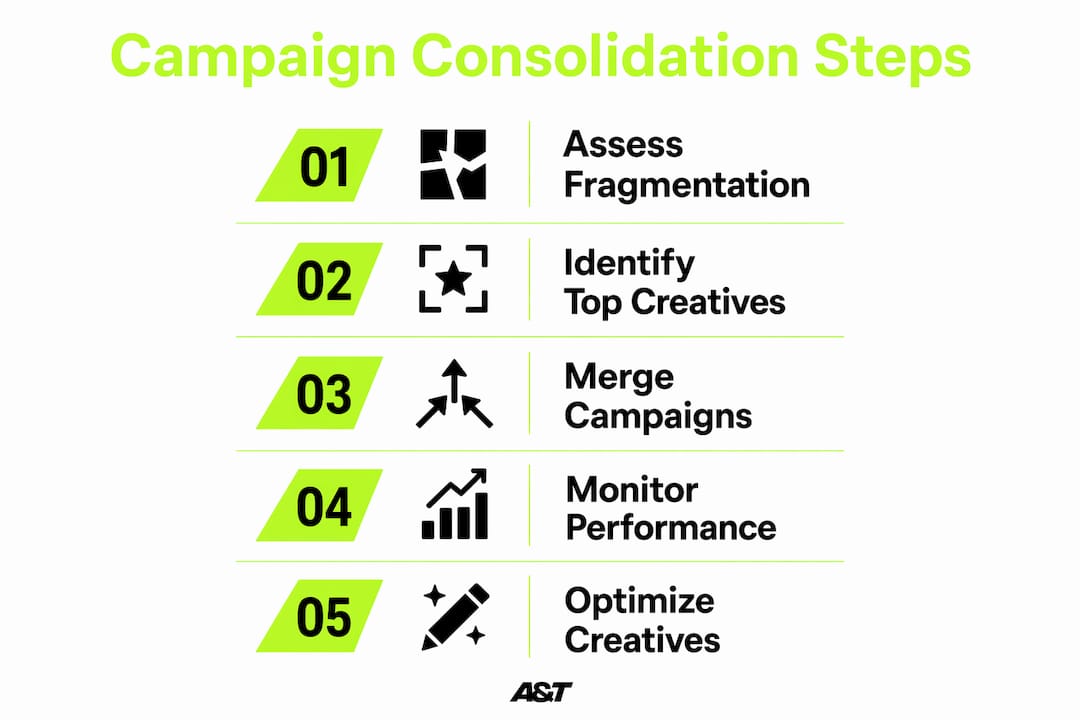
Consolidation done wrong can cause a temporary performance dip. Done right, it produces lasting gains. The process follows a clear sequence.
- Audit your account for fragmentation. Pull a campaign-level report and flag any campaign spending less than your target CPA per week. These campaigns lack the data density to learn effectively.
- Identify audience and creative overlaps. Use platform audience tools to find campaigns targeting the same users. Overlapping campaigns compete against each other in the auction.
- Pause the weakest campaigns first. Fold their audiences into your top 30% of campaigns by ROAS or CPA. Do not delete them immediately. Pause and monitor for 2 weeks.
- Merge related ad groups into larger units. Combine low-impression ad groups that share a theme or audience into single, higher-budget ad groups.
- Wait for the algorithm to relearn. Post-consolidation, expect a 1–2 week adjustment period. Do not make major changes during this window.
- Use automation to maintain creative velocity. Automation scripts and pre-flight validation tools help you push new creatives into consolidated campaigns without disrupting their learning signals.
Campaign architecture in the first month determines whether the following months focus on scaling or firefighting. Getting the structure right early is not optional.
| Fragmentation level | Typical CPA impact | ROAS trend |
|---|---|---|
| High (30+ campaigns, low budgets) | 20–30% above target | Declining |
| Moderate (15–29 campaigns) | 10–15% above target | Flat |
| Low (8–14 campaigns) | Near target | Stable |
| Consolidated (under 8 campaigns) | At or below target | Improving |
Pro Tip: Before merging campaigns, document each one's top-performing creative and audience signal. Carry those assets into the consolidated structure so you do not lose what was already working.
Does consolidated reporting make campaign consolidation more effective?
Consolidating your campaigns without consolidating your reporting creates a blind spot. Platform-reported conversions across Meta, Google Ads, and LinkedIn inflate totals by 40–60% due to overlapping attribution windows. Each platform claims credit for the same conversion, and without deduplication, your budget decisions rest on inflated numbers.
Unified reporting solves this by normalizing data across platforms into a single attribution model. This is not just a reporting preference. It is a prerequisite for making accurate budget allocation decisions. Consolidated ad reporting replaces manual reconciliation and gives every team member the same performance narrative.
For B2B and SMB marketing teams managing complex buyer journeys, unified dashboards are especially valuable. A prospect might click a Google Search ad, see a Meta retargeting ad three days later, and convert through a direct visit. Siloed platform reports make that journey invisible. A unified dashboard makes it clear.
| Reporting approach | Attribution accuracy | Budget decision speed | Cross-team alignment |
|---|---|---|---|
| Siloed platform reports | Low (40–60% inflation) | Slow | Poor |
| Manual spreadsheet reconciliation | Moderate | Very slow | Inconsistent |
| Unified dashboard with deduplication | High | Fast | Strong |
Unified dashboards create a single source of truth that makes cross-team collaboration faster and budget decisions more confident. When your paid media team, leadership, and finance team all look at the same numbers, you stop arguing about data and start acting on it.
Key Takeaways
Campaign consolidation is the single most impactful structural change a marketing team can make to improve ROAS, lower CPA, and free up time for work that actually grows the business.
| Point | Details |
|---|---|
| Consolidation improves algorithm performance | Pooling conversion signals into fewer campaigns accelerates learning and lowers CPA by 20–30%. |
| Operational efficiency is a primary benefit | Fewer campaigns reduce context switching and free your team to focus on creative and strategy. |
| Audit before you merge | Identify overlapping audiences and low-signal campaigns before consolidating to avoid performance loss. |
| Unified reporting is non-negotiable | Siloed platform data inflates conversions by 40–60%; deduplication is required for accurate decisions. |
| Architecture set early determines long-term results | Clean campaign structures in month one lead to scaling in month six, not firefighting. |
What I've learned from watching accounts consolidate in real time
I have seen marketing managers resist consolidation because it feels like giving up control. Running 40 campaigns feels like coverage. It feels like you are reaching every possible audience with a tailored message. That instinct is understandable and almost always wrong.
What those 40 campaigns actually produce is 40 learning phases that never complete, 40 budget lines competing for the same auction, and a team too busy managing the machine to think about what the machine should be saying. The shift I have watched happen in well-run accounts is not just structural. It is a change in how the team spends its time. Once the account is lean, the conversation moves from "why is campaign 23 underperforming?" to "what creative angle should we test next month?"
The discipline required to maintain a lean account is real. Platforms constantly push you toward adding more campaigns, more ad sets, more targeting layers. Resisting that pressure requires a clear framework and someone with the authority to enforce it. The teams that do this well treat their campaign planning process as a standing discipline, not a one-time cleanup.
My honest advice for 2026: consolidate aggressively, invest the time you save into creative development, and build a reporting layer that shows you what is actually happening across platforms. The accounts that do all three consistently outperform the ones that do any one of them in isolation. You can read more about how to structure this in a step-by-step campaign setup that applies these principles from day one.
— Ann
How Atdigiagency approaches campaign consolidation for SMBs
Atdigiagency works with small and medium-sized businesses to build paid ad systems that perform from the first month, not the sixth. Our approach to multi-channel campaign management starts with a full account audit to identify fragmentation, overlapping audiences, and budget waste. We then restructure campaigns across Google Ads and Meta into lean, high-signal architectures that give platform algorithms the data they need to perform. We pair that with unified reporting so you always know where your spend is going and what it is producing. If you are ready to stop managing chaos and start scaling results, our team is ready to build the structure that makes it possible.
FAQ
What is campaign consolidation in digital advertising?
Campaign consolidation is the process of merging multiple ad campaigns into fewer, larger campaigns to pool conversion data, reduce auction overlap, and improve algorithmic learning on platforms like Google Ads and Meta.
Is campaign consolidation effective for small businesses?
Campaign consolidation is effective for businesses of any size. Industry audits show a 20–30% reduction in cost per acquisition after consolidating fragmented accounts, making it especially valuable for SMBs with limited ad budgets.
How long does it take to see results after consolidating campaigns?
Most accounts see measurable CPA improvements within 4–6 weeks of consolidation. Expect a 1–2 week algorithm relearning period immediately after the merge before performance stabilizes.
What are the main benefits of campaign consolidation?
The core benefits of campaign consolidation include faster algorithmic learning, lower cost per acquisition, reduced internal auction competition, cleaner budget oversight, and more time for your team to focus on creative strategy.
How do I know if my campaigns are too fragmented?
Flag any campaign that spends less than your target CPA per week. If your account has more than 15–20 active campaigns and most are under-budget, fragmentation is costing you performance and ad spend efficiency.